Elite Dealer

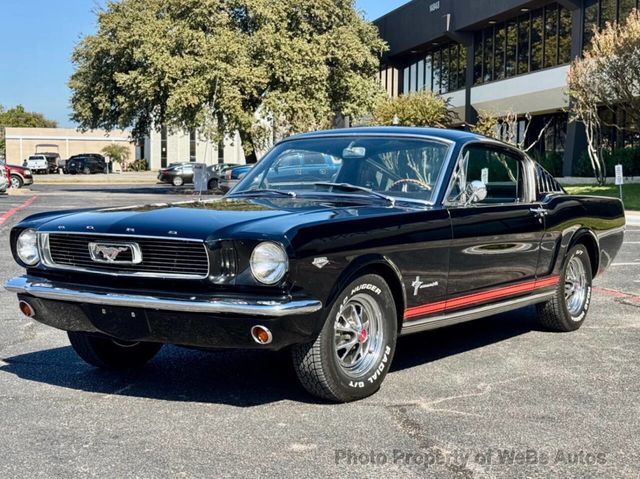
1966 Ford Mustang

$56,997
1966 Ford Mustang

Vehicle Details

Make

Ford

Model

Mustang

Year

1966

Mileage

80,534 miles

VIN

6F09C264182

Body Type

Coupe

Transmission

Manual

Engine

289 V8

Description

1966 Ford Mustang Why This Vehicle is Special The introduction of the Mustang in 1964 created a new class of automobile known as the pony car. The Mustang's styling, with its long hood and short deck, proved wildly popular and inspired a host of competition including Camaro, Firebird, Cougar and others. We have a totally restored 1966 Mustang in stealthy Raven Black paint with its black interior, here at Skyway Classics that is a C Code Engine with a 289 cubic inch engine that not only just purrs down the road but it will stop people in its tracks when they look at the meticulously restored Mustang too.

It has been really taken care of and nicely restored with the last owner taking care of it for the last 44 years. Features 1966 Ford Mustang Restored 2+2 Hardtop Factory C-Code 289 cubic inch engine 4-speed manual Transmission Electronic Ignition Conversion Holley 4-barrel Chrome valve covers Factory correct blue painted engine Open element air cleaner assembly Detailed engine compartment Black restored interior Twin buckets up front and the matching rear seat, dash, door panels Deluxe Steering wheel wood Instrument panel that has all the correct factory gauges 140-mph speedometer, fuel gauge, temperature gauge, oil pressure gauge, ammeter Chrome manual shifter with white shifter ball surrounded by chrome trim on the floor Original looking trunk with Factory trunk mat, spare tire cover, spare tire, and floor jack Mustang wears the fresh Raven Black paint Blacked-out grille Chrome front and rear bumpers Mustang emblem Unique fuel filler cap on the panel between the tail lamps Exhaust exiting underneath Factory styled wheels Road Hugger Radial GT raised white letter tires Mechanical Our Mustang has a rebuilt 289 Cubic Inch factory C-Code 8-cylinder engine with a 4-speed manual transmission, Electronic Ignition Conversion, Holley 4-barrel, Chrome valve covers, Factory correct blue painted engine, Open element air cleaner assembly, and a detailed engine compartment. It starts and runs perfect, and really looks and sounds amazing.

Interior The restored interior is all as it was when it was factory original with its black twin buckets up front and the matching rear seat, dash, door panels, carpet and Mustang floor mats, Mustang sport wood steering wheel, Instrument panel that has all the correct factory gauges including the 140-mph speedometer, fuel gauge, temperature gauge, oil pressure gauge, ammeter, and chrome 4-speed manual shifter with the white shifter ball surrounded by chrome trim on the floor. It also has a great original looking trunk with the factory trunk mat, spare tire cover, and spare tire. Exterior On the outside, our Mustang wears the fresh Raven black with red stripe paint job flowing over all the iconic body lines and accented by the blacked-out grille, chrome front and rear bumpers, Mustang emblem, and out back the unique fuel filler cap on the panel between the tail lamps, with the exhaust exiting underneath.

Our Mustang rides on the factory styled wheels on Road Hugger Radial GT raised white letter tires as this wheel and tire combination is totally fitting on this classic pony car, and combined with the square set body, they give this Mustang a stance that is just magnificent. Conclusion The 1966 Restored Mustang C-Code Engine we have here at Skyway Classics has great looks, performance, and these Mustangs have become as collectable as any other car, and probably more so in the future. If you are in the market for a super clean, sporty and original looking, as well as being a restored first-generation Mustang with factor documentation as well, then look no further! So give us a call at 941-254-6608.

Disclaimer Information found on the website is presented as given to us by the owner of the car, whether on consignment or from the owner we bought it from. Some Photos, materials for videos, descriptions and other information are provided by the consignor/seller and is deemed reliable,

Classic Ford Mustang Buyer's Guide

Full guide
M
Mike Sullivan
Muscle Cars
1964–1973
~5 min read
Updated Apr 2026
The definitive buyer's guide for classic Ford Mustang 1964½-1973. Generation breakdown, rust hotspots, engine code identification, Marti Report essentials, and current market pricing.
This guide covers
✓ 10-point inspection checklist
✓ Common issues & what to avoid
✓ In-person inspection guide
✓ Market pricing by year & condition
✓ 6 FAQs answered
✓ History & fun facts

Ford Mustang Market Overview

Based on 500 Ford Mustang listings currently on ClassicCarsArena.com

500
Listed Now
$38,003
Avg. Asking Price
1964–2001
Year Range
Price Position on Our Site — Above Average
This car: $56,997
Low: $3,000 High: $284,995
Transmission Distribution
Automatic 52%
Manual 34% ◄
Condition Distribution
Excellent 10%
Good 9%
Fair 3%
Poor 0%
Data from ClassicCarsArena.com listings Browse all 500 listings →
💰

What is this car worth?

Check sold prices for the 1966 Ford Mustang

Valuation Tool →

Classic Ford Mustang Buyer's Guide

The Ford Mustang launched on April 17, 1964 and sold a million units faster than any car in American history. Sixty years later, the first-generation Mustang (1964½-1973) remains the cornerstone of the classic car hobby — the gateway car for new collectors, the trophy car for veteran enthusiasts, and the most cloned, faked, and re-stamped muscle car on the market. Whether you're hunting a base inline-six coupe or a documented Boss 429, knowing what separates the real cars from the tribute builds is the difference between an investment and a money pit.

What to Check Before Buying

Verify VIN against data plate and engine casting — Fifth digit of VIN = engine code. Cross-reference with block casting number behind cylinder head.
Order Marti Report for any 1967+ car over $30K — Ford's original production records via Marti Auto Works. $25 confirms what the car actually was when it left the factory.
Inspect torque boxes from underneath — Front and rear, where the unibody meets floor pans. Rotted torque boxes = $3,000-$6,000 repair and chassis flex.
Pull kick panels and check cowl seam — Where windshield base meets firewall. Cowl rust here drains into the cabin and rots floor pans.
Magnet test rocker panels and quarters — Body filler is non-magnetic. If the magnet doesn't stick, the panel has been filled — meaning underlying rust.
Check shock tower welds for cracks — Cracks radiating from upper shock mount = beaten chassis. Common on Big Block cars and 428 CJs.
Verify original GT/Mach 1/Boss equipment — Without Marti docs and matching data plate, treat all performance trim claims as clone candidates.
Test all electrical functions — Every gauge, every switch, every light. Brittle 60-year-old harnesses and worn switches are universal.
Compression test all eight cylinders — Should read 145-175 PSI uniformly. Variance >15% between cylinders = head gasket or ring problem.
Drive at least 30 minutes on highway — Listen for differential whine, transmission slip, brake pulsation, steering wander. Watch for overheating in stop-and-go traffic.

Common Issues

Mustang rust is everywhere and predictable. The torque boxes (front and rear, where the unibody meets the floor pans) are the structural killers — rotted torque boxes mean the car flexes under load and the doors won't close right. Cowl rust hides under the dashboard where the windshield base meets the firewall. Floor pans rust through from the underside in any car that lived north of the Mason-Dixon. Rear quarters, lower fenders behind the front wheels, and the trunk drop-offs are all standard rust zones. Mechanically, first-gen Mustangs are simple but the small details matter. The Toploader four-speed is bulletproof when synchronized properly; the C4 and C6 automatics are robust but commonly leak from front pump seals. The 9-inch rear is bombproof — but make sure the gear ratio matches what's claimed. Engine identification by casting numbers is essential: many cars wear the wrong block, and a 1968 GT 390 with a 1973 351W block is not what the seller is advertising. Electrical issues plague any 60-year-old car. The original wiring harnesses are brittle, the headlight switches fail, the gauges read inconsistently, and the turn signal switches die. Plan to replace the headlight switch, the ignition switch, and at least the engine-bay harness on any first-gen Mustang you buy. Budget $800-$1,500 for a complete electrical refresh.

What to Look For

Always start with the data plate (door tag) and the VIN. The fifth digit of the VIN is the engine code — A=289 4V, C=289 2V, D=289 standard, K=289 HiPo, F=302 2V, J=302 4V (Boss 302), M=351 4V, Q=428 CJ, R=428 SCJ Ram Air, S=390 4V, Z=Boss 429. Cross-reference the VIN engine code with the actual block casting number — they must agree. For any car claimed as a GT, Mach 1, Boss, Shelby, or Cobra Jet, demand a Marti Report. Marti Auto Works has Ford's original production records and can verify exactly what the car was when it left Dearborn or San Jose. A $25 Marti Report will save you $25,000 in mistakes. Cars without Marti documentation should be priced as clones, period. Unibody integrity is the other non-negotiable. Pop the hood, look at the shock towers — cracks radiating from the upper shock mount are common on Big Block cars and indicate the chassis has been beaten. Inspect the torque boxes from underneath. Lift the trunk mat and look at the trunk drop-offs. Pull the rear seat and check the floor where the seat bolts down. Fresh undercoating on a project car is a red flag — it's almost always hiding rust repairs.

Price Guide

Base 1965-1966 coupes with the inline-six or 289 2V remain the most accessible classic Mustang at $18,000-$32,000 for solid drivers. Convertibles add $8,000-$15,000 to equivalent coupe pricing. Fastbacks (1965-1968) are dramatically more valuable due to Bullitt and Eleanor pop-culture demand — a clean 1967-1968 fastback small-block runs $45,000-$75,000. 1967-1968 GT 390 cars (Bullitt-style) trade for $60,000-$110,000 with documentation. The 1968 GT 428 Cobra Jet is the holy grail of the small-bumper era at $120,000-$220,000 for documented numbers-matching cars. 1969-1970 Boss 302 and Mach 1 cars run $70,000-$140,000 depending on condition and equipment. The Boss 429 is six-figure-plus territory — $300,000-$600,000 for documented examples. 1971-1973 cars (the Big Body era) have historically been the bargain entry point but appreciation has accelerated since 2020. A clean 1973 Mach 1 with the 351 Cobra Jet now runs $45,000-$75,000 — up dramatically from the $25,000 territory of a decade ago. Project cars (running but rough) start around $15,000 for coupes and $22,000 for fastbacks.

Did You Know?

The Mustang was originally going to be called the Cougar — Lee Iacocca's team had "Cougar" emblems already produced before a focus group response prompted the last-minute name change. The Cougar name was eventually used for the Mercury sister car launched for 1967. Ford originally projected first-year Mustang sales of 100,000 units. The car sold 418,812 units in its abbreviated 18-month launch year, and over a million Mustangs were sold by March 1966 — a sales pace that has never been equaled by any other American automobile launch. The iconic 1964½ designation isn't actually a real model year — Ford built the early Mustangs as 1965 models, but the cars produced before September 1964 had different alternators, generators, and other details, leading collectors to designate them "1964½" cars to distinguish them.

Similar Listings

Contact Seller

Share only if you'd like the seller to call you directly.

By contacting this seller you accept the Visitors Agreement

Call this seller?

You're about to call WeBe Autos about the 1966 Ford Mustang.

+1 (631) 339-0399

Before you call: Never wire money or share bank info over the phone. Read our scam-avoidance tips.
Call Now

Send to a Friend

Share this 1966 Ford Mustang listing.

Report this Ad

Help us keep the marketplace clean. Our moderation team reviews every report within 24 hours.