From showcar dream to production reality: 1953
The C1 Corvette story begins not on a dealer lot but under the lights of the 1953 Motorama at the Waldorf-Astoria Hotel in New York. Harley Earl's fiberglass two-seater drew the kind of crowd reaction that convinced General Motors management to move fast. The decision to build it was made in months, and production started at a temporary facility in Flint, Michigan, before the year was out.
Every one of the 300 units built in 1953 was identical: the 1953 Polo White exterior with a red interior, a convertible soft top, and no external door handles. The engine was the Blue Flame Six, a 235.5 cubic inch inline-six producing 150 horsepower through a triple-carburetor setup. The only transmission available was a two-speed Powerglide automatic, which drew immediate criticism from sports car enthusiasts who expected a manual gearbox. The cars were largely hand-built, and fit-and-finish reflected that reality. Window sealing was poor, the soft top leaked, and the side curtains were flimsy. GM shipped all 300 units to dealers primarily for promotional purposes, and many sat unsold.
The 1954 inventory crisis and the near-cancellation
General Motors expanded Corvette production dramatically for 1954, moving assembly to St. Louis, Missouri and targeting a much larger sales volume. The factory built 3,640 units. The problem: dealers could not move them. By the end of the model year, hundreds of unsold Corvettes sat in dealer lots and storage facilities. The car's core weaknesses had not been addressed. It still used the Blue Flame Six with the Powerglide automatic, still lacked external door handles, and still had build quality issues that European sports car buyers would not tolerate.
Inside GM, serious discussions took place about ending the Corvette program entirely. The economics were difficult to justify. The car was expensive to produce relative to its sales price, and volume was nowhere near what was needed for profitability. The 1954 situation is often cited as the first genuine near-cancellation, and historians who have reviewed the internal documentation from this period agree the threat was real. What changed the calculus was partly competitive pressure from Ford, which unveiled the Thunderbird for 1955, and partly the arrival of a man named Zora Arkus-Duntov.
The V8 saves the model: 1955 and the Duntov factor
The 1955 Corvette was built in tiny numbers, approximately 700 units, and that low figure reflects how uncertain the car's future was at the start of the model year. But the 1955 edition carried what the earlier cars lacked: Chevrolet's new 265 cubic inch small-block V8, producing 195 horsepower. The engine transformed the driving character of the car. For the first time, the Corvette had power that matched its looks. A three-speed manual transmission also became available, addressing the other major complaint from enthusiast buyers.
Zora Arkus-Duntov, a Belgian-born engineer with a competition background, had joined Chevrolet in 1953. His memo to management arguing for the Corvette's future as a performance machine is well-documented. Duntov understood that the car needed a racing identity to sell, and he pushed internally for development resources. His involvement from the mid-1950s onward shaped almost every performance decision the Corvette team made through the C1 generation and beyond.
"When I look at factory documentation from the 1954 and 1955 period, I see a program that survived by a much smaller margin than the mythology suggests. The V8 did not save a beloved icon. It saved a slow-selling promotional vehicle that GM had not yet decided to keep."
— Tom Ramirez
The proper restyle and peak C1 performance: 1956 to 1957
The 1956 Corvette arrived as a genuinely restyled car. The body received coved sides, external door handles were finally added, and the overall appearance became more purposeful. Wind-up windows replaced the old side curtains. Production climbed to 3,467 units, a meaningful increase that signaled the car was finding its audience. Engine output grew as well, with the 265 small-block available in multiple states of tune.
The 1957 model year represents the engineering peak of the C1 generation for many collectors and historians. Chevrolet bored the small-block out to 283 cubic inches and offered it in multiple configurations, including the landmark RPO 579E fuel injection unit. That Rochester mechanical fuel injection system, developed with significant input from Duntov, produced 283 horsepower from 283 cubic inches, a one-horsepower-per-cubic-inch ratio that was a significant engineering achievement for a production passenger car engine in 1957. A close-ratio four-speed manual transmission was also added to the options list. Production reached 6,339 units, more than doubling the 1956 figure.
| Year | Units Built | Engine | Top HP | Notable Change |
|---|---|---|---|---|
| 1953 | 300 | 235.5 ci Blue Flame Six | 150 | Hand-built, Flint MI; Powerglide only |
| 1954 | 3,640 | 235.5 ci Blue Flame Six | 150 | Moved to St. Louis; hundreds unsold |
| 1955 | ~700 | 265 ci V8 | 195 | Small-block V8 introduced; 3-speed manual added |
| 1956 | 3,467 | 265 ci V8 | 240 | Coved body restyle; external door handles |
| 1957 | 6,339 | 283 ci V8 | 283 | Fuel injection (RPO 579E); 4-speed close-ratio trans |
| 1958 | 9,168 | 283 ci V8 | 290 | Quad headlights; revised interior |
| 1959 | 9,670 | 283 ci V8 | 290 | Trunk storage added; flat floor |
| 1960 | 10,261 | 283 ci V8 | 315 | Aluminum cylinder head option available |
| 1961 | 10,939 | 283 ci V8 | 315 | Duck-tail rear restyle; revised grille |
| 1962 | 14,531 | 327 ci V8 | 360 | 327 replaces 283; final C1 year |
Growth years and the final C1: 1958 to 1962
The 1958 model year brought the most visible styling change since 1956. Quad headlights replaced the original dual units, and the interior received a revised dashboard with additional gauges. The exterior gained chrome trim elements that reflected the design tastes of the period. Production jumped to 9,168 units, a figure that confirmed the Corvette had secured its customer base. The fuel injection option continued, and the 283 small-block remained the foundation of the engine lineup.
Between 1959 and 1960 the Corvette evolved incrementally. Interior storage improved, the dashboard was cleaned up, and engine outputs increased gradually. The 1961 model brought the most significant body change of the late C1 years: a duck-tail rear treatment that previewed the styling direction Chevrolet was developing for the C2. The quad headlights remained, but the rear of the car now had a cleaner, more tapered look that moved away from the chrome-heavy aesthetic of 1958 and 1959.
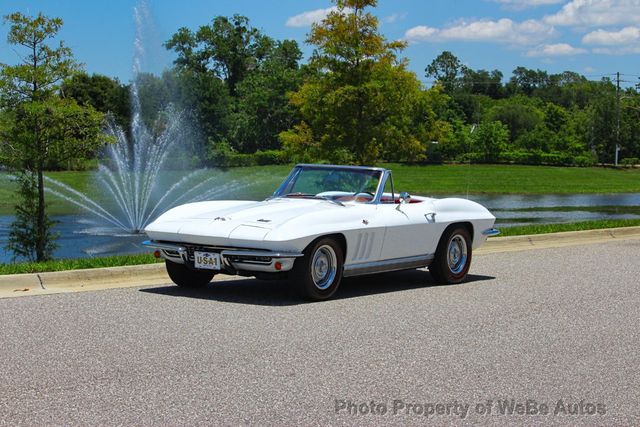
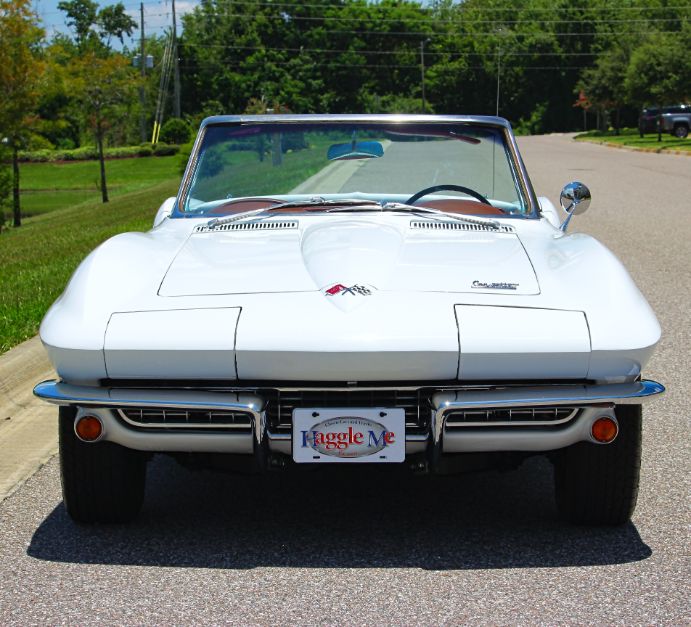
The final C1, the 1962 model, introduced the 327 cubic inch small-block V8 that would define the early C2 generation as well. In its highest state of tune the 327 produced 360 horsepower, and production reached 14,531 units, nearly double the 1961 figure. The 1962 Corvette was a substantially more capable and refined vehicle than anything that had carried the nameplate before it. For anyone considering a classic Corvette for sale, the final C1 year represents the accumulated engineering improvements of an entire decade.
What the C1 generation proved
The C1 Corvette did not arrive as a finished sports car. It arrived as an experiment, survived a near-cancellation, found its identity through the small-block V8, and spent the back half of its production run growing into a credible performance machine. The arc from 300 hand-built promotional vehicles in 1953 to 14,531 factory-built performance cars in 1962 is a useful reminder that automotive legacies are built through iteration rather than instant success.
What the C1 established was a platform logic: a fiberglass body on a steel ladder frame, a small-block V8 with room for displacement growth, and an options structure that let buyers configure power, transmission, and suspension. Every generation that followed built on that framework. The C1's contribution was proving that the framework was worth keeping.
Sources and notes
- Hemmings Motor News — Production figures, model year specifications, and collector market documentation for C1 Corvette generation.
- National Corvette Museum — Factory records, historical documentation, and archive materials covering the full Corvette production history from 1953 onward.
- Motor Trend — Period road tests and technical analysis of C1 Corvette engine and chassis development.