The End of an Era, Refined to Perfection
When General Motors unveiled the 1962 Corvette, there was no fanfare proclaiming it the last of its kind. Nobody at the time was building monuments to the C1. Yet in hindsight, the 1962 model year represents the most polished expression of a design that had been evolving since 1953 — cleaner, more purposeful, and carrying a brand-new engine under its hood that would define American performance for decades to come.
The 1962 Corvette did not arrive with revolutionary intentions. It arrived as a refinement: a car that shed what no longer belonged and gained what the future demanded. That combination of visual simplicity and mechanical ambition is what makes the 1962 the most compelling car of the entire C1 generation.
Cleaning Up the Chrome: The 1962 Exterior Restyle
To understand what changed in 1962, it helps to remember what the car looked like from 1958 onward. The 1958 redesign had introduced a busier aesthetic: quad headlights, chrome accents on the trunk lid, simulated louvers on the hood, and the distinctive side coves trimmed in chrome that divided the body into visual sections. The look was exuberant, very much of its moment — but by the early 1960s, the chrome-laden styling felt increasingly dated.
The 1961 model year had already taken a step toward restraint by introducing a new ducktail rear treatment inspired by a Bill Mitchell concept car called the Stingray racer. The rear fins were softened and the tail was reshaped to a narrower, more tapered form. It was a preview of the direction design chief Mitchell wanted to take the car.
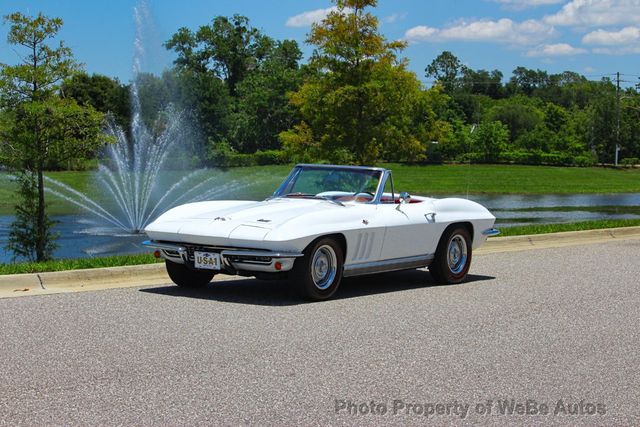
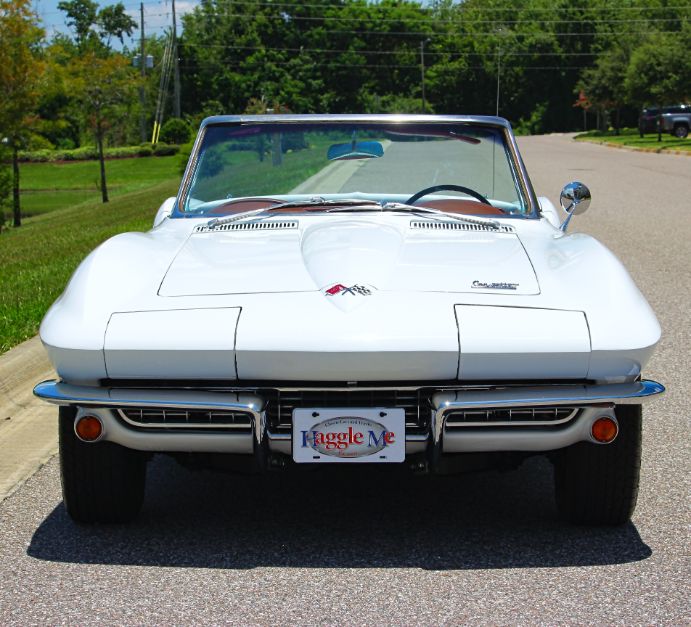
For 1962, the process continued with meaningful clarity. The most striking visual change was the deletion of the contrasting-color side coves. In prior years, those recessed body panels had been painted a secondary color — often white or silver — to break up the body. For 1962, the coves were filled in and painted to match the rest of the car. The effect was immediate: the body read as a single, unified form rather than a divided one.
Equally significant was the grille treatment. The 1961 car retained a mesh grille with chrome surround work. The 1962 replaced it with a body-color grille that visually dissolved into the nose, creating a cleaner, more aggressive face. Combined with the removal of the chrome side cove trim, the overall effect stripped the car of ornament and let the shape speak for itself.
The result was a Corvette that looked both leaner and more modern than its immediate predecessors — closer in spirit to the C2 Sting Ray that would arrive the following year than to the chrome-rich 1958 model that started the run. Historians generally agree that the 1962 exterior restyle was the single most important visual step between the baroque 1958 design and the clean wedge of the C2.
"The 1962 was the year the Corvette got serious about what it wanted to be. The chrome was gone, the shape was sharper, and the engine was finally worthy of the platform."
— Period road test, Sports Car Illustrated, 1962
The 327: A New Heart for the Final C1
If the exterior restyle was the story of subtraction, the engine story for 1962 was one of expansion. The small-block V8 that had transformed the Corvette in 1955 — the 265 cubic inch unit — had grown to 283 cubic inches in 1957. For 1962, it grew again, this time to 327 cubic inches, and the difference was not merely incremental.
The 327 small-block was achieved by increasing the bore of the 283 from 3.875 inches to 4.00 inches while maintaining the same 3.25-inch stroke. The result was a shorter, more free-revving engine that could breathe more efficiently at high rpm than the longer-stroke alternatives of the era. It was not a brute-force displacement increase — it was an engineer's solution.
For 1962, buyers could choose from four versions of the 327:
- 250 horsepower with a single four-barrel carburetor — the base V8, smooth and tractable
- 300 horsepower with a larger four-barrel and higher compression
- 340 horsepower with solid lifters and dual four-barrel carburetors
- 360 horsepower with Rochester mechanical fuel injection — the legendary "fuelie" option
The fuel-injected 360-horsepower version produced one horsepower per cubic inch, a figure that carried genuine significance in the early 1960s as a benchmark of engineering achievement. It was available with a four-speed close-ratio manual gearbox and required a buyer willing to manage a high-strung, temperamental system — but in return it delivered performance that few production cars anywhere in the world could match.
The 327's arrival was not merely a displacement upgrade. It set a template that would carry forward through the C2 and well into the C3 era, eventually growing to 350 cubic inches and becoming one of the most produced V8 engines in automotive history. The 1962 Corvette was the 327's introduction to the car that would make it famous.
Production Numbers and the Record Year
Demand for the 1962 Corvette exceeded all prior C1 production years. The factory at St. Louis built 14,531 units — a figure that reflects both the maturity of the design and the growing American appetite for a proper sports car. To put that number in context, the 1954 model year had seen just 3,640 cars built and struggled to find buyers. The 1962 figure was nearly four times that, and the cars were actually selling.
The breakdown by body style is worth noting: all 14,531 were convertibles, as the removable hardtop was an option rather than a fixed-roof model. The coupe body style would arrive with the C2. This means the 1962 stands as the highest-production year in C1 history and also the last year of the Corvette as an exclusively open car.
The coupe option — a removable fiberglass hardtop that could be ordered from the factory — became increasingly popular in 1962, partly because it improved the car's weather sealing and partly because it gave the Corvette a more finished appearance. Some period buyers ordered the car with both the soft top and the hardtop, then stored the soft top entirely.
The Transition Car: Looking Forward to the C2
The 1962 Corvette is sometimes described as a transitional model, a description that is accurate but incomplete. It implies the car was merely a placeholder, a thing awaiting replacement. The reality is more interesting: the 1962 was a genuinely excellent automobile that also happened to point directly toward its successor.
The visual language of the 1962 — the body-color nose, the unified body side, the ducktail rear — would be developed further (and dramatically so) in the 1963 Sting Ray. The 327 engine would carry over essentially unchanged into the C2 and remain the Corvette's standard V8 for years. The four-speed manual transmission, the close-ratio gearbox, the Positraction limited-slip differential — all of these carried forward.
What did not carry forward was the solid rear axle and the leaf-spring rear suspension that had been a Corvette characteristic since 1953. The C2 introduced an independent rear suspension that transformed the car's handling. In that respect, the 1962 represents the final expression of the original Corvette's chassis philosophy — a reminder that even a near-perfect refinement has limits.
Collectors who specialize in early Corvettes often describe the 1962 as the most desirable C1 precisely because it combines the purest version of the body style with the most powerful available engines. The chrome excesses of 1958–1960 are gone; the mechanical compromises of the earliest cars are long resolved. What remains is a car that does exactly what it was designed to do, without apology or excess.
For those drawn to the history of the C1, the 1962 is the logical endpoint of a decade-long development arc. You can read the full C1 history overview to trace how each year contributed to what the 1962 ultimately became — or browse classic Corvette listings to see what survivors of the final C1 year look like today.
The 1958 redesign that started this final visual evolution is covered in depth in the 1958 Corvette quad headlights article, which traces how GM's stylists arrived at the chrome-heavy look that the 1961 and 1962 models would eventually simplify away.
Sources and notes
- National Corvette Museum — 1962 Corvette History — official museum documentation on the final C1 model year specifications and production
- Corvette Online — 1962 Model Year Guide — engine option breakdowns and production statistics for the 1962 model year
- MotorTrend — Classic Corvette Historical Archive — period road tests and contemporary assessments of the 1962 Corvette's performance
- Hemmings Motor News — 1962 Chevrolet Corvette — collector perspective and historical documentation of the 327 engine's introduction
- SuperCars.net — 1962 Chevrolet Corvette Specifications — complete factory specifications including horsepower ratings and transmission options