The engine that saved the Corvette
In 1953 and 1954, the Corvette was in trouble. The original six-cylinder Blue Flame inline engine produced around 150 horsepower and drove through a two-speed Powerglide automatic. Sports car buyers wanted no part of it. Chevrolet sold 300 units in 1953, fewer than 4,000 in 1954, and was seriously considering canceling the whole program.
What saved it was a small-block V8. In 1955, Chevrolet's new 265 cubic inch V8, designed largely by Ed Cole, went into the Corvette alongside a three-speed manual transmission. The combination changed everything. That 265 produced 195 horsepower in base form, and suddenly the Corvette could actually move. More importantly, it gave the car a mechanical identity it had been missing. The chassis was always there. The engine finally matched it.
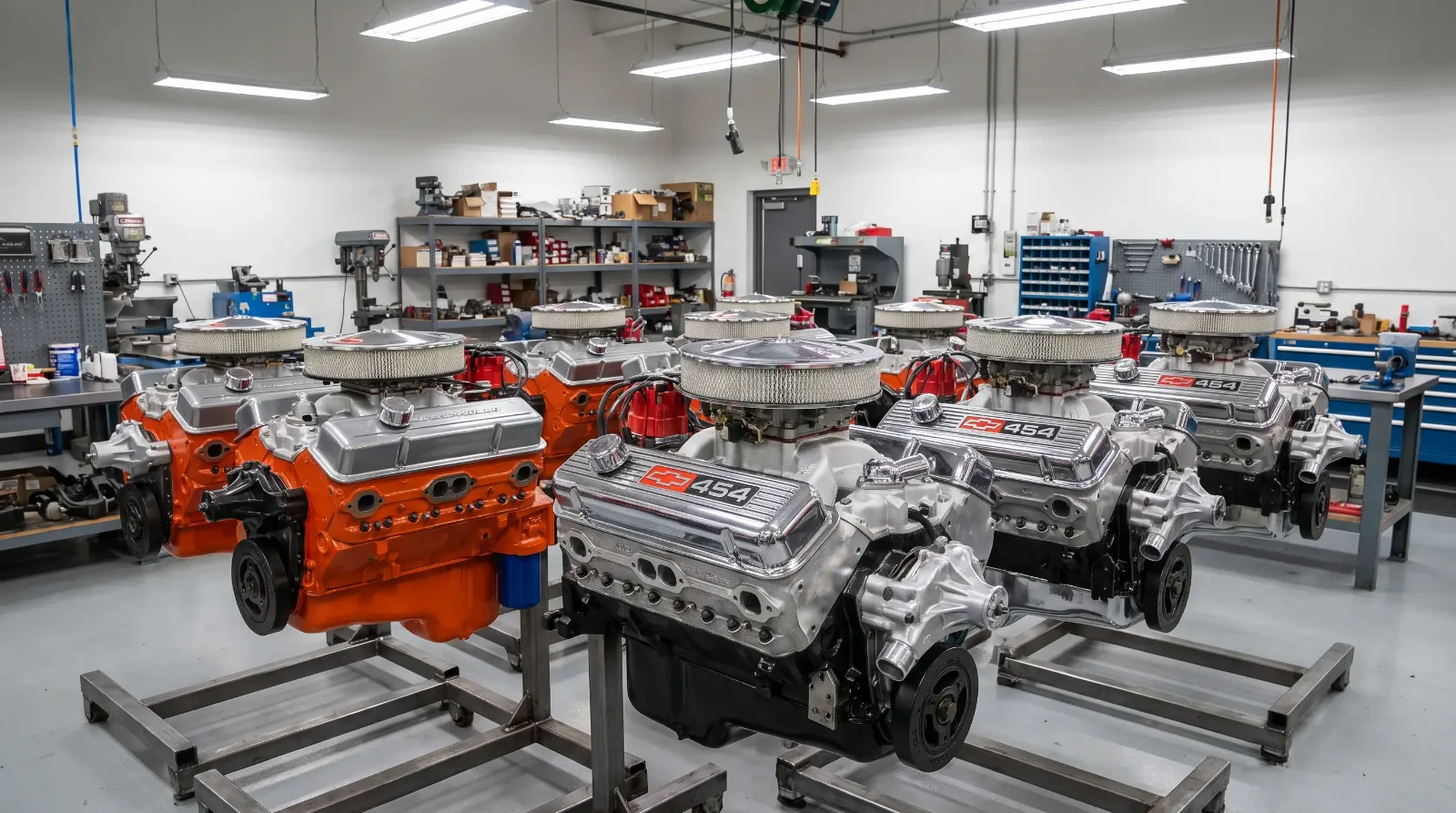
For anyone interested in the Chevrolet Corvette across its full production run, the small-block story is really the engine story. Every generation of Corvette except the mid-engine C8 in its standard form has been defined by some version of it, and even the C8 Z06 brought back a naturally aspirated small-block screamer. That throughline matters. It's a seventy-year engineering conversation conducted entirely in pushrod V8.
From 265 to 370 horsepower: the classic-era small-block
Chevrolet bored the 265 out to 283 cubic inches for 1957, and that's when things got serious. The 283 came in multiple configurations, but the one people still talk about is the fuel-injected version. Rochester mechanical fuel injection, called "fuelie" by everyone who wanted one and couldn't afford one, pushed the 283 to 283 horsepower. That one horsepower per cubic inch number was real marketing gold in 1957, and Chevrolet leaned into it hard.
The 327, introduced for 1962, took the small-block to a displacement that felt right for the Corvette in a way the 283 almost did but not quite. The 327 ran through 1968 in various states of tune, topping out at 375 horsepower in the L84 fuel-injected version of 1964-65. These are the engines that built the small-block's reputation: smooth, rev-happy, responsive in a way the big-blocks never quite managed.
Then came 1969 and the 350. The bore went to 4.00 inches, stroke stayed at 3.48, and the displacement math landed at 350.5 cubic inches, rounded down. The 350 became the small-block's definitive displacement. It ran in the Corvette all the way through 1991 in various forms, and it's still the number most people associate with the engine when they're not thinking LS.
| Engine | Years (Corvette) | Displacement | Peak output (top tune) |
|---|---|---|---|
| 265 V8 | 1955 | 265 ci | 195 hp |
| 283 V8 (fuelie) | 1957-1965 | 283 ci | 283 hp |
| 327 V8 | 1962-1968 | 327 ci | 375 hp (L84) |
| 350 LT1 | 1970-1972 | 350 ci | 370 hp (1970) |
| L98 350 TPI | 1985-1991 | 350 ci | 245 hp |
| LT1 (Gen II) | 1992-1996 | 350 ci | 300 hp |
| LS1 | 1997-2004 | 346 ci (5.7L) | 350 hp |
| LS6 | 2001-2004 | 346 ci (5.7L) | 405 hp |
| LS3 | 2008-2013 | 376 ci (6.2L) | 430 hp |
| LS7 | 2006-2013 | 427 ci (7.0L) | 505 hp |
| LT1 (Gen V) | 2014-2019 | 376 ci (6.2L) | 460 hp |
| LT2 | 2020-present | 376 ci (6.2L) | 490 hp |
The malaise years and the C4 recovery
The 1970 LT1 350 made 370 horsepower. By 1975, the small-block in the Corvette was down to 165 horsepower, net-rated, fighting emissions regulations and running on low-compression ratios designed for regular unleaded. It's a painful table to look at. The car got heavier, the engine got weaker, and for a stretch in the late 1970s the Corvette was genuinely slower than some sport-compact imports.
The recovery started with the C4 in 1984, though the 205-horsepower Crossfire injection L83 wasn't exactly a comeback statement. The real turn came in 1985 with the L98, a 350 with Tuned Port Injection. The L98 started at 230 horsepower and climbed to 245 by 1991. Those numbers look modest against the pre-emissions era, but the driveability was genuinely better. The fuel injection worked. The engine ran clean and pulled hard through a wide rpm range in a way the carburetor setups from the mid-1970s simply didn't.
The Gen II LT1 350 arrived for 1992 and brought reverse-flow cooling, which sent coolant to the cylinder heads first to reduce knock and allow higher compression. Output was 300 horsepower, then 330 for the LT4 in 1996. After fifteen years of managed decline, the small-block Corvette was back in the same conversation with the cars it was supposed to be competing against.
"The malaise era is where I get interested. All those builders in the late seventies pulling the factory iron and dropping in something that actually ran. You can't blame them. But the engineers who figured out how to get the compression back up without the detonation problems? That was real work."
— Jim Vasquez
The LS era: when the small-block became something else entirely
The C5 Corvette launched in 1997 with the LS1, and it reset the baseline for what a production V8 could do. The LS family is technically a third-generation small-block, but the architecture was new enough that calling it an evolution understates what changed. Aluminum block, composite intake manifold, coil-near-plug ignition, a bore spacing of 4.4 inches that allowed serious displacement increases down the line. The LS1 produced 345 horsepower initially, corrected to 350 in later documentation, and it powered a C5 that ran 0-60 in around 4.7 seconds.
The LS6 came in the 2001 Z06 with 385 horsepower, revised to 405 for 2002-2004. This is the one that made people stop arguing about whether American sports cars belonged in the same category as the competition. A stock 2002 Z06 would run with Porsches that cost significantly more. The LS6's combination of high-flow cylinder heads, revised cam profile, and improved oil system was the product of GM's performance engineers doing what they'd been prevented from doing for two decades.
The C6 expanded the LS family further. The base LS2 (2005-2007) displaced 6.0 liters and produced 400 horsepower. The LS3 (2008-2013) went to 6.2 liters and 430 horsepower as the base engine, which would have been a Z06-level output ten years earlier. The LS7 in the C6 Z06 is the peak of the naturally aspirated pushrod small-block in production form: 7.0 liters, 427 cubic inches, 505 horsepower, 8,100 rpm redline. Titanium connecting rods, dry-sump oiling, CNC-ported cylinder heads from the Corvette Racing C6.R program. The LS7 is one of the finest production engines GM has built, period.
The LT family and why GM kept the pushrod
The C7 Corvette arrived in 2014 with the Gen V LT1, a 6.2-liter pushrod V8 with direct injection, variable valve timing, and Active Fuel Management cylinder deactivation. Output: 455 horsepower in the base Stingray, 460 in later versions, 650 in the supercharged LT4 that powered the Z06. The C8's mid-engine base car uses the LT2, a development of the same architecture, producing 490 horsepower.
People keep asking why GM never switched to DOHC for the small-block, given that every major European and Japanese performance competitor moved to four-valve-per-cylinder double overhead cam designs decades ago. The answer has multiple parts. The pushrod architecture is compact in height, which matters for hood lines and center of gravity. It produces strong torque at low-to-mid rpm, which is where most driving happens. The parts ecosystem is enormous. And there's the honest commercial reality: the small-block was perfected over seven decades, and there's no performance gap that required abandoning it.
The C8 Z06 finally brought DOHC to the Corvette family with the flat-plane crank LT6 making 670 horsepower from 5.5 liters. But that's positioned as the exotic variant. The base C8's LT2 is still a pushrod small-block with direct injection, still following the line that runs back to the 265 in 1955. That's not inertia. That's confidence in a design that has delivered at every level the market has asked of it. The Corvette special editions story shows how often the small-block's output ceiling defined what those editions could promise buyers.
Sources and notes
- Antonick, Michael. Corvette Black Book 1953-2023. Michael Bruce Associates. Annual production figures, option codes, and engine availability by year.
- Falconer, Ryan and Ian Forsyth. Corvette: Seven Decades. MotorBooks International, 2017. Engine development history and powertrain chronology.
- Cheetham, Craig. American Muscle Cars. Chartwell Books, 2007. Context for the small-block in the broader American performance market.
- GM Performance Division. LS Series Engine Technical Documentation. General Motors, various years. Factory specifications for LS1, LS6, LS2, LS3, LS7 displacements and output ratings.
- Corvette Museum. "Powertrain History." National Corvette Museum, Bowling Green, Kentucky. ncmuseum.org. Timeline of Corvette engine families 1953-present.
- Car and Driver. "Chevrolet Corvette Z06 Road Test." October 2001. Original contemporary performance testing and LS6 specification documentation.