The Brake Problem That Haunted Corvette's Competition Career
For the better part of a decade, Chevrolet's Corvette carried a contradiction at its core. By the early 1960s it was one of the fastest production cars in America — a legitimate threat to European sports cars on the open road — yet it remained shackled to a braking system that could not survive sustained hard use. The drum brakes fitted to every Corvette from 1953 through 1964 were adequate for the street but genuinely dangerous in competition conditions. They were the car's most serious engineering liability, and everyone who drove a Corvette hard knew it.
The problem was thermodynamic. Cast-iron drum brakes store heat in their mass, and under repeated high-speed stops that mass saturates. Brake fluid boils, linings glaze, and the mechanical advantage that creates stopping force collapses. Drivers called it brake fade, and they respected it the way sailors respect a squall — not a theoretical risk but a predictable, recurring event that required management. At Sebring, Daytona, and Riverside, Corvette drivers learned to budget their braking, to nurse the drums through a stint, to accept that their car's stopping capability at lap sixty was a fraction of what it had been at lap one.
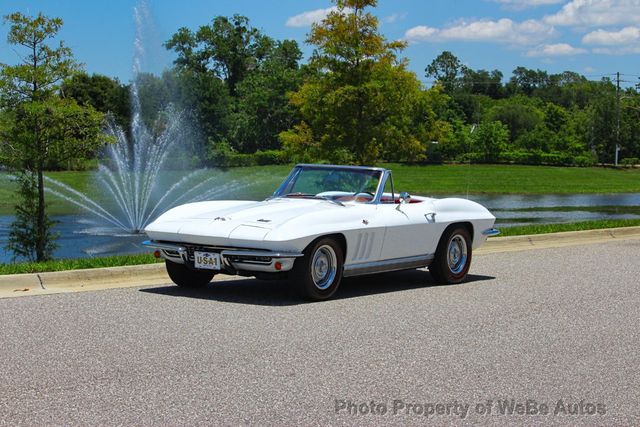
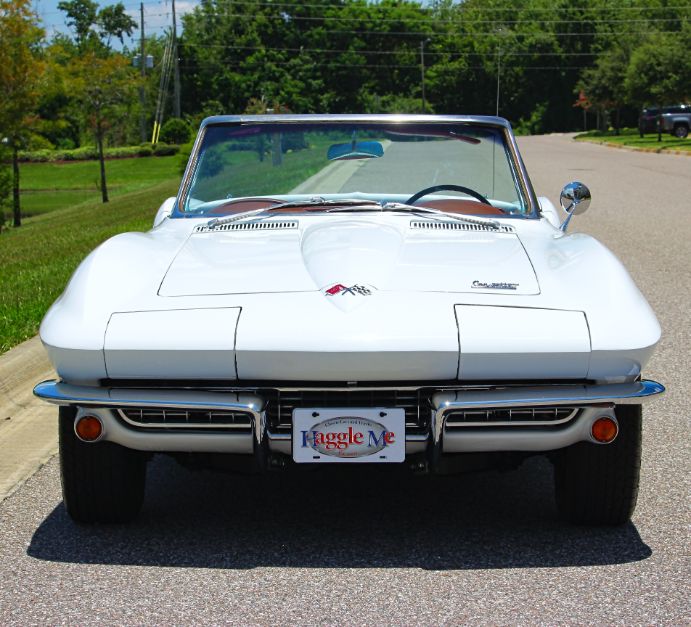
The C2 Corvette Sting Ray, introduced for 1963, brought independent rear suspension, a more sophisticated chassis, and genuine aerodynamic intent. It was a serious engineering step forward. But it still used drum brakes on all four corners, and the limitation that had cost Corvette victories in the late 1950s continued to cost them in the early 1960s. The fix would require a different kind of braking technology entirely — one that managed heat through geometry rather than mass.
The Workaround: RPO J56 and the Limits of Drum Technology
Chevrolet's engineers were not passive about the problem. For 1964 they offered RPO J56, a sintered metallic brake package using aluminum brake drums and metallic linings intended for competition use. The aluminum drums dissipated heat faster than iron, and the metallic linings maintained friction coefficients at elevated temperatures that would destroy conventional organic linings. It was a serious upgrade, and it helped.
But RPO J56 was a refinement of a compromised architecture, not a solution. Aluminum drums still expanded under heat, still developed the geometric fade problem inherent in the design. The metallic linings operated at temperatures that made them largely useless in cold conditions and wore aggressively on the drum surfaces. The package worked for purpose-built race cars that were warmed up before competition and retired at the end of a stint. It was not a satisfying answer for a car that Chevrolet wanted to market as both a road car and a credible competition machine.
The engineers working on the C2 chassis knew what the solution was. Disc brakes had been demonstrated on European road cars and American racing machinery throughout the late 1950s. Jaguar's disc-braked D-Types had won Le Mans in 1955, 1956, and 1957. The technology was proven. The engineering challenge was packaging a four-wheel disc system into the Corvette's existing geometry and hitting a price point that could be offered as production equipment.
| Brake System | Years Used | Configuration | Competition Suitability |
|---|---|---|---|
| Standard drum brakes | 1953–1964 | Cast iron drums, organic linings | Poor — severe fade under sustained use |
| RPO J56 (aluminum drums) | 1964 only | Aluminum drums, sintered metallic linings | Moderate — reduced fade, but geometry unchanged |
| Four-wheel disc (standard) | 1965 onward | Vented rotors, four-piston Kelsey-Hayes calipers | Excellent — fade-resistant, consistent pedal |
The 1965 System: How Chevrolet Engineered It
The disc brake system that appeared on the 1965 Corvette was developed in collaboration with Kelsey-Hayes, one of the leading brake suppliers in American motorsport. The design used vented rotors front and rear — a key detail that separated it from simpler disc systems then available. Vented rotors have an internal air gap between two braking faces, allowing airflow through the rotor mass and dramatically accelerating heat dissipation. At sustained track speeds, a vented rotor runs significantly cooler than a solid disc of the same outer diameter.
The calipers were four-piston fixed units, meaning the caliper body itself did not move. Instead, two pistons on each side of the rotor clamped inward simultaneously. This configuration applies force symmetrically to both rotor faces, reduces the tendency for the rotor to be pushed laterally under braking, and gives the brake a more linear and consistent pedal feel than sliding-caliper designs. The four-piston arrangement also spread the thermal load across more piston area, reducing the likelihood of fluid boiling behind a single large piston.
At the front, the rotors measured 11.75 inches in diameter. At the rear, the system had to accommodate the differential and half-shaft geometry of the C2's independent rear suspension — a packaging challenge that did not exist in the simpler rear axle designs used by most American cars of the period. The engineers solved it by mounting the rear calipers inboard, adjacent to the differential rather than at the wheel. This kept unsprung weight low and protected the rear brakes from road debris.
The system retained a vacuum-assisted power booster as standard equipment, giving drivers the kind of light pedal effort expected in a production car while still delivering the stopping forces the new rotors and calipers were capable of generating. A separate mechanical handbrake operated on small drum mechanisms integrated into the rear rotor hats — a common solution at the time for providing a parking brake on a disc-only system.
What Changed: Stopping Distances, Fade Resistance, and Competitive Credibility
The performance improvements were not subtle. Contemporary road tests documented meaningful reductions in stopping distances from highway speeds. From 60 mph, the 1965 Corvette stopped in distances that were competitive with the best European sports cars of the period. From 80 mph and above — the speeds relevant to track use — the advantage over drum-braked predecessors was even more pronounced, because disc brakes maintained their performance across repeated stops while drums did not.
The fade resistance improvement was the more important story. Road & Track and Car and Driver tested the 1965 Corvette with repeated panic stops from high speed, a procedure that destroyed the stopping capability of drum-equipped cars within a handful of attempts. The disc-braked 1965 completed the same tests with minimal degradation in pedal feel or stopping distance. The brake fade phenomenon that had been an accepted limitation of the Corvette's competition career was, for practical purposes, eliminated.
"The 1965 system didn't just improve on what came before — it changed the category of problem entirely. Drum fade is a thermal management challenge with no clean solution at the architecture level. Disc brakes move the thermal problem to one that engineering can actually solve."
— Jim Vasquez
For racers, the implications were immediate. The Corvette could now run race stints without drivers managing brake temperature as a primary tactical concern. Lap times improved not just because the car stopped shorter, but because drivers could brake later into corners with confidence that the system would respond consistently on lap forty as it had on lap one. The psychological freedom that comes from predictable brakes — the ability to use all of the car's capability — is not captured in stopping-distance figures but it is real and it is significant.
The 1965 model year was also notable for introducing the 396 cubic inch Mark IV big-block engine as a Corvette option — a separate story of substantial power increase. The combination of dramatically more engine output and a braking system finally capable of handling it represented a genuine step change in what the Corvette could do. Earlier discussions of the Corvette's development appear in coverage of the 1963 split-window Corvette and the 1963 Z06 competition package, which show how the factory had been pursuing competition credibility throughout the early C2 years despite the braking limitation.
The four-wheel disc brake system became standard equipment on all 1965 Corvettes — not an option, not a competition package, but the baseline specification for every car that left the St. Louis assembly plant. That decision mattered. It signaled that Chevrolet considered disc brakes the correct engineering choice for the car, not an exotic upgrade for the few buyers who tracked their cars. It also meant that the Corvette's competitive credibility — its ability to be taken seriously as a performance machine against European competition — was no longer compromised by a fundamental systems deficiency.
The broader history of the Corvette as America's sports car includes many engineering milestones, but the 1965 transition to four-wheel disc brakes stands among the most consequential. It resolved the single most consistent criticism the car had faced in a decade of competition and road use. It did so with a system that was technically sophisticated, well-engineered for production, and competitive with anything available from Europe at the time. The drum era ended, and with it the asterisk that had always accompanied the Corvette's otherwise impressive performance credentials.