Open air from the beginning: the C1 roadster era (1953-1962)
The Corvette has always had a complicated relationship with its own roof. When Harley Earl's team unveiled the car at the 1953 Motorama, it arrived as a roadster with a soft top, not a hardtop coupe. That was a deliberate statement: this was America's sports car, meant to be driven the way European roadsters were driven, with the wind doing what it does. The earliest C1s used a manually operated folding canvas top that required some patience and a fair amount of arm strength to operate cleanly. Not elegant, but honest about what the car was.
The 1953 through 1955 cars were all roadsters, which matters for production context. The 1953 run totaled just 300 units, all built at the Flint, Michigan, pilot plant before production shifted to St. Louis. Those cars came with the 235-cubic-inch "Blue Flame" inline six mated to a two-speed Powerglide automatic, which earned early Corvettes a reputation for being underpowered sports cars in appearance only. The small-block V8 arrived in 1955 and changed the conversation. By 1956, Chevrolet had given the C1 a proper redesign with real wind-up windows, which made the soft top experience considerably less drafty.
The 1962 C1 represents the last of the pre-Sting Ray generation, and it is worth noting that every single C1 was a convertible (or roadster, depending on terminology). There was no coupe option until the C2 arrived. Removable hardtops were available as dealer-installed options from 1956 onward, which gave buyers some flexibility, but the open-body architecture was the only game in town for the entire first generation.
The C2 convertible peak and the C3's slow fade (1963-1975)
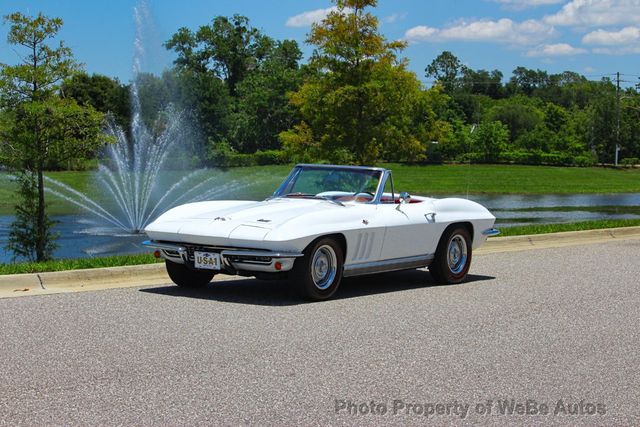
The 1963 Sting Ray changed everything. Bill Mitchell's coupe design, with its iconic split rear window, is what most people picture when they think of a mid-1960s Corvette. But the convertible continued alongside it, and sales tell an interesting story. In 1963, the coupe and convertible were roughly even in volume. By 1964, convertible sales pulled ahead, and they stayed there through much of the C2's run. The 1967 model year produced 14,436 convertibles against 8,504 coupes. That ratio tells you what buyers thought they wanted in a Corvette at the time: the open car, not the closed one.
The C2 convertibles are the cars that command the most serious collector attention today, particularly the 1963 through 1967 big-block cars with documented options. The 1967 L88, regardless of body style, is among the rarest and most expensive Corvettes ever sold. Only 20 L88s were built that year total, across both body styles. For the convertible specifically, the combination of an L88 or L89 engine with a factory-correct M22 "Rock Crusher" four-speed is the configuration that auction houses chase hardest. These are not cars where you approximate figures. The tank sticker and broadcast sheet are the evidence chain. Without them, you are buying a story.
The C3 arrived in 1968 and convertibles initially outsold coupes again. 1969 produced 16,608 convertibles against 22,129 coupes, a shift that reflected the T-top coupe's growing appeal. Through the early C3 years, production numbers for both body styles tracked reasonably close. Then came the regulatory pressure. The National Highway Traffic Safety Administration was moving toward federal rollover protection standards throughout the early 1970s, and the proposed rules, had they been finalized, would have required a full rollover structure that the convertible's architecture could not easily accommodate. Chevrolet made the call to discontinue the convertible after 1975 rather than invest in a redesign that might be obsolete the following year. The last C3 convertible rolled off the line for the 1975 model year, and the body style disappeared from the Corvette lineup for eleven years.
| Generation | Convertible years | Peak production year | Notable variants |
|---|---|---|---|
| C1 | 1953-1962 | 1962 (10,939 total) | All C1s were convertibles |
| C2 Sting Ray | 1963-1967 | 1967 (14,436 convertibles) | L88, L89, 427 big-block variants |
| C3 | 1968-1975 | 1969 (16,608 convertibles) | LT1 small-block, LS6 big-block (1971) |
| C4 | 1986-1996 | 1986 (7,315 units, first year back) | ZR-1 convertible option (1991-1995) |
| C5 | 1998-2004 | 2004 (12,216 convertibles) | Z06 was coupe only; no convertible Z06 |
| C6 | 2005-2013 | 2006 (11,151 convertibles) | ZHZ convertible (Hertz limited run) |
| C7 | 2014-2019 | 2015 (approx. 7,000+ convertibles) | Z06 convertible returned for C7 |
| C8 | 2020-present | Ongoing production | Retractable hardtop, mid-engine layout |
Why the convertible disappeared in 1975, and why it came back in 1986
The NHTSA rollover standard story is often told as settled fact, and the regulatory threat was real. But the full picture is a little more layered. The proposed Federal Motor Vehicle Safety Standard 216, which would have mandated specific roof crush resistance, was the immediate trigger for Chevrolet's decision. The T-top roof configuration the C3 carried made compliance engineering for a convertible genuinely complicated. Rather than spend development money on a solution for uncertain regulatory targets, Chevrolet simply stopped building the open car after 1975. The 1975 production run totaled around 4,629 convertibles, making it a meaningful collector year precisely because everyone knew it was the end.
The 1975 convertible also coincided with significant emissions and performance detuning across the industry. The base L48 small-block made around 165 net horsepower that year, down substantially from early C3 figures. The LS6 454 had already been discontinued after 1971. So the last convertible of the era arrived in what was arguably a low point for American performance cars. That specific combination of "last of the breed" status and the compromised performance context of the mid-1970s creates an interesting collector dynamic: the car matters more for its rarity than for what it does.
The rollover standard never passed in the form that prompted the deletion. NHTSA's rulemaking moved slowly, and by the early 1980s it was clear that convertibles were not going to be regulated out of existence. Chevrolet recognized the market opportunity. The C4 Corvette had launched in 1984 as a coupe only, and by 1986 the convertible returned as a dedicated body style, not just a soft-top coupe variant. The 1986 convertible used a reinforced structure with a steel X-brace under the floor to compensate for the lost rigidity of the roof, a solution that added weight but made the car structurally sound. It was the first Corvette convertible in eleven years, and the market noticed.
"The 1975 convertible is one of those cars where the documentation matters more than the performance numbers. Buyers in Bowling Green understand this. The window sticker, the tank sticker, the broadcast sheet if it survived -- those establish what left the factory. The performance was compromised by the era. The paperwork is the story now."
-- Tom Ramirez
C4 through C7: the convertible as a permanent fixture
From 1986 onward, the Corvette convertible was no longer an asterisk. The C4 offered it through the entire production run, and the 1986 first-year cars have a minor distinction worth noting: they were the pace car for the Indianapolis 500 that year, and Chevrolet produced a limited Pace Car edition. The more significant C4 convertible milestone came with the ZR-1 option. Beginning in 1991, buyers could order the LT5 engine (developed with Lotus, initially rated at 375 horsepower and later bumped to 405) in convertible form. The ZR-1 convertible is rarer than the coupe ZR-1, and the combination of the open body with the King of the Hill engine is what serious C4 collectors seek.
The C5 convertible arrived for 1998, a year after the coupe. One note that matters for collectors: the C5 Z06 was a fixed-roof coupe only. There was no Z06 convertible in the C5 generation. If someone is selling you a "C5 Z06 convertible," that is not a factory configuration. The C5 convertible used a manual soft top rather than a power-operated unit, a cost decision that some buyers found surprising on a car in that price range.
The C6 corrected that, offering a power top standard on the convertible from 2005. The C6 also brought back the Z06 as a coupe-only performance variant, again leaving the convertible without the top-tier engine option until the ZR1 arrived in 2009. A ZR1 convertible did not exist for the C6 generation. The C7 changed the calculus: the 2015 Z06 was offered in both coupe and convertible body styles, giving buyers the 650-horsepower supercharged LT4 in open form for the first time in a long while. The C7 Z06 convertible carries a meaningful premium in today's market for exactly that reason.
Which convertible years command the highest collector premiums
If you are looking at this from a valuation standpoint, certain years concentrate collector attention in ways that others do not. The 1967 C2 convertible with a big-block engine and a documented configuration is at the top. An original 427/435-horsepower L71 car with a matching-numbers drivetrain, correct trim tag, and tank sticker in a desirable color over a contrasting interior can exceed $150,000 at auction without much difficulty. An L88 in any surviving configuration moves multiples of that. These are not cars for buyers who need to use them as drivers.
Below that tier, the 1953 through 1955 C1 convertibles carry strong premiums for their historical significance, particularly the 1953 model year given the limited 300-unit run. A solid, documented 1953 in presentable condition trades in the $60,000-$80,000 range; a concours-quality example goes higher. The 1975 "last C3 convertible" cars have a collector premium attached to the production context rather than any performance spec, and they trade accordingly. Expect to pay $25,000-$45,000 for a solid driver-quality example; show-quality cars approach $60,000 depending on documentation.
The C4 ZR-1 convertibles from 1991 to 1995 have been appreciating as the LT5 generation gets properly recognized. Clean examples with low miles and the correct documentation are now trading in the $35,000-$55,000 range, up from values that were embarrassingly low a decade ago. The C5 and C6 convertibles are still largely in driver territory, with exceptional low-mileage examples commanding modest premiums. The C7 Z06 convertible is the one to watch in the current generation used market. You are looking at the entire structure of the learn-from-documents article linked in the rarest Corvettes in American automotive culture discussion for exactly these kinds of production rarities.
The open-top versus closed debate among Corvette purists
This one does not have a clean resolution, and anyone who tells you it does is probably selling something. The purist argument for the coupe has been consistent since the 1963 split-window arrived: the coupe is stiffer, it handles better, and the closed body is what the performance-focused buyer should want. That argument has structural merit. The C4 convertible's X-brace added meaningful weight. The C5 and C6 convertibles, despite improved chassis engineering, showed measurably more flex under hard cornering than the coupe. If you are taking the car to a track day, the coupe is the correct choice in every generation.
The counterargument is that the Corvette has always been a machine for the American experience of driving, and that experience is better in the open air. This is not a performance argument. It is a different argument entirely. The people who drive their C3 convertibles to shows, who bought their 1966 roadster for what it actually feels like to have a 427 under the hood and no roof over your head, are not making a specification mistake. They are making a different choice about what the car is for.
The market has historically agreed with the open-top buyers to some degree. C2 convertibles have commanded premiums over equivalent coupes for decades, and the C3 convertibles traded near parity with coupes until the coupe-only performance variants (later Z06, ZR1) created a separate value ceiling for the closed cars. Today, the split runs along generation lines. Pre-1975 convertibles typically carry premiums over coupes of equivalent spec. Post-1986 convertibles are roughly at parity or slightly below the coupe for most years, with specific performance variants (C7 Z06 convertible) as exceptions. What is not in debate is this: the convertible has been part of the Corvette's identity since the very first car. The eleven-year gap from 1975 to 1986 is the exception in a seven-decade story, not the rule.
Sources and notes
- National Corvette Restorers Society (NCRS) technical documentation library, ncrs.org. Primary source for broadcast sheet, tank sticker, and production number data across all generations.
- Corvette: America's Sports Car, by Randy Leffingwell (Motorbooks, multiple editions). Comprehensive model-year production and specification reference.
- Bloomington Gold Corvette certification standards documentation, bloomington-gold.com. Authentication criteria and judging standards for C1 through C7 models.
- National Highway Traffic Safety Administration Federal Register records, 1970-1976. Source for rollover standard rulemaking history (FMVSS 216) and proposed regulatory timeline that preceded the 1975 convertible discontinuation.
- Mecum Auctions results database, mecum.com. Auction hammer prices referenced for C2 big-block and C4 ZR-1 convertible valuations are based on publicly reported sale results from recent auction cycles.
- Corvette Black Book, by Mike Antonick (Michael Bruce Associates, annual editions). Authoritative production number and VIN decoder reference used by NCRS, CCOA, and Bloomington Gold judges.