From used car to six figures: how Corvette values rewrote themselves
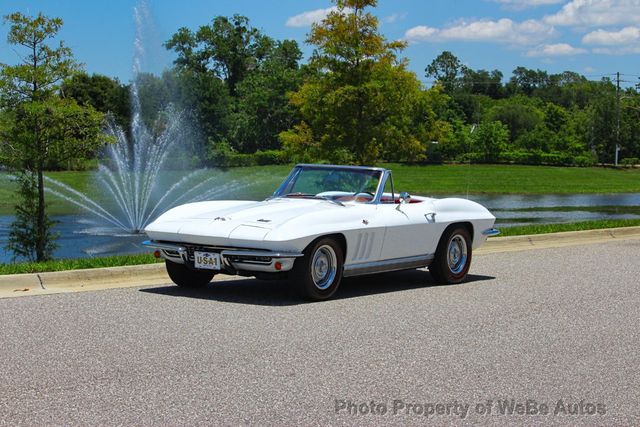
In 1975, a 1963 Corvette split-window coupe was simply a used car. Not an inexpensive one, but a used car, available at the roadside lots and classified columns that were the collector market of that era. Prices for solid examples ran somewhere in the $3,000 to $5,000 range depending on condition and engine, which was real money in 1975 but nothing that suggested the trajectory ahead. The same car today, in comparable condition, trades comfortably above $100,000. Documented, numbers-matching examples with their original drivetrain can push $200,000 at major auction. The split-window coupe is the example everyone cites because it is the most dramatic, but the broader story of Corvette values across generations is equally instructive for anyone thinking seriously about the market.
What happened to the C1 and C2 is not simply inflation or nostalgia. It is a compression of several forces, each of which still operates on younger Corvette generations today. Understanding those forces is more useful than memorizing current prices, because prices move and the forces that drive them do not change much.
What drives a generation's values upward
Hagerty's Corvette value index, which tracks insured values across generations, shows a recognizable pattern when you look at enough generational data. Values for a given Corvette generation typically soften in the decade after the car goes out of production. The buyers who wanted a new one have their new one; the cars are plentiful; enthusiasm for the old design has not yet sharpened into nostalgia. This is the C4's situation today and, to a lesser extent, the C5's.
The turn comes, usually, when the generation's original buyers reach their peak earning years and start looking backward. A 45-year-old who saw a split-window coupe at an auto show in 1963 was making serious purchasing decisions in the mid-1980s. That nostalgia cycle is mechanical and predictable. The cars he remembered were exactly the ones that started moving in price. The same mechanism is now working through the C4 generation, which was current from 1984 to 1996 and whose original buyers are solidly in their 60s.
Supply contraction reinforces the cycle. Deferred-maintenance cars get parted out. Accidents remove others. Rust, in climates that use road salt, takes a slow but consistent toll. Production numbers that seemed large when the cars were new look different 30 years later when you account for attrition. The 1963 split-window coupe had a production run of 10,594 units. That sounds like a lot until you consider how many of those have been damaged, destroyed, restored with incorrect parts, or simply lost to time.
Publication coverage and auction visibility complete the picture. When a major auction house puts a significant Corvette on a prominent lot and it clears a record hammer price, the coverage that follows reaches buyers who were not previously in the market. The rarest Corvettes in history receive disproportionate coverage relative to their numbers, which pulls attention to the broader generation. That attention raises the floor, not just the ceiling.
| Generation | Years | Value trend (2026) | Notes |
|---|---|---|---|
| C1 | 1953–1962 | Firm / appreciating | Fuel-injected 1957–1962 examples lead the market; six-cylinder 1953–1955 cars have a separate collector base |
| C2 (split-window) | 1963 only | Strong appreciating | Most scrutinized Corvette for authenticity; tank sticker and trim tag essential for serious buyers |
| C2 (balance) | 1964–1967 | Firm / L88 and 427 cars appreciating | 427 convertibles in documented condition have moved significantly in the past five years |
| C3 | 1968–1982 | Mixed; early cars firming | 1969 L88, 1970 LT-1 lead; late-C3 cars (post-1975) remain soft |
| C4 | 1984–1996 | Undervalued / early appreciation signs | ZR-1 (LT5 engine) and Grand Sport are the leading variants; base cars still very accessible |
| C5 Z06 | 2001–2004 | Rising steadily | Fixed-roof coupe, LS6 engine, under 16,000 produced per year; price floor rising |
| C6 Z06/ZR1 | 2006–2013 | Stabilizing / selected variants appreciating | LS7 Z06 and ZR1 with low miles attracting serious attention |
The C4: unloved when new, still undervalued
The C4 generation has a reputation problem that its cars do not entirely deserve. When Chevrolet introduced the redesigned Corvette for 1984, it arrived as a single body style with a controversial instrument cluster and an engine that, in base form, produced 205 horsepower. After the muscular C3 cars of the late 1960s and the broader cultural memory of what a Corvette was supposed to be, the C4 felt like a step sideways. Road test coverage was positive but measured. Enthusiasts were not ignited.
That reputation has suppressed values for decades and created what is, at the moment, a genuine opportunity for buyers who look past the generation's unglamorous public image. A clean, well-sorted 1984–1989 base C4 can still be found for $8,000 to $14,000. The ZR-1, introduced for 1990 with the Lotus-developed LT5 engine producing 375 horsepower initially and 405 horsepower from 1993, is a different conversation. Documented, low-mileage ZR-1s are moving through $30,000 to $45,000 for strong drivers and approaching $60,000 for exceptional examples. The Grand Sport, built in 1996 as a limited farewell variant at 1,000 units, consistently trades above $35,000 in original condition. These are not yet the prices that command headline coverage, but the trend line is established.
"The C4 suffers from the same thing the C3's late years suffered from in 1995: too recent to be classic, too old to be modern. That window closes. It always closes. The question is whether you want to buy before or after the market figures it out."
— Sarah Whitfield
The C5 Z06 as a rising sleeper
The C5 generation ran from 1997 through 2004 and introduced the LS engine family to the Corvette, along with a substantially updated chassis and the return of a fixed-roof coupe option. Base C5 values remain modest, with driver-quality examples available from $15,000 to $22,000. The Z06, introduced for 2001, is a different proposition.
The C5 Z06 used the fixed-roof coupe body, a titanium exhaust system, an upgraded suspension, and the LS6 engine producing 385 horsepower in 2001 and 405 horsepower from 2002 forward. It was, by objective measure, one of the most capable performance cars produced at any price in its era. Road tests from 2001 documented 0-60 times around 3.9 seconds. The Nurburgring lap time Chevrolet claimed was competitive with cars costing three times as much. None of this was secret; the automotive press covered it extensively. But the Z06 arrived as a mass-market Corvette, which carried the wrong associations for the price it needed to reach in the collector market.
That is changing. Low-mileage C5 Z06 examples have moved from the $18,000 to $22,000 range of three years ago into the $28,000 to $38,000 range for clean, well-documented cars. Track-day-modified examples remain below that; clean, original survivors are pulling the market upward. The production numbers support the interest: roughly 5,773 Z06s were built for 2001, 8,297 for 2002, 11,632 for 2003, and 5,683 for 2004. That is not rare in any absolute sense, but attrition on high-performance cars used hard is significant. Browse current Corvette listings for sale to see how quickly clean C5 Z06 examples move when they appear at honest prices.
Investment versus driving enjoyment: a tension worth naming
The appreciation story creates a real problem for buyers who intend to use their cars. A C2 427 convertible that was a legitimate driver ten years ago is now carrying enough value that every highway mile registers in a different way. Insurance requirements change. Storage calculus changes. The car that was bought to enjoy becomes an asset that requires managing.
This tension resolves differently depending on what the buyer actually wants. For someone whose primary interest is the investment angle, the answer is relatively straightforward: buy documented, condition-one examples of the right variants, store them properly, and check the Hagerty index annually. For someone who wants to drive, the answer is to buy the generation behind the one currently appreciating. The C5 base car, right now, delivers genuine Corvette performance at a price where actual use does not feel like destruction of capital. In five or ten years, that calculus will shift, and the C6 base car will occupy the same position.
What Hagerty's data consistently shows is that the collector car market, for well-chosen vehicles, has outperformed several traditional investment categories over long periods. But the cars that perform best are the ones that were bought with genuine knowledge of the vehicle, not simply because someone said the market was going up. The split-window coupe at $150,000 rewards the buyer who understood why it mattered. The C4 ZR-1 at $40,000, if the trend continues, will reward the buyer who understood why it was undervalued before the market corrected.
Sources and notes
- Hagerty Valuation Tools — quarterly price guides for collector vehicles by condition tier. hagerty.com/valuations
- National Corvette Restorers Society (NCRS) — primary documentation authority for Corvette authenticity, tank sticker verification, and NCRS judging standards. ncrs.org
- Bloomington Gold Corvette — annual certification event; condition and authenticity standards referenced for C1/C2/C3 market grades.
- Mecum Auctions — public auction result database used for C2 and C4 hammer price data referenced in this article. mecum.com
- Chevrolet Corvette ZR-1 press materials, 1990 model year — original LT5 horsepower figures (375 hp for 1990–1992; 405 hp for 1993–1995) sourced from factory documentation.
- C5 Z06 production figures: Corvette Black Book (Michael Bruce Associates) — annual production records by model year and variant, 2001–2004.