Not every Corvette is created equal
There are roughly 1.7 million Corvettes on the road today across all generations, give or take. Most of them are good cars. Many of them are enjoyable to drive. A small fraction of them are genuinely collectible in the way that serious buyers mean when they use that word. The gap between a $25,000 driver and a $250,000 documented original is not arbitrary. It comes down to a specific set of factors that the Corvette community has spent decades identifying, arguing about, and eventually codifying into formal certification programs. Understanding those factors is the difference between buying a car that holds its value and buying one that surprises you at resale.
I have spent twenty years working from factory records in Bowling Green, and the single most common mistake I see buyers make is conflating condition with collectibility. A car can be beautiful, freshly painted, mechanically sorted, and completely unremarkable from a collector standpoint. Conversely, a tired-looking survivor with original paint and a complete documentation package can outperform show cars at auction by a significant margin. The market does not reward looks alone. It rewards what can be proven.
This article covers the framework that separates a collectible Corvette from a driver: the documentation hierarchy, what numbers-matching actually means, how color affects value, what the formal certification programs tell you, and which generations are gaining or losing favor with collectors right now. If you are thinking about buying or selling a serious Corvette, these are the questions you need answered before any money changes hands.
The documentation hierarchy: what paperwork actually matters
Documentation is not a single thing. It is a stack, and each layer adds value independently. At the top of that stack is the tank sticker. This is the factory's own record of what was installed on a specific car before it left the line. It lists option codes in a format that corresponds to the Corvette's Vehicle Identification Number, and when it survives, it eliminates a substantial amount of guesswork about original equipment. A 1969 L88 with its tank sticker intact is not the same animal as an identical-looking car without one.
Below the tank sticker sits the build sheet, which is a production document sometimes found stuffed under seat cushions or inside door panels from the factory. Build sheets are less formal than tank stickers but carry significant weight because they document assembly-line information. Finding an original build sheet during a restoration is treated as a significant discovery in Corvette circles. Many have been lost, which is why surviving examples command attention.
The window sticker, known formally as the Monroney label, documents the original retail price and equipment list. It is valuable but more commonly reproduced, which means its presence alone is less definitive than a tank sticker. A serious buyer wants to see all three, and will discount a car that cannot produce at least the tank sticker for documented, high-value examples.
| Document | What it proves | Replaceability | Impact on value |
|---|---|---|---|
| Tank sticker | Factory option codes, original equipment | Cannot be legitimately reproduced | High — often adds 15–30% to documented examples |
| Build sheet | Assembly-line production details | Rare, not reproduced for sale | Moderate to high depending on rarity of car |
| Window sticker (Monroney) | Original retail price and options list | Reproductions exist — verify against VIN | Moderate — adds completeness to documentation package |
| Dealer invoice / order form | Customer-ordered specification | Rare to survive | Low to moderate depending on car |
| NCRS / Bloomington documentation | Third-party expert verification | Must be earned through judging | High on serious collector cars |
Numbers matching and date codes: what the registry looks for
"Numbers matching" is the most misused phrase in the Corvette hobby. Technically it means the engine's VIN-stamped partial number matches the car's main VIN, indicating the original engine is still in place. That is the minimum bar. A car can be numbers matching and still be far from original in ways that matter to judges: replaced carburetor, non-date-correct alternator, wrong distributor casting, repainted engine block. The registry does not care about numbers matching alone. It cares about correctness.
Date codes are where this gets specific. Every major component on a Corvette has a casting date or a date code, and those dates follow a logical sequence: the engine block casting date must precede the car's assembly date, the carburetor date must fall within a narrow window of the build date, and accessory components follow their own calendar. The National Corvette Restorers Society judges have seen enough correct and incorrect cars to know immediately when something is off. A carburetor date-coded six months after the car's assembly date is not original, full stop. It may be correct in part number, correct in appearance, and still disqualifying.
For buyers, the practical implication is that a numbers-matching claim is a starting point for investigation, not a conclusion. Before buying a serious documented Corvette, have someone from the NCRS registry examine the car. The cost of that consultation is trivial relative to what you are about to spend. The NCRS has a network of technical advisors who can verify date codes in person, and their opinion carries weight at resale. Without that independent verification, you are taking the seller's word on a question that has real money attached to it.
"The tank sticker matters. Not because it tells you everything — it doesn't — but because it's the factory's own record of what left the line. A 1969 L88 without its tank sticker isn't worthless, but it's a different conversation."
— Sarah Whitfield
Color rarity, option desirability, and what actually moves the market
Color affects Corvette values, but not in a simple way. The relationship between color rarity and price premium depends on generation, year, and what other options accompany the color. On C2 Corvettes (1963 to 1967), certain colors were produced in very small numbers — Nassau Blue, for example, or Goodwood Green in 1964 — and when those cars have matching interiors and correct documentation, they command premiums that straightforward red or white examples do not. The rarity of the color is verifiable through production data, which is another reason documentation matters.
Options matter more than color on high-value examples. A 1967 L88 coupe is worth substantially more than a base 327 in the same color, and no amount of desirable paint color closes that gap. The performance options that move the market on C2 and C3 cars include the L88 (427 cubic inches, factory-rated at 430 hp in 1967 and 1968, though actual output was considerably higher), the ZL1 aluminum-block 427 (produced in very small numbers for 1969), and the LT1 small-block in 1970 through 1972. These options were expensive when new and were ordered in small quantities. The intersection of a rare performance option, correct documentation, and a desirable color is where the highest values live.
On later generations, the calculation shifts. For C4 Corvettes (1984 to 1996), the ZR-1 — which used the LT5 engine designed with Lotus and built by Mercury Marine, rated at 375 hp for 1990 to 1992 and 405 hp from 1993 onward — remains the most collectible configuration. C5 collectibility currently centers on the Z06 hardtop (2001 to 2004) and the fixed-roof coupe (FRC) introduced in 1999, with the 2002 to 2004 Z06 carrying the most attention. For C6, the 427 Z06 and ZR1 variants dominate collector interest. The pattern holds across generations: the highest-output, lowest-production variants with documentation are what collectors pay for.
NCRS and Bloomington Gold: what certification actually tells you
The National Corvette Restorers Society and Bloomington Gold are the two primary certification bodies in the Corvette hobby, and they measure different things. Understanding the distinction matters when evaluating a car that carries one or both credentials.
The NCRS operates a point-based judging system that evaluates originality and correctness against documented factory standards. A car judged at NCRS regional or national level receives a score reflecting how closely it matches factory configuration, including finish quality on components, correct date codes, and accurate assembly details. The highest designation is the Duntov Mark of Excellence, which requires earning a perfect or near-perfect score at a national meet. NCRS judging is documentation-heavy — you cannot score well with a nice-looking car that cannot prove its origins. This makes NCRS certification a meaningful proxy for authenticity on high-value examples.
Bloomington Gold takes a somewhat different approach. The show evaluates condition and correctness but is also known for its Survivor category, which recognizes cars that retain significant original surfaces and materials without restoration. A Bloomington Gold Survivor designation has become increasingly valuable in the market because it addresses a different collector preference: not the perfect restored car, but the unrestored original. As the collector market has matured, survivors with verifiable original paint and interior have outperformed many restorations, particularly on C1 and C2 cars. Bloomington Gold's rigorous vetting process for the rarest Corvettes adds a layer of third-party credibility that is difficult to replicate.
For a buyer, either certification is worth paying for in the purchase price, provided the certification is current and you have verified it with the issuing organization directly. Certifications from twenty years ago do not account for changes that may have occurred since judging. Ask for the most recent score sheet, and if the car has not been judged recently, factor in the cost and risk of re-evaluation.
Which generations are gaining favor and which are losing it
Collector preference is not static, and where the market stands in 2026 reflects both generational aging among buyers and some genuine reassessment of which cars matter historically. A brief summary of where things stand:
C1 Corvettes (1953 to 1962) have maintained steady interest, particularly the 1953 originals (only 300 were produced, all Polo White with red interior), the 1957 with its fuel-injected 283 cubic inch engine rated at 283 hp, and the 1962 as the last of the solid-axle cars. Values on documented C1s have not collapsed, but they have not grown dramatically either. The buyer pool for pre-1963 cars is older, and succession planning is a real issue in this segment.
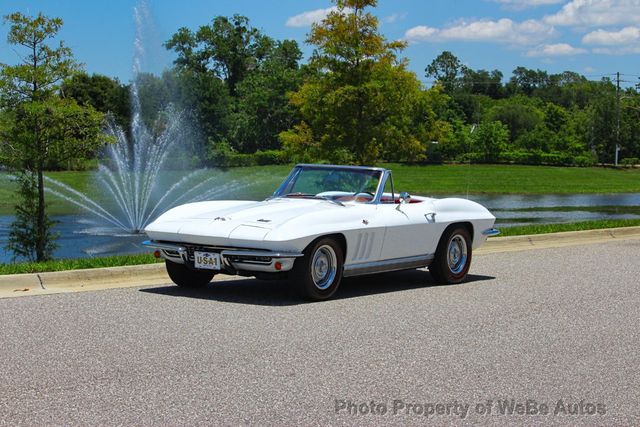
C2 Corvettes (1963 to 1967) remain the most desirable generation among serious collectors. The 1963 split-window coupe is the landmark car — only the 1963 model year had the divided rear window, and Zora Arkus-Duntov famously disliked it, leading to its deletion for 1964. The irony that the feature Duntov removed became the most sought-after visual identifier in the generation is not lost on anyone who follows the market. High-option C2s, particularly L78 and L88 equipped cars with documentation, continue to attract serious money.
C3 Corvettes (1968 to 1982) present a split picture. The early chrome-bumper cars (1968 to 1972) are gaining, driven by collector interest in documented big-block examples. The late C3s (1973 to 1982) remain largely driver territory with the exception of the 1978 Pace Car replica and certain limited editions. The market for mid-C3 cars has softened at the lower end as supply exceeds demand.
C4 Corvettes (1984 to 1996) are in the early stages of collectibility recognition. ZR-1 values have firmed after years of being undervalued relative to the engineering investment they represent. Low-mileage, documented ZR-1s in desirable colors are finding buyers in a way they were not five years ago. The rest of the C4 generation remains in driver territory.
C5 and C6 Corvettes are now firmly in the collector conversation for their top-tier variants. The C5 Z06 (2001 to 2004) and fixed-roof coupe have aged well. The C6 ZR1 and 427 Z06 are being bought by collectors who see them as the last of a specific era of normally-aspirated performance before supercharging became standard. The C7 Z06 and ZR1 are still too recent for meaningful collector assessment, though low-mileage examples of the final 2019 ZR1 are attracting attention.
Collector versus investor: a difference that matters
The Corvette market has two kinds of serious buyers, and they make decisions differently. Understanding which one you are — or which one you are buying from — affects how you should approach a transaction.
A collector buys cars for reasons that include but are not limited to financial return. The collector wants a specific car because of what it represents historically, because they grew up with it, because they want to show it, or because they have spent years researching it and want the example that meets their standard. Collectors generally hold cars for a long time, maintain them properly, and are less likely to sell under market pressure. They are also more likely to have done the research to know exactly what they are buying. Buying from a genuine collector often means buying a well-maintained car with organized documentation.
An investor approaches Corvettes as an asset class. The calculation is return on capital: buy low, sell high, hold only as long as the position makes sense. There is nothing wrong with this approach, but it changes what you should expect from the transaction. An investor is more likely to have bought a car based on market data rather than deep marque knowledge, which means their documentation may be less organized and their understanding of the car's specifics may be more superficial. It also means they may be more willing to negotiate because they are thinking in percentage returns rather than emotional attachment.
The practical difference for a buyer: a collector-owned Corvette with a long ownership history and organized paperwork is usually preferable to an investor-held car with a shorter history, even if the investor's car appears in better condition. Condition can be improved. Provenance cannot be manufactured. For cars where the documentation package is most of the value, this distinction is not academic. If you are ready to look at available cars, browse current Corvette listings to see what the market is offering right now.
Sources and notes
- National Corvette Restorers Society (NCRS), Judging Standards and Guidelines, ncrs.org — the primary reference for originality and correctness criteria across all Corvette generations.
- Bloomington Gold Corvette, Certification and Survivor Program Documentation, bloomingtongold.com — covers the Survivor and Gold Certification criteria and judging history.
- Corvette: America's Sports Car, Corvette Black Book, Michael Bruce Associates — the standard reference for production numbers, option codes, and VIN decoding by model year, updated annually.
- Hagerty Valuation Tools, Corvette Market Trend Data 2022–2026, hagerty.com — used for value range references by condition tier and generation; updated quarterly.
- Zora Arkus-Duntov, The Legend Behind Corvette, Jerry Burton (Bentley Publishers, 2002) — primary source on factory engineering decisions including the 1963 split-window deletion and L88 development history.
- Mecum Auctions and Barrett-Jackson public results archives — used for auction result references and hammer price data on documented L88 and ZL1 cars, publicly available on each company's website.