
The romance of a barn find ends the moment you hand over cash and realize you have bought a car you cannot legally register. I have watched more than one buyer fall in love with a dusty coupe, drag it home on a trailer, and then spend the next eight months fighting a state DMV over a title that does not exist. Paperwork is the part nobody photographs for the magazine spread, and it is the part that decides whether your find becomes a driver or a very expensive yard ornament.
Ownership & Lifestyle
8 min read
Buying a Barn Find: Titles and Paperwork
The unglamorous side of a barn find: no-title cars, bonded titles, VIN checks, and how to keep from buying a stolen or cloned car.
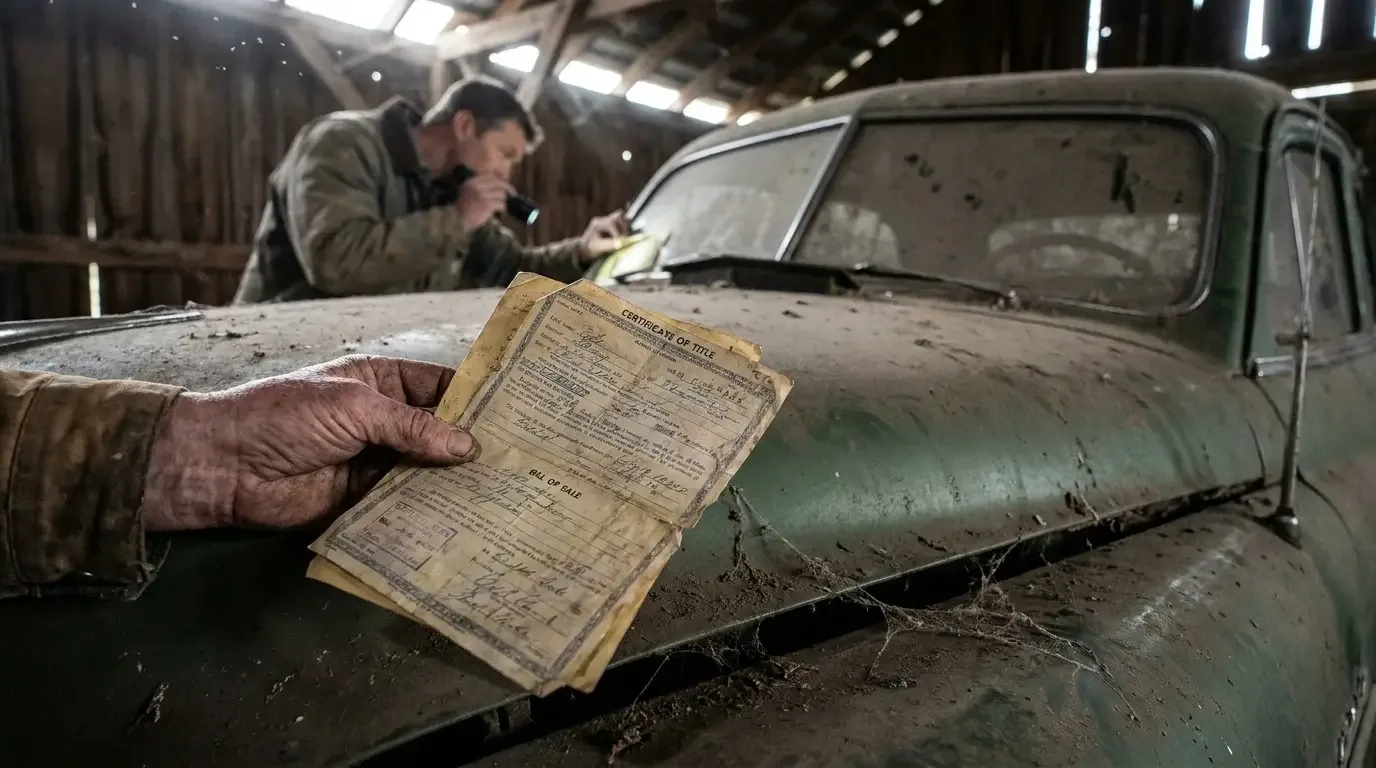
This is the boring, unglamorous, save-your-wallet side of the hobby. If you already understand how to find barn finds, the next skill to build is reading the documents, or the lack of them, before money changes hands. None of what follows is legal advice, and every rule below varies by jurisdiction, so treat this as a map of the terrain and always confirm the specifics with your own state DMV.
Why so many barn finds have no title
A car sitting in a barn for thirty years usually outlived its paperwork. Titles get lost in house fires, thrown out by heirs cleaning an estate, or simply never transferred when the last owner bought the car with a handshake in 1974. In a lot of states an unregistered vehicle eventually falls off the DMV system entirely, so there is no record to point back to. That does not automatically make the car a problem, but it does make it your problem to solve.
The worst version is the car whose title was never legally clean to begin with. Somewhere in its past it may have been stolen, salvaged after a wreck, or given a rebuilt brand that never got resolved. Storage hides all of that. A barn does not care whether a car is honest, and neither does a seller who just wants the thing gone.
Reading what the seller actually hands you
When you look at a barn find, the documents matter as much as the sheet metal. There is a real difference between a car with a clean assignable title and a car with a stack of receipts and a hopeful story. Sort the paperwork into what you can use and what is just background.
| Document | What it does for you | Watch out for |
|---|---|---|
| Clean title in seller's name | Easiest path. Sign, notarize where required, transfer. | Name must match seller's ID exactly. |
| Open / unassigned title | Title signed by a prior owner, not the seller ("title jumping"). | Often illegal to accept; breaks the chain of ownership. |
| Bill of sale only | Starting point for a bonded title or state title process. | Not proof of ownership by itself in most states. |
| Registration or old tags | Supporting evidence of the ownership history. | Expired registration is not a title. |
| No paperwork at all | Abandoned-vehicle or bonded-title route. | Longest, most uncertain path. Price accordingly. |
If the seller offers you a title that someone else signed but was never transferred into the seller's name, walk carefully. That is title jumping, it is illegal in most states, and you can inherit the mess. A car with honest gaps in its history is fixable. A car with a forged or jumped title is a trap. If you ever sell the car on, Classic Cars Arena's seller paperwork guide covers how to hand over a clean title the right way.
Bonded titles and the abandoned-vehicle route
When there is no title and no way to trace the last legal owner, most states offer a surety bond title, usually just called a bonded title. You buy a small surety bond, typically for one and a half to two times the car's value, and the state issues a title that carries the bond for a set period, often three years. If nobody comes forward claiming the car during that window, the brand drops off and you hold a normal title. It is the standard tool for the honest buyer who simply cannot produce prior paperwork.
The other common path is the abandoned or mechanic's-lien process. Rules differ sharply here, and some states restrict it to licensed dismantlers or towing operators rather than private buyers, so this is one to confirm locally before you count on it. The general shape is: prove you have possession, notify the last known owner and any lienholder, wait out a statutory period, and then apply for title. It is slower and more paperwork-heavy than a bonded title, but for a car with genuinely no ownership trail it may be the only door.
VIN verification and spotting a stolen or cloned car
The VIN is your single best defense against buying trouble. Find it, read it, and make sure the numbers agree with each other and with the documents. On older cars the VIN can sit on the dash, the firewall, the frame, the door post, and stamped into the engine or body depending on the marque. If the dash plate looks freshly riveted, if the numbers are uneven, or if one location says one thing and another says something else, stop.
A cloned car wears the identity of a legitimate, still-registered vehicle of the same make and model. Somebody copies a real VIN onto a stolen or salvaged car so the paperwork looks clean on a quick check. The tell is usually mismatched numbers between locations, a VIN plate that does not match the era of the car, or a title whose described details do not line up with what is in front of you.
🔧 Inspection Priorities
- Match every VIN location. Dash, door, frame, and engine stamp should agree. Any mismatch is a stop-work signal. Cost: free, just your time.
- Run a title/theft check. Use a VIN history service and check the national theft records. A few dollars now beats losing the whole car later.
- Confirm the VIN plate looks original. Correct font, correct rivets, correct patina for the age. Re-riveted plates warrant a professional inspection.
- Cross-check the title description. Body style, year, and color history should be consistent with the car. Discrepancies mean questions before cash.
- Ask for an official VIN inspection. Many states offer or require one for out-of-state or no-title cars. Cost: usually a small state fee.
If a car is stolen and later recovered, the rightful owner or their insurer can reclaim it no matter how much you paid. You would be out the money with no legal ownership. That is why the VIN and theft check come before the handshake, every single time.
"I have never regretted the hour I spent under a car with a flashlight checking VIN stamps. I have absolutely regretted the times I trusted a nice story and a stack of receipts instead. The paperwork is the car, as far as your state is concerned."
Robert Halloran
Pricing the paperwork into your offer
Every hour and dollar you will spend making a car legal comes out of what it is worth to you today. A titled, honest car is simply worth more than an identical car with no paper, and your offer should say so. If you know where more of these cars turn up, our guide to Where Barn Finds Still Hide pairs well with this one, because the best-documented finds tend to come from owners who kept their files, not just their cars.
When you are ready to buy something already sorted, plenty of sellers list cars with titles in hand. Browsing current barn finds for sale is a fast way to calibrate what clean paperwork is worth against the project cars that come with a bond and a prayer. Pay for the honest history when you can find it. It is almost always cheaper than manufacturing it later.
Sources and notes
- General state DMV titling procedures for bonded (surety-bond) titles and abandoned-vehicle processes. Rules vary by jurisdiction; confirm with your own state DMV.
- Standardized 17-character VIN adoption references for the 1981 model year (North America).
- Vehicle history and national theft-record check practices used by dealers and private buyers.
- Buyer and appraiser interviews on evaluating documentation and detecting cloned or title-jumped vehicles.
Have a
Classic Car
for Sale?
Reach thousands of serious classic car collectors across the US.
Sell It Here →
Are You a Classic Car Dealer?
List your full inventory and connect with targeted classic car buyers.
Join as a Dealer →
#barn find title
#bonded title
#VIN verification
#abandoned vehicle
#buying classic cars
#bill of sale

About the author
Robert Halloran
Texas-based classic truck enthusiast with decades of experience buying, restoring, and writing about American pickups from the 1940s through the 1980s.
More in Ownership & Lifestyle
Comments
Be the first to comment on this article.