
I still remember the first club plaque I ever got a close look at, bolted crooked to a firewall at a swap meet outside Milwaukee, the chrome long gone dull. That little plaque told you everything you needed to know about a car. It said the car belonged to a group, that the group had rules, and that the guy driving had earned his way in. Clubs were the backbone of hot rodding before magazines and speed shops turned it into a business, they organized the racing, policed the bad behavior, and built the culture that shows like the grand national roadster show still celebrate today.
Ownership & Lifestyle
7 min read
Hot Rod Clubs and Their History
Plaques, the SCTA, and the clubs that organized racing and civilized hot rodding, from the postwar boom to the modern traditional revival.
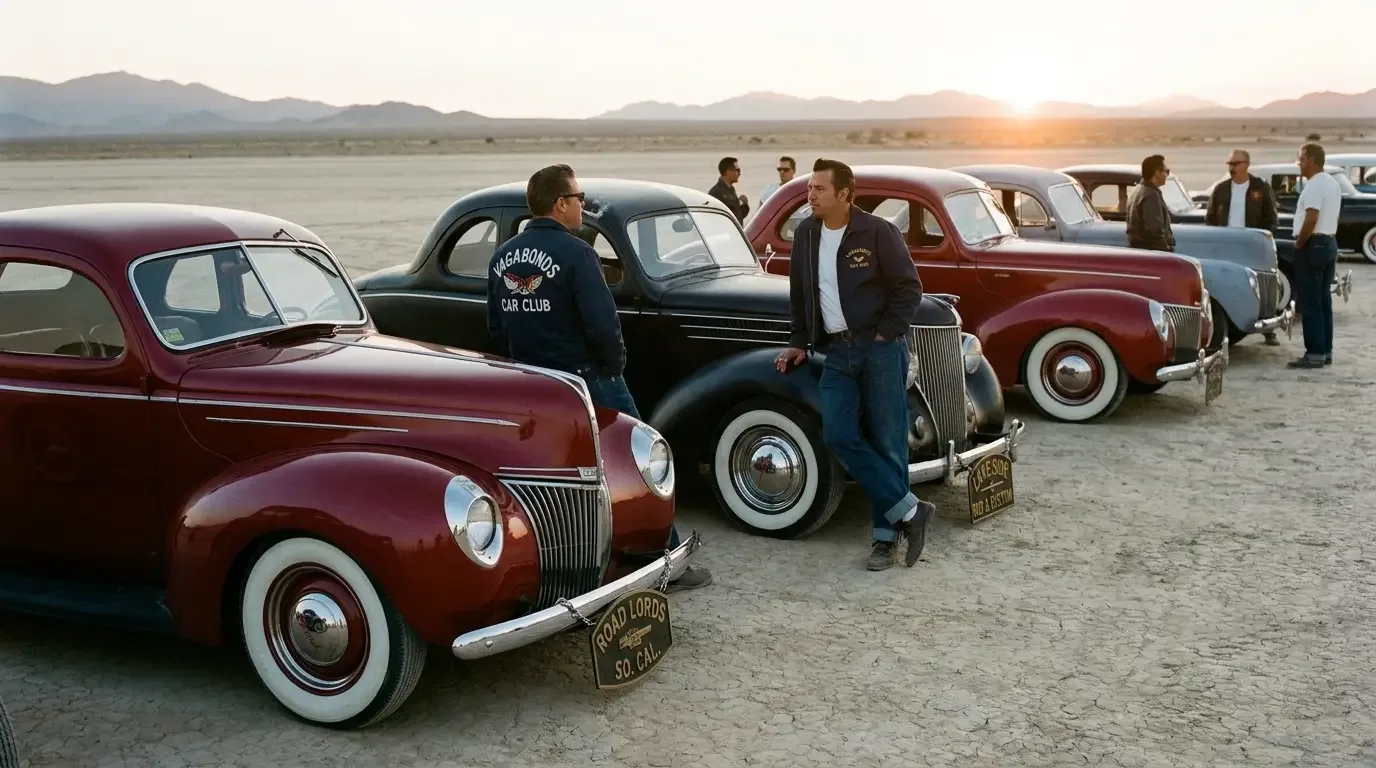
The first postwar clubs and their plaques
Hot rod clubs go back further than most people think. Guys were forming loose groups to run the dry lakes in Southern California through the 1930s, but the real explosion came right after the war. Servicemen came home in 1945 and 1946 with mechanical skills, a little money, and a taste for speed they had picked up overseas. They bought up cheap prewar Fords, stripped them down, and looked for other guys doing the same thing. The club was how you found them.
The plaque is the thing everybody remembers. Cast in aluminum or pot metal, usually with the club name arched over a hometown, it bolted to the frame horn or hung from the rear bumper. It was a membership card you could see at forty miles an hour. Names got creative fast. The Sidewinders, the Road Kings, the Pharaohs, the Coffin Cheaters, the Choppers, the Bean Bandits out of San Diego. Each club had its own plaque design, its own jacket, and its own reputation. You did not just buy a plaque. You showed up, you proved your car and your character, and the members voted you in. Get thrown out and you handed the plaque back.
The SCTA and its member clubs
The single most important organization in early hot rodding was the Southern California Timing Association, the SCTA, founded in 1937. The SCTA was not one club. It was an umbrella that tied together dozens of local clubs so they could run organized timed events at the dry lakes, mostly at Muroc and later El Mirage. Instead of a hundred guys showing up and racing each other in the dust with no timing and no safety, the SCTA gave the whole thing structure.
To run under the SCTA, your club had to be a member in good standing, and your car had to pass tech. That is a huge part of why hot rodding survived. The clubs that belonged to the SCTA policed themselves because their standing depended on it. Member clubs included legendary names like the Road Runners, the Ramblers, the Sidewinders, and the Low Flyers. The association handed out timing tags, kept class records, and settled disputes. If you wanted your speed to count, it had to be recorded by the SCTA.
| Organization | Founded | Role |
|---|---|---|
| SCTA (Southern California Timing Association) | 1937 | Umbrella body for dry-lakes timed racing; member clubs only |
| Russetta Timing Association | Late 1940s | Rival timing body; allowed closed cars and coupes early on |
| NHRA (National Hot Rod Association) | 1951 | National drag-racing sanction; grew out of the same club culture |
| Bonneville Nationals | 1949 | SCTA-run land-speed meet on the salt |
The SCTA also ran the first Bonneville Nationals in 1949, moving from the lakebeds to the salt flats for cars that had simply gotten too fast for the shorter lakes courses. That is the direct ancestor of the land-speed racing that still happens today.
How clubs organized the racing and cleaned up the image
Here is the part that gets lost. In the late 1940s and early 1950s, hot rodders had a serious public relations problem. Newspapers ran stories about reckless kids racing on public roads, and a lot of that reputation was earned. The word "hot rod" was practically a slur in some towns. City councils talked about banning the cars outright.
The organized clubs are what turned that around. The smart clubs understood that if the outlaw image stuck, they would lose the streets and the lakes both. So they policed their own. A club member caught street racing or driving like an idiot could lose his plaque, and losing your plaque meant losing your standing with every other club in the area. Clubs organized supervised events, worked with local police to set up legal racing, and pushed members toward the dry lakes and drag strips instead of the boulevard.
"People forget the plaque was accountability. Do something stupid on the street and you weren't just embarrassing yourself, you were dragging the whole club through it with you. That kept a lot of guys honest who otherwise wouldn't have been: I saw it work that way more than once."
Gary Nowak
Clubs also did the unglamorous community work that changed minds. They ran car washes and toy drives, sponsored fundraisers, and invited the press to see clean, well-built cars instead of wrecks. The National Hot Rod Association, founded by Wally Parks in 1951, grew straight out of this club-driven effort to make racing safe, legal, and respectable. Parks had edited the SCTA newsletter and understood exactly what the clubs were fighting. The whole story of how hot rodders went from outlaws to a recognized hobby runs through these clubs, and it connects to the broader hot rods in movies and music that later romanticized the very rebellion the clubs worked to civilize.
The modern traditional club revival
The club never really died, but it faded through the muscle-car years when the store-bought performance car made the home-built hot rod feel old-fashioned. It came roaring back in the 1990s with the traditional hot rod revival. A new generation looked at the slick billet-and-fiberglass street rods of the era and wanted nothing to do with them. They wanted the real thing: flathead power, steel bodies, period paint, and yes, a club plaque hanging off the back.
Modern traditional clubs like the Choppers, the Shifters, and the Beatniks brought back the whole ritual. Members build period-correct cars, wear the jackets, run the plaques, and hold to the same unwritten rules about earning your spot. Events like the Race of Gentlemen put these clubs and their cars back on the beach and the sand, running the way the originals did. The plaque means what it always meant. It says this car belongs to something bigger than one guy in a garage.
What strikes me most is how little the core idea has changed in seventy-five years. A group of people who take the craft seriously, who hold each other to a standard, and who mark it with a piece of cast metal you can read across a parking lot. That was what a hot rod club was in 1948, and it's what the good ones still are, same as the club plaques I used to see swapped and argued over at meets back home. To understand where all of this fits in the larger picture, read the classic hot rod story.
Sources and notes
- Period hot-rod press and timing-association newsletters covering SCTA and Russetta events.
- Dry-lakes and Bonneville land-speed records and club rosters held by land-speed racing historians.
- Museum and show archives documenting club plaques, jackets, and membership practices.
- Interviews with traditional-club builders and long-time members on club rules and the revival era.
- Dates and founding years confirmed against primary organization records prior to publication.
Related Reading
Have a
Classic Car
for Sale?
Reach thousands of serious classic car collectors across the US.
Sell It Here →
Are You a Classic Car Dealer?
List your full inventory and connect with targeted classic car buyers.
Join as a Dealer →

About the author
Gary Nowak
Lifelong Midwest rodder who has been building and driving traditional pre-war hot rods since the 1970s.
More in Ownership & Lifestyle
Comments
Be the first to comment on this article.