
Ask ten people what a hot rod is and you get ten answers, most of them wrong. Some picture a rusty rat rod with a skull shifter. Some picture a candy-flake show car that never sees a road. Both are downstream of the real thing, and neither is the real thing. A hot rod is older, simpler, and meaner than any of that.
Car Features
19 min read
The Classic Hot Rod Story
An old American car, stripped of weight and packed with more engine than the factory intended. The full story of the hot rod, from the dry lakes to the Deuce.
What a hot rod actually is
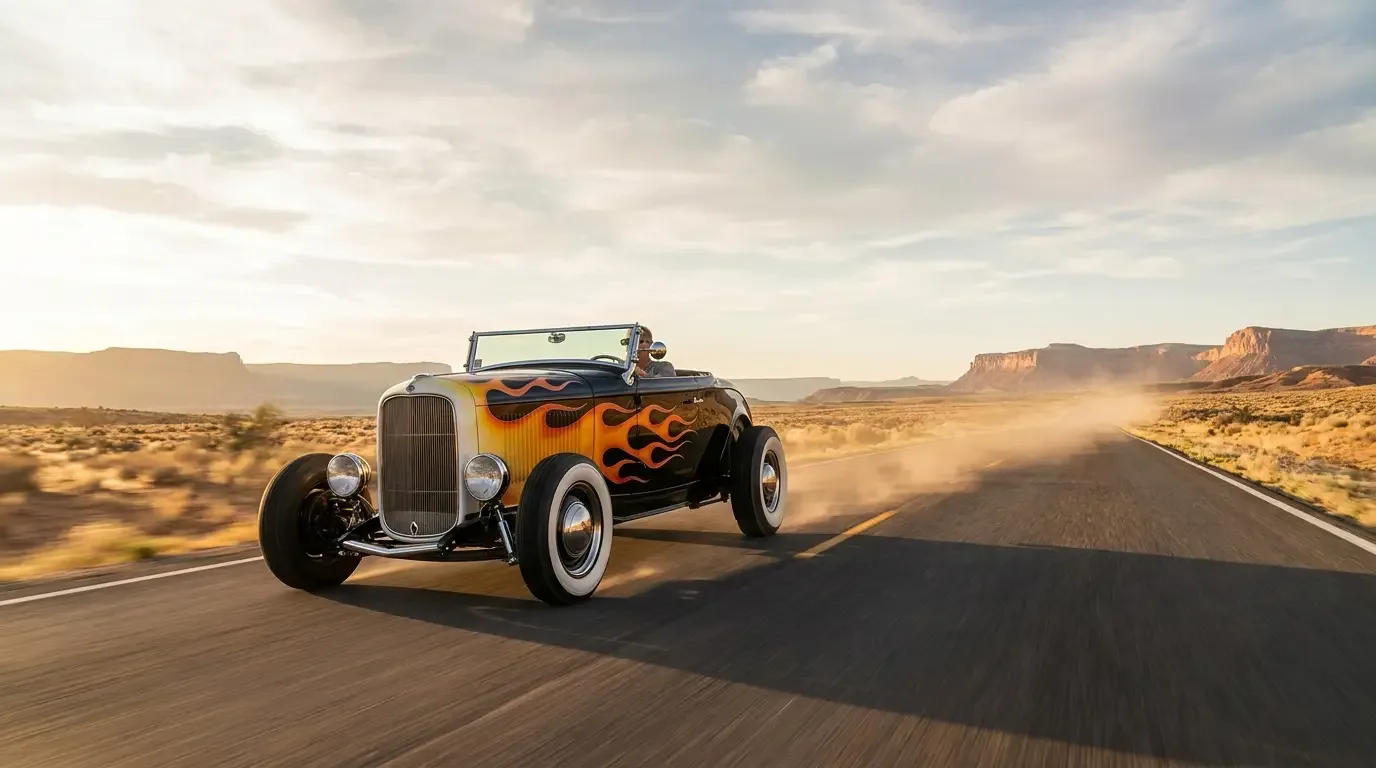
A hot rod is an old American car, usually a pre-1949 body, stripped of dead weight and fitted with more engine than the factory ever intended. That is the whole definition. Everything else, the flames, the chop, the whitewalls, the chrome, is decoration hung on top of a car built to go faster than it left the factory. Take a 1932 Ford, pull the fenders and running boards, drop in a hotter motor, lower the stance, and you have a hot rod. The factory built a family sedan. Somebody in a driveway turned it into something else.
The word "rod" points at the engine. When you "hop up" a flathead you are working on the internals, and old-timers talked about the parts you swapped, the rods among them. The name stuck to the whole car. A hot rod is a hopped-up car, and the hop-up is the point. A cool-looking old Ford that runs a stock motor and never got faster is a period-correct restoration, and there is nothing wrong with that, but it is not a rod. The performance is not optional. It is the definition.
Why pre-1949, though? Because that is where Detroit changed the rules. Cars built before the war and just after it still rode on a separate frame with a body bolted on top, which meant a kid with a torch and a floor jack could pull the body, box the rails, and rework the whole car in a home garage. When the industry moved toward heavier, wider, chrome-laden slabs in the early 1950s, the cars got harder to lighten and less honest in their lines. The classic hot rod body sits in that early window on purpose: a Model A, a 1932 through 1934 Ford, a 1940 coupe. Those shapes were light, cheap, and simple, and they took modification the way clay takes a thumb.
You will find hundreds of these cars listed as classic hot rods for sale at any given time, and the good ones share that DNA no matter the decade they were built in. Strip weight, add power, lower the car, make it yours. If a car does not do those four things it is wearing the costume without doing the job.
The dry lakes and the men who started it
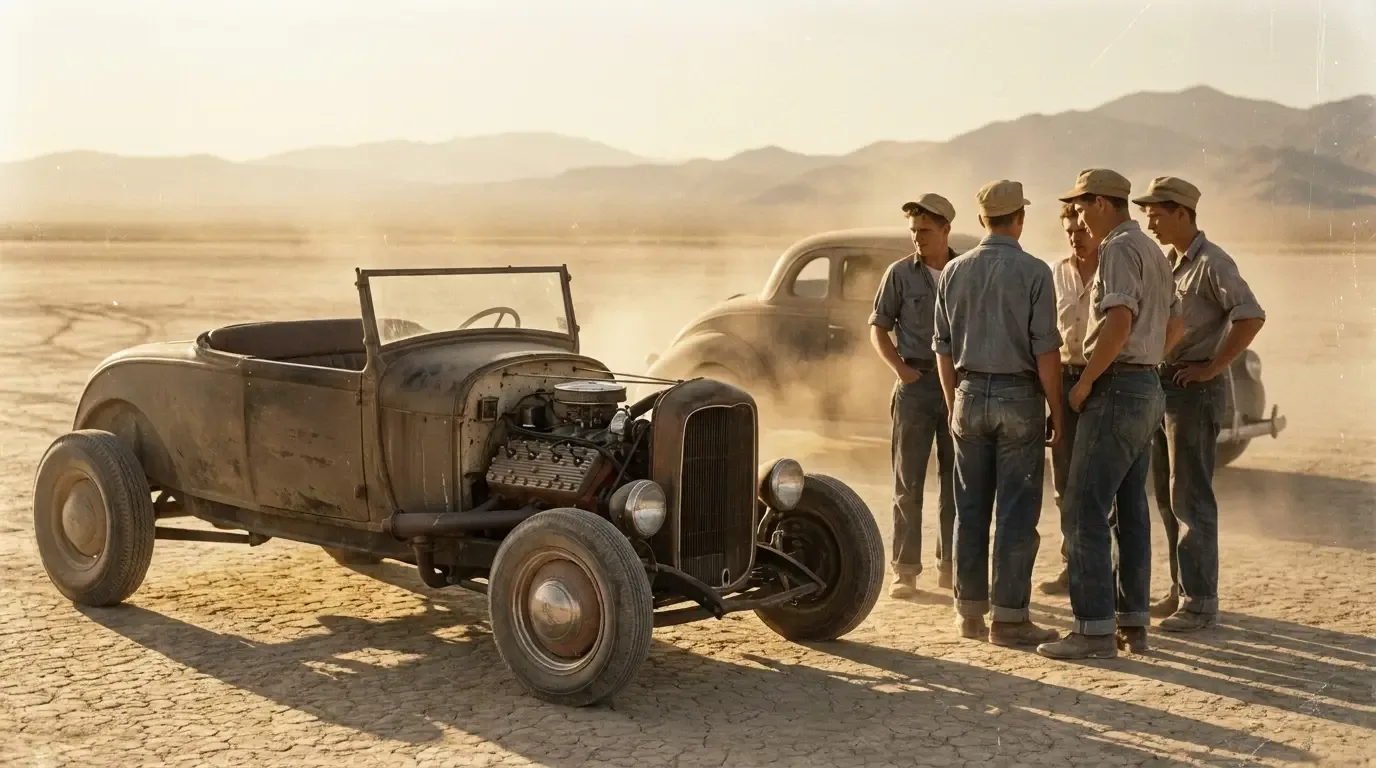
Southern California made the hot rod, and it made it out in the desert. North of Los Angeles the dry lake beds, El Mirage and Muroc chief among them, go flat and hard for miles when the water evaporates. In the 1930s young men hauled stripped-down Fords out there and ran them flat out to see how fast they would go. No fenders, because fenders are weight and drag. No windshield, for the same reason. Just a body, a hopped-up engine, and a straight line long enough to find out the truth.
Those runs were the whole education. You learned that lighter was faster before anybody wrote it in a book. You learned that the flathead Ford V8, introduced in 1932, would take more than Ford ever gave it if you machined the heads, ran better carburetion, and freed up the exhaust. The Southern California Timing Association organized the chaos in 1937 and started keeping records, which meant the bragging finally had numbers behind it. The story of the American hot rod runs straight out of those lake beds, and you can trace the whole culture back through them in the history of hot rodding.
The lakes also bred the parts industry that would later feed the whole hobby. Vic Edelbrock ran his own roadster at Muroc through the late 1930s, and what he learned against a stopwatch went straight into the intake manifolds he sold out of a small Los Angeles shop. Ed Winfield ground camshafts and built carburetors that racers drove across the state to buy. This was research and development done in the dirt, with the desert as the dyno: a part either made the car quicker over a measured mile or it did not, and there was no marketing department to hide behind. That honesty is why so many of those early speed-equipment names outlived their founders.
The cars themselves were spartan to the point of danger: a channeled Model A body on a Deuce frame, a hopped flathead breathing through a pair of carburetors, mechanical brakes that barely deserved the word, and a driver sitting inches off the ground with a leather helmet and a prayer. Speeds crept up year over year as the men learned, and by the end of the 1930s the fastest of them were reaching well past 120 miles per hour on the dry lakes.
Then the war took the whole generation overseas. That pause matters more than people think.
Why the postwar years mattered so much
The men came home in 1945 and 1946 with mechanical training the Army and the aircraft plants had beaten into them, a little money, and a country full of cheap prewar Fords nobody wanted anymore. That combination is the whole reason the hot rod exploded when it did. A returning airman who had rebuilt radial engines under fire was not going to be intimidated by a flathead. He had cash, skill, and a Model A or a Deuce he could buy for pocket change.
What had been a small desert scene before the war became a movement after it. The speed shops that had sold a trickle of parts turned into real businesses. Guys like Vic Edelbrock and Ed Winfield had been building better manifolds and cams for years, and now there was a market big enough to keep them alive. The knowledge that used to pass hand to hand at the lakes started showing up in print. Hot Rod magazine launched in 1948 and put the whole underground on newsstands across the country, which meant a kid in Ohio could learn what the California guys already knew.
The scene needed a home off the desert too, because street racing had turned deadly and the public was fed up with it. In 1951 Wally Parks, then editor of Hot Rod magazine, helped found the National Hot Rod Association to pull the racing off the boulevards and onto sanctioned strips with a starting line, a finish line, and rules. That move gave a reckless pastime a governing body, a safety framework, and a legitimate face. Drag racing grew out of it into a professional sport, but its roots are the same as the roadster on the dry lake: two cars, a straight line, and the question of who is quicker.
Cheap fuel and a postwar economy that put spending money in young hands did the rest. A returning serviceman could pick up a running prewar Ford for well under a hundred dollars, and every dollar he did not spend on the car he spent on the engine. The raw material was lying around for almost nothing, which is why the hobby caught fire.
The car that came to stand for all of it was already fifteen years old by then.
The Deuce coupe and why it became the icon
Nineteen thirty-two Ford. The Deuce. If a hot rod has a single face, that is the one. Ask a builder why and you get real reasons, not nostalgia. Nineteen thirty-two is the first year Ford put the V8 in an affordable car, so the Deuce came from the factory with the engine the hot rodders wanted. The body has proportions that just work, the grille shell has a shape people never stopped loving, and because Ford built a lot of them there were enough survivors to go around.
The three-window and five-window coupes are the classics, but the roadster is the purest form. Chop the top a few inches, lose the fenders, sit it low, and a Deuce roadster looks fast standing still. It has been the template for seventy years. When ZZ Top put a little red 1933-based coupe on album covers and MTV in the 1980s, they were selling an image that had already been burned into the American brain for decades. The Deuce is to hot rods what the Les Paul is to rock guitar. Other cars work. This one is the archetype.
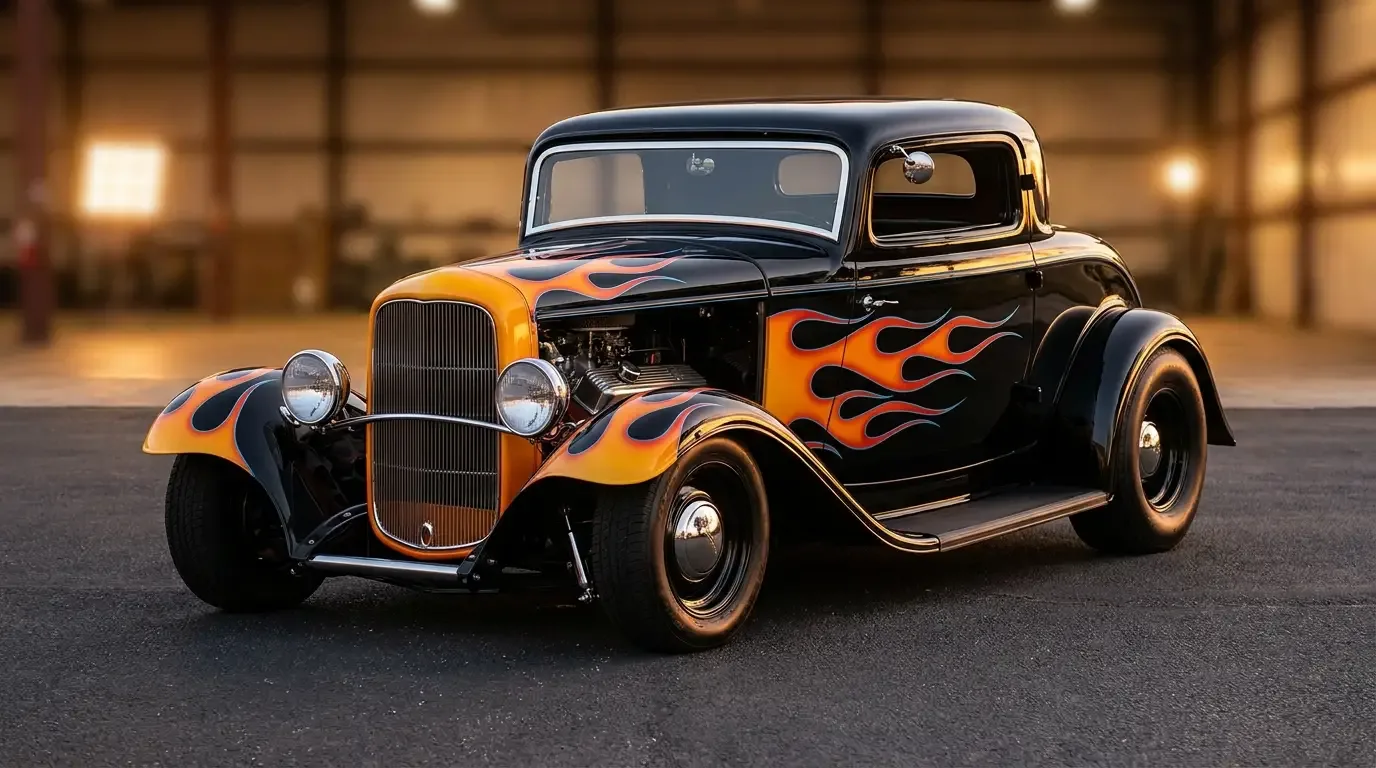
The highboy is where the Deuce reaches its purest expression, and the term is worth knowing because builders live and die by it. A highboy is a Deuce with the fenders removed and the body left sitting up on top of the frame rails, so the frame shows and the car stands tall, the opposite of the channeled car that drops down over the rails. A highboy roadster on a dropped front axle, big-and-little tires, and a chromed grille shell is the shape most people picture when they think hot rod, even if they could not name it. The look was cemented in 1955 when Tom McMullen laid flames down the flanks of his Deuce highboy and put it in the magazines, and rodders have copied that car ever since.
Popular culture kept feeding the legend. In 1973 the film American Graffiti put a chopped, primered 1932 five-window coupe on screens across the country, and a generation that had missed the dry lakes fell for the shape all over again.
"People think the Deuce is famous because it is pretty. It is famous because it is right. Correct proportions, the first good V8, and enough of them survived that a working guy could actually get one. Beauty is what you notice second."
Jim Vasquez
How you actually build one: the chop, the channel, the hopped-up flathead
Real hot rodding is bodywork and machining, not shopping. The moves have names because they are craft, and a few of them define the whole discipline.
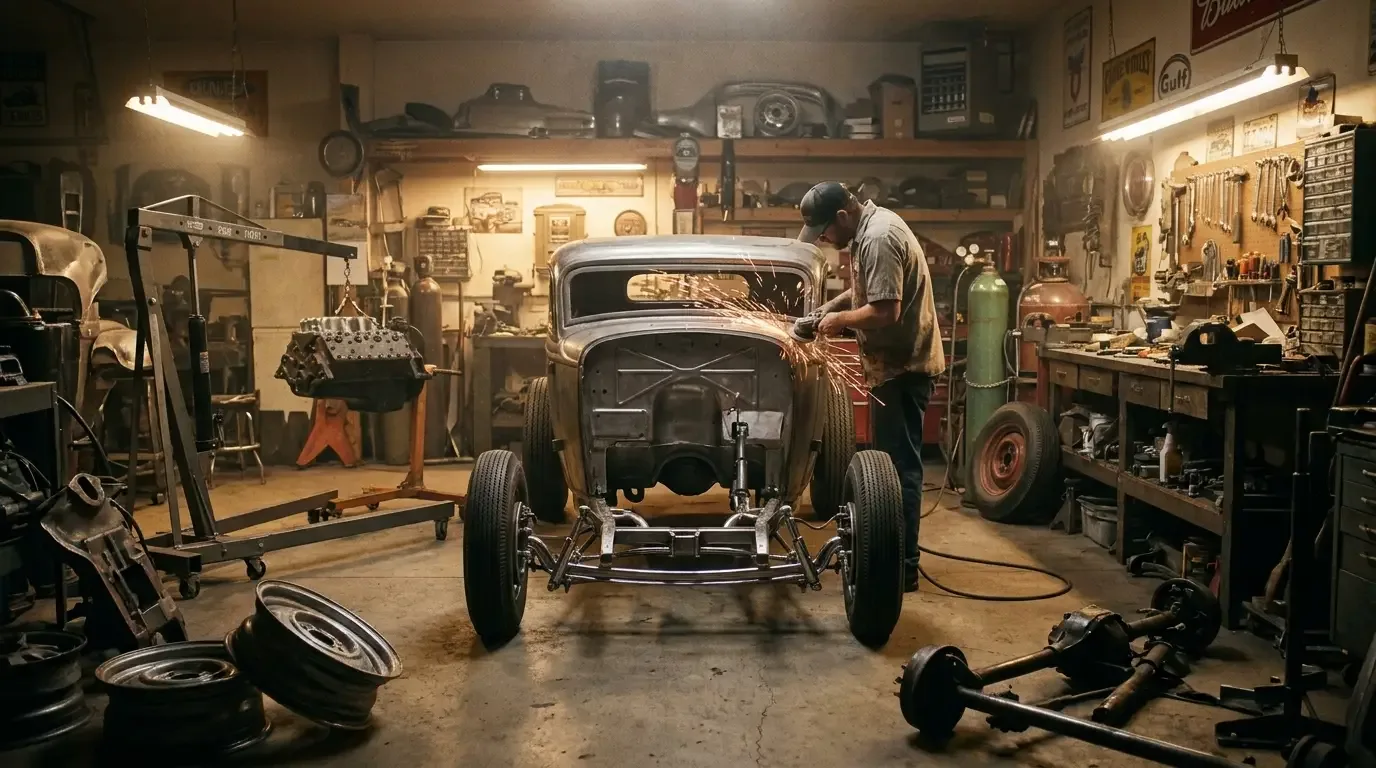
The chop is the top. You cut the pillars, drop the roof a few inches, and reweld everything so the greenhouse sits lower. Done right, a chop transforms a car, tightens the whole profile and turns an upright coupe into something menacing. Done wrong it looks like a mistake, and the difference is all in how the glass, the posts, and the drip rails get reworked to hide the surgery. It is the hardest common cut to pull off, which is exactly why builders judge each other on it.
Channeling drops the body over the frame. Instead of cutting the roof you cut the floor, lift the body, and reset it so it sits down around the chassis rails rather than perched on top of them. The car gets lower without touching the roofline. Nose and deck means shaving the hood and trunk emblems and handles for a smooth, clean look. Lead work, the old-timers filling seams with molten lead and filing it flush, is where "leadsled" comes from. And underneath it all sits the engine, because none of the bodywork means anything if the car cannot get out of its own way.
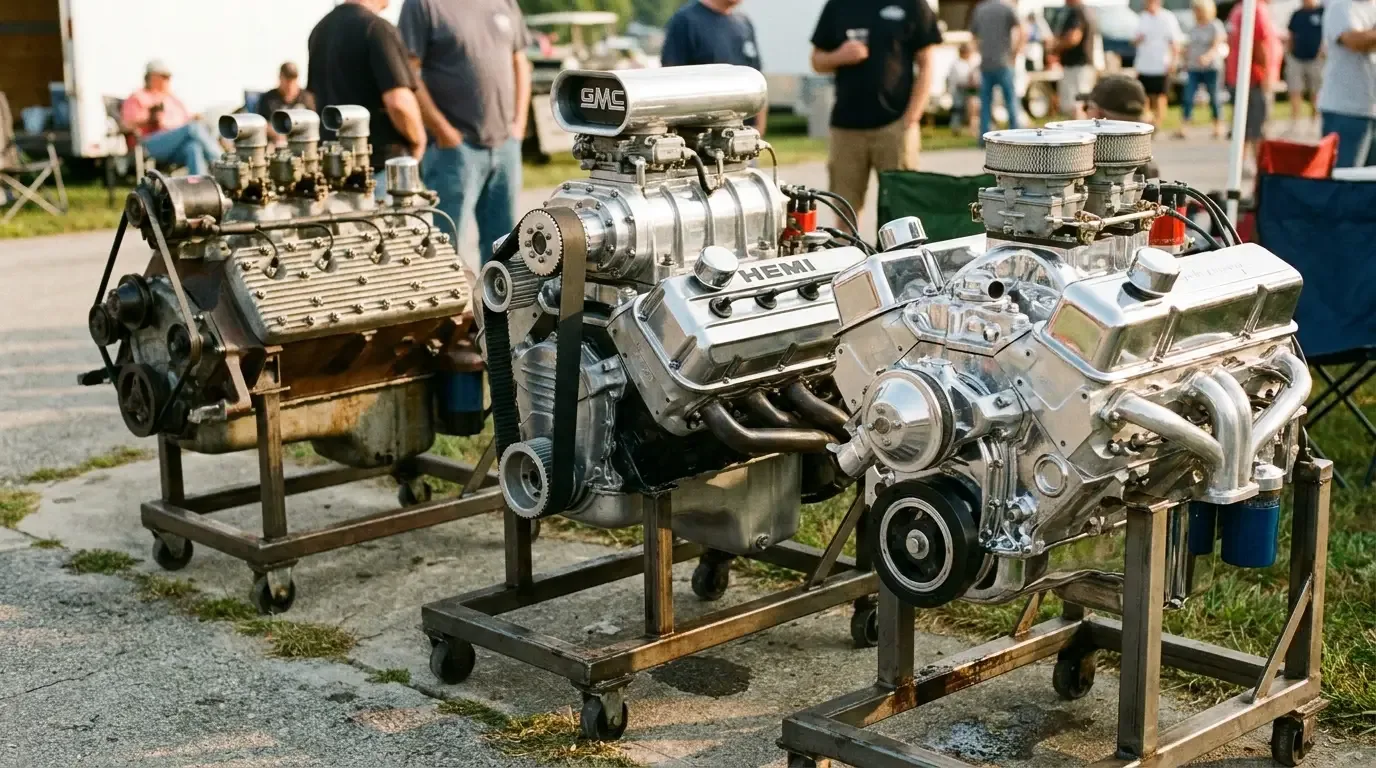
The flathead Ford V8 is the traditional heart. Stock it made modest power, but the aftermarket learned to wake it up: high-compression aluminum heads, multiple carburetors on a better intake, a hotter camshaft, and headers to let it breathe. A well-built flathead is not fast by modern standards, but it is period-correct and it sounds like history. When small-block Chevrolet arrived in 1955 it made more power for less money and less fuss, and a lot of rodders swapped to it, which is why "traditional flathead" versus "small-block swap" is still an argument at every show.
The flathead to small-block shift, and why it split the hobby
The biggest decision the hobby ever made was whether to stay loyal to the flathead or move on. For twenty years the flathead Ford V8 was the only game that made sense: cheap, everywhere, and understood down to the last trick. But it had hard limits. The valves sat in the block instead of the head, which choked the way it breathed, and it ran hot no matter what you did, because the exhaust snaked through the block and cooked the water jackets on its way out. You could spend a fortune making a flathead fast and still lose to a stock modern engine.
Then Chevrolet dropped the small-block V8 in 1955, and the ground moved. Here was a lightweight, overhead-valve V8 that made more power out of the crate than a heavily built flathead made after months of work, and it cost less to keep alive. A rodder could pull a tired flathead, bolt in a 265 or later a 283 Chevy, and pick up a huge jump in power in a weekend. The swap became so common it was simply the default answer to "what should I put in it."
That is where the family first split, and the argument has never fully healed. To the traditionalist, a Chevy small-block in a Ford is heresy dressed up as progress: the car loses the period-correct heartbeat that made it what it was. To the pragmatist, the flathead is a museum piece that overheats in traffic and leaves you on the shoulder. Both sides are right, which is exactly why the fight goes on. A well-sorted flathead is history you can hear. A small-block is history you can drive across three states without a tow truck.
"I have built both, and here is the truth. The flathead is the soul of the thing and the small-block is the sense of it. A young guy asks me which to run and I ask him one question back: are you building a time machine or a road car? Answer that honest and the engine picks itself."
Jim Vasquez
The look: flames, rake, chrome and the language of the paint
Hot rod styling is a vocabulary, and once you can read it the cars start talking. Rake is the stance, nose down and tail slightly up, the posture of a car leaning into a launch even at the curb. Get the rake wrong and the whole car looks off no matter how good the paint is.
Flames are the signature. Traditional flames lick back from the nose in hand-laid layers, and a good painter blends the colors so the fire looks like it is moving. Pinstriping, the thin hand-brushed lines that Von Dutch turned into an art form in the 1950s, edges panels and dashboards with a steadiness no tape can fake. Then came the wild candy and metalflake paints, the deep translucent colors laid over a bright base so the whole car seems lit from inside. Chrome and polished aluminum do the rest, dressing the engine bay and the trim so the car reads as jewelry as much as machine.
None of this is random. Every choice, the height of the rake, the reach of the flames, the width of the whitewall, signals what the builder was going for and which era he was saluting. A traditionalist and a show builder can use the same techniques and end up with completely different statements.
The culture: kustom kulture, the shows, and the people
The cars built a culture, and the culture kept the cars alive. "Kustom kulture," spelled with the K's on purpose, is the whole world of custom cars, the art, the music, and the attitude that grew up around them in postwar California. The builders became famous names. George Barris built cars for Hollywood and turned customizing into a brand. Ed "Big Daddy" Roth built wild show rods and drew the monster cartoons that ended up on a million T-shirts. Von Dutch turned pinstriping into a signature. These men made hot rodding into an art movement whether the art world noticed or not.
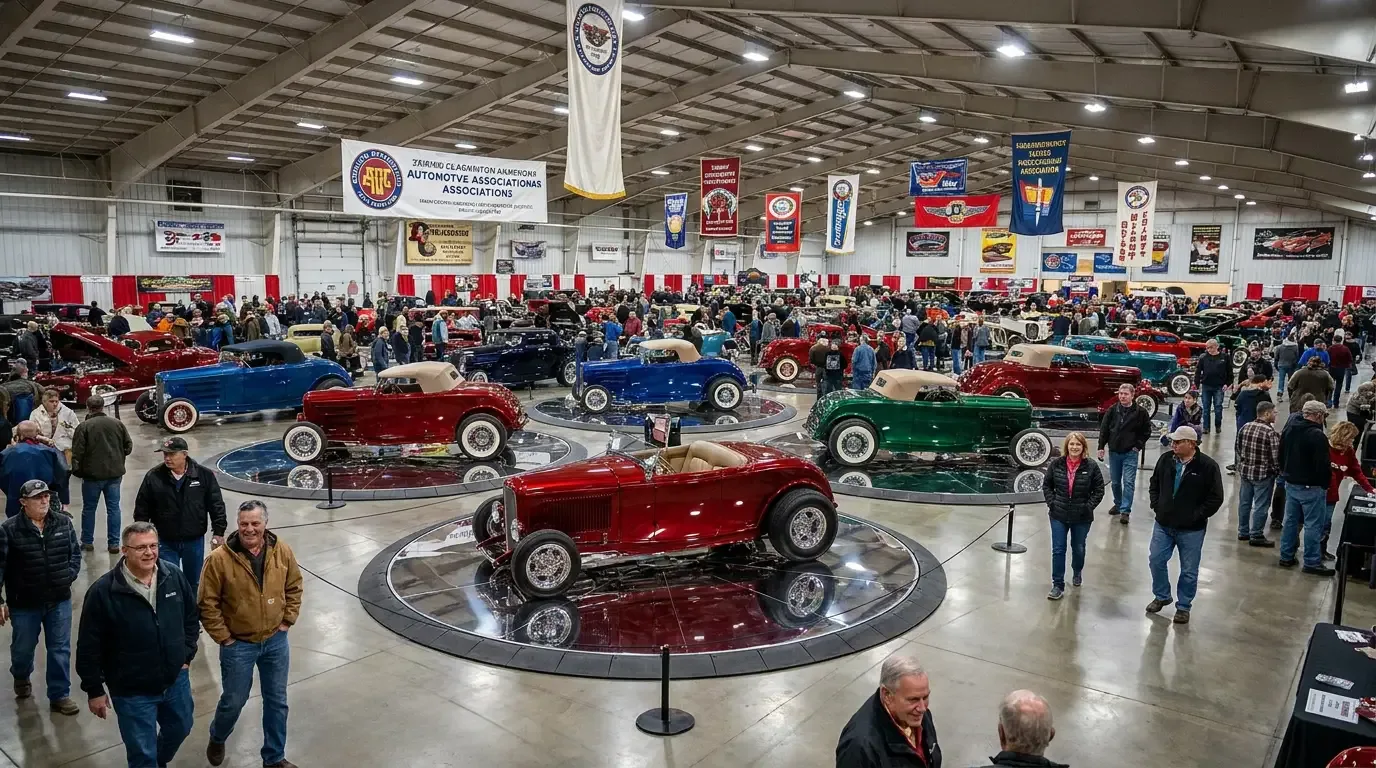
The scene lives at the shows. The Grand National Roadster Show, running since 1950, hands out the America's Most Beautiful Roadster trophy, a nine-foot prize that builders spend years chasing. Winning it is career-defining; a serious contender might spend two or three years and a small fortune on a single car with no guarantee the judges will nod. Judges crawl under the car with mirrors and lights, because at that level the underside has to be as perfect as the paint.
The speed side never died either. The Bonneville Salt Flats keep the racing tradition alive, where the same stripped-down philosophy that started at the dry lakes still chases records every August at Speed Week, a pilgrimage that draws rodders from around the world. And below the trophy chase lives the real heartbeat of the hobby: the local car clubs, the weekend cruise-ins, the swap meets where a guy sells a rare set of finned heads out of his trunk. Reputations are made at the big shows, but the culture actually lives in ten thousand small garages.
Over the last few decades a whole revival of traditional, period-correct building has pushed back against billet-and-fiberglass excess, insisting that a hot rod should look like it could have rolled out of 1955, right down to the wide whitewalls and the era-correct paint. The revival brought back flatheads, dropped axles, and honest steel, and turned a younger generation on to building the way the old-timers did. If you want the full picture of the shows, the clubs, and the world these cars built, it is all in hot rod culture.
"The car gets you in the door. The people are why you stay. I have friends I have known forty years because we were both under a Deuce at two in the morning trying to make a deadline for the same show."
Jim Vasquez
Traditional versus modern, and where the family splits
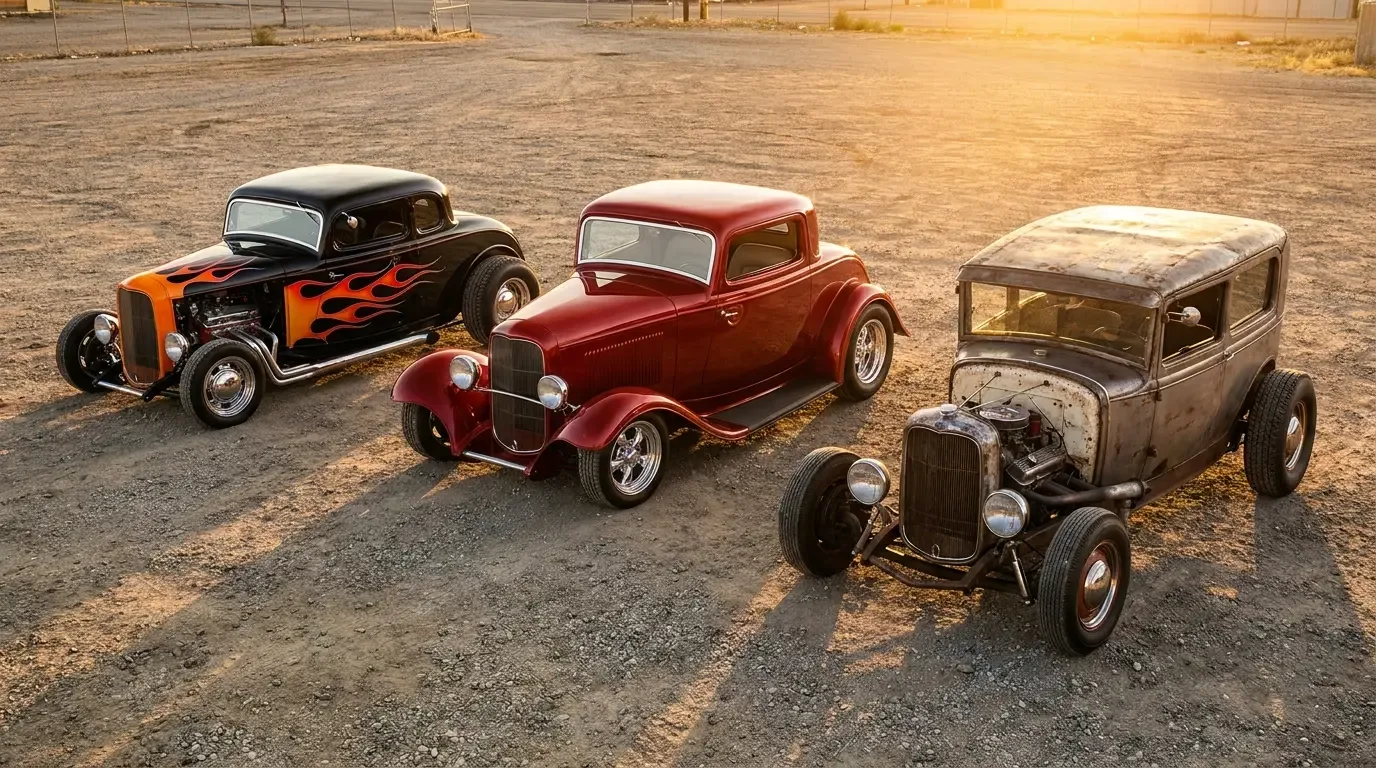
Not every old custom is a hot rod, and the distinctions matter to the people who build them. A traditional hot rod is period-correct, built with the parts and techniques that would have existed in a given era, flathead or early small-block, drum brakes, honest patina or lacquer paint. A modern street rod takes the same body style but fills it with current technology: a crate engine, an automatic overdrive, air conditioning, disc brakes, and a stereo. It is built to drive across the country in comfort, and purists sniff at it while its owners drive right past them.
Then there is the rat rod, deliberately unfinished, rust left showing, built cheap and mean as a reaction against the checkbook show cars. The full breakdown of where the lines fall is worth reading, because the terms get thrown around loosely and they are not interchangeable. The differences between a hot rod, street rod and rat rod come down to intent, era, and money more than they come down to any single part.
| Type | Era / build ethos | Typical engine | Built to |
|---|---|---|---|
| Traditional hot rod | Period-correct, pre-1965 techniques | Flathead or early small-block V8 | Look and run like it was built in its era |
| Street rod | Modern, comfort-focused | Crate V8, overdrive automatic | Drive far in air-conditioned comfort |
| Rat rod | Anti-show, low-buck | Whatever runs, often a small-block | Look raw, cost little, make a statement |
| Kustom / leadsled | 1950s smooth-body style | Flathead or period V8 | Show its bodywork and paint |
Why the hot rod endures
The hot rod has outlasted the flathead, the dry lakes, and most of the men who invented it, and it keeps pulling in people who were not born when the last Deuce rolled off the line. Part of it is the shape, because a chopped roadster sitting on its rake still stops traffic. Part of it is the sound. But most of it is the idea underneath, that you can take something ordinary, an old family Ford, and with your own hands and your own taste turn it into something faster and meaner and entirely yours.
That is a very American idea, and it does not age. The tools change and the engines change, but a teenager building his first car in a garage today is doing exactly what a returning airman did in 1946 and what a kid at the dry lakes did in 1938. Strip the weight. Add the power. Get it low. Make it yours. As long as people want to do that, the hot rod is not going anywhere.
Sources and notes
- Period hot-rod press and early enthusiast magazine archives covering dry-lakes racing, postwar speed shops, and the rise of the small-block swap.
- Flathead Ford V8 and early small-block Chevrolet engine references for the hop-up and swap history.
- Grand National Roadster Show and Bonneville / dry-lakes timing-association records for show and speed history.
- Kustom kulture histories and builder interviews (Barris, Roth, Von Dutch and the traditional revival) for the cultural and styling context.
Related Reading
Article
Hot Rod, Street Rod, Rat Rod: What's the Difference
Article
The History of the American Hot Rod
Article
How a Hot Rod Is Built: The Techniques
Article
Hot Rod Engines: Flathead to Small-Block
Article
Hot Rod Style: Flames, Paint and Stance
Article
Hot Rod Culture and Shows
External
/hot-rods-for-sale
Have a
Classic Car
for Sale?
Reach thousands of serious classic car collectors across the US.
Sell It Here →
Are You a Classic Car Dealer?
List your full inventory and connect with targeted classic car buyers.
Join as a Dealer →

About the author
Jim Vasquez
Southern California hot rod and custom car builder with roots in the traditional kustom kulture scene.




Comments (1)
V
Vince Calabrese
2 months ago
My neighbor has run one of these as a driver for eleven years. No trailering, no shows, just enjoying the car. That perspective doesn't get enough coverage.