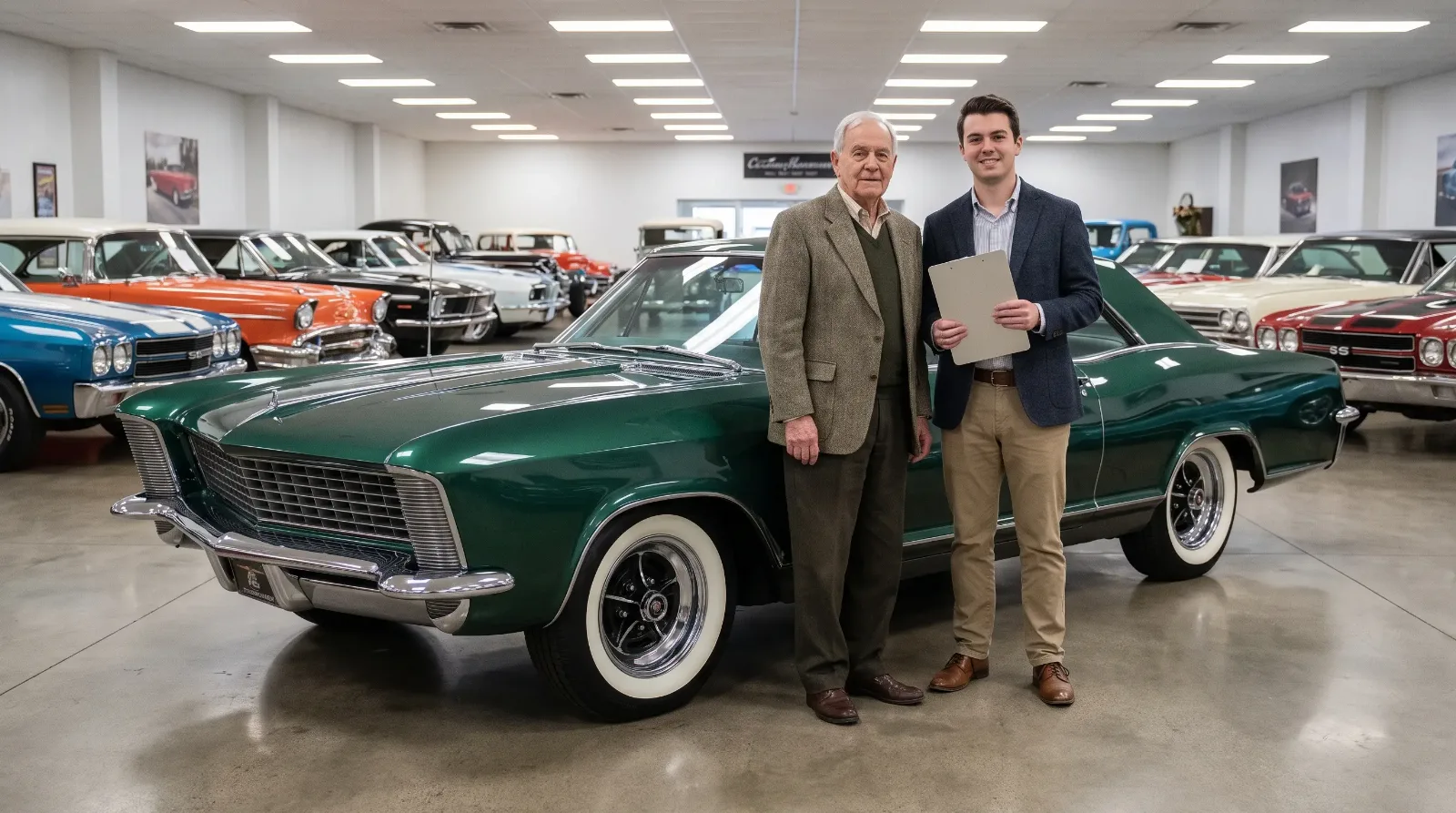
Take an owner with a classic worth around $40,000. A clean, driver-grade car with decent paperwork and nothing exotic about it. Three ways to turn it into money are on the table: sell it privately, send it to auction, or hand it to a dealer through classic car consignment. The private sale costs the least on paper and the most in time. The auction is fast and public, and the hammer price is whatever two motivated bidders decide on one afternoon. Consignment sits between the two, and the question most owners ask first is the wrong one. They ask what the commission costs. The better question is what the commission buys.
On a $40,000 car, a 5% fee is $2,000 and a 10% fee is $4,000. That money either pays for real exposure, buyer screening and a clean transfer of funds, or it pays for a car to sit in a showroom corner for four months while the asking price goes stale. The contract decides which. This guide covers how consignment is structured in 2026, what it costs in practice, how it compares with the alternatives, and how to tell a consignment dealer worth trusting from one that simply has floor space.
How classic car consignment works
In a consignment sale, you keep ownership of the car and the dealer acts as your selling agent. The dealer markets the car, fields inquiries, qualifies buyers, negotiates within limits you set, and handles the paperwork at closing. When the car sells, the dealer deducts its fee and pays you the balance. Title never passes to the dealer. That point matters more than any other line in the arrangement, because it determines what happens to you if the dealer runs into financial trouble while your car is in its care.
There are two working models. Showroom consignment is the traditional one. You deliver the car to the dealer's premises, it goes on the floor next to the dealer's own inventory, and buyers see it in person. The advantage is foot traffic and the credibility of a physical location. The cost is that the car leaves your control, picks up miles being moved around the lot, and may carry storage or detailing charges on top of the commission.
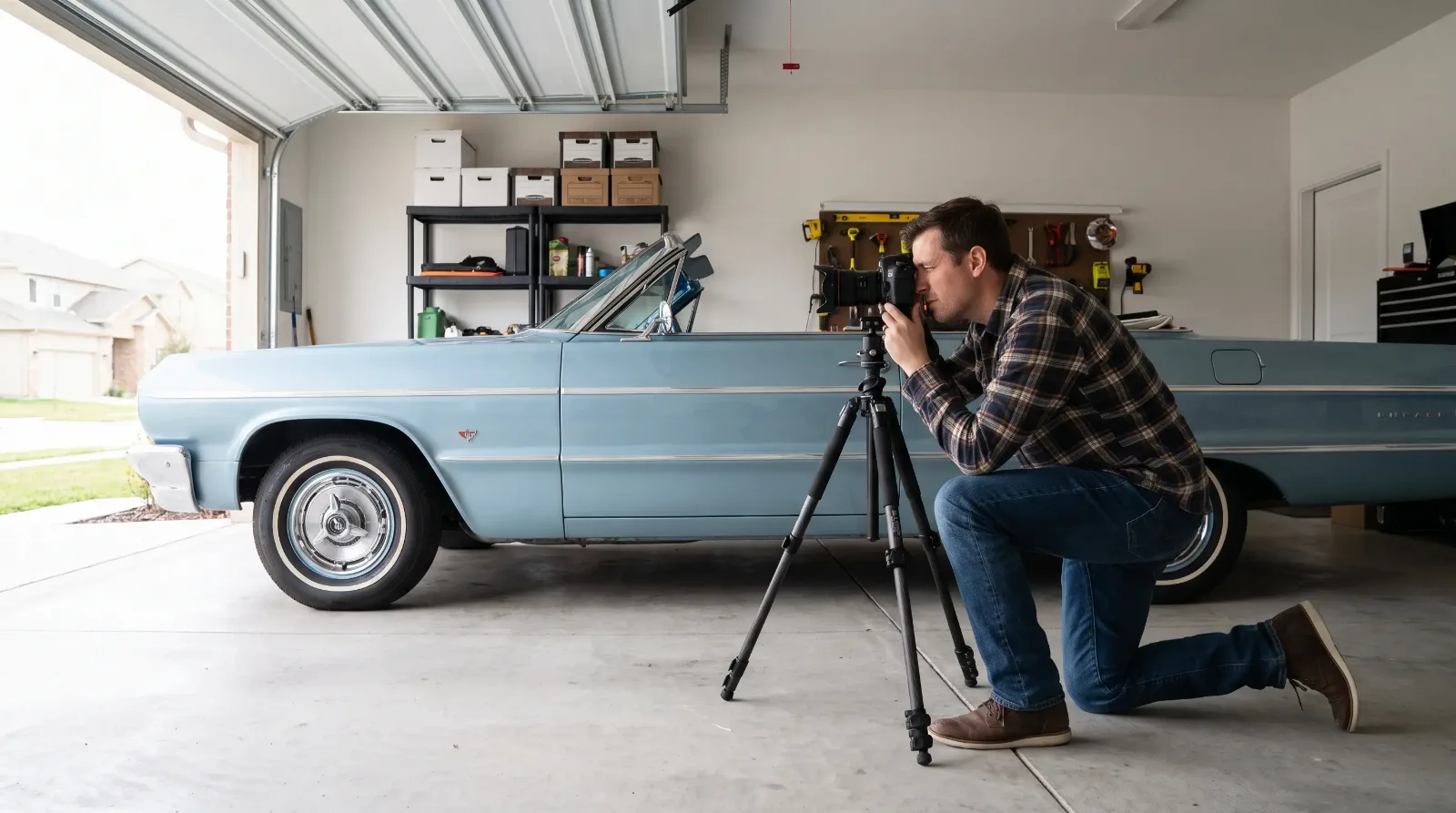
Remote consignment keeps the car in your garage. The dealer photographs it or has you supply photos, writes and distributes the listing, screens the calls, and arranges showings by appointment. When a buyer commits, the dealer handles the deposit, the balance and the payout. Classic Car Deals, based in Cadillac, Michigan, runs this model nationwide: the car stays with the seller until it sells, the seller sets the price, and buyer funds pass through the company, which then pays the seller. WeBe Autos in Riverhead, on Long Island, describes itself as a marketing agent rather than a dealer and works the same way. The car remains the seller's property and is shown by appointment.
Remote consignment is cheaper because the dealer carries no floor cost for your car. It also shifts work back to you. You are the one opening the garage on a Saturday morning for a buyer who may or may not be serious, and the car's presentation on that day is your responsibility, not the dealer's. A car that photographs as a solid #2 and shows up dusty with a weak battery will be negotiated as something less.
What consignment costs
Consignment pricing comes in a handful of structures, and the headline percentage rarely tells the whole story. A low commission with a monthly storage charge can cost more than a higher commission with no extras once the car has sat for 90 days. Read any fee schedule as a total cost at three points: if the car sells in 30 days, if it sells in 90 days, and if it does not sell at all.
| Fee structure | How it works | Published example or typical figure | What to watch |
|---|---|---|---|
| Percentage with reserve | Seller pays a share of the sale price; the car cannot sell below your written floor | Barrett-Jackson auction consignment: 10% of the hammer price with a reserve, plus an entry fee | A reserve set above the comps leaves the car sitting |
| Percentage, no reserve | Lower rate in exchange for accepting what the market offers | Barrett-Jackson: 8% of the hammer price with no reserve | Full exposure to a soft-market sale price |
| Net price, dealer markup | You name the figure you want; the dealer earns whatever the car sells for above it | Classic Car Deals: free to the seller, with the commission made when the car sells above your price | A markup that pushes the asking price above the comps and slows the sale |
| Percentage, success only | Fee owed only if the agent produces the buyer and the sale closes | WeBe Autos: 5% of the final price, $500 minimum, free to list. A Touch of Classics: 5% after the seller is paid | Exclusivity terms that apply the fee to a buyer you found yourself |
| Flat fee | Fixed dollar amount regardless of sale price | Classic Cars West: $3,000 flat on cars under $30,000 | Whether any part is paid upfront or non-refundable |
| Listing fee plus commission | Upfront marketing charge, smaller cut at the sale | Classic Cars Las Vegas lists a $350 initiation fee plus 8% to 12%. Fantasy Junction charges $1,000 on arrival plus a sliding commission | The listing fee is gone if the car does not sell |
| Showroom percentage | Higher share covering floor space, staff and walk-in traffic | Published rates we found run from about 7% to 15%, sliding down as the price rises | Storage, prep and transport billed on top |
| Extras: storage, detailing, photography | Charged per service or per month | WeBe Autos photo and HD video: $150 if you bring the car in, $200 if they travel, free if you supply 30 to 100 photos. Showroom monthly fees: $150 at Classic Cars Las Vegas, $250 at Fantasy Junction after the first three months | Charges that keep accruing while the car is unsold |
The published remote-consignment rates cluster around 5%. A Touch of Classics, a broker in Midlothian, Texas, says it charges nothing upfront and takes a 5% commission only after the car sells and the seller has been paid. WeBe Autos lists 5% of the final sale price with a $500 minimum, owed only if it produces the sale. Classic Car Deals takes a different route: its consignment page says the program costs the seller nothing, and the company makes its commission when the car sells above the seller's price. Its separate online auction program has listed seller fees of 5% with a reserve and 3% without.
On the $40,000 example, those rates come to $2,000 at 5% and $1,200 at 3%. A showroom dealer at 10%, a rate that Classic Cars West and Classic Cars Las Vegas both publish for a car at this price, would take $4,000 before any storage or prep charges. The gap is real money, but it is not automatically the wrong side of the trade. A showroom with steady walk-in buyers for your type of car may sell it faster and closer to the asking price, and a faster sale at a better number can more than cover the difference. The fee only looks expensive when the exposure it buys is thin.
Minimums deserve attention on cheaper cars. On a $6,000 car, a $500 minimum is an effective rate above 8%. Minimum fees are reasonable, since the work involved in selling a cheap car is not much smaller than the work involved in selling an expensive one, but they change the math at the low end of the market.
Consignment vs auction vs private sale
None of the three routes is the cheapest in every case. Each trades cost against time, effort and certainty in a different proportion, and the right choice depends on which of those you are short on. The table below compares them on the factors that move the net figure that reaches your bank account.
| Factor | Consignment | Auction | Private sale |
|---|---|---|---|
| Timeline | In our experience, often one to four months, depending on price and demand | Fixed sale date; consign weeks ahead. Barrett-Jackson mails proceeds 21 banking days after the sale | Open-ended, from days to many months |
| Seller cost | Roughly 5% to 15% of the sale price, plus possible extras; some programs charge nothing directly and build their margin into the price | Live auctions charge a seller commission plus an entry fee (Barrett-Jackson: 8% to 10%; Mecum entry fees start at $350). Online platforms often charge sellers a modest listing fee and collect mainly from the buyer (Bring a Trailer: $99 to list) | Advertising and your time; no commission |
| Seller effort | Low at a showroom, moderate with remote consignment | Low once the car is consigned and delivered | High: listing, calls, showings, payment and title |
| Price outcome | Negotiated within your reserve; often close to retail | Set by bidders on the day; can beat retail or fall well short | Full retail is possible if you hold out for the right buyer |
| Main risk | Contract terms, dealer solvency, car sitting unsold | A public no-sale, or a low result with no reserve | Fraud, time-wasters, payment risk, safety at showings |
The private route keeps the most money on paper. It also puts every risk on you: screening buyers, verifying funds, managing test drives and handling the title transfer. Plenty of owners do this well. If you are comfortable with that work, you can list your classic yourself and keep the commission. Be aware that the common scams in this market, such as overpayment checks, fake escrow services and shipping-agent schemes, are aimed at private sellers precisely because nobody professional stands between the seller and the buyer.
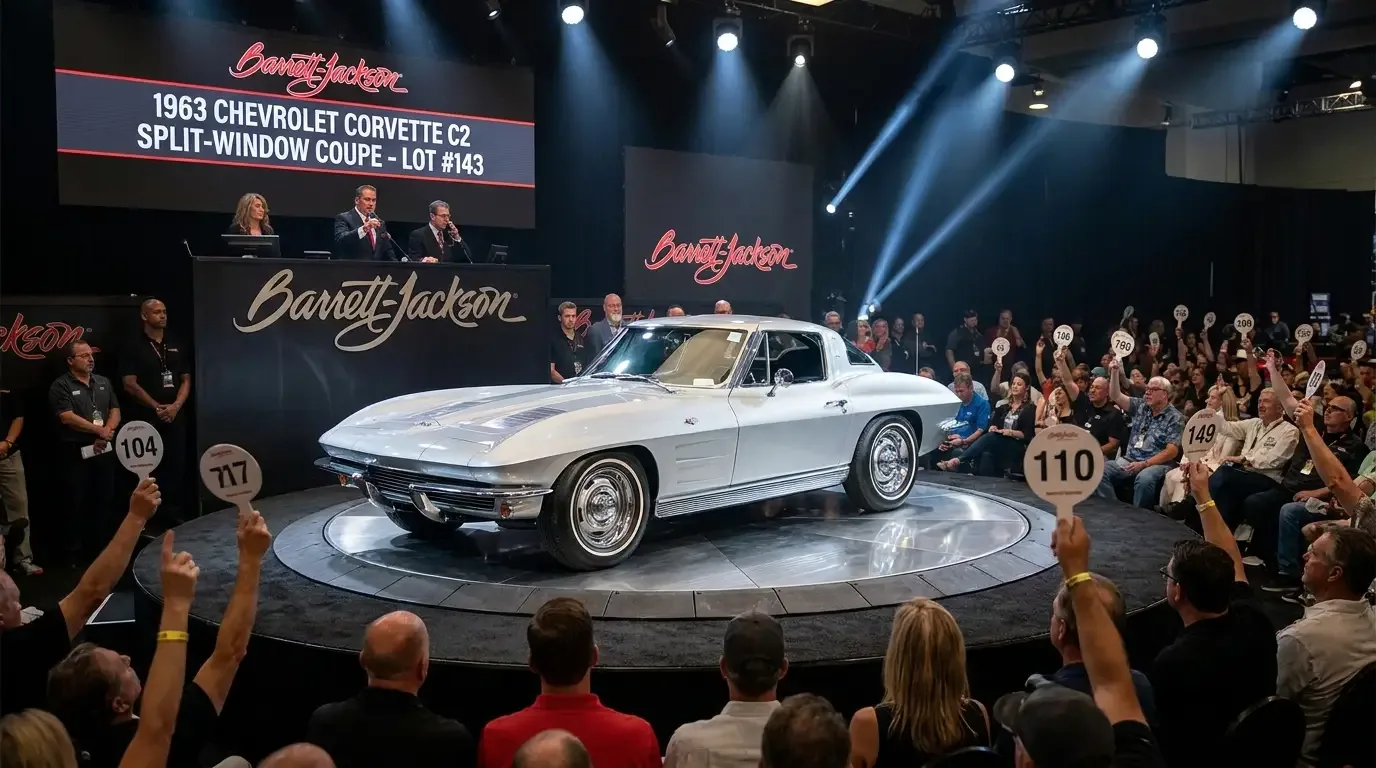
Auctions answer a different question: what will the market pay this week. That certainty has value for estates, for owners who need liquidity on a known date, and for cars with deep bidder pools. It carries a specific downside. A car that fails to meet its reserve becomes a public no-sale, and the next buyer knows it. For buyers, weighing an auction versus a private sale involves the mirror image of the seller's trade-off: speed and competition on one side, time and negotiation on the other. Consignment is where you land when you want a professional handling the sale but do not want your price decided in a single afternoon.
What to check in a consignment agreement
The consignment agreement is where the real cost and the real risk sit. Two dealers quoting the same percentage can hand you very different contracts, and the differences only surface when something goes wrong: the car does not sell, you get an outside offer, or the dealer closes its doors. Read every clause below before you sign, and get any verbal promise added in writing.
The funds clause carries the most downside. When a dealer collects the buyer's money into its general account and then pays you, you are an unsecured creditor for the days or weeks in between. If the business fails in that window, the car is gone and the money is tied up in someone else's insolvency. A dealer that runs buyer funds through a separate trust or escrow account, and pays out on a stated timeline, removes most of that exposure. Ask how many days pass between the buyer's payment clearing and your payout. A specific number is a good sign. A vague answer is not.
Insurance comes second. Many collector car policies limit or exclude coverage once the car is in a dealer's custody, and some dealer garage policies cover the dealer's own inventory but not consigned cars. Call your insurer before the car leaves your garage. With remote consignment the open question is test drives: who is allowed to drive, who rides along, and under whose policy any damage is paid.
The early-termination clause is the one owners skip, and it is the one that turns a slow sale into a costly one. A penalty calculated as a percentage of the asking price means that an optimistic asking price, often the dealer's suggestion, raises the cost of walking away. Negotiate it down or out before signing, especially on a longer term.
Pricing and how long a sale takes
The asking price decides how long a car sits more than any other factor. A consignment dealer has a structural incentive to accept a high asking price at signing, because it wins the consignment, and then to suggest reductions a month later. Arrive with your own number and the evidence behind it.
That evidence starts with comparable sales: completed transactions, not asking prices, for the same model in similar specification and condition, ideally within the last 12 to 18 months. Condition tier moves value more than most owners expect. Hagerty's price guide rates cars from #1 (concours) to #4 (fair), with #2 meaning excellent and #3 meaning good, and values each tier separately. A car presented as a #2 that inspects as a #3 will be priced by the buyer as a #3, and in our experience the gap between those tiers on a $40,000 car can run roughly $8,000 to $12,000. Be honest about which tier your car sits in before a buyer's inspector decides for you. Checking what your car is worth against recent comps gives you a defensible starting figure before you sit down with any dealer.
Documentation is the third input, and the one owners most often undervalue. Service records, receipts for major work, original sales paperwork, ownership history and photos of any restoration all convert into price because they reduce the buyer's risk. A thin file costs money at the negotiating table, and it costs more on a car whose value depends on originality. Assemble the file before the car is listed, not after a buyer asks for it.
On timing, in our experience a correctly priced driver-quality car in a popular segment often sells within one to three months on consignment. Niche cars, very expensive cars and anything priced above the comps can take far longer. If there are no serious inquiries in the first three to four weeks, the price is the likely problem, not the marketing. Seasonality also plays a part. Spring and early summer bring more buyers into the market across most of the country, and a convertible listed in December asks more of its price than the same car listed in April.
How to choose a consignment dealer you can trust
Consignment has a low barrier to entry. Anyone with a website and a decent camera can call themselves a consignment specialist. The checks below separate dealers who sell cars for a living from those who mainly collect listings.
Start with the sales record. Ask for a list of cars the dealer has sold in the past year in your price range and segment, with sale prices if they will share them. A dealer that takes in many consignments and sells few of them is renting you a parking space. Ask what share of consigned cars actually sell within the contract term. Few dealers have that number ready, and the ones that do tend to be the ones worth hiring.
Then check the business itself. Confirm that the dealer holds a license where your state requires one for consignment sales. California, for example, treats anyone in the business of selling consigned vehicles as a dealer, requires a written consignment agreement and expects the owner to be paid within 20 days of the sale. Look up its business registration and complaint history, and read reviews from sellers specifically rather than buyers. Search the company name alongside words like "unpaid" or "lawsuit." When you browse classic car dealers near you, study how their current listings are written and photographed. That is exactly how your car will be presented to buyers.
Red flags worth walking away from:
- Large upfront fees with no clear link to a specific service.
- Pressure to sign the same day, or to sign over the title before a buyer exists.
- Buyer funds paid into the dealer's operating account with no stated payout timeline.
- An asking price far above your comps, offered without evidence.
- No written answer on insurance coverage while the car is in their care.
- Reluctance to put you in touch with past consignors.
It also helps to think like the person on the other side of the deal. A buyer looking at a consigned car is asking the same questions about the same dealer: does it disclose condition honestly, does it allow independent inspections, how does it handle deposits. The process of buying from a classic car dealer rewards transparency, and dealers who run a clean process for buyers tend to run one for sellers too. A dealer that resists a buyer's pre-purchase inspection will cost you sales, because the serious buyers will leave and the ones who stay will discount for the uncertainty.
When consignment is the wrong choice
Consignment is not the default answer, and some cars and situations are better served elsewhere. If you need money by a known date, an auction with a fixed sale day is more predictable. If the car is a recognized blue-chip model with a deep bidder pool, competitive bidding may outperform a negotiated sale. If the car is worth less than roughly $10,000, minimum and flat fees take a large share of the proceeds: a $3,000 flat fee on a $10,000 sale is 30%. A private sale usually makes more sense.
Consignment also fails cars with unresolved problems. A title issue, an undisclosed accident history, a non-running engine or a condition well below the asking price will not be fixed by better marketing. The car will sit, accumulate fees and come home with a stale listing history attached to it. Fix the problem or price it in first. And if you already have a likely buyer, a club member or a friend who has wanted the car for years, paying a commission to formalize a deal you could close yourself makes little sense.
"A consignment fee buys exposure to the right buyers and a clean path for the money. If the contract can't show you both, you're paying 5% for a parking space and somebody else's optimism about your car."
— Marcus Feld
For the owner of that $40,000 car, the arithmetic is straightforward. A 5% fee costs $2,000. If it gets the car sold at a fair price inside 90 days, with buyer funds held properly and the title handled correctly, it is cheap. If it ties the car up for six months at an unrealistic price, under a contract with an exit penalty, it is expensive at any rate. Price the car on evidence and read the agreement clause by clause. Then choose the dealer by what it has sold, not by what is parked on its floor.
Sources and notes
- California DMV: consignments (VC §266), agreement and 20-day payment rule
- Hagerty: price gaps between condition tiers
- Barrett-Jackson: seller commission and payout timing for consignors
- Bring a Trailer: how seller and buyer fees work
- Classic Cars West: published consignment fee schedule and 120-day term
- Classic Cars Las Vegas: initiation fee, monthly fee and commission tiers
Dealer terms quoted in this guide are taken from each company's own published pages and can change. Confirm current fees in writing before you sign.