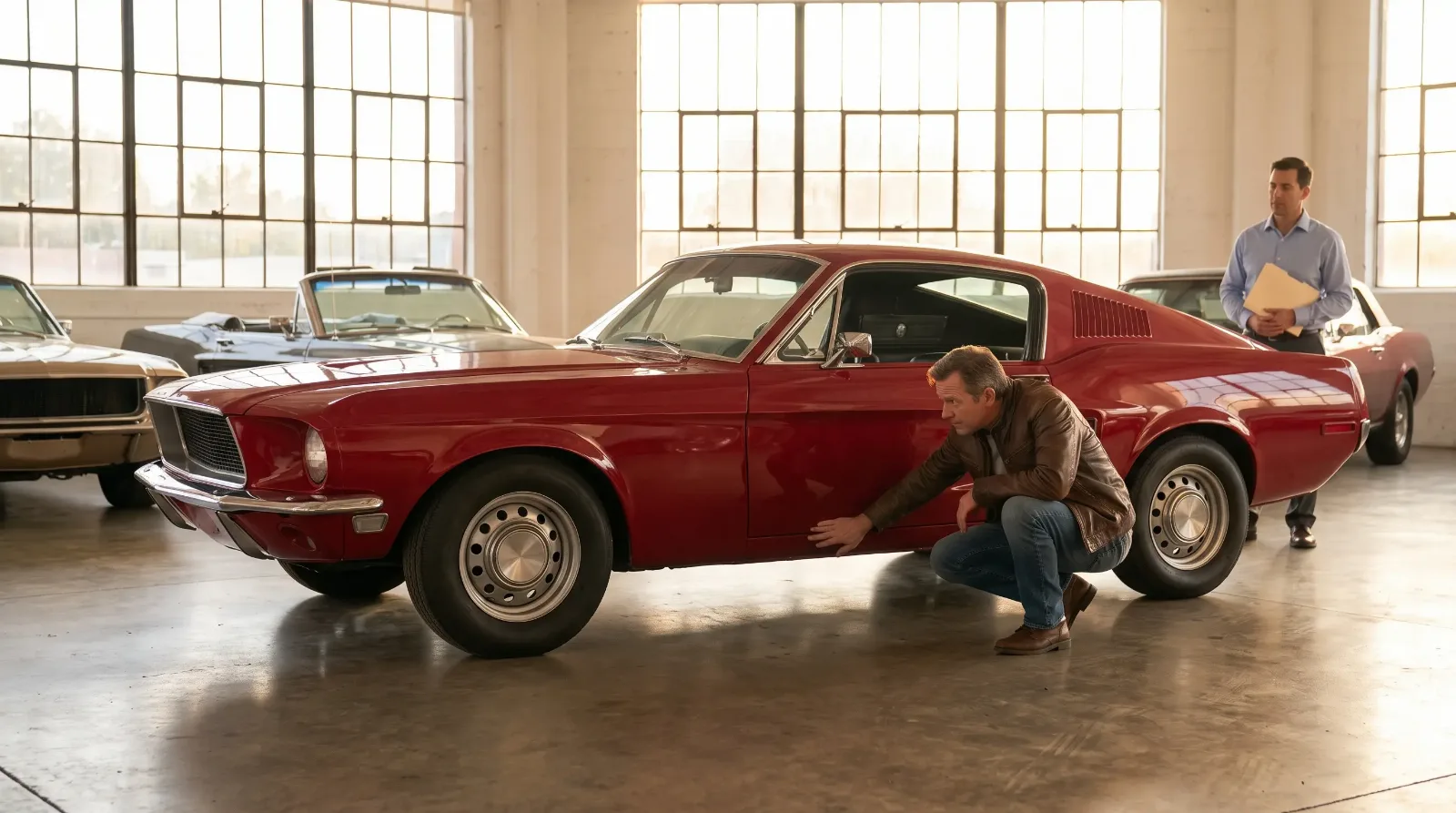
The listing had 31 photos, all shot in clean afternoon light. A 1967 Mustang coupe, fresh paint, a tidy engine bay, an asking price that looked fair against recent sales. The buyer lived in Chicago. The car sat on a dealer's floor in Atlanta, three states away. By the second evening of scrolling through the gallery, he had already decided it was his, and the only question left in his head was how fast he could get it home.
That is the moment most bad purchases begin. If you want to know how to buy a classic car from a dealer without regret, start by separating the things that feel reassuring from the things that actually protect you. Good photos, a friendly voice on the phone, a polished website and a 4.8-star average protect you from nothing. A title in the seller's name, an independent inspection, a payment method with recourse and a paper trail you can verify do. The rest of this guide walks through those protections in the order you will need them, from figuring out who you are really buying from to the scams that target remote buyers in 2026.
Dealer, consignment house or private seller
The word "dealer" covers several business models, and the differences decide who owns the car, who holds your money and how much room you have to negotiate. Before you ask a single question about the car, find out which kind of seller you are dealing with.
A traditional dealer buys inventory with its own money and holds the title. That has two consequences. First, the dealer has a cost basis, so a car that has sat on the floor for six months is costing them money and the asking price usually has room in it. Second, the dealer is the party you would pursue if something goes wrong. In most states a licensed dealer has to post a surety bond with the state, commonly somewhere between $25,000 and $50,000 depending on the state and license type, which gives buyers a limited claim if the dealer commits fraud or fails to deliver title. The bond is capped, though, and shared among every claimant, so treat it as a backstop rather than a guarantee. Most classic cars are still sold as-is, so do not expect a warranty, but dealer-owned stock at least puts one accountable company between you and the car.
A consignment seller is an agent. The car belongs to a private owner who has set a floor price, and the dealer earns a commission when it sells. Your negotiating room is limited by what the owner will accept, and every counteroffer goes back to someone you never speak to. The bigger question is where your money sits. Some consignment houses route the buyer's funds through their own account and pay the owner after the deal closes. Others have you pay the owner directly. Ask, in writing, who receives the deposit, whether it is held in a separate trust or escrow account and who signs the title over to you. If you want the seller-side mechanics in more detail, we have covered how classic car consignment works.
Then there are hybrids. WeBe Autos on Long Island describes itself as a "marketing agent, not a dealer," and the cars it lists stay owned by their sellers and are shown by appointment. A Touch of Classics in Midlothian, Texas, works as a broker and says it takes a 5% commission only after the car sells. Neither model is a problem in itself. The point is that the business presenting the car may not own it, may not hold your money and may not be the party that signs the title. A private seller, meanwhile, offers the cleanest price negotiation and the least protection, since there is no license, no bond and usually no second chance once the cash changes hands.
How to vet a dealer before you call
Do the homework before the first phone call, because once you are talking to a good salesperson your judgment gets worse. That is not a criticism of dealers. It is how people buy things they already want.
Start with time in business. Look up the company in the state's business entity database and check when it was registered. A dealer that has operated under the same name for fifteen years has a reputation to protect. A company formed eight months ago with a domain registered last spring might be perfectly honest, but it has no record for you to read, and you should weigh the rest of your checks more heavily.
Next, the Better Business Bureau profile. The letter grade matters less than what sits under it. Open the complaints, read them in full and read the dealer's responses. Three complaints about a paint chip on delivery tell you very little. Two complaints about titles arriving months late, or deposits that were never refunded, tell you a great deal. Do the same with Google reviews and the marque forums. Ignore the stars and read the one-star and two-star entries, looking for a pattern rather than a single angry customer.
Confirm a physical address and look at it. Pull it up on a street-level map. A building with a showroom or a fenced lot full of cars is what you want to see. A mailbox store, a residential apartment or an empty lot is a reason to stop. While you are at it, check the dealer license number against the state DMV or dealer board lookup, if the state publishes one.
Finally, ask for references, specifically two recent buyers who purchased remotely from another state. An established dealer will have them and will not mind the request. If you want a starting list of established names, browse our directory of classic car dealers and run each one through the same checks before you pick up the phone.
Questions to ask about the car
Once the dealer passes, the car has to pass. These questions are the minimum, and the answers should come in writing or in a recorded video, not just a phone conversation.
Ask for the VIN before anything else, and check that the number on the title, the VIN plate and any secondary stamping all agree. Run it through a vehicle history service, keeping in mind that coverage for older cars is thin. Then ask about title status. You want a clean title in the name of the dealer or the consignor, with no liens and no salvage or rebuilt brand. Some states do not issue titles for older vehicles, which means certain cars change hands on a registration and bill of sale alone. New York, for example, does not title cars of model year 1972 or older and uses a transferable registration as proof of ownership instead, and Vermont does not require a title for vehicles more than 15 model years old. That is legal, but it makes your own state's registration process slower, so learn the rules before you commit.
Documentation is where values are made or lost. Ask what paper exists: build sheet, window sticker, factory invoice, marque reports, restoration receipts, ownership history. If the listing says "numbers matching," ask exactly which numbers and ask for photos of the stampings and date codes. On many muscle cars the matching-numbers premium is large enough that it should be proven, not asserted; on the most desirable models it can be the difference between a strong sale and no sale at all.
Last, ask for a live video walk-around. Request a cold start filmed from the moment the key turns, the underside on a lift, close shots of the floors, rockers and trunk pan, and a short drive. Ask the salesperson to hold up a note with your name and today's date in the first frame. A real dealer can do this in twenty minutes. Our guide to buying a classic sight unseen has a longer list of questions for cars you cannot visit.
Inspection: in person or third party
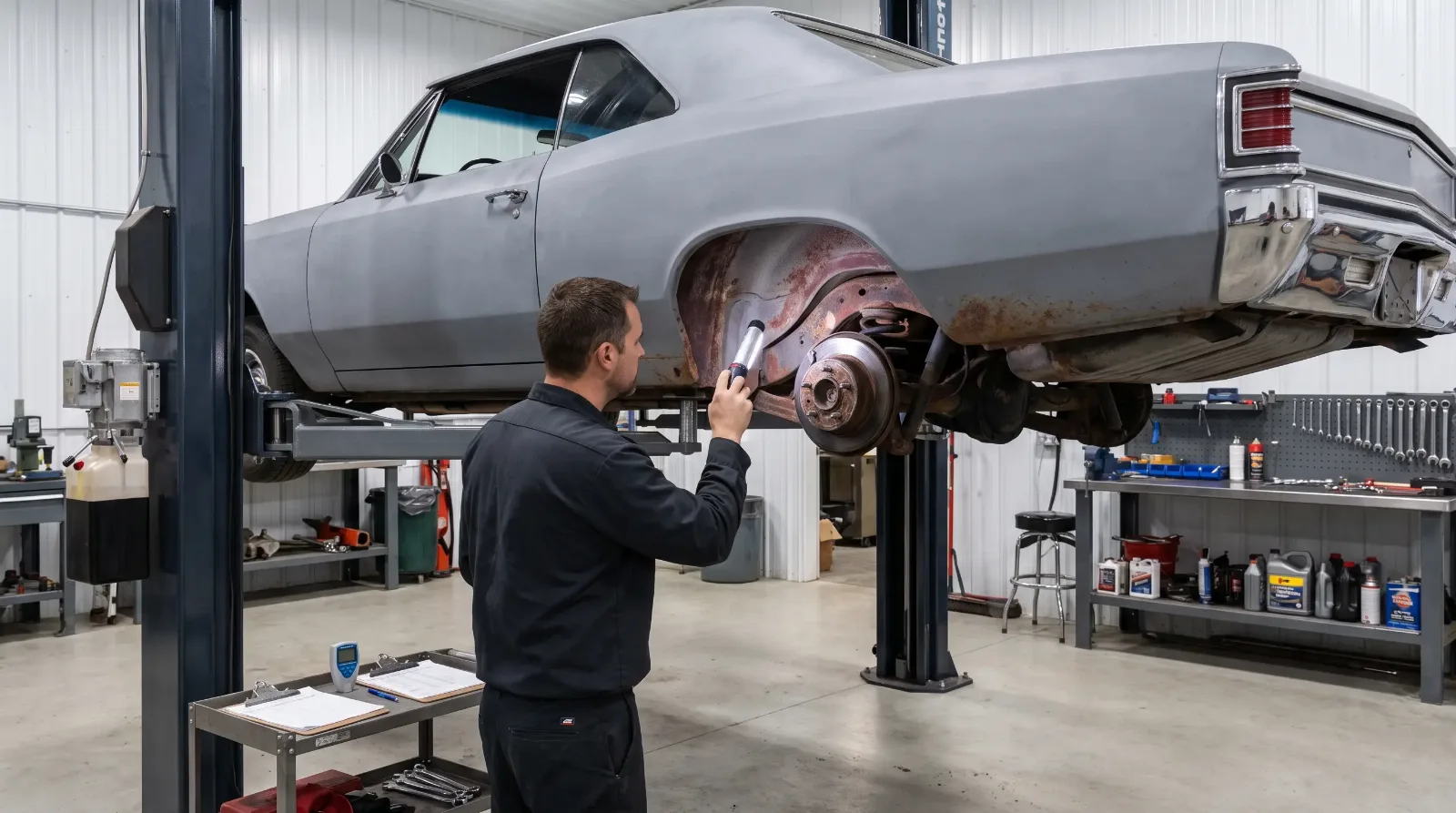
An inspection is the cheapest insurance in the hobby, and skipping it is the most expensive mistake I see in the data. The best option is to go yourself, ideally with someone who knows the model. When the car is three states away, the next best thing is an independent inspector you hire and pay. That last part matters. An inspector recommended by the dealer is not independent, however honest they may be.
Mobile inspection services typically charge roughly $250 to $500 for a classic car pre-purchase report with photos, and a marque specialist who travels to the car can cost more. For a rare or high-value car, pay for a model specialist rather than a general mechanic. They know where these cars rust, including the spots under a vinyl top that no photo reaches. Here is how I would rank the inspection points, ordered by what a miss costs you.
🔧 Inspection Priorities
- VIN and title match. If the VIN on the car does not agree with the title, you may not be able to register the car at all, and in the worst case it is stolen. The cost of a miss is the entire purchase price.
- Structural rust and frame damage. Rotted floors, frame rails, rockers and lower quarters, or a frame that has been pulled straight after a crash. Proper metal repair on a unibody car can run well into five figures.
- Engine and drivetrain identity and health. Compression or leak-down test, oil condition, smoke on startup, and stampings that match the claimed originality. A wrong block can erase the premium you paid; a professional rebuild commonly costs $5,000 to $10,000 on its own.
- Body filler and paint quality. A paint thickness gauge finds filler that photos never show. A good driver-quality respray commonly costs $5,000 to $12,000, and show-quality paint far more.
- Brakes, cooling, wiring and suspension. Cheaper fixes in dollar terms, but they decide whether the car is safe to drive off the transporter.
Get the report in writing with dated photos, then use it. A clean inspection confirms the price. A report with problems is a negotiating document, and a report with a VIN or structural issue is a reason to walk away. For a deeper checklist on high-value American iron, see our guide to a pre-purchase inspection.
Deposits, payment and paperwork
How you pay decides what you can recover if the deal goes wrong. The table below is the short version.
| Payment method | Risk to the buyer | Protection | When it makes sense |
|---|---|---|---|
| Wire transfer | High | Almost none once sent; recalls rarely succeed | Final balance only, after title and inspection are verified, to an account confirmed by phone on a number you found yourself |
| Escrow (licensed service) | Low, if the escrow is real | Funds released only after you accept the car | Remote purchases from private sellers or small dealers; type the escrow site address yourself |
| Credit card deposit | Low | Billing-dispute rights under the Fair Credit Billing Act, for example if the car is not delivered as agreed; write to the issuer within 60 days of the statement | Holding deposits; many dealers cap the card amount or add a fee |
| Cashier's check | Medium | Traceable, but hard to stop once deposited | In-person closing with the signed title in your hand |
| Cash | High | Only a signed receipt | In-person closings only; a dealer receiving more than $10,000 in cash, in one payment or related payments, must report it to the IRS on Form 8300 |
Deposits deserve their own attention, because they are where remote buyers most often lose money. A well-designed deposit policy prices in the inspection rather than pretending it does not exist. Classic Car Deals in Cadillac, Michigan, which runs nationwide online consignment, is a useful example. The company lists a deposit that holds a car for seven days: $1,000 refundable if you plan a personal inspection, $500 refundable for a third-party inspection, or $500 non-refundable if you waive inspection. Funds go through Classic Car Deals, which then pays the seller. I like that structure. It rewards the buyer who inspects, and it makes clear who is holding the money. Whatever dealer you use, ask for the deposit terms in writing before you send anything: amount, hold period, refund conditions and who holds it.
The paperwork for an out-of-state purchase is simpler than people fear. You need the signed title, a bill of sale with the VIN, price and date, and an odometer disclosure where one applies. Under federal rules, vehicles of model year 2010 and older are exempt from odometer disclosure, so nearly every classic is, although your state may still ask for a mileage figure on its own forms. Sales or use tax is generally owed in the state where you register the car, not where you bought it. If you do pay tax to the selling state, most states credit it against what you owe at home, up to their own rate, so keep the bill of sale that shows the tax paid. Some dealers will also collect the tax for your home state. Some states also require a VIN verification before they will title a car from elsewhere; Florida, for instance, asks for a VIN and odometer verification form signed by a law enforcement officer, a Florida notary or a licensed dealer. Call your DMV before the car ships, ask what they need and ask about historic or antique plates, which can lower registration costs in exchange for mileage or use limits.
Financing and shipping
A regular bank or credit union may be reluctant to lend on a car that is fifty years old, because there is no standard book value to secure the loan against. Many banks and credit unions cap used-car loans at around 10 model years, although a few credit unions run separate classic car programs. Specialty collector-car lenders such as J.J. Best Banc & Co. and Woodside Credit lend against appraised or agreed value. Terms vary by lender and loan size: J.J. Best lists terms of 48 to 84 months, while Woodside offers longer terms on more expensive cars, up to 12 years on the largest loans. Expect a down payment of around 10% to 20%, and more for hot rods and modified cars, with a rate above what you would see on a new car. An unsecured personal loan is the other route. It avoids a lien on the title, which makes the paperwork simpler, but rates are usually higher. Either way, arrange financing before you place a deposit, not during the seven-day hold.
Line up insurance too. An agreed-value collector policy should be active before the car leaves the dealer's lot, and any lender will require it.
For shipping, the choice is open or enclosed transport. Open carriers are the same multi-car trailers that move new cars to dealerships. They are cheaper and usually faster to schedule, but the car is exposed to weather, road debris and whatever the car above it leaks. Enclosed transport keeps it in a box trailer, often with liftgate loading that suits low cars. As a rough guide, 2026 quotes for a coast-to-coast open move tend to land between about $1,000 and $2,000, and enclosed transport usually costs 40% to 60% more, with non-running cars costing extra. For a driver-quality car on a short route, open transport is fine. For anything with fresh paint or six figures of value, pay for enclosed.
Check the carrier's USDOT or MC number in the federal motor carrier database, get a certificate of its cargo insurance and make sure the bill of lading records the car's condition with photos at pickup. If the dealer arranges shipping, ask whether they are using a broker, who then hires the actual carrier, and get the carrier's name before the truck shows up.
Classic car scams and red flags
Most classic car scams aimed at remote buyers follow a small number of scripts, and they work because they target the emotional state described at the top of this guide: you have already decided the car is yours. The FBI's Internet Crime Complaint Center has warned about vehicle sale fraud built around cars the seller never owned, below-market prices and false claims of partnership with well-known marketplaces, logging nearly 27,000 complaints and about $54 million in losses between 2014 and 2017 alone. The patterns below cover most of what I see reported.
Behind every one of these is the same move: rush the buyer past verification and get the money into a channel that cannot be reversed. Slow down at exactly the moment the seller wants you to speed up. Our full checklist on how to avoid classic car scams goes deeper on spotting cloned listings and fake escrow.
"Price is the first data point, and in a scam it is always the wrong one. When a car is listed well below every comparable sale I can find, I don't treat it as a bargain. I treat it as a question nobody has answered yet."
— David Mercer
Buying from a reputable dealer is still the safest way to buy a car you cannot easily see in person. The dealer has a name, an address, a license and a reputation that took years to build, and those are real protections. They only work if you check them. Verify the seller, verify the car, inspect it, pay in a way you can recover, and the Mustang three states away becomes a reasonable purchase rather than a gamble. When you are ready to start looking, browse classic cars for sale from dealers and apply every step above to the first one that catches your eye.
Sources and notes
- FTC: Using credit cards and disputing charges (Fair Credit Billing Act)
- FBI Internet Crime Complaint Center: Fraudulent online vehicle sales public service announcement
- IRS: Cash payments over $10,000, motor vehicle dealership Q&As (Form 8300)
- New York DMV: Acceptable proofs of ownership for vehicles
- California DMV: Credit for tax paid to another state
- J.J. Best Banc & Co.: Auto financing FAQs