What the door data plate actually is
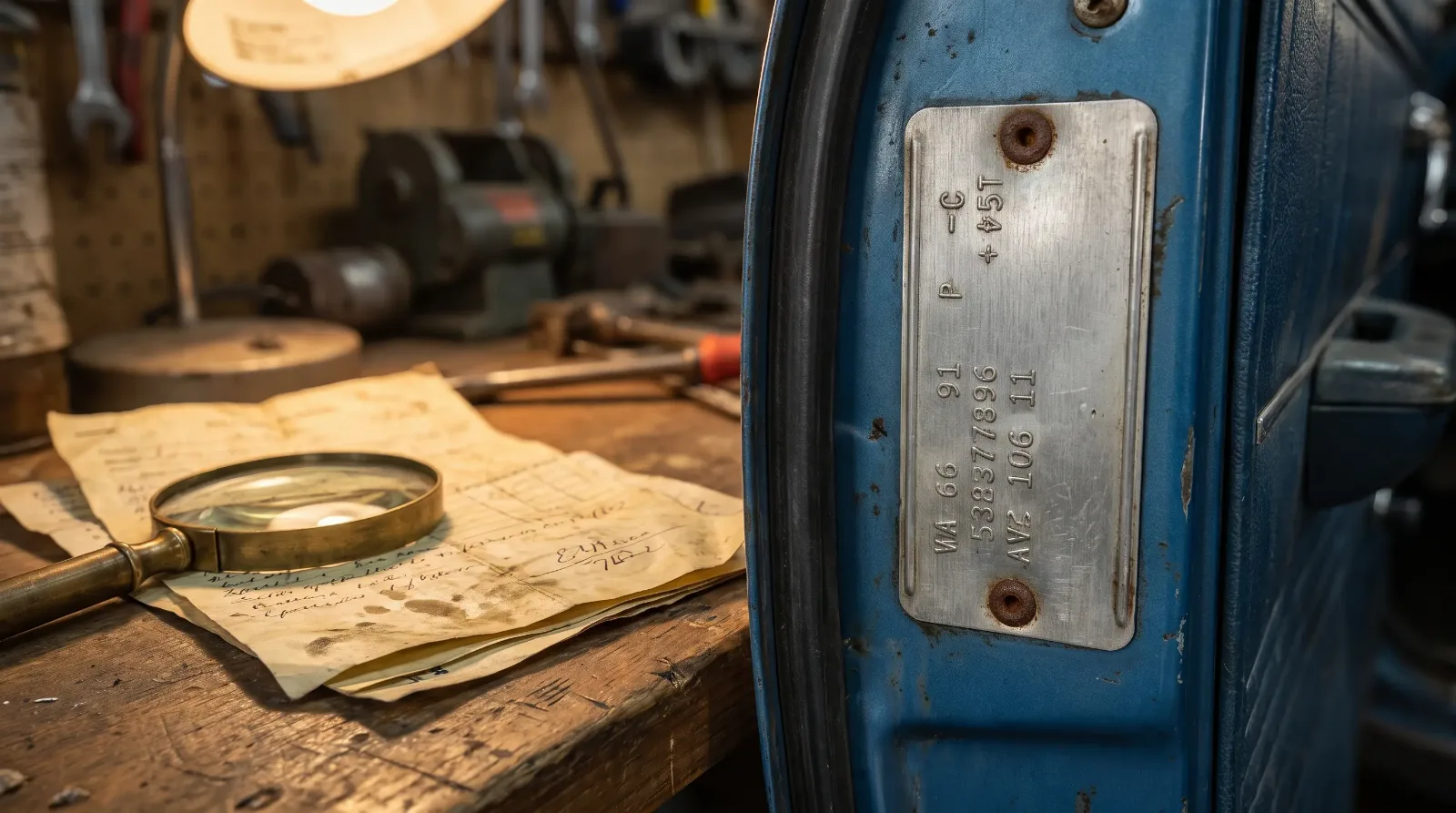
Every 1965 through 1973 Mustang left the factory with a small metal plate riveted to the driver's door or door jamb. Ford called it the warranty plate, though collectors today almost universally call it the door data plate. It is one of the most information-dense documents on the entire car, encoding in a few rows of stamped characters the body style, paint color, interior trim, production date, destination district, axle ratio, and transmission. Later Mustangs, from 1968 onward, received a paper certification label in addition to or instead of the riveted metal plate, carrying similar data in a slightly revised format to meet federal safety labeling requirements. For a serious authentication check, this plate must be read alongside the Mustang VIN, because the two documents cross-check each other and together tell a story that cannot easily be faked.
Understanding how to read the plate is part decoder-ring puzzle and part factory history lesson. The codes themselves were never meant to be public-facing, which is why Ford published no owner's guide for them. Restorers and historians have reverse-engineered the system over decades from production records, dealer documentation, and thousands of surviving cars. Most of the major codes are well established; a handful of edge cases and regional variations remain subjects of ongoing research.
Locating and reading the plate
On 1965 and 1966 Mustangs the plate is riveted directly to the driver's door, typically in the lower corner near the latch. On 1967 models Ford moved it to the door jamb on most production runs, and from 1968 onward the combination of a metal plate and a federal certification label (often a white adhesive sticker placed on the door jamb) became standard. If a car has been repainted or the door replaced, the plate may be missing or may belong to a different car, which is itself a red flag for authenticators. A plate with fresh rivets, mismatched paint overspray patterns, or rivet holes that don't align with the door's original stampings all warrant close inspection.
The plate reads left to right across each row. Ford used a consistent row structure across the 1965-1970 era, though the exact number of rows and the spacing of codes evolved slightly year to year. Read each field as a discrete code unit, not as a continuous string. Abbreviations used below reflect common restoration-community usage; Ford's own internal terminology varied slightly by model year and plant.
Decoding each row: a field-by-field guide
The table below covers the standard code rows found on most 1965-1970 Mustang door data plates. Some fields were combined or expanded in certain years; the 1965 plate is slightly more compact than the 1969 or 1970 version. Where formats are well-established they are listed precisely; where specific sub-codes vary enough to require individual research they are marked accordingly.
| Row / Field | What it encodes | Format / example | Notes |
|---|---|---|---|
| Body / style code | Body type and trim level | Two digits + letter, e.g. 65A (hardtop, standard bucket seats), 63A (fastback, standard), 76A (convertible, standard). The two digits set the body: 65 = hardtop/coupe, 63 = fastback (2+2), 76 = convertible. The letter suffix sets trim: A = standard, B = luxury/deluxe (Pony interior), C = standard bench seat. | The body must agree with the VIN body code (the 3rd-4th VIN characters on 1965-66 cars: 07 hardtop, 08 convertible, 09 fastback) |
| Exterior color code | Factory paint color | One or two alphanumeric characters, e.g. A (Raven Black 1965), M (Wimbledon White 1965) | Color codes changed year to year; a 1967 code does not match a 1965 chart |
| Interior trim code | Seat material, color, and type | Two to three characters, e.g. 22A (standard bench, black vinyl) | Encodes both color family and whether interior is standard, deluxe, or GT |
| Production date | Day and month of assembly (scheduled build date) | Two-digit day of month + month letter, e.g. 30R = the 30th of April. The letter is the month, not a week. On 1965-66 plates the common scheme runs from the August start of the model year; for example R = April, T = June, V = August. | The letter encodes the month; it is read together with the VIN sequence number and known plant schedules to confirm both documents fit the same build window |
| DSO (District Sales Office) | Ford sales district that ordered the car | Two-digit number, e.g. 11 (Boston), 21 (Atlanta), 33 (Detroit), 41 (Chicago), 51 (Denver), 72 (San Jose), 81 (Ford of Canada) | Export and Canadian cars carry distinct high-range or 80-series codes; fleet and special orders often add suffix digits to the district number |
| Rear axle ratio code | Differential gear ratio | Single character. On 1965-66 plates numbers are open axles and the matching letters are limited-slip (Equa-Lok): 1 = 3.00:1 open, 6 = 2.80:1 open, 9 = 4.11:1 open; A = 3.00:1 Equa-Lok, C = 3.20:1 Equa-Lok. Later years (1969-70) use a different combined number-and-letter scheme, so always read against a chart for the car's exact year. | Must match the axle tag on the differential carrier; a mismatch indicates an axle swap |
| Transmission code | Gearbox type | Single character, and the assignments shifted by era. 1965-66: 1 = 3-speed manual, 5 = 4-speed manual, 6 = C4 Cruise-O-Matic automatic. 1969-70: 1 = 3-speed manual, 5 = 4-speed manual, 6 = 4-speed close-ratio, W = C4 automatic, U = C6 automatic, X = FMX automatic. | Cross-checks the VIN transmission character and the tag on the transmission case |
"The data plate is not a summary of the car, it is a primary document. When the plate disagrees with the VIN or the axle tag, the plate wins as your starting point for the investigation, not your conclusion."
— Tom Ramirez
How the data plate cross-checks the VIN
The door data plate and the VIN are designed to be read together, and discrepancies between them are among the most useful signals an authenticator can find. For further background on how the VIN itself is structured, see the identification hub, which covers all the major Ford documentation points in one place.
On a 1965 or 1966 Mustang the VIN encodes model year, assembly plant, body series, engine code, and sequential production number. The data plate does not repeat the engine code, but it does encode the body style, which should agree with what the VIN's body series digits indicate. The production date on the data plate, when combined with the sequential production number in the VIN, can be checked against known production schedules to verify that both documents plausibly belong to the same assembly sequence. A plate dated February 1966 on a car whose VIN sequence number corresponds to a late-1965 production run is a mismatch worth investigating.
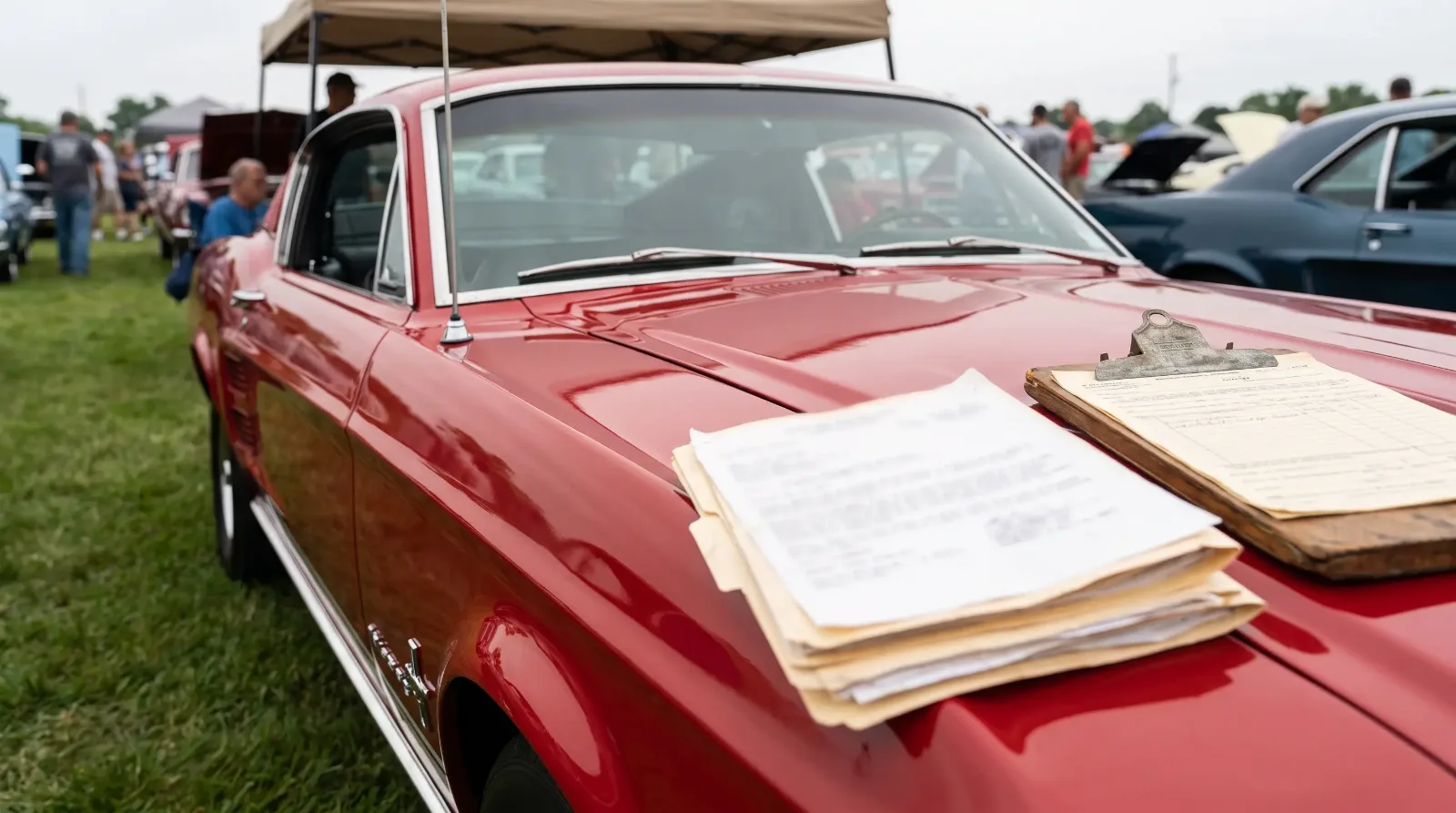
The transmission and axle codes on the plate should agree with the transmission tag (typically stamped on the case or a tag attached to it) and the axle tag on the differential carrier. A numbers-matching evaluation that stops at the VIN without checking the data plate against those secondary tags is incomplete. On high-value cars such as the original GT350, GT500, Boss 302, or Boss 429, these cross-checks are standard practice, and any gap in the chain of documentation reduces the car's claim to authenticity regardless of how correct any single piece looks in isolation.
Common pitfalls and authentication notes
The most frequent problem encountered in data plate authentication is substitution. Because the plate is riveted rather than welded, it can be removed and replaced. A plate from a correct-year parts car can be installed on a different car to misrepresent its original specifications. Authenticators look for consistency in the rivet heads, corrosion patterns that match the surrounding door metal, and paint history around the plate perimeter. A plate surrounded by bare metal on a car with layers of old paint is suspicious. A plate whose codes describe a rare option combination that the VIN's production number cannot support is equally so.
Paint codes on the plate are among the most consulted fields for color-correct restorations, but they require care. Ford used the same color name with different paint formulas across years, and a color code from one year's chart cannot be assumed to match the same code from another year. Always use a color code reference keyed to the specific model year of your car. Similarly, interior trim codes specify the factory-issued color and material, but they do not specify every component. Some trim codes applied to base interiors also appear on deluxe interior cars with different execution, and a handful of codes were used at only one assembly plant.
The DSO code is often overlooked but can be valuable for research. A car with a high-range DSO number, indicating export, that shows up with domestic-specification equipment is worth examining. Conversely, certain DSO codes for fleet or government orders correlate with specific option deletions or additions that are otherwise unusual on civilian cars.
For production-date verification, the day-and-month code can be cross-referenced against assembly-plant shutdown records. Ford plants typically shut down for changeover in late July or early August each year for new model introduction. A car whose plate shows a production date in that window will fall into a small batch of late-outgoing or early-incoming models, and the exact day stamped on the plate can sometimes distinguish them.
Sources and notes
Code assignments shifted from year to year, and a few fields (notably month-letter conventions and the 1969-70 axle scheme) are documented slightly differently across reference charts. Always decode against a chart keyed to your car's exact model year, and treat the plate as the starting point of an investigation rather than the final word. This article is provided for general restoration and authentication research; it is not a substitute for inspection by a qualified marque expert or registry.
- Classic Pony Cars — 1965 Mustang Data Plate Decoder
- FastbackStack — 1965-1970 Mustang Body Style Codes
- Classic Industries — Decoding Your 1965 Mustang's Data Plate & VIN
- Early Mustang — 1965 Data Plate Decode Information
- Classic Pony Cars — 1969 Mustang Data Plate Decoder
- CJ Pony Parts — 1965 Mustang VIN and Data Plate Decoder