The documentation ecosystem behind every classic Mustang
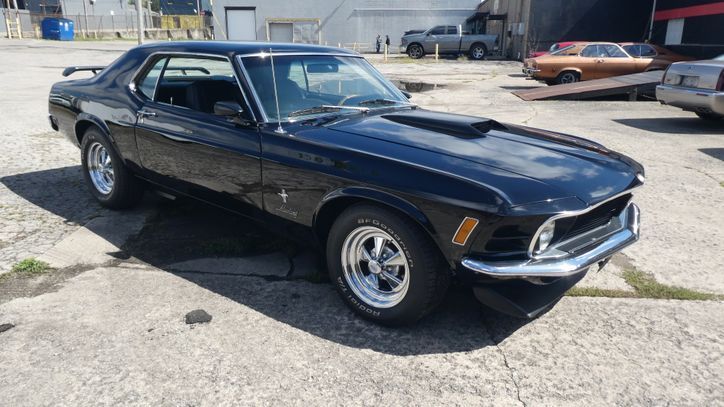
A classic Mustang tells two stories. One is written in sheet metal and stamped codes; the other lives in paper, microfilm, and a corporate database in Dearborn. Authentication is the work of making those two stories agree. No single source proves a car by itself, which is why serious collectors learn to read several at once: the VIN, the door data or warranty plate, the factory option and trim codes, and, for the model years it covers, the Marti Report drawn from Ford's own production records. Each source answers a different question, and the value of a car rises or falls on how cleanly those answers line up. This article is the overview of that ecosystem and how its pieces cross-check. The deeper origin of these cars, if you want the broader context first, runs through the classic Ford Mustang story.
The principle underneath all of it is simple. A factory-built car left the assembly line carrying a set of codes that described exactly what it was: body style, engine, color, trim, axle, transmission, and the plant and date it was built. Those codes were recorded in more than one place. When the codes on the car match the codes in the records, and the records are internally consistent, you have provenance. When they disagree, you have a question that must be answered before money changes hands.
The VIN: where every identification starts
The vehicle identification number is the spine of the whole process. On first-generation Mustangs built from 1964 through 1973, the VIN is a compact code, typically eleven characters, that encodes the model year, the assembly plant, the body style, the original engine, and a sequential production number. The first digit is the model-year digit. The second character is a letter for the assembly plant: Dearborn, Michigan; San Jose, California; and Metuchen, New Jersey each carried their own plant code. The next two digits give the body serial code, which distinguishes a hardtop coupe from a fastback or a convertible. Then comes a single letter, the engine code, followed by the consecutive unit number.
That engine letter is one of the most useful characters on the entire car, but it is also the one that shifts most from year to year, so it must always be read against a chart for the specific model year. On the small-block 289 cars a C-code points to a two-barrel 289, an A-code to the four-barrel 289, and a K-code to the high-performance "Hi-Po" 289 (T marks the 200 six). Later years reassign and add letters: F shifts from the early 260 to the 302 by 1968, the 351 Windsor and Cleveland arrive as H, M, Q, and R across 1969 to 1973, and the big-blocks carry their own letters, such as S for the 390, R or Q for the 428 Cobra Jet, and Z for the Boss 429. A car advertised as a K-code Hi-Po whose VIN does not carry a K is not a K-code car, whatever sits under the hood. On the early cars the VIN appears on a stamped tab visible through the windshield and is repeated on the door data plate and on the inner fender. Because the same letter can mean different engines in different years, a careful researcher confirms the specific table for the year in question rather than assuming continuity across all nine model years.
The door data plate and the warranty plate
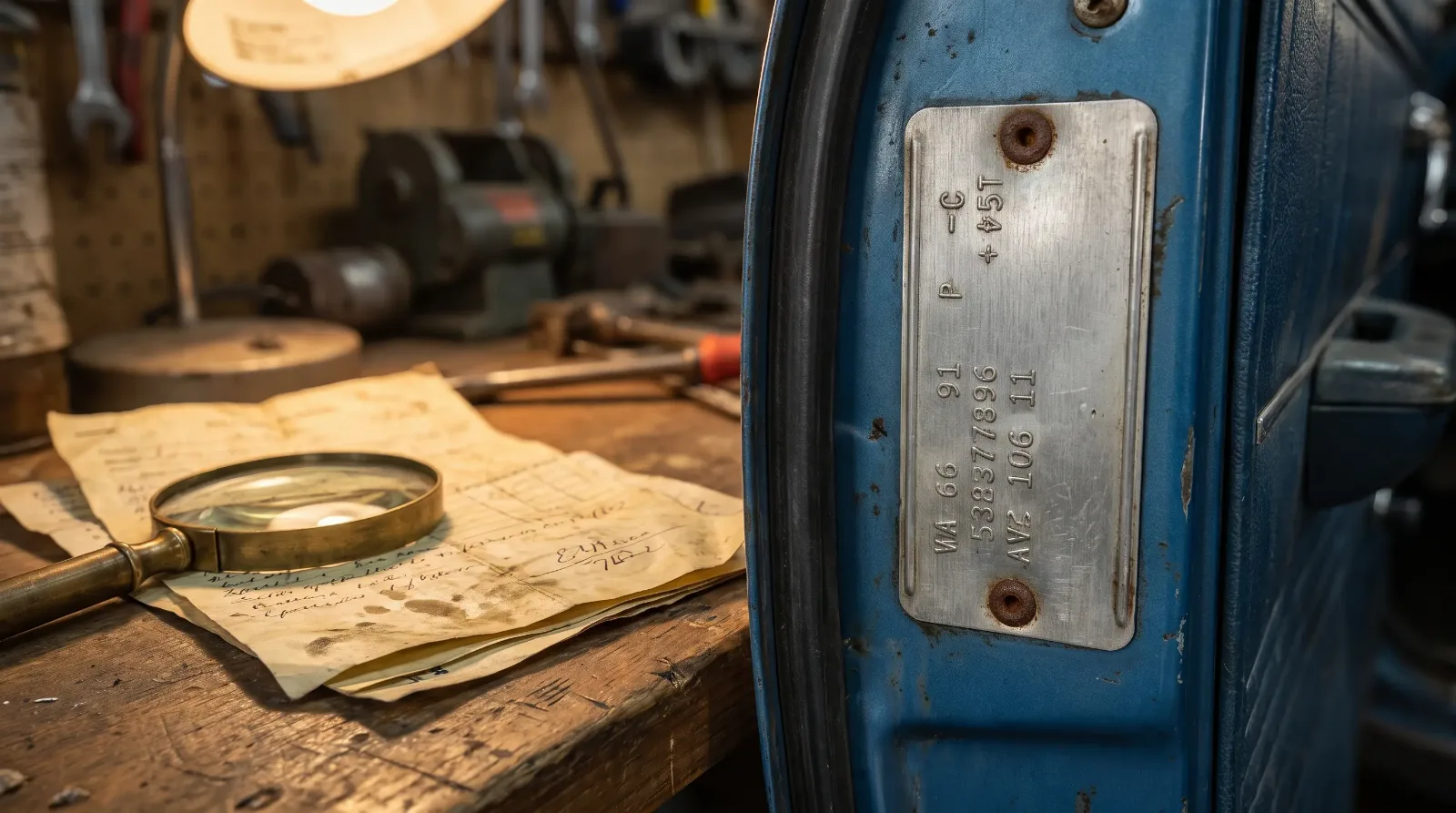
Riveted to the driver's door or its jamb is the second pillar of identification: the data plate, called the warranty plate on the earliest cars and the certification or vehicle data label on later ones. Where the VIN is a short summary, the door plate is the detailed build specification. It repeats the VIN and then expands on it with a row of codes describing how that specific car was ordered and assembled.
On a 1965 to 1967 warranty plate you typically find the body code, the exterior paint color code, the interior trim code, the date the car was scheduled to be built, the district or sales office that ordered it, the rear axle ratio code, and the transmission code. Each is a short alphanumeric value that maps to a Ford reference chart. A paint code reads as a single letter that decodes to a specific factory color; an interior trim code decodes to a material and color combination. The build date code, often a number-and-letter pair, gives the scheduled assembly date, which must be plausible against the VIN's sequence and the engine's casting date.
The data plate matters precisely because it is the bridge between the abbreviated VIN and the full order. A repainted car can be checked against its original paint code. A reupholstered interior can be checked against the trim code. The plate is also a favorite target for fraud, since swapping or restamping it can make a plain coupe appear to be something rarer. That is why investigators treat the plate as a claim to be verified against other records, never as proof on its own.
The Marti Report: Ford's production database in your hands
For Mustangs built from the 1967 model year onward, the single most powerful document available is the Marti Report. Marti Auto Works holds a license to Ford's original production database, the records that captured how each car was ordered and built. Supplying a VIN returns a report listing the factory-installed options, the colors and codes, the order and build dates, the DSO (district sales office) the car was shipped to, and, valuably, how many cars were produced to that same specification. Because the database is Ford's own, the Marti Report is as close to a factory birth certificate as a classic Mustang can have.
Its coverage is the key limitation to understand. The licensed database covers Ford, Lincoln, and Mercury vehicles built in the United States and Canada from the 1967 model year forward, a start point tied to the record-keeping required under the Motor Vehicle Safety Act of 1966. That means the 1965 and 1966 Mustangs fall outside its scope and must be authenticated through the warranty plate, surviving paperwork, and marque-specific registries instead. Within its range, though, the Marti Report does something no other single source can: it independently confirms the door-plate codes against the factory record and quantifies rarity. A report stating that a car was one of a few hundred built in a given color-and-engine combination turns a vague claim of scarcity into a documented figure.
"A Marti Report does not make a car valuable. It makes a car knowable, and knowable is what the market actually pays for."
— Tom Ramirez
How the sources cross-check one another
The discipline of authentication is triangulation. Any one source can be wrong, altered, or missing; the strength of a case comes from agreement across independent records. The VIN engine letter should match the engine code implied by the door plate, which should match the option list on the Marti Report, which should match the casting and date codes on the actual engine block. The build date on the data plate should fall in a sensible window after the engine's casting date, typically a matter of weeks, and before the car's documented delivery. The paint and trim codes on the plate should match the report and the physical car, allowing for any honest restoration.
When those layers agree, the case is strong. When one disagrees, that single conflict is the whole story. A VIN that decodes to a six-cylinder car wearing a V8 badge, a data plate whose build date predates its own engine's casting, a Marti Report that lists a base coupe while the seller describes a GT, each is a thread that, pulled, unravels the claim. The table below summarizes what each source covers and what it reveals, so the cross-checks become a checklist rather than a guess.
| Identification source | Model years it covers | What it reveals |
|---|---|---|
| VIN (stamped tab and inner fender) | 1964½ to 1973 (all) | Model year, assembly plant, body style, original engine, sequential build number |
| Warranty / data plate (door or jamb) | 1964½ to 1973 (all) | Paint code, interior trim, scheduled build date, DSO, axle and transmission codes |
| Marti Report (Ford database) | 1967 onward | Factory-installed options, build and order dates, ship-to DSO, production totals for the spec |
| Engine casting and date codes (block) | All, where original block survives | Engine family and displacement, casting date for numbers-matching checks |
| Option and trim codes (decoded from plate) | All | Specific factory color, interior, equipment groups, special-order content |
Numbers-matching and what it really means
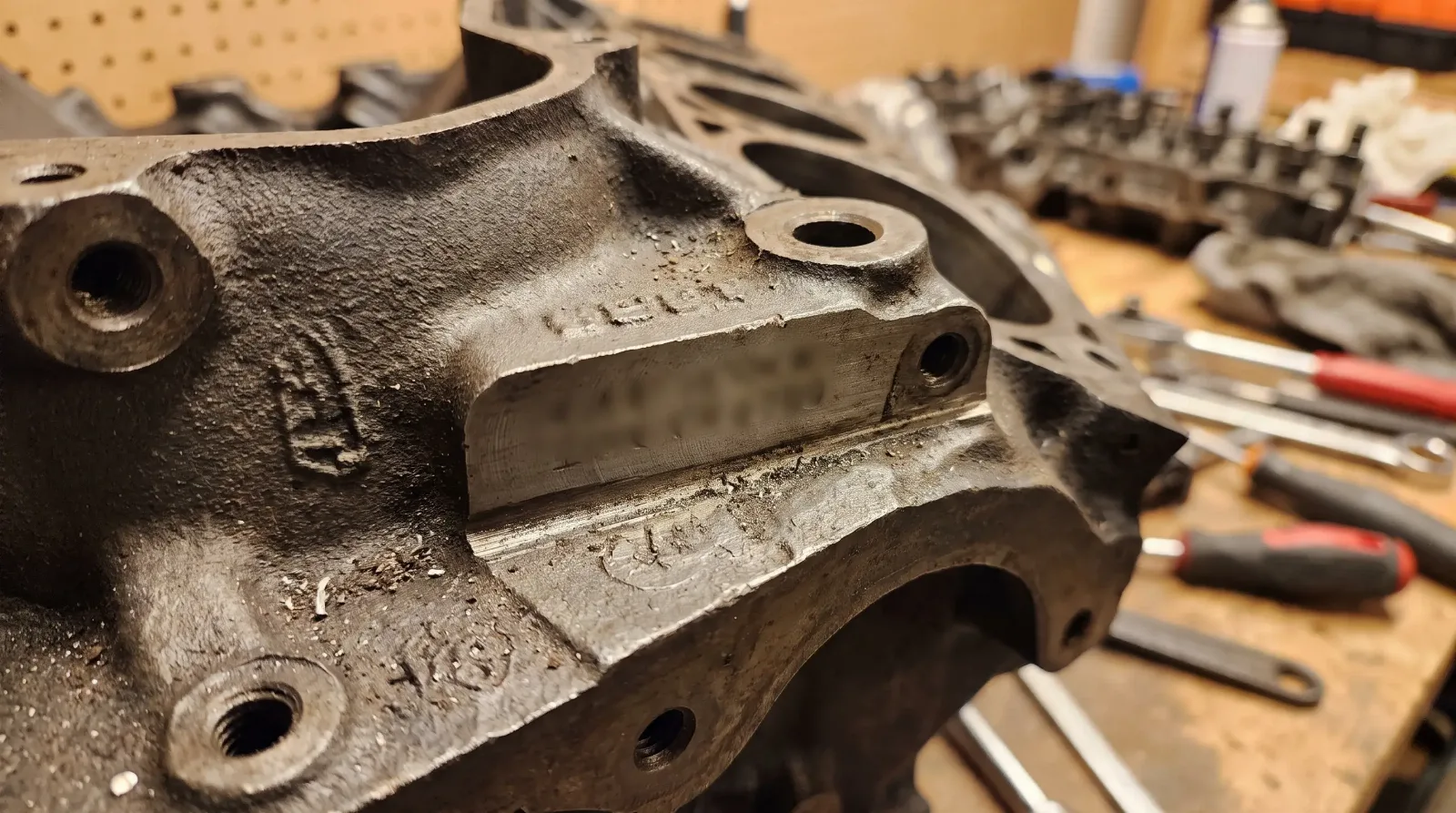
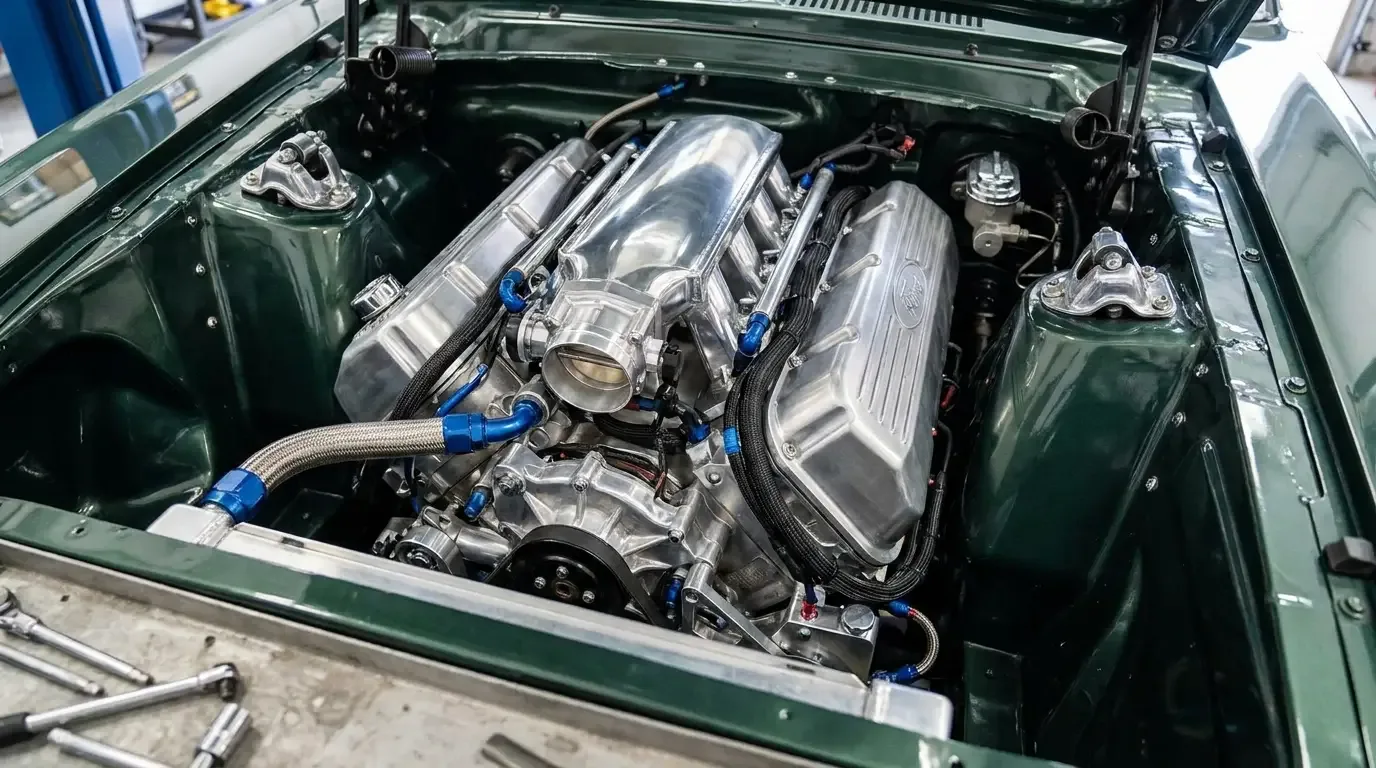
"Numbers-matching" is among the most used and most abused phrases in the classic Mustang world. In its strict sense it means the major drivetrain components the car left the factory with are still in the car, confirmed by the date and casting codes stamped or cast into them lining up with the build record. On a Mustang the central check is the engine block: its casting number identifies the engine family and displacement, and its casting date should fall a reasonable interval before the car's assembly date. Some buyers extend the standard to the transmission and rear axle as well.
The distinction carries real money. A documented numbers-matching car, where the original engine confirms the VIN's engine letter and the Marti Report's option list, commands a premium over an otherwise identical car running a correct-type but non-original replacement engine. That gap is not nostalgia; it reflects how hard originality is to fake and how completely it depends on the paper trail agreeing with the metal. A correctly rebuilt period engine of the right type keeps a car drivable and honest, but it is not the same claim, and the careful seller states which it is. Numbers-matching is therefore less a feature of the car than a conclusion drawn from the records, which is why it cannot be asserted without them.
Why provenance drives value and how fakes get caught
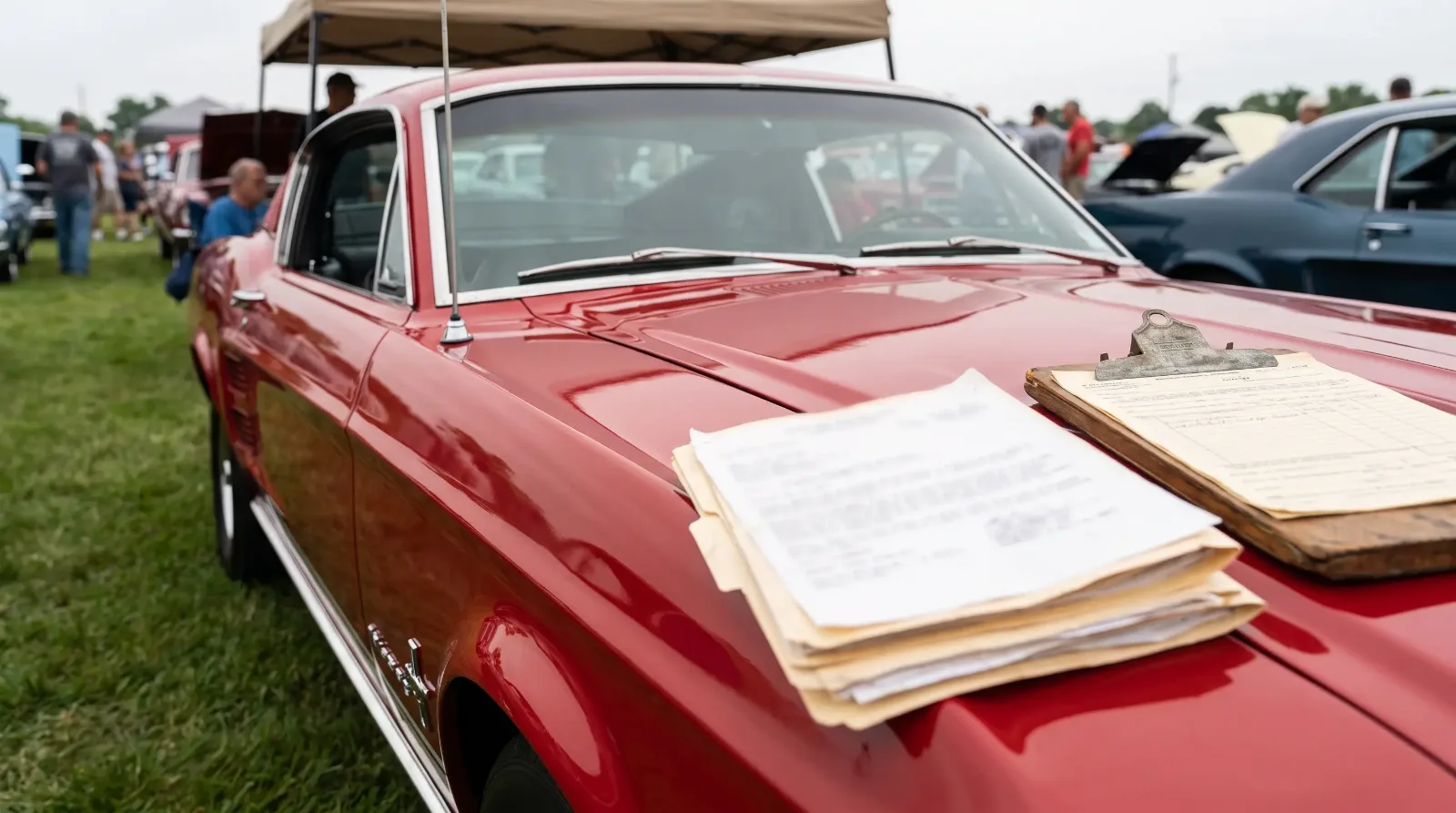
Provenance is the reason two Mustangs that look identical in photographs can sell for wildly different sums. A car with a complete documentation file, an original window sticker, a Marti Report, a consistent ownership chain, and physical codes that all agree, carries a premium because the buyer is purchasing certainty. The absence of that file does not prove a car is fake, but it pushes risk onto the buyer, and the market discounts risk. Documentation is simply the cheapest insurance available against a future authenticity dispute.
Fakes get caught at the seams between sources. A restamped engine pad may pass a casual glance but contradict the casting date or the VIN's engine letter. A swapped data plate produces a build date or DSO that the Marti Report flatly contradicts. A clone wearing GT or Mach 1 trim cannot conjure the factory option codes that a genuine car carries in Ford's own database. The fraudster has to forge every layer consistently, and the more independent records a buyer pulls, the harder that becomes. Persistent myths about which cars are "rare" or "special" only make the verification habit more important, and many of those stories are dismantled in common Mustang myths. For collectors who learn to read the documentation ecosystem first, the field of classic Mustangs becomes far easier to navigate with confidence.
Sources and notes
This article is provided for general educational purposes and reflects publicly available production history. VIN structures, plate layouts, code tables, and database coverage varied by model year and were quoted differently in period references. It is not a substitute for a professional pre-purchase inspection or a formal report from a licensed production-data service. Always verify any specific car against primary documentation before making a purchase decision.
- Ford Mustang (first generation) — Wikipedia (model years, body styles, engine families, and assembly plants)
- Marti Auto Works (licensed Ford production database and Marti Report coverage)
- Vehicle identification number — Wikipedia (general VIN structure and historical formats)
- Mustang Specs (year-by-year engine codes and specification references)
- 1964-1973 Ford Mustang VIN Decoder — Classic Industries (per-year VIN structure, engine-code letters, and plant codes)
- What Is a Marti Report? — CJ Pony Parts (Marti Report scope and 1967-onward coverage)