
1950 Mercury Eight
$39,997
Vehicle Details
Mercury
Eight
1950
1,197 miles
50DA52957M
Coupe
Manual
255ci Flathead V8
Description
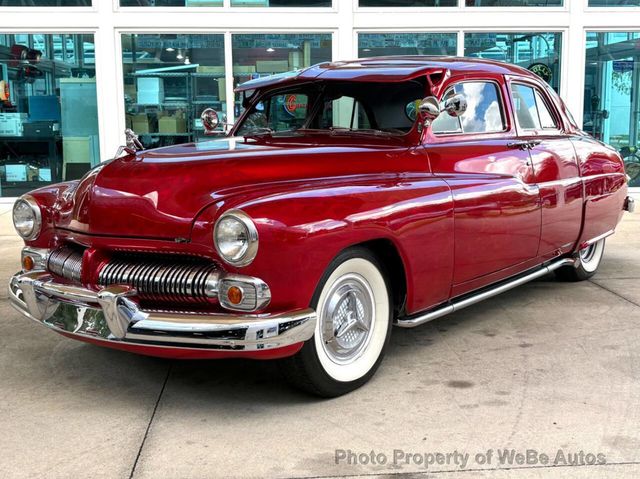
1950 Mercury Coupe — Candy Apple Red Custom with Flathead V8 and Dual Carbs The 1950 Mercury Coupe holds a specific and well-earned place in American automotive history. When Ford introduced the redesigned Mercury line for 1949, the result was a low, wide, fastback-style body that custom car builders immediately recognized as raw material worth working with. By 1950, the design had been refined slightly, and the coupe body style — with its long roofline, wide rear glass, and smooth flanks — became the foundation for some of the most celebrated customs of the era.
Ike Uyeda, Sam Barris, and most famously his brother George Barris used the 1949 to 1951 Mercury coupe as the starting point for cars that defined what custom culture meant in postwar America. The 'shoebox' Mercury, as it came to be known, was not just popular — it was the template. This particular 1950 Mercury Coupe has been built in that same tradition: a serious custom with real mechanical upgrades, a finished undercarriage, and a presence that is immediately recognizable to anyone who knows the history of this body style.
Why This Car Is Special The 1950 Mercury Coupe was the preferred canvas of the early custom car movement for good reason. Its proportions were already lower and longer than most American cars of the period, and the body responded well to the nips, chops, and modifications that builders applied to it. This example has not been chopped or sectioned — it wears its original roofline — but what has been done is thorough and cohesive.
The Candy Apple Red paint with subtle flame detail, the Edelbrock-equipped flathead V8 running dual carburetors, and the painted undercarriage tell you this car was built by someone who paid attention to the whole package, not just the parts you see at eye level. The upgrades are practical where they need to be — alternator conversion, power steering, upgraded shocks — and expressive where the build calls for it, with gold flake dash work, a custom wood steering wheel, and chrome spotlight mirrors that put this squarely in the classic kustom tradition. Features - Flathead V8 with Edelbrock intake manifold - Dual carburetor setup - Dual exhaust system with chrome tips - Alternator upgrade replacing original generator - Power steering - Lowered suspension - Upgraded shocks - Painted undercarriage - Whitewall tires - Custom chrome star hubcaps - Chrome rocker panel trim - Chrome spotlight mirrors - Chrome bumpers front and rear - Custom hood ornament - Candy Apple Red paint - Subtle flame detail paintwork - Custom wood steering wheel - Custom gold flake dash panel - Upgraded gauges and tachometer - Aftermarket AM/FM stereo - Power windows - Cloth bench seats front and rear in gray and burgundy - Seat belts front and rear Mechanical The heart of the 1950 Mercury Coupe is the flathead V8, and that engine is very much present here.
Ford's flathead V8 had been in continuous development since 1932, and by 1950 the Mercury version displaced 255 cubic inches and produced around 110 horsepower in stock form. That number goes up meaningfully when you add what this car has: an Edelbrock intake manifold feeding a dual carburetor setup. Edelbrock was producing performance intake manifolds for the flathead as far back as the 1940s, and their dual-carb setups were a staple of early hot rod and custom builds.
The result is a noticeable improvement in throttle response and top-end breathing compared to the single-carb factory configuration. A dual exhaust system handles the exit side of the equation, and chrome tips exit cleanly at the rear. The original generator has been replaced with an alternator, a practical upgrade that provides more reliable electrical output and supports the power windows, stereo, and other modern accessories without stressing the charging system.
Power steering has been added, which makes a meaningful difference in a car this size. The suspension has been lowered for a cleaner stance, and upgraded s
Mercury Eight Buyer's Guide
Mercury Eight Market Overview
Based on 27 Mercury Eight listings currently on ClassicCarsArena.com
Selling a classic? Here's how
Fees, audience and photo limits compared: the best sites to sell a classic car .
Mercury Eight Buyer's Guide
Jim Vasquez here, and I want to be honest about my bias: the Mercury Eight is my people's car. When guys like Harry Westergard and the Ayala brothers were shaping what custom culture would become, they kept coming back to the same starting point, the Mercury Eight. The proportions were right, the mechanicals were willing, and that flathead V8 just begged to be modified.
The Mercury Eight ran from 1939 through 1951, and every single year produced something special. The pre-war cars (1939–1942) established the template. The postwar cars (1946–1951) refined it, culminating in the 1949–1951 fastback body styles that James Dean made immortal. If you want to understand where hot rodding and custom culture came from, you need to start here.
What to Check Before Buying
Common Issues
What to Look For
Price Guide
Did You Know?
1950 Mercury Eight
Contact Seller

Car alert
Get an email when a 1945-1955 Mercury Eight is listed
At most one email a day. Stop anytime with one click.
Nationwide consignment dealer
WeBe Autos lists vehicles from sellers across multiple states. The vehicle may not be at the dealer's address shown. Contact the dealer to confirm the vehicle's actual location before traveling.
Buying safely?
Read our scam-avoidance tips before paying →
Listing Actions
Browse by Era
1950s Classics for SaleAll 1950 Classics
Browse all 1950 Cars for SaleGet classic car alerts
Latest arrivals, newest deals, and discount coupons, straight to your inbox.
Selling your classic car?
Reach millions of classic car enthusiasts on the largest US classics marketplace.
Sell Your Car →Similar Listings

 United States
1939 Mercury Eight
 United States
1939 Mercury Eight
 United States
1940 Mercury Eight
 United States
1940 Mercury Street Rod
Contact Seller
Call this seller?
You're about to call WeBe Autos about the 1950 Mercury Eight.
+1 (631) 339-0399
Car alert
Get an email when a 1945-1955 Mercury Eight is listed
At most one email a day. Stop anytime with one click.
Report this Ad
Help us keep the marketplace clean. Our moderation team reviews every report within 24 hours.