
Oldsmobile 88 Buyer's Guide
The 1949 Oldsmobile Rocket 88 is the first muscle car — a lightweight body with a big-displacement overhead-valve V8 that made it the fastest American production car in its day. Everything that followed in the American performance car tradition traces back to this car.

Mike Sullivan here. Before the GTO, before the 409, before any car we typically call a "muscle car," there was the 1949 Oldsmobile 88. Take a look at what it was: the company put their new high-compression overhead-valve 303ci "Rocket" V8 — their big engine — into the lighter Futuramic 76 body instead of the heavier 98. Lighter car, bigger engine. That's the muscle car formula, and Oldsmobile invented it in 1949.
The Rocket 88 dominated NASCAR in 1950 and 1951, won its class at Daytona, and proved the performance credentials beyond any marketing claim. Jackie Brenston's "Rocket 88" — often called the first rock and roll song — was a tribute to this car in 1951. When you buy an early Olds 88, you're buying the origin story of American performance.
The Muscle Car Origin: 1949–1953
The 1949 Oldsmobile Rocket 88 was the product of an engineering decision that changed everything. Oldsmobile had developed the "Rocket" engine — a 303ci overhead-valve V8 with a high-compression design that produced 135 horsepower and a then-remarkable power-to-weight ratio. The company put this engine into the lighter "Futuramic" 76 body for 1949, creating a car that was simultaneously elegant, comfortable, and faster than anything in its price class.
The performance was real. At the February 1950 Daytona Speed Trials, Rocket 88s took the top three positions. In the first season of the NASCAR circuit in 1950, 88s won 10 of 19 races. Lee Petty drove one. Red Byron drove one. These weren't specially prepared race cars — these were cars you could walk into an Olds dealer and buy.
The Rocket V8 Family
The 303ci engine grew through the 1950s into a family of increasingly capable V8s. By 1956, the 324ci Rocket V8 produced 230 horsepower. By 1959, the 394ci version was producing 315 horsepower — impressive for a production car of any era. These engines established Oldsmobile's performance credibility and led directly to the 442 program in the 1960s.
The Classic Era: 1954–1964
The 88 continued through the 1950s as Oldsmobile's volume performance car. The design evolved with each year — the 1957 and 1958 cars had the fin treatment that the era demanded; the 1959–1960 cars had the "plateau" twin-fin design; the 1961–1963 cars had a cleaner, more controlled appearance. All of these were genuine performers with the current Rocket V8 engine and Hydra-Matic transmission.
| Year | Engine | Output | Notes |
|---|---|---|---|
| 1949–1951 | 303ci Rocket V8 | 135–160 hp | Original Rocket; NASCAR winner |
| 1952–1955 | 303ci / 324ci V8 | 145–185 hp | Progressive development |
| 1956–1958 | 324ci / 371ci V8 | 230–312 hp | Fin era; significant power growth |
| 1959–1963 | 394ci V8 | 270–315 hp | Peak displacement Rocket |
| 1964–1970 | 330ci / 400ci / 425ci V8 | 260–375 hp | Super 88 and Delta 88 era |
| 1971–1974 | 350ci / 455ci V8 | 170–320 hp | Emissions era; 455 still torquey |
Super 88 and Delta 88
Oldsmobile added the "Super 88" designation in 1951 for a higher-trim, slightly longer version, and the "Delta 88" name arrived in 1965. The Delta 88 is the version most widely available in the market today — a full-size cruiser with the 400ci or 455ci V8 that represents the mature muscle car era. These are legitimate performers at remarkably low prices compared to equivalent Chevrolet Impalas or Ford Galaxies.
The 442 Connection
The Oldsmobile 442 grew directly from the 88 platform in 1964 — Olds took the F-85 Cutlass body, added the big-block engine option, and created a muscle car package that became legendary. The 88 continued as the full-size alternative: all the torque, all the performance, in a car that could seat six. The 455ci 88 of the early 1970s is the overlooked bargain of the Olds collector world.
"People argue about where the muscle car started and usually land on the 1964 GTO. But the formula — big engine, light body, go fast — was Oldsmobile in 1949. They did it first, they proved it on the track, and they got the song written about them. That's the original."
— Mike Sullivan
Browse Oldsmobile 88 listings
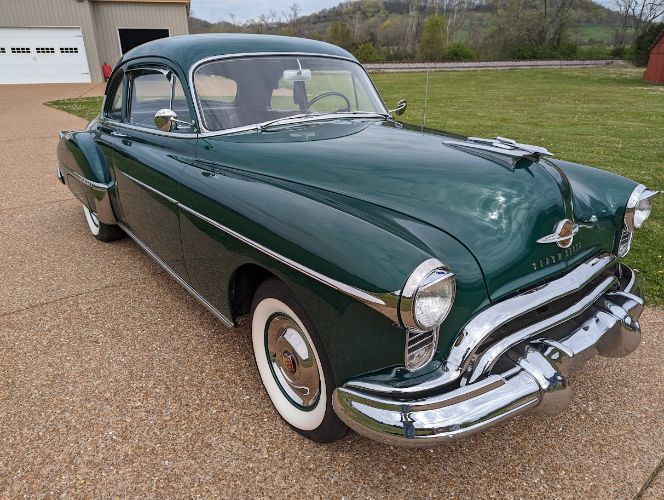 Dealer
 United States
1950 Oldsmobile 88
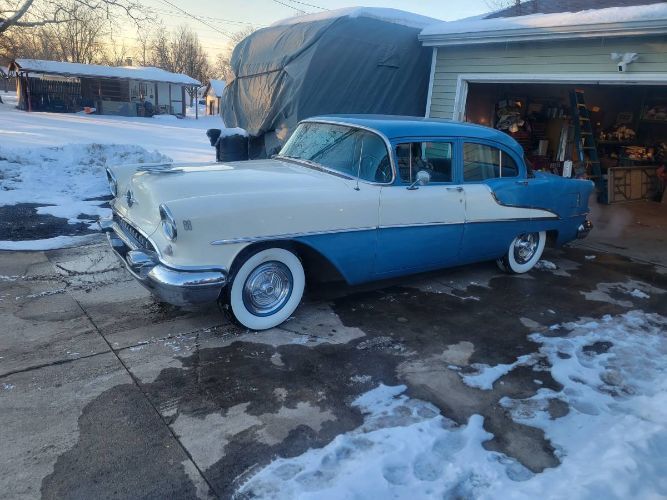 Dealer
United States
Dealer
United States
1955 Oldsmobile 88
What to Look For
On 1949–1953 Rocket 88s, inspect the frame rails and body sills carefully — these are 70+ year old cars and rust is the primary enemy. The original 303ci Rocket V8 should be compression-tested; these engines have been through many decades and condition varies widely. Verify the correct Hydra-Matic transmission — these early units are rebuildable but finding specialist shops is harder than for later cars. On 1955–1964 88s, inspect the lower door skins and rocker panels for rust. On Delta 88s with the 455ci, check for the typical Olds oil consumption from worn valve stem seals — detectable with a cold-start smoke test. Verify the Turbo-Hydramatic transmission operation: smooth shifts through all ranges without slip.Pre-Purchase Checklist
-
Frame Rust (1949–1956)
Inspect frame rails thoroughly on early cars — these are 70+ year old vehicles and frame integrity is foundational. -
Lower Door & Rocker Rust
Probe lower doors and rockers on all generations — standard rust location on all Olds 88s. -
Rocket V8 Compression
Compression test on early cars — verify even cylinders and no outliers before purchase. -
455ci Smoke Test
Cold start on 455ci cars — blue smoke indicates valve stem seal wear, manageable but plan for repair. -
Transmission Function
Drive through all ranges: smooth shifts with no slipping. Early Hydra-Matic or later TH400 both rebuildable. -
Carburetor Operation
Cold start and warm idle — varnish from storage is common on any Olds that has been sitting. -
Interior Condition
Assess upholstery and headliner condition — replacement materials are available but original interiors add value. -
VIN Verification (Performance Cars)
On claimed high-performance variants, verify the broadcast sheet or trim tag against the car's specification.
Common Issues
Frame and body rust on 1949–1956 cars — age is the primary concern. Lower door skin and rocker panel rust on all generations. Early Rocket V8 oil consumption on unrestored high-mileage examples. Hydra-Matic seal leaks on 1949–1955 cars. 455ci valve stem seal wear causing blue smoke at startup — manageable with regular maintenance. TH400 band adjustment needed on high-mileage later cars. Carburetor varnish on all stored examples.More 88 for sale
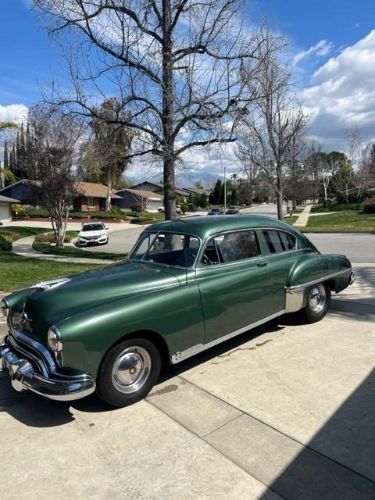 Dealer
United States
Dealer
United States
1949 Oldsmobile 88
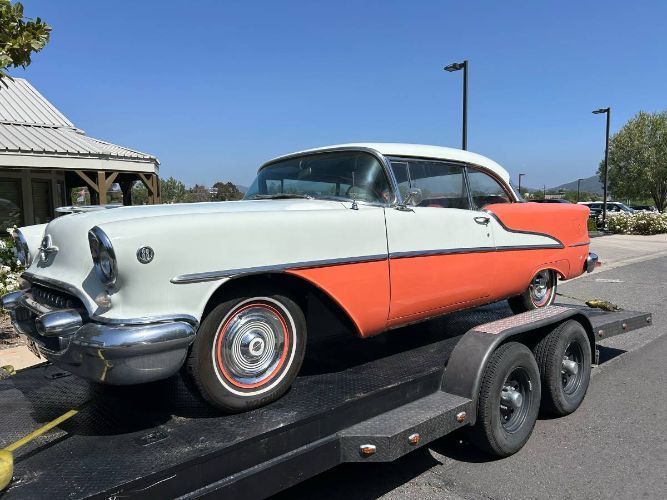 Dealer
United States
Dealer
United States
1955 Oldsmobile 88
Pricing Guide
1949–1951 Rocket 88 (any condition): $14,000–$40,000. 1952–1956 88 (driver): $10,000–$22,000. 1957–1964 88/Super 88 (driver): $8,000–$18,000. 1965–1970 Delta 88 (400ci or 425ci): $7,000–$18,000. 1971–1974 Delta 88 (455ci): $5,000–$14,000. Royale Brougham variants add 10–20% over standard Delta 88. Documented 1949–1951 Rocket 88 in show condition: $45,000–$75,000.Fun Facts
"Rocket 88," recorded at Sun Studio by Jackie Brenston in 1951, is considered by many music historians to be the first rock and roll record — it was a direct tribute to the Oldsmobile 88's performance reputation. The 88 won 10 of 19 NASCAR races in the inaugural 1950 season, establishing the car's performance credentials beyond any advertising claim. The same basic performance concept Oldsmobile applied in 1949 — big engine in a lighter, lower-trim body — became the defining formula for every muscle car that followed over the next 25 years.Frequently Asked Questions
Ready to find your 88?
Browse 6+ active Oldsmobile 88 listings on Classic Cars Arena.
View Listings →