Elite Dealer

1955 Chevrolet Bel Air

$32,997
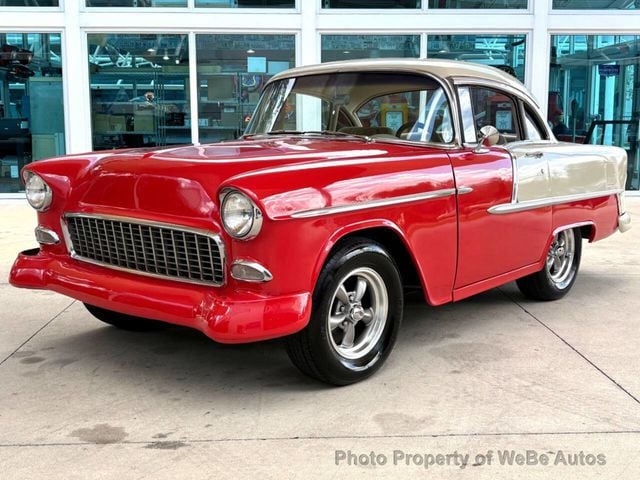
1955 Chevrolet Bel Air

Vehicle Details

Make

Chevrolet

Model

Bel Air

Year

1955

Mileage

36,997 miles

VIN

VC55N120309

Body Type

Coupe

Transmission

Automatic

Engine

350 V8

Description

1955 Chevrolet Bel Air — Custom Shorty Build with 350 V8 and Dual Exhaust Why This Car Is Special The 1955 Chevrolet Bel Air is one of the most recognizable automobiles ever built in America. It was part of what Chevrolet internally called the 'Motoramic' generation — the first year of a completely new body design that replaced the rounded, slab-sided styling of the early 1950s. Designer Clare MacKichan led the team that gave the 1955 Chevy its low, wide, Ferrari-inspired grille, wraparound windshield, and clean two-tone bodywork.

The car was a commercial and cultural landmark. Chevrolet sold nearly 1.7 million passenger cars that year, and the Bel Air was the top-trim model in the lineup, sitting above the Two-Ten and One-Fifty series. What made 1955 especially significant was the introduction of Chevrolet's first small block V8.

The 265 cubic inch engine was a clean-sheet design by Ed Cole and Harry Kleinhans, and it changed the American performance landscape permanently. It was light, efficient, and easy to modify — a trait that made the tri-five Chevys a natural foundation for hot rodders and custom builders for the next seven decades. The small block grew over the years into the legendary 350, which is exactly what powers this car today.

This particular 1955 Chevrolet Bel Air has been built in what is known in the hobby as a 'shorty' configuration — a custom build style where the roofline, body, or overall proportions are modified to give the car a lower, choppier, more aggressive stance than factory. It is a deliberate departure from stock, and that is the point. The builder chose to keep the Bel Air's identity intact — the correct trim badges, the original dashboard architecture, the signature two-tone paint — while adding a purpose-built drivetrain and a set of supporting upgrades that make it a real driver.

The odometer shows 369,975 miles, a number that reflects the car's age and history, and the VIN prefix VC55N confirms this is a 1955 Chevrolet passenger car built at the Norwood, Ohio assembly plant. This is not a show trailer queen. It is a finished, driveable custom that can be enjoyed today.

Features List - Custom Shorty build - 350 cubic inch small block V8 - Edelbrock 4-barrel carburetor and performance intake manifold - Chrome Edelbrock air cleaner - Shorty headers - Dual exhaust with Flowmaster mufflers and chrome tips - Aluminum radiator - ACCEL performance plug wires - Chrome valve covers - Upgraded alternator - Two-tone red and cream exterior paint - Chrome front and rear bumpers - REV Classic alloy wheels - Fuzion Touring tires - Bel Air trim badge and original-style dashboard - Dashboard clock - Custom steering wheel - Tufted velour front bench seat - Lap seat belts - Red carpet interior - Sunpro Sport three-gauge cluster (oil pressure, water temperature, volts) - AM radio - Clean undercarriage Mechanical The engine in this 1955 Chevrolet Bel Air is a 350 cubic inch small block Chevrolet V8, the displacement that the original 265 grew into by 1967 and the displacement that became the backbone of General Motors performance cars and trucks for decades. On top of that block sits an Edelbrock carburetor and matching Edelbrock intake manifold. Edelbrock has been building intake and carburetion hardware since the 1930s, and their performer-series combinations are a trusted pairing for street-driven small blocks — improving airflow over stock while remaining well-suited to pump gas and everyday driving.

The chrome Edelbrock air cleaner visible in the engine photos is a common complement to that setup and keeps the presentation clean and consistent. The shorty headers improve exhaust scavenging compared to stock cast iron manifolds, allowing the engine to breathe more freely at the top end. From there, exhaust flows into a dual system running Flowmaster mufflers and exiting through chrome rectangle tips at the rear.

Flowmaster's chambered muffler design produces a distinctive tone tha

Classic Chevrolet Bel Air Buyer's Guide

Full guide
M
Mike Sullivan
Muscle Cars
1950–1975
~5 min read
Updated Apr 2026
Definitive buyer's guide for classic Chevrolet Bel Air 1950-1975. Tri-Five 1955-1957 era, body trim verification, small-block V8 identification, frame inspection, and current market pricing.
This guide covers
10-point inspection checklist
Common issues & what to avoid
In-person inspection guide
Market pricing by year & condition
5 FAQs answered
History & fun facts

Chevrolet Bel Air Market Overview

Based on 203 Chevrolet Bel Air listings currently on ClassicCarsArena.com

203
Listed Now
$53,756
Avg. Asking Price
1950–1993
Year Range
Price Position on Our Site — Below Average
This car: $32,997
Low: $6,495 High: $178,995
Transmission Distribution
Automatic 56% ◄
Manual 29%
Condition Distribution
Excellent 15%
Good 10%
Fair 4%
Poor 2%
Data from ClassicCarsArena.com listings Browse all 203 listings →
💰

What is this car worth?

Check sold prices for the 1955 Chevrolet Bel Air

Valuation Tool →

Classic Chevrolet Bel Air Buyer's Guide

The Chevrolet Bel Air ran from 1950 through 1975 across five distinct generations, but for collectors, the name means one thing above all: the 1955-1957 Tri-Five era. Those three model years define the most iconic Chevrolet body shape ever produced and represent one of the most active segments in the entire classic car market. Whether you're hunting a 1957 fuel-injected convertible, a clean 1955 hardtop, or a survivor 1953-1954 Bel Air with the original Blue Flame six, knowing what separates a documented original from a Chevy 210 dressed up with Bel Air trim is the difference between an honest investment and an expensive lesson.

What to Check Before Buying

Verify cowl tag body code matches claimed trim — Many 150s and 210s sold as Bel Airs. Cowl tag body code is the only reliable trim verification.
Cross-reference VIN engine code with block casting — 5th digit of VIN identifies engine. Casting number on back of block must agree.
For 1957 Fuelie claims, demand specialist authentication — VCCA, NCRS, or recognized Tri-Five specialist. Forgeries exist with non-original FI units.
Inspect X-frame body mount points — Collapsed bushings collect water and rot frame from inside. Common rust point on Tri-Five cars.
Probe X-frame at front kick-up — Behind front wheels. Solid steel resists; rotten metal flakes.
Magnet test rear quarters and rockers — Body filler is non-magnetic. Driver-quality cars universally have filler — verify how much.
Check trunk floor and drop-offs — Lift trunk mat to inspect. Trunk pan rusts from underneath; drop-offs collect water.
Examine cowl seam for water damage — Where windshield base meets firewall. Cowl rust drains into cabin and rots floor pans.
For convertibles, inspect rear corners — Top mechanism mounts here. Structural rust compromises top operation and convertible value.
Test all electrical and verify 6V vs 12V — 1950-1954 cars original 6V; 1955+ original 12V. Verify conversion done properly if applicable.

Common Issues

Tri-Five Bel Air rust hits in predictable places. Lower rear quarters (especially behind the rear wheels), rocker panels, lower fenders, trunk floor pan, trunk drop-offs, floor pans (front and rear footwells), and the cowl seam where the windshield base meets the firewall. The X-frame on 1955-1957 cars rusts at the body mount points and at the kick-up behind the front wheels. Convertibles add structural concerns at the rear corners where the top mechanism mounts to the body. Mechanically, the 235 Blue Flame six (1953-1962) and the 265/283/327 small-block V8s (1955+) are bulletproof when maintained. Common issues include worn timing chain on inline-sixes, leaky valve covers and oil pan gaskets, and tired Carter or Rochester carburetors. The Powerglide two-speed automatic and the Saginaw three-speed manual are both robust; the Muncie four-speed (rare on early cars) is the most desirable transmission. Differential whine on deceleration indicates worn pinion bearings — $1,200-$2,500 to repair. Electrical issues are universal classic-car concerns: brittle 65+ year-old wiring harnesses, failing voltage regulators, worn ignition switches, and tail light bulb sockets that corrode and fail. Many cars have been converted to 12-volt systems from the original 6-volt (1950-1954) — verify the conversion was done properly before purchase.

What to Look For

VIN authentication is the first stop. The 1955-1957 Bel Air VIN is on the driver-side door jamb plate (later cars) or the cowl tag under the hood (early 1955 cars). The trim tag (also on the cowl) lists the body style code, paint code, interior code, and accessory codes. Cross-reference all three (VIN, cowl tag, build sheet if present) before negotiating final price. For 1955-1957 cars, the fifth digit of the VIN identifies the engine. Cars with the 265 V8 (1955-1956) have specific casting numbers; cars with the 283 V8 (1957) similarly. The rare 1957 Fuelie cars (with mechanical fuel injection on the 283) carry significant premium pricing and require specialist authentication. Body trim verification is essential. The Bel Air was the top trim level on 1953-1956 cars (above the 150 and 210 sub-models), and many cars sold today as Bel Airs are actually base 150s or mid-trim 210s with Bel Air emblems and trim added. The cowl tag body code identifies the original trim level — verify before paying premium money. Frame inspection is the second non-negotiable. Crawl under the car with a flashlight. Probe the X-frame at the rear body mount points and the front kick-up. Body mount bushings collapse over 60+ years and water pools above them, rotting the frame from inside the boxed sections. Replacement is $2,500-$5,000 per side if needed.

Price Guide

1955 Bel Air values: driver-quality 265 V8 hardtops run $28,000-$48,000 today. Convertibles add $15,000-$25,000 to equivalent hardtop pricing. Documented original-paint, low-mileage cars: $55,000-$95,000. 1956 Bel Airs are similarly priced — driver-quality hardtops $28,000-$48,000, convertibles $45,000-$75,000. The Nomad two-door wagon (Bel Air-trimmed) is a special case at $55,000-$95,000 for solid drivers and $120,000-$220,000 for documented originals. 1957 Bel Air is the icon. Driver-quality 283 V8 hardtops run $38,000-$65,000. Convertibles: $55,000-$95,000. Documented Fuelie 283 cars: $120,000-$280,000+ depending on body style. The 1957 Bel Air convertible is one of the most photographed and recognized American cars in the world, and prices reflect that cultural status. 1953-1954 Bel Airs (Blue Flame six era) are the bargain entry into Bel Air ownership at $22,000-$40,000 for solid drivers. 1958-1964 cars (post-Tri-Five) are dramatically cheaper — $15,000-$32,000 for driver-quality examples. 1965-1975 Bel Airs (full-size B-body era) are the bargain segment, with clean drivers at $12,000-$25,000. Project Tri-Five Bel Airs (running but rough) start around $10,000-$20,000. Stripped roller candidates: $5,000-$12,000. Rust restoration runs $25,000-$60,000 in body and frame work alone.

Did You Know?

The 1955 Bel Air was the launch year of the small-block Chevy V8 (the 265), one of the most successful engine designs in automotive history. The basic small-block architecture remained in production through the 2000s, powering everything from passenger cars to trucks to crate engines, and the 1955 launch is widely credited with establishing Chevrolet performance credibility for the next half-century. The 1957 Bel Air convertible has been featured in over 200 films and television productions, making it among the most-photographed American cars in cinema history. Pop-culture exposure has reinforced collector demand and continues to support strong pricing for clean original examples. Roughly 1,530 1957 Chevrolets were fitted with the optional 283 cubic inch V8 with Rochester Ramjet mechanical fuel injection (the famous "Fuelie"), making it a rare factory option. The Fuelie produced 283 horsepower — one of the first American production engines to achieve one horsepower per cubic inch. Documented Fuelie Bel Airs now command significant premium pricing and require specialist authentication.

How Does It Compare?

Head-to-head matchups for the Chevrolet Bel Air:

Browse all comparisons →

Similar Listings

Contact Seller

Share only if you'd like the seller to call you directly.

By contacting this seller you accept the Visitors Agreement

Call this seller?

You're about to call WeBe Autos about the 1955 Chevrolet Bel Air.

+1 (631) 339-0399

Before you call: Never wire money or share bank info over the phone. Read our scam-avoidance tips.
Call Now

Send to a Friend

Share this 1955 Chevrolet Bel Air listing.

Report this Ad

Help us keep the marketplace clean. Our moderation team reviews every report within 24 hours.