
1970 Chevrolet Camaro
$49,995
Vehicle Details
Chevrolet
Camaro
1970
1,500 miles
Coupe
Manual
463
Description
1970 Chevrolet Camaro
• 463ci Big Block V8
• 6-Speed Manual
• Documented Performance Build
Platt Motors is pleased to offer this extensively modified 1970 Chevrolet Camaro, a long-term-owned American muscle car featuring a professionally built 463-cubic-inch Chevrolet big-block V8, Borg-Warner 6-speed manual transmission, upgraded 12-bolt Positraction rear axle, four-wheel disc brakes, and an impressive collection of engine-building documentation.
Owned by the same enthusiast for more than 25 years, this Camaro represents a decades-long passion project. The owner describes building the car into the Camaro he dreamed of having in high school, continually refining its performance, appearance, and driving characteristics over the years.
Throughout its history, the Camaro has undergone several configurations, including drag racing, autocross, and street-oriented use. Today, it combines substantial horsepower potential, a performance-oriented drivetrain, and aggressive muscle-car styling.
ENGINE AND PERFORMANCE
At the heart of this Camaro is a professionally built 463ci Chevrolet big-block V8, assembled by Steve White Enterprises of Anderson, California.
Extensive documentation from 2018 and 2019 accompanies the vehicle, including engine measurements, machining specifications, cylinder-head valve spring setup sheets, rotating assembly balancing records, parts breakdowns, and an April 15, 2019 invoice totaling $10,711.23.
Documented engine work and components include:
* 463ci Chevrolet big-block V8 * 4.290-inch bore and 4.000-inch stroke * Professionally machined engine block * Block sonic testing and recorded cylinder-wall measurements * Crankshaft machining and balancing * KB hypereutectic pistons * Performance camshaft and roller lifters * Upgraded valve springs and pushrods * Cylinder-head and manifold package * Performance ignition components * Engine assembly, clearance verification, and test-running
The owner reports approximately 1,500 miles on the engine since the build.
TRANSMISSION AND REAR AXLE
Power is delivered through a Borg-Warner 6-speed manual transmission, providing the driver with direct control of the big-block Chevrolet’s performance.
The Camaro also features a substantially upgraded 12-bolt rear axle, with accompanying parts documentation from The Performance Shop in Redding, California.
Documented rear-end components include:
* GM 12-bolt rear axle assembly * Richmond 4.11 rear gears * 3-series Positraction differential * Moser 31-spline axles * Moser C-clip eliminator components * Moser forged aluminum 1350 yoke * Reinforced rear-end components * Rear disc-brake conversion components
The combination of a big-block V8, 6-speed manual transmission, and 4.11 rear gearing gives this Camaro a decidedly performance-focused character.
CHASSIS, BRAKES AND WHEELS
Originally developed with racing in mind, the Camaro has evolved through several stages of performance modification.
The owner reports that the vehicle previously had a roll cage, which has since been removed as the car transitioned toward street use.
Additional equipment and features include:
* Wilwood four-wheel disc brakes * Performance-oriented suspension modifications * Rear sway bar and chassis upgrades * Performance fuel system with racing-style fuel pump * Approximately 15-gallon fuel cell * Staggered 17-inch front and 18-inch rear wheels * Nitto performance tires * Rear tires approximately 275/40ZR18 * Front tires approximately 245/45ZR17
EXTERIOR AND INTERIOR
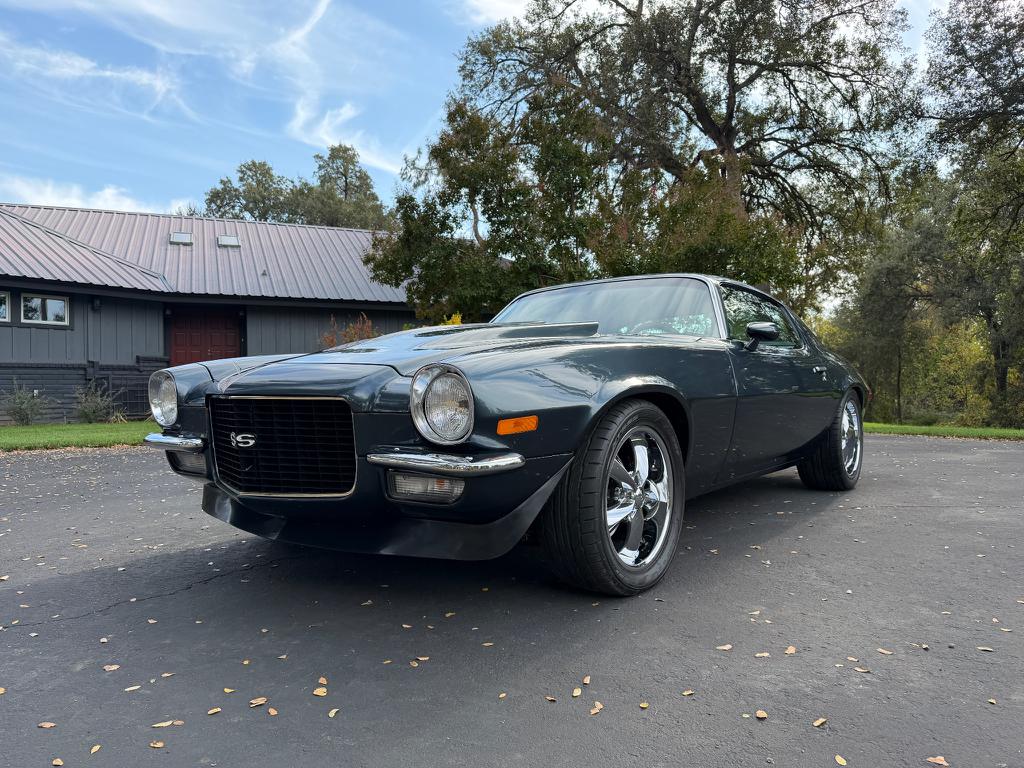
The Camaro is finished in a striking dark metallic blue, described as a modern Chevrolet Denali color. The owner reports that the vehicle was repainted approximately three years ago.
The deep blue finish complements the Camaro’s aggressive second-generation body styling and gives the vehicle a distinctive appearance.
According to the owner, the body is free of known rust, although a couple of paint imperfections are acknowledged.
The interior is described as mostly new, reflecting the owner’s continued investment in the vehicle over the years.
OWNERSHIP AND BUILD HISTORY
One of this Camaro’s most appealing attributes is its long-term ownership and documented development.
The current owner has enjoyed the vehicle for more than 25 years, gradually transforming it into his vision of the ideal performance Camaro.
Rather than following a single build formula, the car has evolved through numerous configurations, reflecting the owner’s interests in drag racing, autocross, and high-performance street driving.
The engine was professionally built by Steve White Enterprises, with detailed machining and assembly paperwork preserved.
Supporting records include:
* Engine assembly and machining documentation * Cylinder-head and valve spring specifications * Engine block sonic testing results * Crankshaft balancing records * Detailed engine parts invoices * April 2019 engine build invoice * Rear axle and performance component documentation * Additional restoration receipts and spare parts reported by the owner
CONDITION AND DISCLOSURES
The owner reports a recent oil change using 15W-40 oil and replacement spark-plug wires.
A small belt squeal upon startup has been disclosed.
The vehicle is extensively modified from original factory specifications and has a history of competition-oriented use. It should be evaluated as a custom-built performance vehicle rather than a factory-original restored Camaro.
Mileage shown on the vehicle is approximately 1,406 miles; actual total chassis mileage is not verified.
WHY THIS CAMARO IS SPECIAL
Finding a modified 1970 Camaro is not especially difficult. Finding one with more than 25 years of ownership history, a documented professional big-block engine build, substantial drivetrain upgrades, and records supporting the work is considerably more interesting.
This Camaro represents years of enthusiasm, mechanical development, and personal investment. It was built to be enjoyed, driven, and appreciated by someone who values old-school Chevrolet big-block performance.
For the enthusiast seeking a distinctive second-generation Camaro with a 6-speed manual transmission, aggressive styling, and documented performance components, this is a compelling opportunity.
Offered by Platt Motors, Weaverville, California.
Additional photographs, build documentation, and nationwide transportation assistance are available upon request.
Classic Chevrolet Camaro Buyer's Guide
Chevrolet Camaro Market Overview
Based on 247 Chevrolet Camaro listings currently on ClassicCarsArena.com
Selling a classic? Here's how
Fees, audience and photo limits compared: where to sell your classic car online .
Classic Chevrolet Camaro Buyer's Guide
The Chevrolet Camaro launched in September 1966 as Chevy's direct response to the Ford Mustang, and for over five decades it has defined American performance for an entire generation of enthusiasts. Whether you're hunting a numbers-matching first-generation Z/28, a survivor split-bumper second-gen, or a clean third-gen IROC-Z, the Camaro buyer's market is deep, varied, and full of pitfalls for the unprepared.
What to Check Before Buying
Common Issues
What to Look For
Price Guide
Did You Know?
Also Consider
Similar classic cars shoppers also browse:
How Does It Compare?
Head-to-head matchups for the Chevrolet Camaro:
1970 Chevrolet Camaro
Contact Seller
Listed by dealer
Car alert
Get an email when a 1965-1975 Chevrolet Camaro is listed
At most one email a day. Stop anytime with one click.
Buying safely?
Read our scam-avoidance tips before paying →
Listing Actions
More in this area
Browse by Era
1970s Classics for SaleAll 1970 Classics
Browse all 1970 Cars for SaleModel History
How the Chevrolet Camaro evolved (1967–2002) across 4 generations.
📈 View Full EvolutionGet classic car alerts
Latest arrivals, newest deals, and discount coupons, straight to your inbox.
Selling your classic car?
Reach millions of classic car enthusiasts on the largest US classics marketplace.
Sell Your Car →Similar Listings

 United States
1917 Chevrolet Touring Car
 United States
1918 Chevrolet 100
 United States
1924 Chevrolet 100
 United States
1925 Chevrolet 100
Contact Seller
Call this seller?
You're about to call Platt Motors about the 1970 Chevrolet Camaro.
+1 (707) 599-9448
Car alert
Get an email when a 1965-1975 Chevrolet Camaro is listed
At most one email a day. Stop anytime with one click.
Report this Ad
Help us keep the marketplace clean. Our moderation team reviews every report within 24 hours.