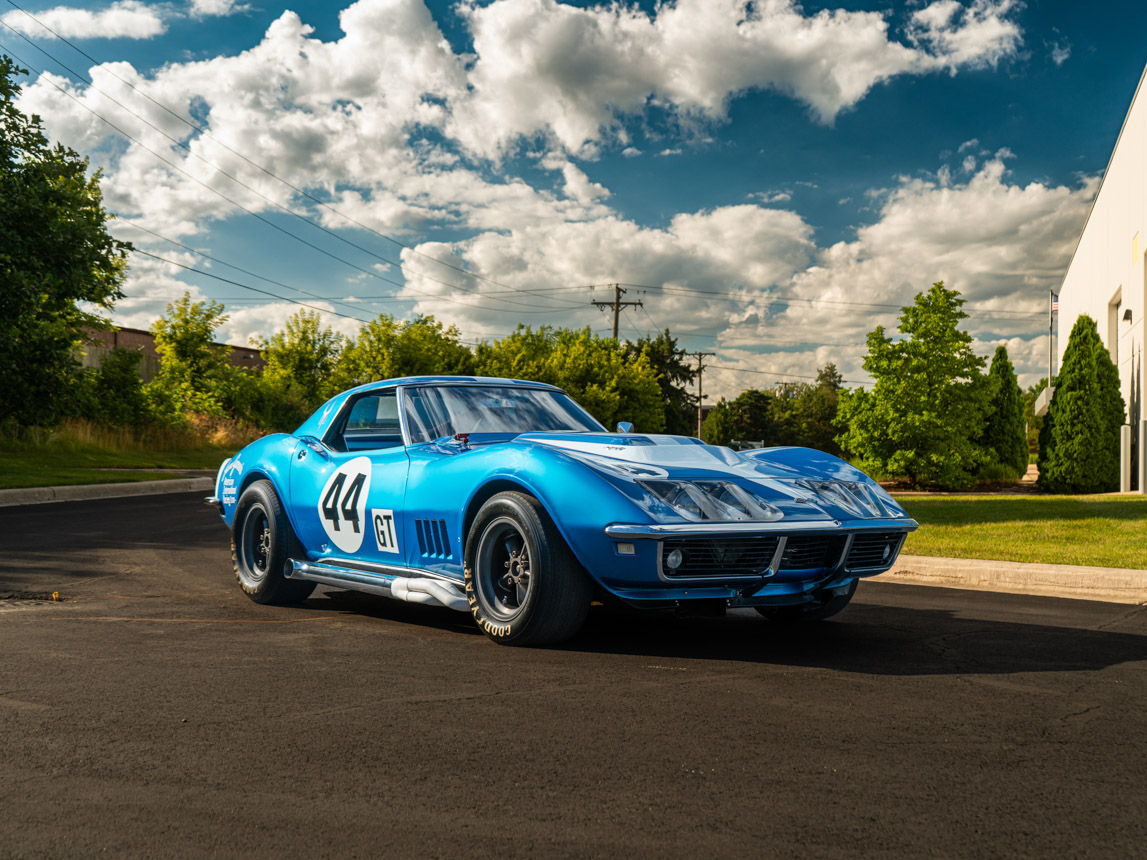
1968 Chevrolet Corvette

Anaheim, California

$999,000

1968 Chevrolet Corvette

Vehicle Details

Make

Chevrolet

Model

Corvette

Year

1968

Body Type

Convertible

Transmission

Manual

Engine

L88 427/500+hp

Description

1968 Chevrolet Corvette L88 Convertible – James Garner AIR Daytona Race Car #44

An Extraordinary Piece of Corvette Racing and Hollywood History!

Corvette Mike is proud to offer one of the most historically significant Corvettes ever built: the legendary 1968 Corvette L88 Convertible, No. 44, campaigned by Hollywood icon James Garner’s American International Racing (AIR) team at the 1968 24 Hours of Daytona.

This remarkable Corvette represents a rare combination of Chevrolet’s legendary L88 performance, authentic motorsports history, and a direct connection to one of Hollywood’s most celebrated automotive enthusiasts.

The James Garner Racing Connection

Best known for his starring roles in Maverick, The Great Escape, and The Rockford Files, James Garner was also a passionate motorsports enthusiast who established American International Racing to compete at the highest levels of sports car racing.

In late 1967, Garner’s AIR team acquired three specially ordered 1968 Corvette L88 Convertibles, all finished in Le Mans Blue. These were no ordinary Corvettes. Equipped with Chevrolet’s legendary 427 cubic-inch L88 big-block engine, they were intended for serious competition.

With assistance from renowned Corvette racer Dick Guldstrand and legendary engine builder Traco Engineering, the cars were prepared for endurance racing.

Two of the three Corvettes, numbered 44 and 45, entered the grueling 1968 24 Hours of Daytona, marking an unforgettable chapter in Corvette racing history.

One of Only 80 L88 Corvettes Built in 1968!

The L88 was Chevrolet’s ultimate competition-oriented Corvette engine package. Although officially rated at 430 horsepower, its true performance potential was considerably greater.

Just 80 Corvettes were equipped with the L88 engine in 1968, making these cars among the most desirable and collectible big-block Corvettes ever produced.

What makes this particular example so extraordinary is its identity as the actual No. 44 James Garner AIR Daytona race car, one of only three L88 Corvettes originally prepared for Garner’s racing program.

Finished in its distinctive Le Mans Blue racing livery, this Corvette captures the spirit of American endurance racing during one of its most exciting eras.

A Rare Opportunity for the Serious Collector

Few Corvettes can claim such an extraordinary combination of rarity, historical significance, racing provenance, and celebrity association.

This isn’t simply another collectible L88 Corvette. It’s a genuine piece of American motorsports history, connected to James Garner, Dick Guldstrand, and the legendary 1968 Daytona endurance race.

For collectors seeking a truly significant Corvette with a story that goes far beyond production numbers, the James Garner AIR No. 44 L88 represents an exceptional opportunity.

Contact us for additional information, photographs, and details about acquiring this historically important Corvette.

Classic Chevrolet Corvette Buyer's Guide

Full guide
M
Mike Sullivan
Muscle Cars
1953–1982
~6 min read
Updated Apr 2026
Complete buyer's guide for classic Chevrolet Corvette C1, C2 and C3 (1953-1982). Birdcage rust, frame inspection, engine code identification, and current market pricing for split-windows, L88s and LT-1s.
This guide covers
✓ 10-point inspection checklist
✓ Common issues & what to avoid
✓ In-person inspection guide
✓ Market pricing by year & condition
✓ 5 FAQs answered
✓ History & fun facts

Chevrolet Corvette Market Overview

Based on 467 Chevrolet Corvette listings currently on ClassicCarsArena.com

467
Listed Now
$44,324
Avg. Asking Price
1931–2000
Year Range
Price Position on Our Site - Above Average
This car: $999,000
Low: $4,000 High: $999,000
Transmission Distribution
Automatic 50%
Manual 34% ◄
Condition Distribution
Excellent 15%
Good 15%
Fair 4%
Poor 1%
Data from ClassicCarsArena.com listings Browse all 467 listings →
💰

What is this car worth?

Check asking prices for the 1968 Chevrolet Corvette

Valuation Tool →
🔑

Selling a classic? Here's how

Fees, audience and photo limits compared: compare the places to sell classic cars .

List Yours →

Classic Chevrolet Corvette Buyer's Guide

The Chevrolet Corvette has been America's sports car for over seventy years, but the classic Corvette market splits into three distinct generations, each with its own buyer profile and its own pitfalls. The C1 (1953-1962), C2 mid-year (1963-1967), and C3 shark (1968-1982) cover three decades of evolution from solid-axle straight-six convertibles to small-block legends to LT-1-powered chrome-bumper cars. Knowing which Corvette is yours, and what it actually is versus what the seller claims, is the difference between a sound investment and an expensive lesson.

What to Check Before Buying

✓
Verify dashboard VIN against trim tag and engine partial VIN , All three must agree. Engine partial VIN is on driver-side block deck near cylinder head.
✓
Demand original tank sticker for any car over $60K , Glued inside top of gas tank. Lists all original options. Gold standard for premium Corvette verification.
✓
Order NCRS Shipping Data Report ($50) , Available from National Corvette Restorers Society. Confirms original equipment from GM records.
✓
Inspect birdcage at door frames and cowl , Pull door panels, lift carpet at windshield base. Perforation = $8,000-$25,000 structural repair.
✓
Probe frame at kick-up and rear cross-member , Solid steel resists; rotten metal flakes. Frame replacement is $15,000-$30,000 if needed.
✓
Examine fiberglass under raking light , Stress cracks at body mounts, headlight buckets, rear panel. Deep cracks = impact damage or chassis flex.
✓
Check T-top seals and headliner (C3) , Water staining indicates failed seals. Leaks rot birdcage from inside.
✓
Verify Big Block valvetrain on cold start , Solid-lifter L72/L78/L88/ZL1 should tick and subside with oil pressure. Continuous noise = valve adjustment or worn lifters.
✓
Compression test all eight cylinders , Should read 145-185 PSI uniformly across the bank. Variance >15% = head gasket or ring problem.
✓
Test all electrical and pop-up headlights (C3) , Vacuum-actuated headlights commonly fail. Hidden leaks in vacuum lines drop the lights at speed.

Common Issues

Corvette "birdcage" rust is the structural killer for C2 and C3 cars. The birdcage is the steel inner structure that supports the fiberglass body, windshield frame, A-pillars, doglegs, and roof. When the birdcage rots, the body flexes, glass cracks, and door alignment goes off. Birdcage repair on a C2 or C3 is $8,000-$25,000 depending on extent. Frame rust on C1 (boxed steel) and C3 (X-frame) Corvettes is the second major concern. The kickup behind the front wheels, the rear suspension mounting points, and the rear cross-member all rot in salt-belt cars. Probe the frame with a screwdriver, solid steel resists, rotten metal flakes. Mechanical issues vary by generation. C1s commonly have weak Powerglide automatics and tired solid-lifter 283 fuelies. C2s have strong drivetrains but the leaf-spring rear suspension wears bushings and the differential carriers crack. C3s suffer from sloppy T-tops that leak, failing radiators, and worn front coil springs that sag the front end. The L88 cars (1967-1969) had aluminum heads that crack from heat cycling, a deal-breaker if not previously addressed.

What to Look For

VIN authentication is the first stop. The C1 and C2 cars used the dashboard VIN plate; the C3 added the windshield-pillar VIN starting in 1968. Cross-reference the VIN against the trim tag (riveted to the body brace under the glovebox or on the firewall depending on year) and against the engine block partial VIN. Big Block cars (1965+ 396, 1966+ 427, 1970+ 454) and Z06/L88/ZL1 specials must have all numbers matching to claim premium prices. For C2 and C3 cars, inspect the birdcage. Pull the door panels and look at the inner door structure. Lift the carpet at the windshield base and look at the inner cowl. Pull the headliner if practical and look at the roof structure on coupes. Surface rust is acceptable; perforation is structural and expensive to repair. For any high-dollar Corvette claim (L71 427/435, L88, ZL1, Z06, LT-1) demand the original tank sticker (the build sheet that was glued to the inside top of the gas tank). Tank stickers are the gold standard for verification. Cross-reference the tank sticker codes against the VIN and the engine block partial VIN. Fiberglass condition is uniquely Corvette. Look for stress cracks at the body mount points, around the headlight buckets, and at the rear panel where the bumpers attach. Surface gel-coat cracks are cosmetic; deeper structural cracks indicate impact damage or chassis flex.

Price Guide

C1 (1953-1962) Corvettes range from $45,000 for solid 1958-1962 driver-quality 283 V8 cars up to $300,000+ for documented 1957-1962 fuelie cars in concours condition. The 1953 launch year (only 300 built) is a special case, documented original 1953s sell for $200,000-$400,000. C2 (1963-1967) is the most coveted Corvette generation. The 1963 split-window coupe is the icon, $95,000-$200,000 for drivers and survivors, $300,000+ for documented L84 fuelie cars. 1965-1967 396/427 Big Blocks are $85,000-$180,000 for drivers, with documented L71 Tri-Power cars at $140,000-$280,000. The 1967 L88 is the holy grail, only 20 were built, and documented examples bring $2.5M-$5M at auction. C3 (1968-1982) is the bargain entry to Corvette ownership. Driver-quality 1968-1972 small-blocks run $22,000-$42,000. The 1970-1972 LT-1 (small-block, solid-lifter, 350-360 hp) is the underrated gem at $45,000-$85,000 for documented numbers-matching cars. 1973-1977 cars are the bargain era at $15,000-$28,000. 1978 silver anniversary and 1982 Collector Edition cars trade for $22,000-$35,000.

Did You Know?

The Corvette name was suggested by GM PR director Myron Scott, named after the small, fast warship class. GM trademarked "Corvette" in May 1953, just one month before the car's June launch. The 1963 split-window coupe was a Bill Mitchell design that survived for only one model year. Zora Arkus-Duntov, the Corvette's chief engineer, hated the split window because it killed rearward visibility, and he successfully lobbied to remove it for the 1964 model year. The one-year-only design is now the most iconic Corvette body style ever produced. Only 20 L88 Corvettes were built for 1967, and Chevrolet deliberately under-rated the engine at 430 horsepower to keep insurance companies off the buyer's back. The L88 actually produced approximately 540 horsepower in road-going trim and was conceived purely as a homologation special for road racing: Chevrolet refused to install a heater, radio, or AM/FM in any L88, telling buyers to special-order them at the dealer if they actually wanted comfort features.

Similar Listings

Contact Seller

Share only if you'd like the seller to call you directly.

By contacting this seller you accept the Visitors Agreement

Call this seller?

You're about to call Corvette Mike about the 1968 Chevrolet Corvette.

+1 (714) 630-0700

Before you call: Never wire money or share bank info over the phone. Read our scam-avoidance tips.
Call Now

Car alert

Get an email when a 1963-1973 Chevrolet Corvette is listed

At most one email a day. Stop anytime with one click.

Send to a Friend

Share this 1968 Chevrolet Corvette listing.

Report this Ad

Help us keep the marketplace clean. Our moderation team reviews every report within 24 hours.