Pro Dealer

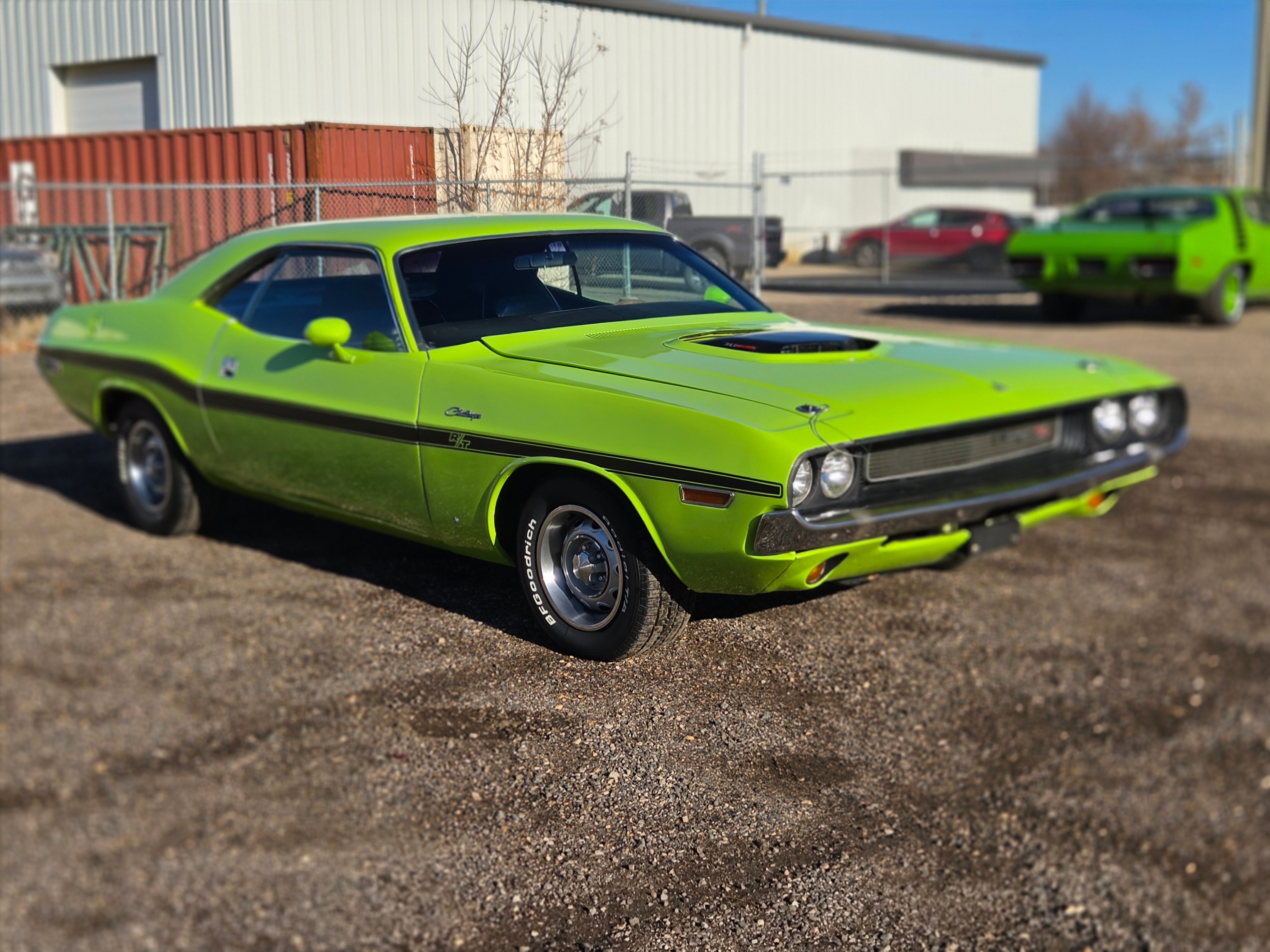
1970 Dodge Challenger

Saskatoon, Saskatchewan

$44,630

1970 Dodge Challenger

Video

Vehicle Details

Make

Dodge

Model

Challenger

Year

1970

Mileage

54,000 miles

Body Type

Coupe

Transmission

Manual

Fuel Type

Gasoline

Engine

383 ci V8

Description

Price: US $44,630 (CAD $62,990 at the dealer).

1970 Dodge Challenger R/T. True JS23 car, meaning the “S” confirms it’s a real R/T. N08 code translates to a 383 4-bbl V8 and D21 confirms it’s a 4-speed manual floor shift car! One of the most ultimate Mopars out there! Very well equipped and super cool! This car left the factory in FJ5 (Sublime green both upper and lower) and it’s been repainted in its factory color.

Paint quality is quite good too! Lots and lots of codes on the fender tag including high back bucket seats, console with wood grain, full door panels, Rallye instrument cluster pack, tachometer, tinted glass, left and right hand manual racing mirrors, hood tie down pins, roof drip rail moldings, dual exhaust with chrome exhaust tips, am radio, Canadian specs and longitudinal black stripes. After researching, it’s unclear if the Shaker hood was factory, or added after the fact, as it’s been documented that some 1970 Challenger’s lacked any code stamped, but were equipped with the hood. That may take some more research in the case of this car.

Besides that, everything else looks correct on this one. We have no proof the engine is numbers matching, but it runs, starts and drives well, just like you’d expect a vintage Mopar to. Under the hood the alternator is chromed, and there’s chromed Edelbrock valve covers.

Everything else looks stock. We’ve also determined that the two front fenders are fiberglass replacements. For years and years, metal replacements weren’t available, and the only restoration parts a guy could get were fiberglass.

Paint is nice, but the car overall condition would be considered above driver quality, but below a showroom car. It’s nice, but not so nice that you wouldn’t want to drive it, putting it right in the sweet spot for someone looking for a real ’70 R/T challenger they can get out onto the road without thinking twice! The interior is in fair shape again, with a little wear here and there, but no major concerns. Some of the things we will get to when the shop has time includes touching up the door panels (some peeling), re-dying the rear seat and possibly replacing the carpets.

There’s a bit of sun-fade on the carpets in some areas. Some sections of the instrument cluster could also use a bit of restoration work, but nothing that stops a person from driving and enjoying the car just the way it is. The trunk has the spare rallye wheel, jack and tire iron and the original radio in a box, as a newer CD player has been installed.

The trunk was painted black at some point (body color paint is factory correct), but at least it’s clean and in good shape. The car has a lot going for it! A true R/T with a 4-speed manual, lots of cool options, a great color and good looks in the kind of condition you could be driving all summer long! Hard to find a Challenger just as this one sits. The odometer reads 54,000 miles, but with only 5 digits, true milage is unknown.

Classic Dodge Challenger Buyer's Guide

Full guide
M
Mike Sullivan
Muscle Cars
1970–1974
~4 min read
Updated Apr 2026
Definitive buyer's guide for classic Dodge Challenger 1970-1974. E-body authentication, fender tag verification, Hemi and 440 Six Pack identification, current pricing.
This guide covers
✓ 10-point inspection checklist
✓ Common issues & what to avoid
✓ In-person inspection guide
✓ Market pricing by year & condition
✓ 5 FAQs answered
✓ History & fun facts

Dodge Challenger Market Overview

Based on 17 Dodge Challenger listings currently on ClassicCarsArena.com

17
Listed Now
$67,458
Avg. Asking Price
1970–2015
Year Range
Price Position on Our Site - Below Average
This car: $44,630
Low: $5,995 High: $210,995
Transmission Distribution
Automatic 47%
Manual 24% ◄
Condition Distribution
Excellent 6%
Good 6%
Fair 6%
Data from ClassicCarsArena.com listings Browse all 17 listings →
💰

What is this car worth?

Check asking prices for the 1970 Dodge Challenger

Valuation Tool →
🔑

Selling a classic? Here's how

Fees, audience and photo limits compared: the best sites to sell a classic car .

List Yours →

Classic Dodge Challenger Buyer's Guide

The Dodge Challenger launched for the 1970 model year as Chrysler's second E-body offering, sharing platform with the already-released Plymouth Barracuda but with Dodge-specific styling and trim. Across just five model years of classic-era production (1970-1974), the Challenger established itself as one of the most desirable American muscle cars ever produced, particularly the rare Hemi R/T variants and the 1970-only T/A homologation specials. The 1970-1971 cars are the high-water mark of E-body Challenger performance with engine options spanning from the slant-six up to the legendary 426 Hemi. The 1972-1974 cars represent the smart-money entry into E-body Challenger ownership at a fraction of equivalent early-E-body pricing. This guide covers what every buyer should verify before paying premium money for any Challenger variant.

What to Check Before Buying

✓
Inspect fender tag rivets and stamping style , Original 1970-1974 tags use dome-headed rivets. Re-stamps and replacements are common fraud vectors.
✓
Locate and verify broadcast sheet , Check under rear seat, inside front seat bottom springs, behind rear seat back panel, in heater box.
✓
Verify VIN engine code matches block partial VIN , 5th digit of VIN identifies engine. Block partial VIN stamped on front pad. Both must agree.
✓
Get Galen Govier inspection for $150K+ cars , Recognized Mopar authentication expert. $200-$500 inspection mandatory for premium-engine claims.
✓
For T/A Challenger claims, demand specialist authentication , 1970-only homologation special, only 2,400 built. Specific equipment required: 340 Six Pack, side-exit exhaust, fiberglass scoop.
✓
Inspect rear frame rails for rust and impact , Two longitudinal members from rear wheel wells to rear bumper. Common rust point and impact damage location.
✓
Push down on each corner and watch doors , E-body unibody is light and flexes. Door movement relative to body = chassis flex damage.
✓
Magnet test rear quarters and trunk drop-offs , Body filler is non-magnetic. Driver-quality cars universally have filler.
✓
Check rear window channel rust , On hardtop coupes, water gets trapped under rear glass. Invisible rust until glass is removed.
✓
Compression test all eight cylinders , Should read 145-185 PSI uniformly. Hemi cars run higher, 165-195 PSI on properly built engines.

Common Issues

Mopar E-body rust on Challenger follows the same patterns as the Plymouth 'Cuda. The lower fenders behind the front wheels, the rear quarter panels (lower and upper at the rear glass), the trunk pan, the trunk drop-offs, the rear frame rails, and the floor pans are all standard rust zones. The rear window channel on coupes traps water and rots from inside out. Mechanically, the Mopar B and RB big-block V8s (383, 440) are bulletproof when maintained. The 426 Hemi requires specialist setup, cross-ram intake, dual four-barrel carburetors, and solid-lifter valvetrain need attention from someone who knows the engine. The A833 four-speed manual and Torqueflite 727 automatic are both robust. The 8.75-inch and Dana 60 rear ends are strong; broken stub axles are uncommon except on extremely abused cars. Body alignment is a particular concern for E-body Challengers. The unibody is structurally lighter than Mustang and Camaro of the same era and is prone to flex damage on hard-driven cars. Push down on each corner and watch the doors. They should not move relative to the body. Inspect the rear frame rails for rust and impact damage. Electrical issues vary. Original wiring harnesses are 50+ years old and prone to chafing. Voltage regulators on 1970-1972 cars commonly fail. Ammeter wiring on dashboards has caused fires in some cars, always check the back of the gauge cluster for heat damage and consider a voltmeter conversion. Vacuum-actuated systems (heater controls, Tic-Toc-Tach optional) commonly fail and require careful repair.

What to Look For

Fender tag and broadcast sheet are the gold-standard authentication for any Mopar E-body. The fender tag (riveted to the driver-side inner fender) is a coded plate listing all factory-installed options. The broadcast sheet (the build sheet that traveled with the car through the assembly line) is often hidden under the rear seat, in the springs of the front seat bottom, behind the back panel of the rear seat, or stuffed into the heater box. For any Challenger R/T claim, verify the fender tag R/T option codes. The 5th digit of the VIN identifies the engine code: G=318, H=340, J=340 Six Pack (T/A only), L=383 4V, U=440 4V, V=440 Six Pack, R=426 Hemi 8V. Cross-reference all three (VIN, fender tag, engine block partial VIN) and demand a Galen Govier inspection for any car priced over $150,000. For T/A Challenger claims (1970 only), verify the unique equipment package: 340 Six Pack engine (three two-barrel carburetors), side-exit exhaust system, fiberglass hood scoop, strobe-stripe graphics, and special suspension. Only 2,400 T/A Challengers were built: Galen Govier inspection is mandatory for authentication. Body alignment is the second non-negotiable for E-body cars. The unibody is structurally weak compared to other muscle cars of the era, heavily flexed cars show up as misaligned doors, cracked windshields, or trunk lids that don't close right. Push down on each corner of the car and watch the doors. They should not move relative to the body. For Hemi Challenger claims, demand specialist authentication. Forgeries with re-stamped fender tags and Hemi engines from non-Challenger donor cars are well-documented in the market. The Hemi engine has unique casting numbers, special engine mounts, and specific stamping codes that verify originality. Document the car. Photograph every panel, every fender tag, every chassis number stamping, every engine bay component, and every identifying tag. Build a comprehensive case file before purchase.

Price Guide

1970-1971 Challenger pricing varies dramatically by engine. Base 318 hardtops: driver-quality $32,000-$55,000. 340 R/T cars: $50,000-$85,000. 383 R/T cars: $55,000-$95,000. 1970 T/A Challenger (only 2,400 built): driver-quality $90,000-$160,000. Documented numbers-matching cars: $130,000-$220,000+. Convertibles in T/A spec do not exist (T/A was hardtop-only). 1970-1971 440 R/T cars: driver-quality $80,000-$140,000. 440 Six Pack R/T cars: $120,000-$220,000+ documented. 1970-1971 Hemi R/T cars: driver-quality $250,000-$450,000. Documented numbers-matching Hemi R/T hardtops: $400,000-$800,000+. Hemi R/T convertibles (only 9 built across two model years) approach $1.5M-$2.5M+ at top auctions. 1972-1974 Challengers: driver-quality 340/360 cars run $30,000-$55,000. Documented original cars in good condition: $42,000-$70,000. The 1973-1974 Challenger Rallye package (the closest thing to R/T trim post-1971) commands $35,000-$60,000. Convertible Challengers (1970-1971 only): add 30-50% premium over equivalent hardtop pricing. Driver-quality 1970-1971 base convertible cars run $55,000-$95,000. Project Challengers start around $20,000-$40,000 for non-numbers-matching base cars. Stripped E-body roller candidates without engine or transmission can still bring $15,000-$28,000 because the demand for proper Challenger restoration projects exceeds supply.

Did You Know?

The Dodge Challenger was Chrysler's response to internal demand from Dodge Division for an E-body offering after Plymouth had already secured the Barracuda. Initially, Chrysler's product planners had not approved a Dodge variant of the E-body platform: Plymouth was supposed to be the sole E-body brand. Dodge Division executives lobbied successfully through 1968-1969 for a Dodge variant, and the 1970 Challenger launched with a slightly longer wheelbase (110 inches versus Barracuda's 108 inches) to differentiate it from the Plymouth car. The 1970 Challenger T/A was developed specifically for SCCA Trans-Am racing homologation. Dodge needed to produce a minimum number of street-legal cars to qualify the Challenger for the racing series. The 340 Six Pack engine (three two-barrel carburetors) was unique to the T/A package and not offered on any other E-body. Only 2,400 T/A Challengers were produced for the 1970 model year, the 1971 Trans-Am season saw rule changes that made continued homologation production unnecessary. The Hemi 426 in the Challenger R/T was significantly under-rated by Dodge. The factory rating of 425 horsepower (gross) was deliberately conservative to manage insurance company concerns about high-output muscle cars, actual dyno output on a properly tuned Hemi 426 was approximately 500 horsepower. Documented Hemi Challengers are now blue-chip collector cars with consistent appreciation, particularly for the rare convertible variants.

Similar Listings

Contact Seller

Share only if you'd like the seller to call you directly.

By contacting this seller you accept the Visitors Agreement

Call this seller?

You're about to call Rod's Hotrods Customs and Sales about the 1970 Dodge Challenger.

+1 (306) 242-7637

Before you call: Never wire money or share bank info over the phone. Read our scam-avoidance tips.
Call Now

Car alert

Get an email when a 1965-1975 Dodge Challenger is listed

At most one email a day. Stop anytime with one click.

Send to a Friend

Share this 1970 Dodge Challenger listing.

Report this Ad

Help us keep the marketplace clean. Our moderation team reviews every report within 24 hours.