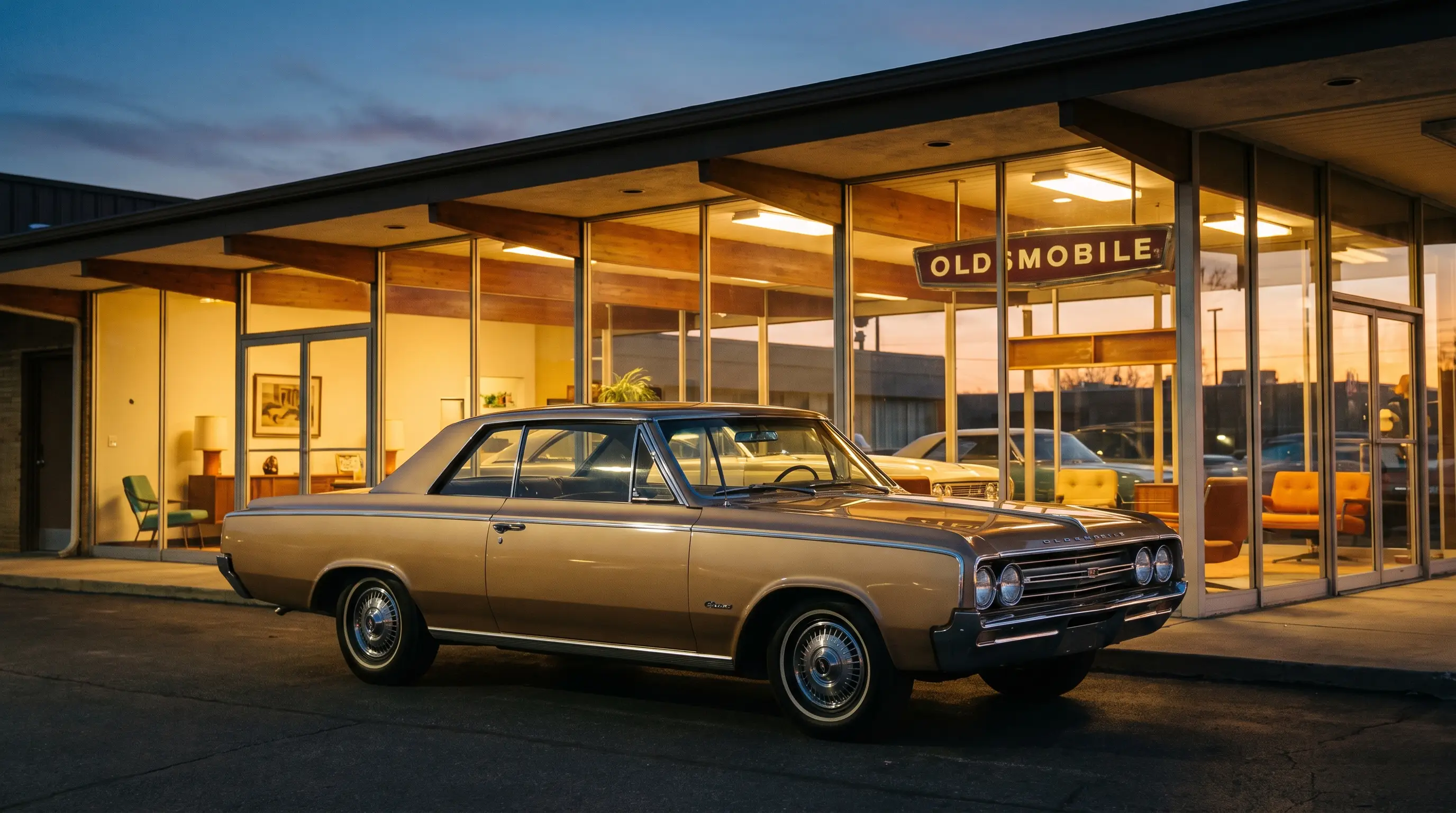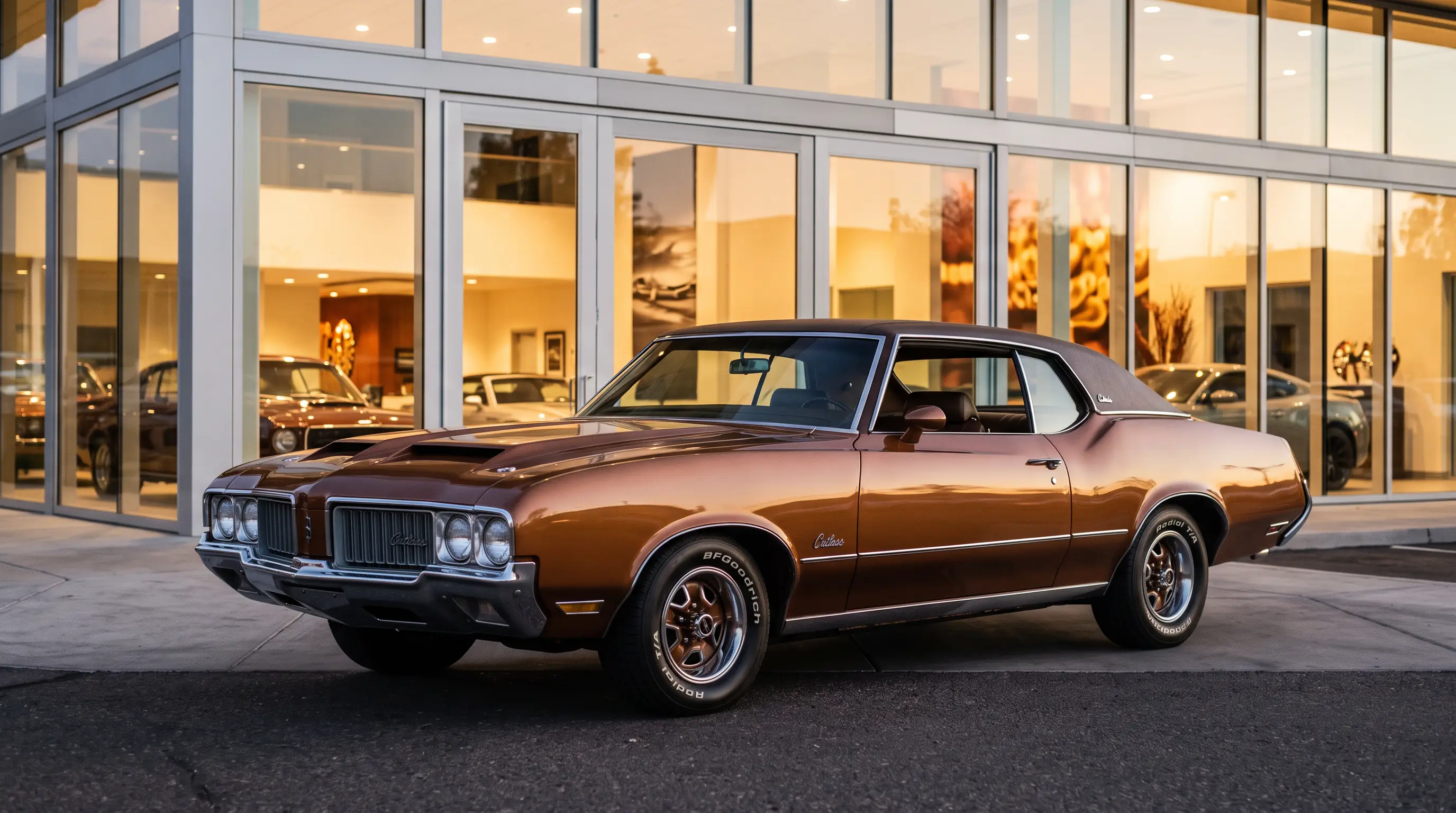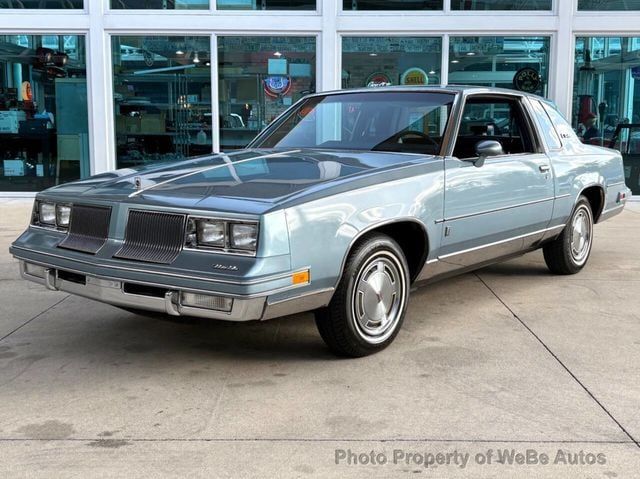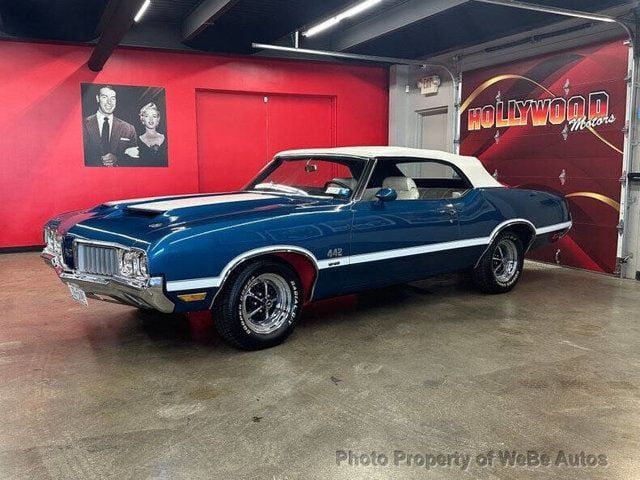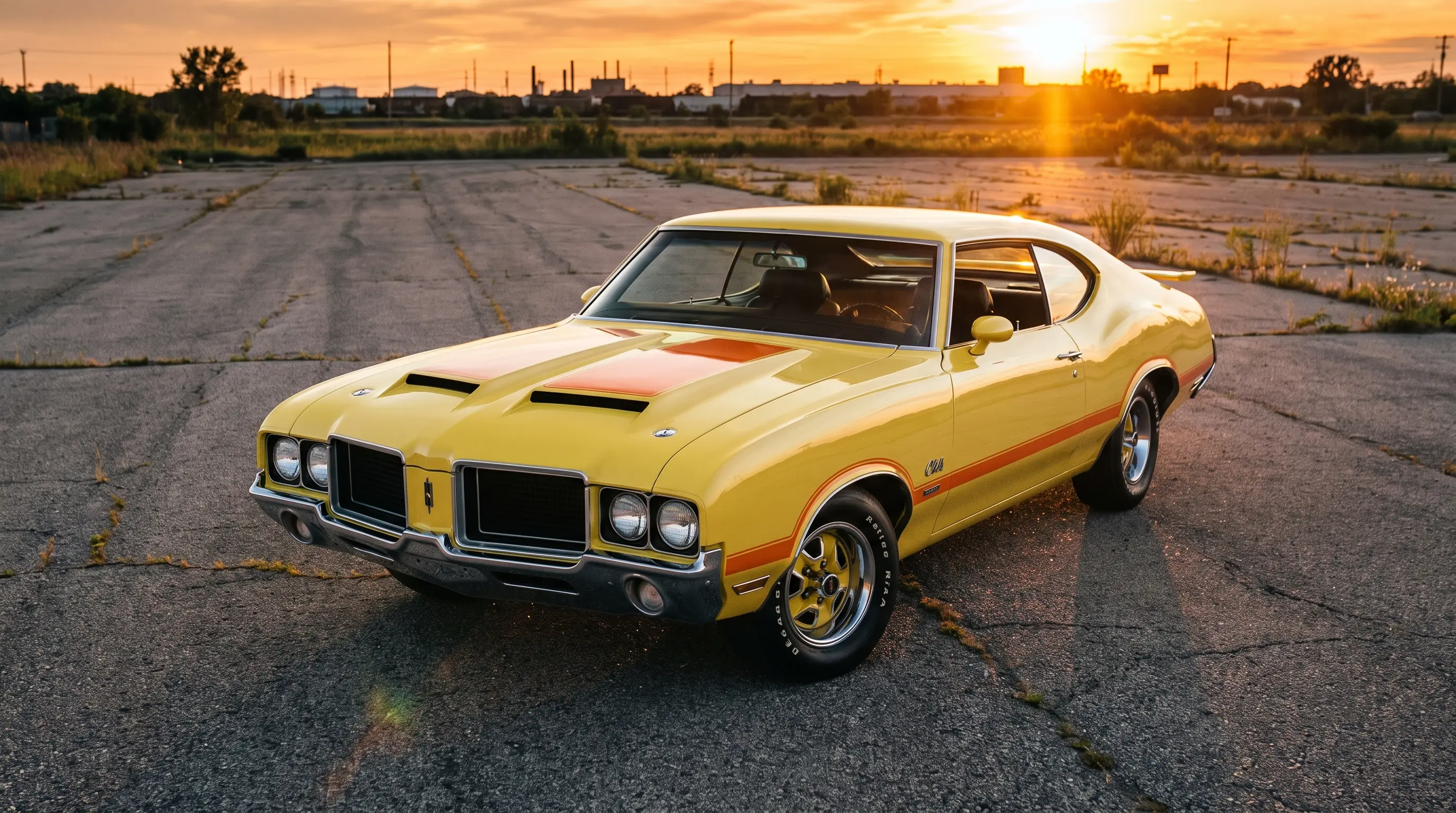
The Oldsmobile Rallye 350 exists because of an insurance clerk somewhere doing math on a 442. By 1970, premiums on big-block muscle cars had climbed to the point that plenty of buyers who wanted the look and the attitude of a performance Cutlass simply could not afford to carry one on their policy. Oldsmobile's answer was the Rallye 350, a one-year-only special edition built on the Cutlass S body that delivered the visual punch of a 442 with a small-block underneath it and a lower premium attached.
Built to dodge the insurance man
The Rallye 350 package started with a Cutlass S hardtop or convertible and layered on a very specific look: Sebring Yellow paint as the signature color, a blacked-out grille and taillight panel, body-colored urethane front and rear bumpers rather than chrome, and a bold stripe treatment running the length of the car. It was loud in a way the standard Cutlass S never tried to be, and that was the point. Buyers wanted a car that looked like trouble at a stoplight without the rate hike that came with checking the 442 box on the order form.
The visual package borrowed heavily from what Oldsmobile had already learned building the 442, and it is worth remembering that this whole story only makes sense in the context of what came before it. For how the Cutlass began, the Rallye 350 is a good illustration of how far the platform had been stretched by 1970, from a compact economy car to a rolling billboard for a performance image built on a small-block budget.
What was actually under the hood
Despite the aggressive styling, the Rallye 350 kept things comparatively modest mechanically. The standard engine was Oldsmobile's 350 Rocket V8, rated at 310 horsepower in four-barrel form, a genuinely strong small-block for the era but nowhere near the 455's output in a 442. That gap between the way the car looked and the way it actually performed is exactly why some period buyers were disappointed and why some modern collectors undervalue it. The Rallye 350 was never pretending to out-drag a big-block car. It was built to look the part at a price point, both at the dealership and at the insurance renewal, that a 442 buyer could not touch.
Suspension and brakes generally followed whatever heavy-duty options the buyer specified, since the Rallye 350 was an appearance and marketing package layered onto existing Cutlass S mechanicals rather than a ground-up performance model. A well-optioned Rallye 350 with the F41 handling package and power front discs could hustle down a back road credibly. A base one with the standard suspension rode and handled like the family Cutlass it fundamentally still was underneath the paint.
That inconsistency is part of what makes the model interesting to research now. Two Rallye 350s built a few weeks apart could feel meaningfully different to drive depending on what the original buyer checked on the order form, which is a reminder that the appearance package was never a single fixed specification the way a 442 or W-31 was. It was a look you could bolt onto a wide range of underlying mechanical choices, and the paperwork is often the only way to know which combination a particular survivor actually left the factory with.
| Feature | Rallye 350 spec |
|---|---|
| Base body | Cutlass S hardtop or convertible |
| Signature color | Sebring Yellow |
| Standard engine | 350 Rocket V8, 4bbl |
| Bumpers | Body-colored urethane front and rear |
| Model years offered | 1970 only |
A short-lived idea with a long memory
Oldsmobile offered the Rallye 350 for the 1970 model year only, and total production landed at 3,547 cars, modest compared to the broader Cutlass S run. Its rarity today owes as much to that single-year window as to survivorship, since a striking yellow paint job and stripe kit that once screamed for attention at a drive-in is exactly the kind of car that got repainted a more sensible color once the novelty wore off in the mid-1970s. Finding a numbers-matching, unmolested Rallye 350 in its original Sebring Yellow is a genuinely different proposition from finding a garden-variety 1970 Cutlass S.
The story sits comfortably alongside Oldsmobile's other 1970 attempts to squeeze more excitement out of the small-block, and readers chasing the full picture of that era should look at a related deep-dive on the W-31, which took a very different, much more serious engineering approach to getting real performance out of the same basic 350 engine family.
"The Rallye 350 tells you everything about what 1970 buyers actually wanted. They wanted the theater of a muscle car. Whether the drivetrain backed up the theater was, for a lot of them, a secondary concern."
— Tom Ramirez
Buying one today
Values for the Rallye 350 have climbed as more buyers have come to understand what the package actually is, rather than dismissing it as a plain Cutlass S with a paint job. Documentation matters enormously here, since the appearance package can be replicated on a plain Cutlass S with enough time and a paint gun, and a car claiming to be an original Rallye 350 without a build sheet or window sticker to back it up deserves real scrutiny before any money changes hands. For the fuller arc of how the Cutlass name evolved around cars like this one, our Classic Cars Arena feature covers the whole lineage. Buyers hunting for one, or for any well-kept small-block Cutlass from the era, will find current classic Oldsmobile Cutlass for sale listings worth checking regularly, since genuine Rallye 350s do not sit on the market long once they surface.