I get asked what an Art Deco car is worth more often than almost any other question in this field, and the honest answer is always a range followed by a list of conditions. Deco cars sell on design first, mechanics a distant second, which makes them behave differently from most other collector categories. A gorgeous body on an unremarkable chassis can outsell a faster car in a plain one, and that inverts a lot of assumptions people bring in from other parts of the hobby.
Value in this category rests on four things, in this order: condition, documentation, liquidity, and downside. I will walk through what actually sits at the top of the market and why, but the short version is that the number is never the interesting part. The caveat behind the number is. For the design context behind these cars, see the valuable art deco cars guide.
What actually drives value in this category
Condition is the part buyers see first and weigh too heavily. A beautifully restored car photographs well, but restoration quality without documentation is a smaller factor than most new buyers assume. Documentation is the part that actually moves the number, because it answers the question every serious buyer eventually asks: is this body original to this chassis, and can you prove it.
Liquidity matters more in this category than in mainstream collector cars, because the pool of buyers for a specific coachbuilder-and-chassis pairing is genuinely small. A Duesenberg in any condition has more potential buyers than a one-off Delahaye with obscure coachwork, even if the Delahaye is arguably the finer design. Downside is what you risk if a body's story does not hold up under scrutiny, and on a rebodied or heavily altered car, that downside can erase most of the premium a buyer thought they were paying for.
The cars at the top of the market
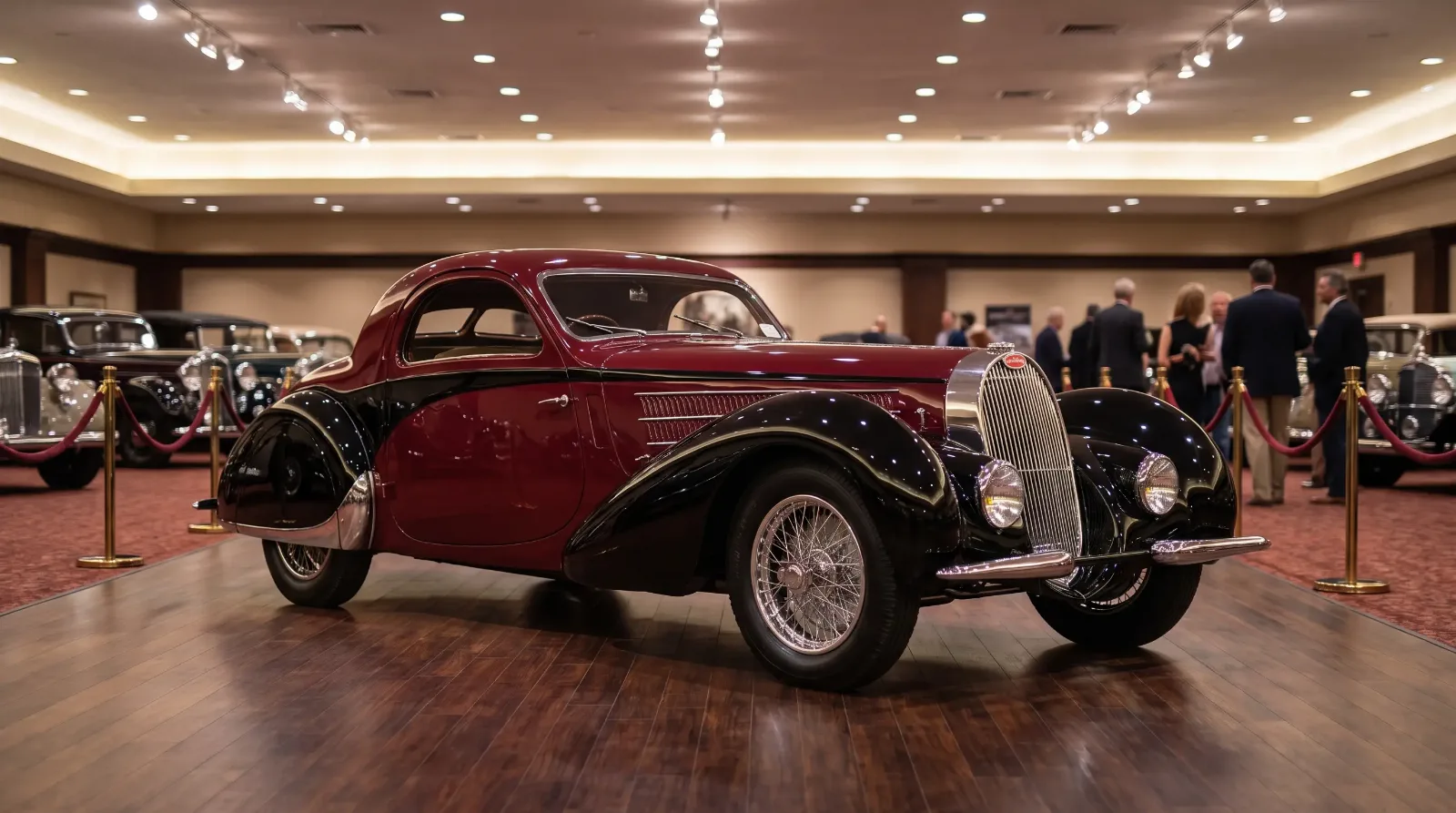
Bugatti's Type 57SC Atlantic sits at the summit, and it is not close. A handful were built in the late 1930s, and one confirmed sale reportedly reached $30-40 million, the highest price ever recorded for a car at that point, driven by scarcity, an unmistakable design, and factory documentation most other Deco cars cannot match. The Talbot-Lago T150-C SS with Figoni et Falaschi teardrop coachwork sits in a similar rarefied tier, though generally below the Atlantic, with results typically landing in the single-digit millions and one exceptional 1937 example setting a marque record above $13 million.
Below those two, a broader group of French coachbuilt Delahaye and Delage cars with documented Figoni, Saoutchik, or Franay bodies most often trade in the high six figures to low-to-mid seven figures depending on condition and provenance. American entries like the Cord 810/812 and the Pierce-Arrow Silver Arrow occupy a different, more accessible bracket, generally well below the French coachbuilt cars, since they were built in larger numbers and lack the one-off body story that drives the top of the market.
Condition tiers and what they mean for price
The standard #1 through #4 grading gives a useful shorthand, though I would rather you understand what sits behind the numbers than memorize them.
| Tier | Description | Typical value relative to #1 |
|---|---|---|
| #1 | Concours condition, full documentation, correct body pairing | Baseline, 100% |
| #2 | Excellent driver, minor wear, strong but incomplete records | Meaningfully below #1, often a majority of the top value |
| #3 | Good condition, needs work, documentation gaps | A fraction of #1, roughly the middle of the range |
| #4 | Project car, questionable or missing body history | A small fraction of #1 value |
A car can sit anywhere on this scale regardless of coachbuilder pedigree. A #4 Figoni-bodied Delahaye with a broken provenance chain is worth a fraction of a #1 example from the same chassis and coachbuilder pairing, and the gap between them is usually wider than newcomers expect.
Documentation, comps, and the downside case
Provenance means the full ownership chain, ideally with no unexplained gaps, plus factory or coachbuilder records confirming the body originally belonged to that chassis. Comps mean recent sales of genuinely similar cars, and in this category they are scarce almost by definition, since the finest examples were near one-offs when new. A thin comp set widens the appraisal range, and a wide range tends to favor the buyer, not the seller.
The downside case is the one sellers rarely bring up unprompted. If a body's history cannot be confirmed, or if records surface showing a rebody at some point in the car's life, the value can drop sharply even if the car looks identical to a documented original. I have seen this happen at auction more than once, and it is the single biggest risk in this category for a buyer who skips the paperwork in favor of the photographs.
"I can give you a number on any Deco car in one sentence. The honest version takes an hour, because the number only means something once you know whether the paperwork backs it up."
— Marcus Feld
Where the entry points are
Not every path into this category requires eight-figure money. American streamline cars, well-documented mid-tier French coachbuilt Delahaye and Delage examples, and lesser-known coachbuilder pairings all offer a way in at a fraction of the Atlantic or the top Talbot-Lago prices, without giving up the design DNA that defines the category. The tradeoff is usually a smaller, thinner resale market, which circles back to the liquidity point above.
For anyone weighing where to start, comparing documented cars against undocumented ones side by side is the fastest education available, and you can browse the vintage listings to see how condition and paperwork track against asking price in practice. The broader story of how these cars fit into pre-war collecting as a whole is worth reading too, in the full pre-war story, and the way this design language kept influencing cars long after the war is a subject worth following further if you keep reading.
Sources and notes
- Motor1 - 1936 Bugatti Type 57SC Atlantic fetches record $30 million
- Gooding and Company - 1937 Talbot-Lago T150-C-SS Teardrop Coupe result
- Motor1 - 1937 Talbot-Lago sells for 13.4 million, sets marque record
- Sports Car Digest - Figoni et Falaschi Delahaye 135M auction result
- Broad Arrow Auctions - 1938 Delahaye 135 MS Figoni et Falaschi Coupe
- Hagerty - What a collector car's condition grade really means