
The 1958 Impala one year design is the least understood fact about the car's debut season, and it is arguably the most important one for anyone trying to place the model correctly in Chevrolet history. Every 1958 full-size Chevrolet, Impala included, rode on a body and chassis that existed for exactly that single model year and was never repeated afterward. Chevrolet moved on to a longer, lower, entirely different platform for 1959, which means the 1958 Impala is not simply the first year of a longer design run. It is its own isolated chapter, built once and then set aside.
Car Features
7 min read
The One-Year 1958 Body That Never Repeated
The 1958 Impala rode on a body and chassis Chevrolet used for exactly one model year, sharing no parts with the 1957 car before it or the redesigned 1959 that followed.
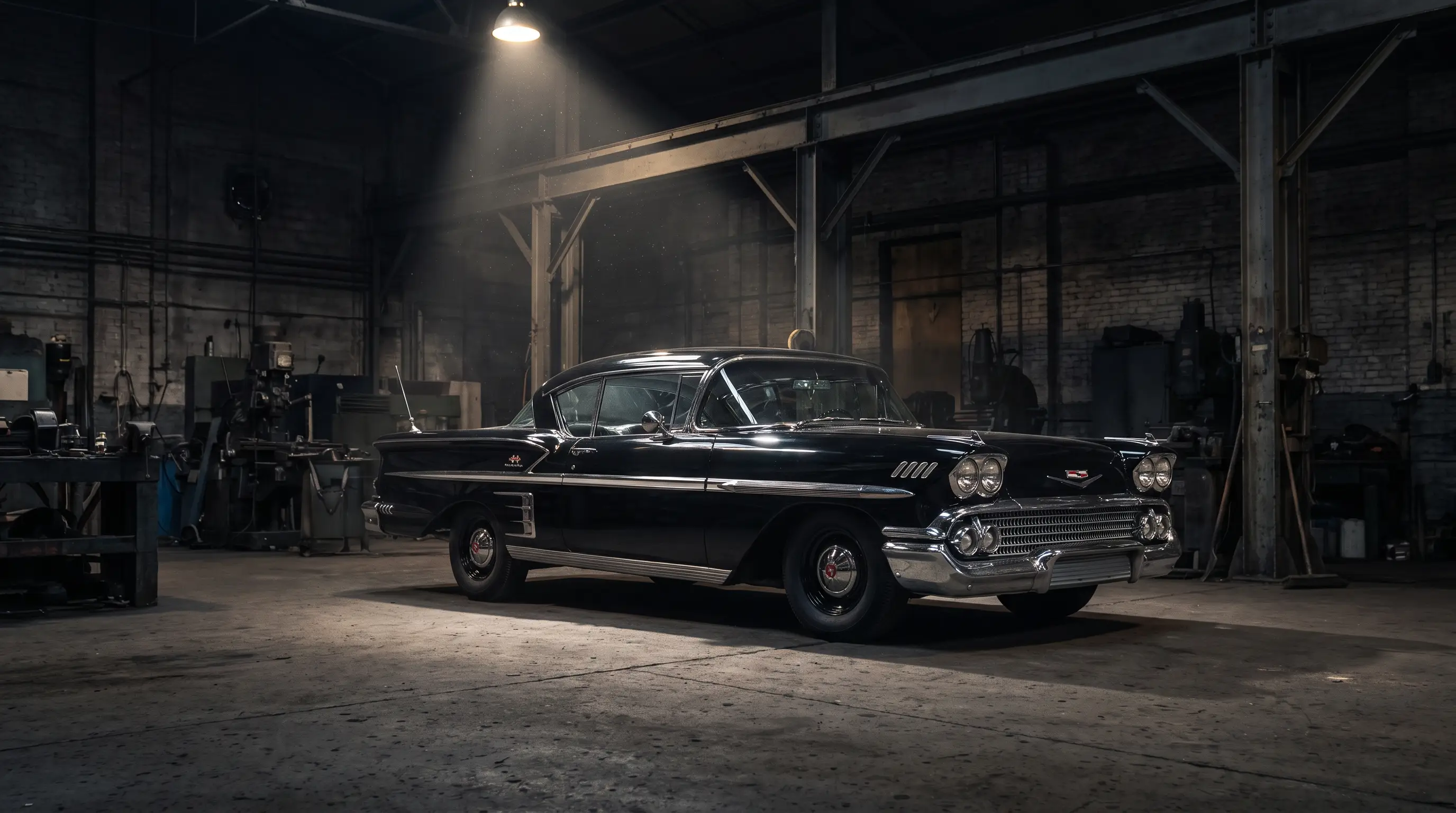
That one-year status is unusual even by the standards of an industry that redesigned cars more often in the 1950s than it does now. Most manufacturers stretched a body over two or three model years to spread out tooling costs, and Chevrolet itself had done exactly that with the body that preceded 1958. The decision to abandon the 1958 body after a single season, rather than carry it forward with mild trim updates the way 1957 had followed 1956, tells you how much General Motors was willing to spend chasing the styling war of the late 1950s.
Why Chevrolet built a body it planned to retire
The 1958 full-size Chevrolet body existed to solve an immediate, short-term problem. General Motors corporate design had committed every division to quad headlights and a lower, wider stance for 1958, and Chevrolet's engineers paired that mandate with a new perimeter frame, marketed as the Safety Girder X-frame, that allowed the body to sit lower without giving up structural integrity. Getting all of that ready for 1958 meant working within the dimensions and engineering constraints already locked in for that specific model year. The far more dramatic, longer, and lower body Chevrolet wanted for the new decade was still in development and would not be ready until 1959, so the 1958 cars became a one-year bridge between the 1957 design and the redesign everyone inside the company knew was coming.
That bridge status explains a lot about how the 1958 Impala looks compared to its immediate predecessor and successor. It shares its basic proportions and greenhouse with the 1957 Bel Air it replaced, since there was no time or budget to redesign the passenger compartment from the ground up. But its lower stance, quad headlights, and new frame point clearly toward where Chevrolet was headed, making the 1958 body a genuine transitional design rather than either a facelift of the old car or a preview of the new one.
What survives from a body built for one year
Because the 1958 body was never reused, none of its sheet metal, trim, or unique fittings interchange with the 1959 or later cars. Restorers working on a 1958 Impala today are working with parts that Chevrolet tooled once, ran for a single production year, and then scrapped the dies for entirely. That has real consequences for anyone trying to keep a 1958 car on the road with original parts. Reproduction manufacturers have covered the most commonly needed pieces over the decades, but plenty of trim details and interior fittings specific to the 1958 body remain harder to source than parts for the more common 1957 or 1959 model years.
The one-year status also means the 1958 Impala cannot be cross-shopped for parts against any other model year the way owners of longer-running body designs sometimes can. A 1958 grille, for instance, fits nothing before or after it. That isolation is inconvenient for restoration but it is exactly what gives the 1958 body its identity among collectors, who treat it as a standalone design statement rather than one entry in a longer, more familiar production run.
"Chevrolet built the 1958 body to last one season and then walked away from it entirely. That's rare enough on its own to make the car worth studying, independent of anything else it did well."
- Tom Ramirez
How the one-year design shapes collector value
Cars built on a body that existed for a single model year tend to hold a particular kind of appeal for serious collectors, because the design cannot be confused with an earlier or later year at a glance the way a car from a multi-year body run sometimes can. A 1958 Impala is unmistakably a 1958 Impala, distinct from both the 1957 Bel Air it grew out of and the 1959 Impala that replaced it. That visual clarity, combined with genuinely lower production numbers than the years surrounding it, keeps demand for well documented original examples steady among buyers who specifically want a car representing that one transitional season. Readers who want the full story of how that single model year fit into Chevrolet's broader Impala history will find the one-year body is the foundation the rest of the debut year narrative sits on.
For buyers actively shopping the model, that scarcity shows up directly in the market. Anyone comparing what is available can look at classic Impala for sale listings and see how prices for genuine 1958 examples track against the far more common 1959 and 1960 cars that followed the redesign.
Comparing it against Chevrolet's other short-run bodies
Chevrolet was no stranger to short production runs elsewhere in its history, but few of them are as clean a break as 1958. The 1955 through 1957 Bel Air, by contrast, is remembered as a three-year design family with clear year-to-year differences that still share a common architecture underneath. The 1958 body has no such family to belong to. It stands alone between the 1957 cars and the completely reengineered 1959 lineup, sharing meaningful engineering, like the new X-frame, with neither its predecessor nor its successor. That isolation is part of why identifying an authentic 1958 car is usually more straightforward than sorting through the finer year-to-year distinctions collectors argue about within a longer body run. There is no adjacent model year for a 1958 Impala to be confused with.
It also means the 1958 body carries a specific kind of documentation risk. Because no other model year shares its parts, a car missing its original trim or drivetrain components cannot simply be filled in with pieces borrowed from an adjacent year the way owners of a 1955 through 1957 Bel Air sometimes manage. Verifying a 1958 Impala's originality means verifying 1958-specific details and nothing else, which raises the stakes for buyers relying on trim tags, casting numbers, and factory paperwork rather than a general sense that the parts on the car look period correct.
A design that only had to work once
Chevrolet's engineers and stylists built the 1958 body under a deadline that guaranteed it would never need a second act, and in some ways that freed them to push the frame, the stance, and the trim further than they might have if the body were meant to carry into a second or third model year. The result is a car that looks like exactly what it was, a one-time bridge between two very different eras of Chevrolet design, and that singular status is precisely what still draws collectors to it today.
Sources and notes
Related Reading
Have a
Chevrolet Impala
for Sale?
Reach thousands of serious classic car collectors across the US.
Sell It Here →
Are You a Classic Car Dealer?
List your full inventory and connect with targeted classic car buyers.
Join as a Dealer →
#restoration parts
#1958 impala
#Chevrolet Impala history
#X-frame chassis
#classic Chevrolet design

About the author
Tom Ramirez
Corvette researcher and historian based in Bowling Green, Kentucky. Two decades documenting Corvette production history from original factory records.
Related Listings - Chevrolet Impala




Comments
Be the first to comment on this article.