
Archival order sheets for the 1972 model year list a configuration that most enthusiasts today barely acknowledge exists: the two-wheel-drive K5 Blazer. It shared the same body, the same removable steel top, and the same trim ladder as its four-wheel-drive sibling, yet it has been almost entirely written out of the truck's popular history. The 1972 K5 Blazer 2wd deserves a more careful look, because it tells us something about who actually bought this truck in period, and that story is less romantic and more interesting than the trail-conquering image the model carries today.
Car Features
6 min read
The Overlooked 1972 Two-Wheel-Drive K5
The two-wheel-drive 1972 K5 Blazer has been mostly written out of the model's history, but fleet and municipal buyers ordered it deliberately.
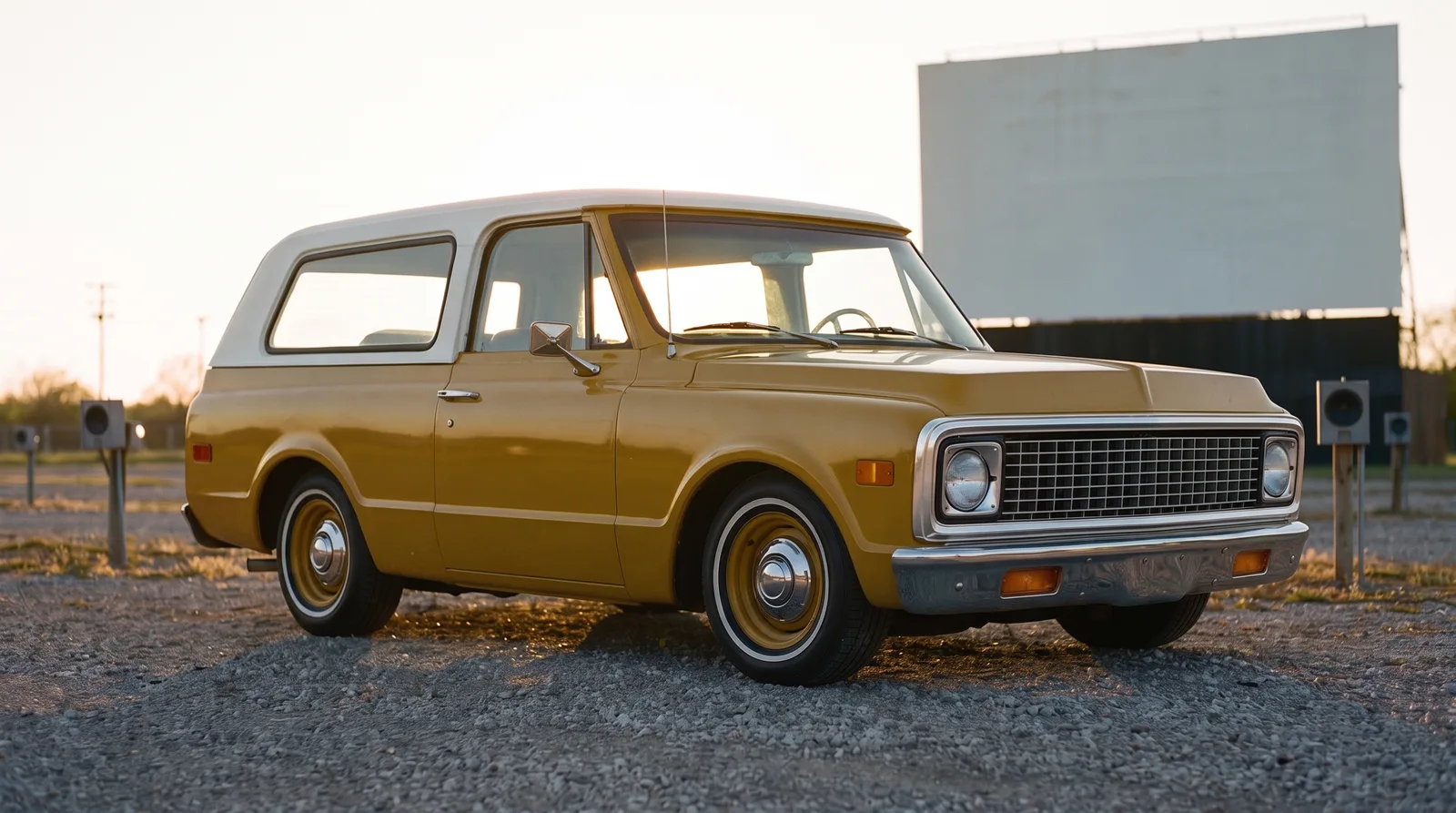
Who actually ordered a two-wheel-drive Blazer
Not every 1972 buyer needed a transfer case. Fleet operators running Blazers as light utility vehicles in flat, dry regions had no practical use for four-wheel drive and no interest in paying for the added weight, complexity, and fuel consumption it brought. Municipal departments, parks services in milder climates, and commercial operators who wanted the K5's cargo versatility and open-top capability without the mechanical overhead all show up in period records as two-wheel-drive purchasers. For these buyers, the Blazer was competing less against a Jeep and more against a station wagon or a light panel truck, and the two-wheel-drive configuration made that comparison make more sense on paper.
There was also a straightforward cost argument. Removing the transfer case, front driveshaft, and front differential from the order sheet lowered the purchase price meaningfully, which mattered to buyers watching a fleet budget across dozens of vehicles rather than admiring a single truck in a showroom.
Government agencies operating in warmer states were among the most consistent two-wheel-drive buyers, ordering Blazers for parks maintenance, road crews, and light utility duty where four-wheel drive would have added cost without adding any real capability the job required. Purchasing agents working within fixed annual budgets treated the transfer case and front axle as an optional expense to be justified line by line, and in regions without meaningful snow or off-road terrain, that justification simply was not there.
What changes mechanically, and what stays the same
A 1972 K5 Blazer 2wd retains the same frame, the same removable top mechanism, and largely the same engine options as the 4x4, which means the driving experience above the axle line is nearly identical. What disappears is the front differential, the transfer case, and the associated linkage, replaced by a simpler driveshaft running straight back to the rear axle. The result is a lighter truck, marginally quicker off the line with a given engine, and noticeably better on fuel in an era when gas prices were becoming a real conversation for the first time.
Ride height also differs slightly, since the two-wheel-drive trucks sit a touch lower at the front without the weight and geometry of the front axle assembly, a detail that period photographs confirm even though it rarely appears in factory literature.
Regional patterns worth noting
Two-wheel-drive orders clustered geographically in period records, concentrated in the South and in flatter agricultural regions of the Midwest where snow and steep terrain were rarely a concern for daily operations. Texas, Oklahoma, and parts of the Gulf Coast show up disproportionately in surviving fleet documentation for two-wheel-drive K5 Blazers, a pattern that tracks logically with climate and terrain rather than any regional preference for the configuration itself. Northern states, by contrast, show almost exclusively four-wheel-drive purchases in the same fleet categories, since winter conditions made the two-wheel-drive option a non-starter for any buyer thinking practically about year-round use.
That regional concentration matters today for anyone trying to locate a surviving example, since a two-wheel-drive 1972 K5 Blazer is statistically far more likely to have spent its working life in a warm, dry climate, which also tends to mean less rust and corrosion damage than a truck that spent decades in a colder, wetter region. The configuration that made it unfashionable to collectors may, in a roundabout way, have also protected many of these trucks from the corrosion that claimed so many of their four-wheel-drive counterparts.
Why they are rare on the collector market now
Survivorship worked against the two-wheel-drive Blazer in ways that have nothing to do with build quality. Fleet vehicles were generally worked harder and disposed of sooner than personally owned trucks, cycled out once maintenance costs rose past a threshold a purchasing department had set years earlier. Collectors chasing the K5 Blazer's rugged image have also historically prioritized four-wheel-drive examples, which pushed prices and restoration attention toward those trucks and left two-wheel-drive survivors undervalued and, in many cases, unrestored or parted out for their sheet metal and trim.
What remains today is a genuinely scarce subset of the 1972 production run, one that documents a different, quieter chapter of the model's history than the one usually told.
| Feature | 1972 K5 Blazer 2wd |
|---|---|
| Drive layout | Rear-wheel drive only |
| Top | Removable steel hardtop, same as 4x4 |
| Typical buyer | Fleet, municipal, commercial operators |
| Weight vs 4x4 | Lighter, no front axle or transfer case |
| Market status today | Scarce, historically undervalued |
"The two-wheel-drive trucks were not a lesser Blazer. They were a different answer to the same question, and period buyers understood that even if collectors have mostly forgotten it."
- Sarah Whitfield
Insurance and appraisal specialists who handle vintage trucks sometimes note that a two-wheel-drive K5 Blazer, once verified as genuinely factory-configured, can appraise higher relative to its rarity than its raw sale price would suggest, since so few examples exist for comparison and demand within the small pool of collectors who specifically seek them out remains steady even as broader market attention stays focused on the four-wheel-drive trucks.
Documenting a survivor
For anyone researching or restoring a 1972 K5 Blazer 2wd, period fleet records, dealer invoices, and state title histories carry more weight than they would for a common four-wheel-drive truck, precisely because so few two-wheel-drive examples survive with paperwork intact. A documented fleet history, oddly, can add more credibility to one of these trucks than it would to a private-buyer 4x4, since it confirms the truck is what it claims to be rather than a converted or reconfigured example.
Researchers should also pay attention to the VIN and body tag data specific to drivetrain configuration, since these codes typically confirm original axle and transfer case status independent of whatever hardware happens to be bolted to the truck decades later. Cross-referencing that coded information against any surviving purchase paperwork remains the most reliable way to settle the question of originality when a fleet record itself has been lost to time.
To understand where the two-wheel-drive trucks fit within the full 1972 lineup, including trim levels and the drivetrain options offered alongside them, read the background on the model year as a whole. And if this overlooked configuration has you curious about what has survived, you can find a classic K5 Blazer and see the range of trucks currently on the market.
Sources and notes
Related Reading

About the author
Sarah Whitfield
Third-generation classic car collector specializing in pre-war American and European coachbuilt automobiles. Researcher and concours enthusiast.
Related Listings - Chevrolet Blazer

Comments
Be the first to comment on this article.