
By the time the 1968 model year closed, the muscle car price war 1968 buyers had watched unfold was no longer a two-car story between Plymouth and Pontiac. It had become an industry-wide scramble, with nearly every domestic manufacturer suddenly reconsidering how much trim, luxury, and margin they could afford to strip out of a performance car without losing money on it. The Road Runner didn't just compete in that price war. It started it.
Car Features
7 min read
The 1968 Road Runner and the Muscle Price War
The muscle car price war 1968 kicked off traces directly back to the Road Runner's stripped-down pricing strategy, and it reshaped how the whole industry sold performance.
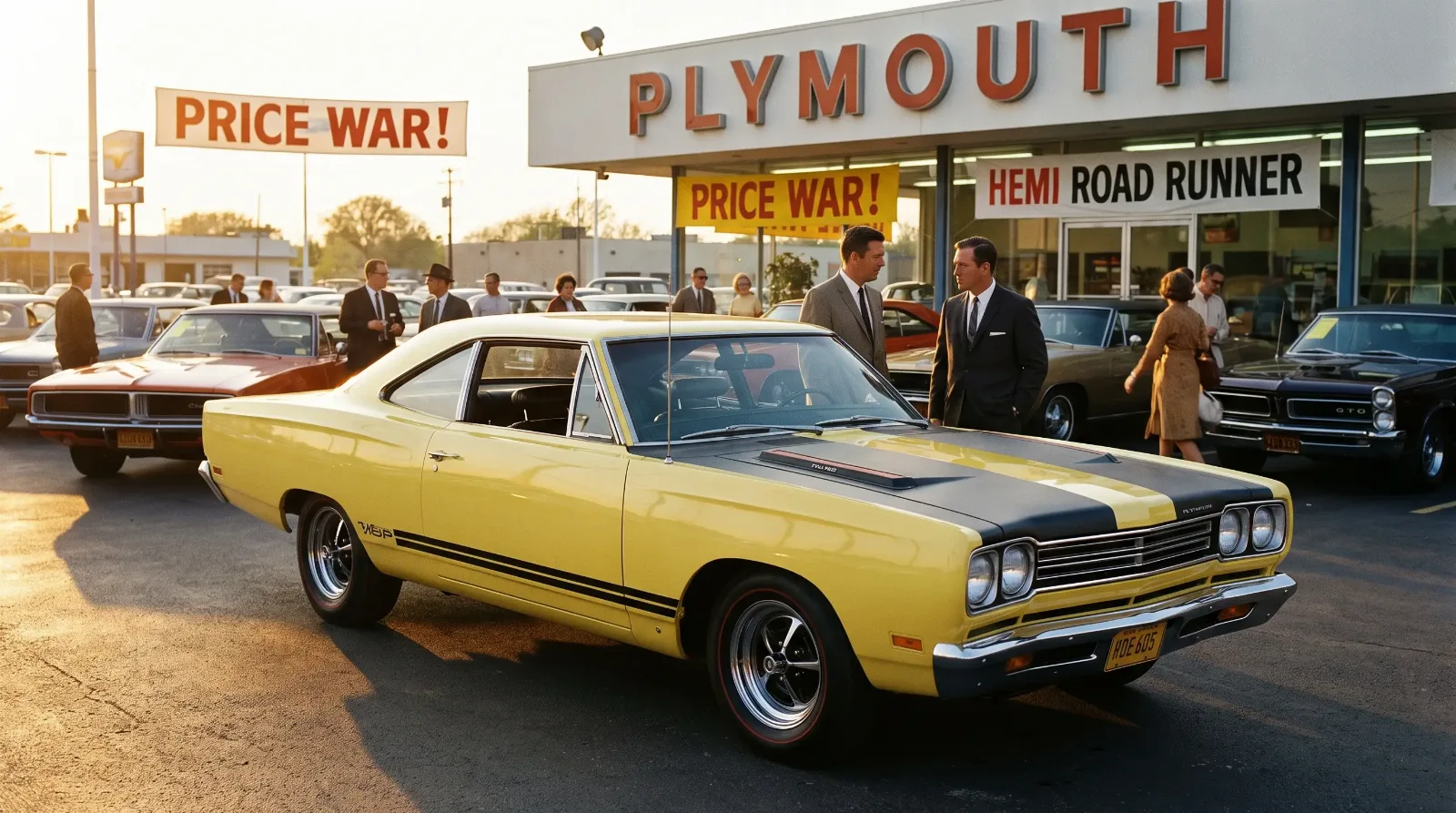
How a single model reshaped an entire segment's pricing
Before 1968, the muscle car formula was fairly settled. Take a mid-size platform, install a big engine, and load it with enough trim and options to justify a healthy price and margin. The GTO, the 4-4-2, the GS, all followed some version of that approach. Plymouth's decision to build the Road Runner around a stripped-down, low-price structure instead broke that pattern, and the sales results forced competitors to respond within a single model year.
That response came fast because the numbers were impossible to ignore. Plymouth's own conservative sales projection for the Road Runner sat around 2,500 units for the model year. Actual sales came in many multiples higher, a gap large enough that other manufacturers' product planners could not dismiss it as a fluke.
Who moved first and how
Pontiac responded within a year or two with the GT-37, a stripped-down performance package built specifically to compete at a lower price point than the standard GTO. Chevrolet leaned harder into affordable Chevelle performance trims, and Ford pushed its Torino GT pricing down to stay competitive with the new value-focused segment the Road Runner had opened up.
None of these responses fully matched the Road Runner's combination of low price, genuine standard-engine performance, and pop culture identity through the Warner Bros licensing deal, but the competitive pressure was real and it permanently shifted how manufacturers thought about entry-level muscle car pricing for the remainder of the era.
What buyers gained from the competition
The most direct beneficiary of the muscle car price war was the buyer. A young factory worker or returning serviceman in 1968 or 1969 suddenly had multiple genuinely fast, genuinely affordable options to choose from, where a few years earlier the segment had mostly catered to buyers willing to pay a premium for performance plus prestige. That shift in accessibility is a large part of why muscle cars from this specific window remain so deeply embedded in American car culture. More people could actually own one.
It also meant manufacturers had to get more honest about what their base trim levels actually delivered. Advertising copy across the industry started emphasizing standard performance specs rather than burying real numbers under option package language, because buyers comparing the Road Runner against a competitor's base model wanted straightforward comparisons.
| Model | Approximate starting price, 1968-1969 | Response type |
|---|---|---|
| Plymouth Road Runner | Under $2,900 | Originated the price war |
| Pontiac GT-37 | Stripped T-37 coupe plus a roughly $198 GT Sport Package, below standard GTO pricing | Direct competitive response |
| Chevrolet Chevelle SS 396 | Approximately $2,875 | Pricing adjustment |
"What people miss about this period is that the horsepower race gets remembered, but the price war is the part that actually determined how many of these cars ended up in real driveways instead of just magazine ads."
- Sarah Whitfield
What the price war meant for insurance and the end of the era
The muscle car price war of 1968 and 1969 also had an unintended consequence that would matter enormously within a few short years. As more affordable performance cars put big horsepower into the hands of younger, less experienced drivers, insurance companies began taking notice of accident and claim rates tied to these models. That scrutiny would eventually help drive the punitive insurance surcharges of the early 1970s that made muscle car ownership dramatically more expensive for young buyers, even as sticker prices themselves stayed relatively contained.
It is a bit of historical irony that a price war designed to make performance cars more accessible ultimately contributed to conditions that made owning one financially harder just a few years later. The Road Runner and its budget-focused competitors succeeded so completely at putting horsepower into younger hands that the insurance industry responded in a way nobody in Detroit's product planning offices had fully anticipated back in 1968.
By 1972 and 1973, rising insurance premiums on high-output engines had done more to slow the muscle car segment's momentum than any single competitor's pricing strategy ever could. The price war that made these cars accessible in 1968 gave way, within just a handful of years, to an insurance environment that made owning the same horsepower a much harder financial case to make to a young buyer's parents or lender.
Why this context still matters for collectors
Understanding the broader price war helps explain production volume patterns that show up in today's collector market. Cars built specifically to compete on price during this window, the Road Runner chief among them, tend to have larger surviving populations and stronger parts networks than cars built purely around prestige positioning. That accessibility, born directly out of the competitive pricing pressure of 1968 and 1969, is part of why ownership of these cars remains realistic for a broader range of collectors today than some of the rarer, higher-trim muscle cars from the same era.
Read the background on how the Road Runner launched and set this whole competitive dynamic in motion, including the internal Plymouth decisions that shaped the car's original price target.
If you want to see how these pricing dynamics play out in today's market, you can find a classic Runner and compare condition, documentation, and asking price across the model's production years.
Lessons product planners still reference
Even outside the classic car world, the Road Runner's price war remains a case study some business schools and automotive historians point to when discussing how a single well-targeted product can force an entire industry to reconsider its pricing assumptions within a matter of months rather than years. That kind of rapid competitive response is not unique to the auto industry, but the muscle car price war of 1968 is one of the cleaner, best-documented examples of it happening in real time, with sales figures and competitor responses both a matter of public record.
A price war with a lasting legacy
The muscle car price war of 1968 did not last forever, and by the early 1970s rising insurance costs and tightening emissions rules would reshape the segment in ways no amount of price competition could offset. But for a brief and genuinely important window, the industry had to compete on value as much as on horsepower, and that shift traces directly back to one Plymouth product decision that put a cartoon bird on a stripped-down coupe and priced it to sell.
Sources and notes
Related Reading
Have a
Plymouth Road Runner
for Sale?
Reach thousands of serious classic car collectors across the US.
Sell It Here →
Are You a Classic Car Dealer?
List your full inventory and connect with targeted classic car buyers.
Join as a Dealer →
#muscle car history
#Plymouth Road Runner
#mopar history
#1968 Road Runner
#muscle car price war 1968
#Pontiac GT-37

About the author
Sarah Whitfield
Third-generation classic car collector specializing in pre-war American and European coachbuilt automobiles. Researcher and concours enthusiast.
Related Listings - Plymouth Road Runner

Comments
Be the first to comment on this article.