
The 1968 Cutlass is where General Motors stopped sharing a single wheelbase across every body style on the A-body platform, and that single engineering decision changed how the whole car looked and drove. Two-door models moved to a shorter 112-inch wheelbase while four-door sedans and wagons kept a longer 116-inch chassis, a split that let Oldsmobile give the coupe a tighter, more athletic stance without compromising rear-seat room on the family-oriented body styles. Coupled with all-new "Coke bottle" sheet metal that curved in at the doors and flared at the rear fenders, the 1968 Cutlass looked like nothing that came before it, and the factory records from this changeover tell a more interesting story than the styling alone suggests.
Car Features
6 min read
The 1968 A-Body Cutlass
The 1968 Cutlass split two-door and four-door models onto different wheelbases, adopted new Coke-bottle styling, and let the 442 finally become its own series.
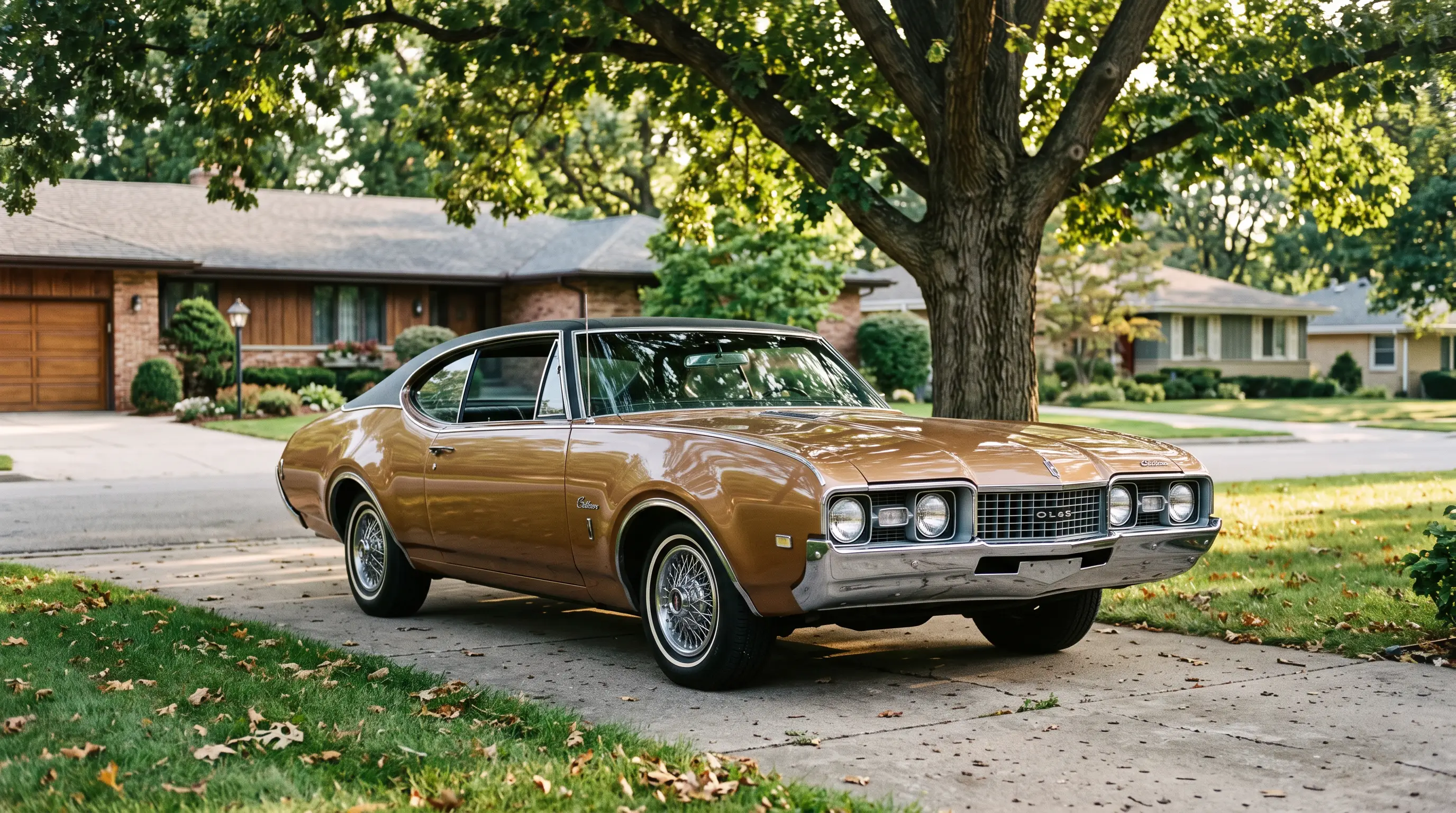
A shorter wheelbase built for a very different reason than speed
It would be easy to assume Oldsmobile shortened the coupe's wheelbase purely to sharpen handling, and that assumption is not entirely wrong, but the bigger driver was proportion. General Motors' design studios across every division were chasing a longer hood, shorter deck look for 1968, the same visual language showing up on the Chevelle and GTO that same model year, and a shorter wheelbase on the two-door body let Oldsmobile push that proportion further than the outgoing 1966-67 car allowed. The four-door sedans and wagons kept the longer chassis because that market did not want or need the same visual drama, and because interior room mattered more to those buyers than a low, aggressive stance.
The result split the Cutlass lineup into two genuinely different driving experiences riding on what most people still describe, correctly at the platform level, as one generation. A two-door Cutlass Supreme hardtop from this era rides on a noticeably different wheelbase than its four-door sedan sibling in the same model year, a detail that surprises a lot of newer collectors who assume "same generation" means "same chassis dimensions" across the board.
The 442 leaves the option sheet and becomes its own series
Through 1967, the 442 had existed as a package layered onto the Cutlass or F-85, an option code rather than a standalone model. For 1968, Oldsmobile promoted the 442 to its own series, distinct from Cutlass on the order form even though the two shared body, platform, and most of their engineering underneath. That distinction matters for anyone researching build sheets from this year, because a 1968 442 is titled and documented differently than a Cutlass Supreme with performance options checked, even when the two cars end up mechanically close to identical.
The W-30 forced-air induction package, which routed cool outside air directly to the carburetor through ducting in the front fenders rather than pulling heat-soaked air from the engine bay, had debuted two years earlier in 1966 and carried forward into this newly independent 442 series. Oldsmobile's engineering department had spent the previous several years building toward exactly this kind of dedicated performance hardware, and 1968 is where that development work became attached to a genuinely separate model line rather than a checkbox on a Cutlass order form.
Cutlass Supreme holds the top spot, and the numbers back it up
Cutlass Supreme continued as the top-of-line trim for 1968, carrying the best interior appointments and exterior brightwork in the non-442 lineup, and it remained the volume leader within the broader Cutlass name. Buyers gravitated toward the Supreme hardtop coupe body style especially, drawn by the new fastback-influenced roofline that suited the shorter two-door wheelbase particularly well. Factory production figures from this year show Cutlass Supreme models representing a substantial share of total Cutlass output, reinforcing a pattern that had already been building since the Supreme trim's 1966 introduction.
The Vista Cruiser wagon, meanwhile, continued to occupy its own extended-wheelbase niche within the lineup, built on a stretched platform to accommodate its distinctive raised glass roof panels over the rear seating area. It sat apart from both the short-wheelbase coupes and the standard-length sedans, a third distinct chassis length within what buyers and dealers alike still referred to simply as "the Cutlass line."
None of this happened by accident. Oldsmobile's product planners had watched three straight years of buyers gravitating toward the sportier hardtop body style over sedans and wagons, and the dual-wheelbase decision for 1968 was a direct response to that shift, letting the coupe chase a proportion the sedan never needed while protecting the family-oriented body styles from losing the interior room that sold them in the first place. Reading the two chassis lengths side by side in the factory specification books makes it clear this was a deliberate segmentation strategy, not a compromise forced by manufacturing constraints.
| Spec | 1968 Cutlass |
|---|---|
| Two-door wheelbase | 112 in |
| Four-door/wagon wheelbase | 116 in |
| Styling theme | New "Coke bottle" bodyline, longer hood/shorter deck |
| 442 status | Promoted from option package to standalone series |
| Performance option carried over | W-30 forced-air induction (debuted 1966) |
| Top non-442 trim | Cutlass Supreme |
"The paperwork changed as much as the sheet metal did in 1968. People look at a 442 from this year and a Cutlass Supreme from the same year and assume one's just a fancier version of the other because they share a body. Pull the factory documentation and you'll see Oldsmobile was already treating them as separate cars on paper, years before most buyers thought of it that way."
Tom Ramirez
Where this generation sits in the bigger Cutlass story
The 1968 restyle did not appear out of nowhere. It built directly on the platform Oldsmobile established with the A-body Cutlass generation earlier in the decade, taking the same fundamental engineering and pushing the styling, the wheelbase strategy, and the 442's independence further than any prior year had attempted. It would not be the final word either. Oldsmobile kept refining this basic formula through the early 1970s, and readers following the lineup year by year should look at the next story in this set to see how the Cutlass Supreme trim continued to evolve once this dual-wheelbase generation had settled in. For a car built on a chassis split this deliberately, the 1968 Cutlass rewards exactly the kind of documentation-first research that separates a real understanding of the car from a guess based on the badge alone.
Sources and notes
- Oldsmobile Cutlass - Wikipedia
- Oldsmobile 442 - Wikipedia (W-30 debut, 442 as separate model)
- Conceptcarz: 1968 Oldsmobile Cutlass specifications and dimensions
- Over-Drive Magazine: 1968 Oldsmobile mid-size cars fact sheet
- ClassicCars.com Journal: 1968 Oldsmobile 4-4-2 W30
- Indie Auto: 1968-69 Oldsmobile Cutlass styling
Related Reading
Have a
Oldsmobile Cutlass
for Sale?
Reach thousands of serious classic car collectors across the US.
Sell It Here →
Are You a Classic Car Dealer?
List your full inventory and connect with targeted classic car buyers.
Join as a Dealer →

About the author
Tom Ramirez
Corvette researcher and historian based in Bowling Green, Kentucky. Two decades documenting Corvette production history from original factory records.
Related Listings - Oldsmobile Cutlass




Comments
Be the first to comment on this article.