
The 1959 Thunderbird 352 V8 is the engine that made the Square Bird a real highway car instead of a boulevard cruiser with a nice dash. Ford dropped the two-seat Thunderbird after 1957, widened the body, added a back seat, and needed torque to move the extra iron. The 352 did the job. Then Ford went further in 1959 with an optional 430 cubic inch V8, and the Square Bird stopped being subtle.
Car Features
8 min read
The 352 and 430 V8: Square Bird Power
The 352 V8 turned the Square Bird into a real highway car, and the optional 430 made it quick. Here is what each engine actually delivers.
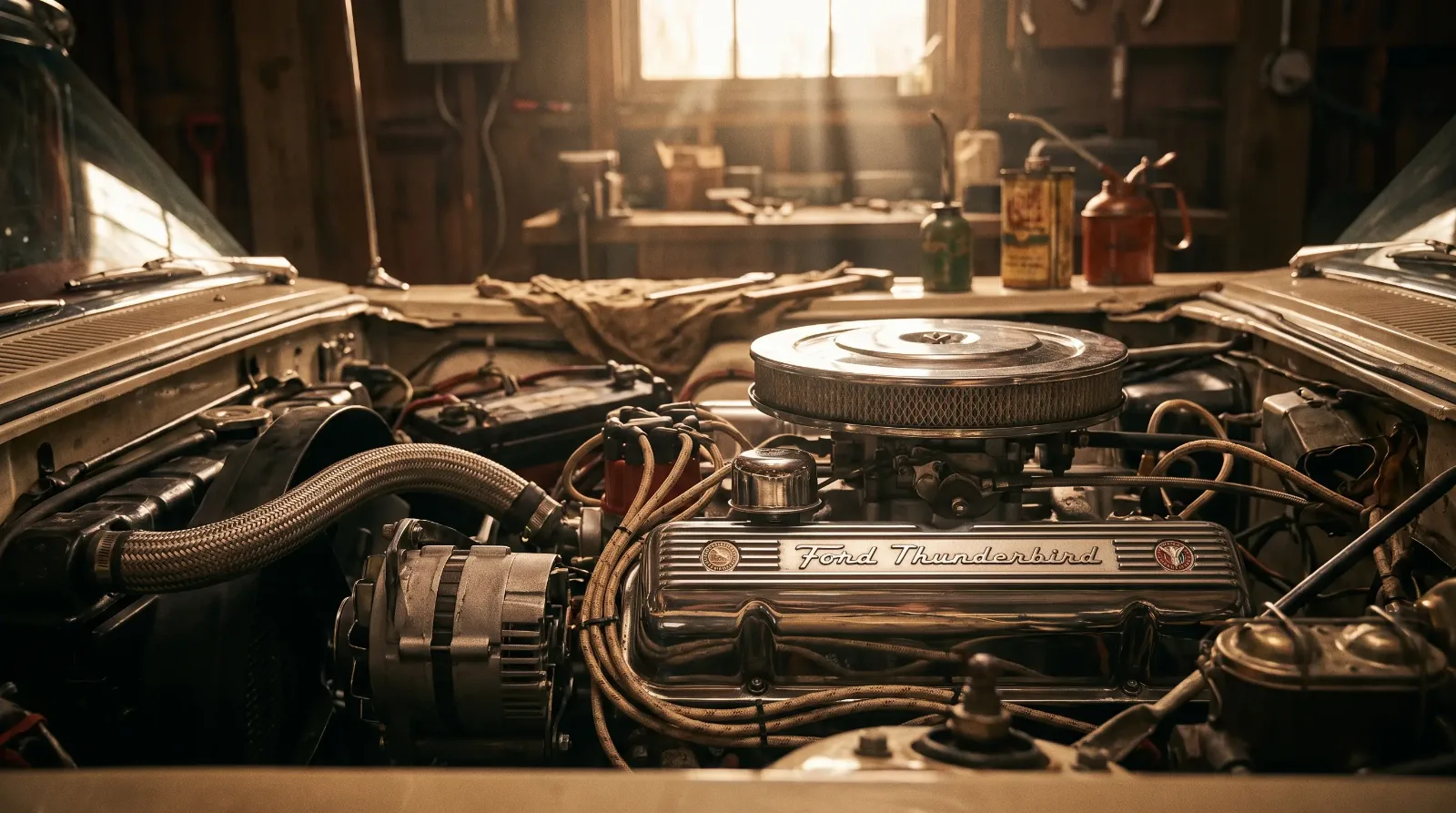
What the 352 actually delivered
The standard 1958-1960 Thunderbird engine was a 352 cubic inch FE-series V8, rated at 300 horsepower with a four-barrel carburetor. That number held steady across the run, though Ford's advertised figures from this era should be read with a little skepticism, gross ratings measured without accessories tend to run optimistic. Real-world output was likely closer to the 250-270 range once you account for the fan, alternator, and full exhaust. Torque sat around 380 lb-ft, which is the number that actually mattered for a car weighing over 4,000 pounds. The 352 used a single four-barrel Holley or Ford-built carburetor depending on the model year, cast iron heads, and a two-bolt main block. Nothing exotic. It was a truck-grade bottom end wearing a passenger car's clothes, and that's exactly why it held up.
Compression ran around 10.2:1, which demanded premium fuel even in 1959, and the engine bay had room to spare compared to what would come later. Ford paired the 352 with a three-speed Cruise-O-Matic transmission as the dominant choice; a manual was technically available but almost nobody ordered one in a personal luxury car. This wasn't a car built for a clutch pedal.
The 430 arrives and changes the conversation
For 1959, Ford pulled the 430 cubic inch MEL-series V8 out of the Lincoln and Mercury parts bin and offered it as a Thunderbird option. Rated at 350 horsepower and roughly 490 lb-ft of torque, the 430 was a different animal entirely, longer, heavier, and built around a different bore spacing than the FE-family 352. It required its own transmission calibration and a stouter cooling package. Buyers who checked that option box were paying for effortless passing power on a two-lane highway, not lap times.
350 horsepower at 4,400 rpm is the confirmed factory rating, and it's worth flagging because gross horsepower claims from this period varied by press kit and by year as Ford's own numbers shifted in 1960 literature. What's not in dispute is that the 430 made the Square Bird one of the quickest full-size American cars you could buy that wasn't a Chrysler letter car.
Why the 352 was the smarter buy then and now
Here's the blunt version: most 1959 Thunderbird buyers who checked the 430 box were paying for a number, not a noticeable improvement in daily driving. The 352 already had enough torque to move the car briskly off the line and cruise at highway speed without strain. The 430 added weight over the front axle, more parts to source when something breaks, and a transmission that isn't interchangeable with the 352's Cruise-O-Matic in a simple swap. If you're buying a driver today, not a numbers-matching investment piece, a well-sorted 352 car is the one to own. Parts are more available, the FE family is a known quantity to any competent shop, and you're not chasing MEL-specific components that get scarcer every year.
The math backs this up. A 300 horsepower 352 with 380 lb-ft moves a 4,400 pound Thunderbird from zero to sixty in roughly eleven seconds, unremarkable by any modern standard but perfectly adequate for the car's actual job. The 430 shaves maybe a second and a half off that number. That's not nothing, but it's not the difference between a good car and a bad one either. It's the difference between a good car and a slightly quicker version of the same good car, at real cost in parts availability.
"People chase the 430 because it sounds bigger on paper. The 352 is the engine that actually made the Square Bird work as a car you drive every week."
- Dan Reeves
Reliability and what breaks
The FE-series 352 has a well-documented service history because Ford used it across trucks, Galaxies, and Thunderbirds for over a decade. Timing chain wear, valve seal hardening, and carburetor float issues are the predictable failure points on a car this age, nothing specific to the Thunderbird application. The 430, by contrast, saw a much shorter production run and narrower application, which means fewer rebuilders have deep experience with it and fewer NOS parts exist. That scarcity shows up at the counter every time you need a water pump or an intake gasket.
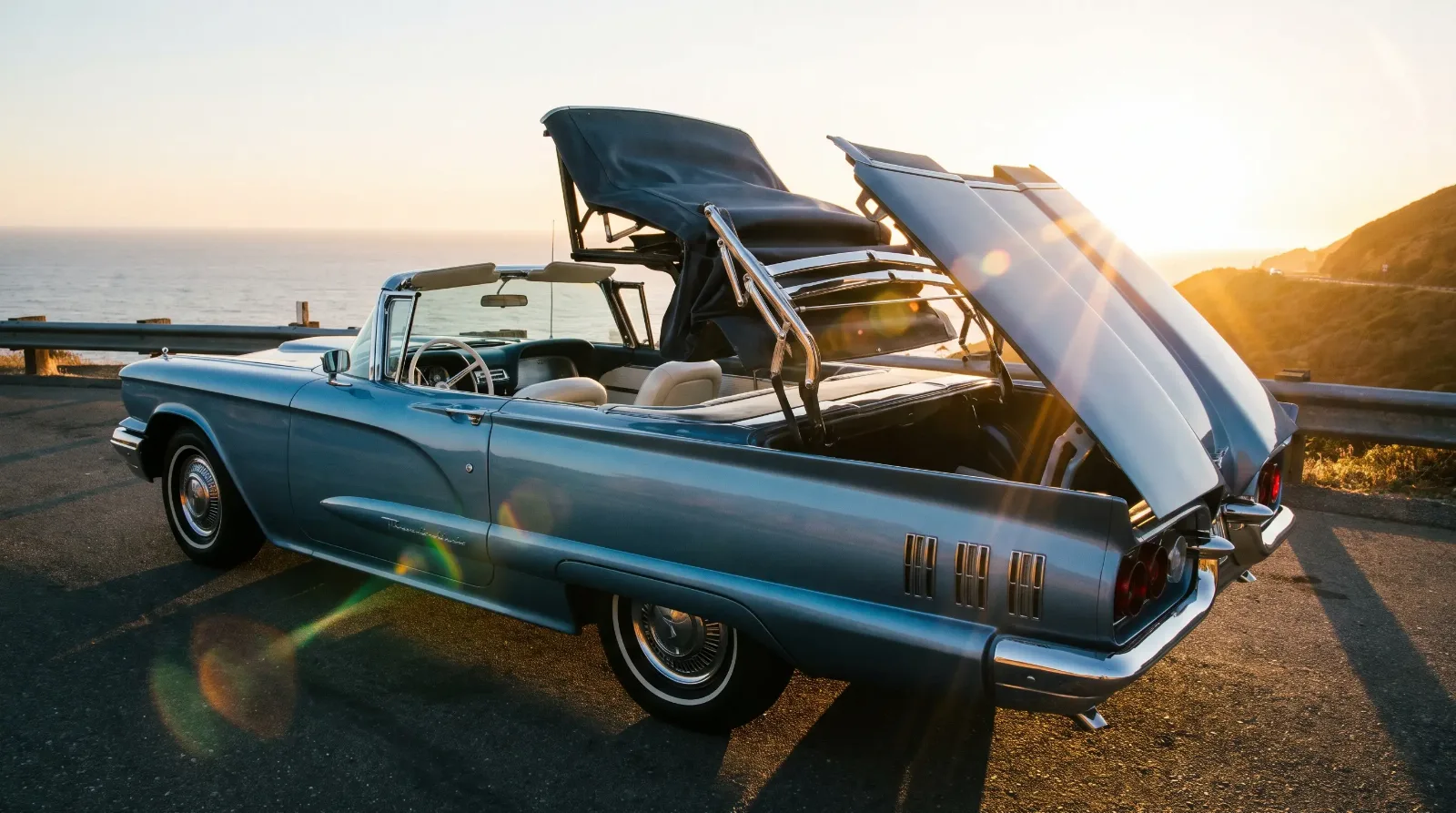
For background on how the Square Bird came to exist in the first place, our 1958 ford thunderbird retrospective covers the body redesign and the sales pitch that turned Ford's two-seat sports car into a four-passenger personal luxury coupe. The convertible variant added its own complications on top of the drivetrain question, which a related story gets into in detail.
What to look for if you're shopping
Confirm the engine matches the trim tag before you get attached to a car. Engine swaps happened over sixty-plus years of ownership, and a 352 badge on the fender doesn't guarantee a 352 under the hood, or the reverse. Ask for documentation, check casting numbers, and don't take a seller's word on displacement without popping the hood and looking at the block yourself.
Cost of ownership over the long haul
Run the numbers on what it actually costs to keep either engine on the road for a decade of ownership, not just the purchase price difference. The 352's parts network is deep because Ford used the FE family across so many applications for so many years, trucks, Galaxies, Fairlanes, even later performance cars that share enough architecture to keep machine shops familiar with the platform. A water pump, an intake gasket, a rebuild kit, none of it requires special sourcing. You call a supplier, you get the part, you move on with your week.
The 430 doesn't offer that same convenience. Its production run was short and its use limited mostly to Lincoln and the higher trims of Mercury alongside the Thunderbird, which means the aftermarket support built around it is thinner across the board. Rebuild kits exist, but expect to pay more and wait longer. A shop unfamiliar with the MEL family will also charge more in labor simply because they're relearning a platform they don't see every week, unlike the 352 which most competent classic Ford mechanics have handled dozens of times over.
None of this makes the 430 a bad engine. It's a fine piece of engineering that did exactly what Ford wanted, deliver serious torque without redesigning the car around it. But bad engine and expensive-to-own engine are two different judgments, and buyers frequently conflate them because a bigger number on a spec sheet feels like it should translate to a better ownership experience. It usually doesn't.
What the fuel and driving experience actually feel like
Neither engine rewards spirited driving in the way a modern reader might expect from "350 horsepower." Both are long-stroke, low-revving American V8s built for effortless cruising rather than any kind of aggressive throttle work, and both return fuel economy in the low double digits on a good day, worse in city driving. If you're buying a Square Bird expecting sports car dynamics from either engine option, you've misread what this car was built to do. It was built to make a two-lane highway trip feel relaxed, not to win anything at a stoplight.
That said, the difference in how the two engines deliver their power is noticeable from the driver's seat even if the stopwatch difference is modest. The 430 pulls with more authority in the midrange, the kind of passing power that matters on a two-lane road behind a slow truck. The 352 gets you there too, just with slightly more patience required. Which one you want depends entirely on what kind of driving you actually plan to do with the car once it's yours.
| Spec | 352 V8 (standard) | 430 V8 (optional, 1959-60) |
|---|---|---|
| Displacement | 352 cu in | 430 cu in |
| Horsepower (gross) | 300 hp | 350 hp |
| Torque | ~380 lb-ft | ~490 lb-ft |
| Carburetion | Single 4-barrel | Single 4-barrel |
| Family | FE-series | MEL-series |
If you're in the market, Thunderbirds for sale now gives you a current look at what's available, engine option and all. Check the block before you check the price.
Sources and notes
Related Reading
Have a
Ford Thunderbird
for Sale?
Reach thousands of serious classic car collectors across the US.
Sell It Here →
Are You a Classic Car Dealer?
List your full inventory and connect with targeted classic car buyers.
Join as a Dealer →

About the author
Dan Reeves
Performance engine builder from North Carolina's motorsports corridor, focused on swaps, forced induction and making real, repeatable power.
Related Listings - Ford Thunderbird
Comments
Be the first to comment on this article.