The dentist who embarrassed the professionals
There is a photograph from Elkhart Lake, 1956, that tells you everything you need to know about how the Corvette arrived in SCCA racing. A white fiberglass two-seater is leading a field of Jaguars and Porsche Spyders. The driver is a periodontist from Washington, D.C. His name is Dick Thompson, and over the next seven years he will win more SCCA national championships in a Corvette than any other driver of his era, earning the nickname "The Flying Dentist" in the process.
Thompson was not a factory driver in any formal sense. He was an amateur who happened to be very fast, and he drove cars that Chevrolet's engineering team was quietly, sometimes officially, making faster. The relationship between Thompson, Zora Arkus-Duntov, and the SCCA B-Production class is one of the more interesting backroom stories in American motorsport. What you see in the record books is a Corvette winning championships. What you don't see is the work it took to build a production sports car that could win them honestly.
Duntov and the homologation problem
Zora Arkus-Duntov joined Chevrolet in 1953, the same year the Corvette was introduced. He spent the next two decades trying to make the car match its looks, and a significant part of that effort ran through the SCCA rulebook.
SCCA production-class racing required that cars compete essentially as sold. The B-Production class in the late 1950s placed the Corvette against Jaguar XK140s, Austin-Healey 100-6s, and, as the class boundaries shifted, Triumph TR3s and assorted European machinery. To win legitimately, the Corvette had to be genuinely competitive in stock form, or close to it. Duntov understood that the racing program and the street car were inseparable. If the Corvette proved itself at Elkhart Lake and Watkins Glen, it sold in showrooms. If it got embarrassed by a TR3 on a road course, that was a different conversation.
His approach was methodical. The 1956 Corvette received a significant mechanical upgrade over the 1953 and 1954 cars, including the new 265 cubic inch small-block V8 in place of the original six-cylinder. By 1957, Duntov had the 283 cubic inch V8 available with fuel injection, which in its highest state of tune produced one horsepower per cubic inch, 283 hp. This was not an accident. That specific output was engineered partly with the SCCA class boundaries in mind. The fuel-injected 283 also got Duntov's own high-lift camshaft, which became known informally as the "Duntov cam" and was offered as a factory option beginning in 1957.
Homologation also required minimum production numbers. Duntov worked within Chevrolet's production system to ensure that enough cars were built with competition-relevant options to satisfy SCCA requirements. The RPO 684 heavy-duty racing suspension package, offered in 1957, included stiffer springs, a larger front anti-roll bar, Cerametallic brake linings, and a quick-ratio steering box. These were listed in the dealer order guide. They were street-legal. They also made the Corvette a more serious racing proposition than almost any other production car available for the money.
"Duntov wasn't just building a sports car. He was building a car that could prove itself on a road course in front of judges who knew what they were looking at. Every option code in that 1957 order guide was an argument."
— Jim Vasquez
B-Production dominance and the C2 era
Thompson's 1956 and 1957 championships established the Corvette in B-Production, but the story continued through two more generations of the car. The C1 (1953 to 1962) gave way to the Sting Ray in 1963, and the Sting Ray arrived faster and better sorted than anything that had come before it.
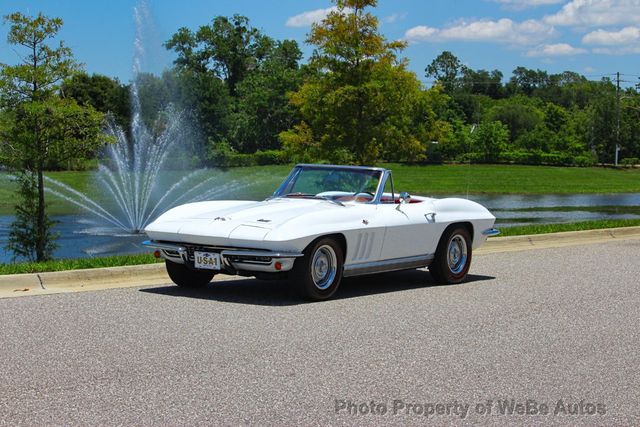
The 1963 Sting Ray introduced independent rear suspension, a first for the Corvette. On a road course, this mattered. The solid-axle rear of the C1 had always been a limitation, something Thompson and the other SCCA regulars had learned to work around rather than solve. The C2's IRS changed the car's behavior in corners in ways that took a lap or two to appreciate and several seasons to fully exploit.
The available engines kept pace. The 327 cubic inch small-block, introduced in 1962, replaced the 283 and came in multiple states of tune. The L76 version produced 340 hp; the fuel-injected L84 reached 375 hp. For 1965, Chevrolet added the 396 cubic inch Mark IV big-block as an option, and by 1966 the 427 was available in the Corvette in several configurations. The L72 427 was rated at 425 hp, though many people familiar with those engines believe the actual output was higher.
| Year | Engine | Rated HP | SCCA Class |
|---|---|---|---|
| 1957 | 283 ci fuel-injected V8 | 283 hp | B-Production |
| 1962 | 327 ci V8 (L76) | 340 hp | B-Production |
| 1963–64 | 327 ci fuel-injected (L84) | 375 hp | B-Production |
| 1965 | 396 ci Mark IV V8 | 425 hp | A-Production |
| 1966–67 | 427 ci V8 (L72) | 425 hp | A-Production |
The big-block engines pushed the Corvette into A-Production, where it competed against Ferrari 275s and other serious European machinery. That was a different kind of argument. Thompson won his 1962 and 1963 championships in the 327-powered cars before moving up. Other drivers, including Dr. James Jeffords in an earlier era, had also taken SCCA national titles in Corvettes, a record of consistency that few American production cars could match. For a deeper look at how this period fits into the car's broader competition history, the full Corvette racing history traces the arc from Elkhart Lake through Le Mans and beyond.
Trans-Am and the limits of a heavy car
The SCCA Trans-American Sedan Championship, which began in 1966, presented a different problem. The series was built around smaller-displacement cars, initially with a 5-liter (305 cubic inch) ceiling on engine size. The Corvette's available powerplants were all larger. This meant the Corvette could not compete in the main Trans-Am class as the rules were written.
What happened instead was that Corvette drivers competed in the over-2.5-liter class that ran alongside the main Trans-Am events during some seasons, effectively as a support category. This arrangement kept Corvettes on the same circuits as the Mustangs and Camaros that were winning the headline class, but it was not the same competition. The Corvette was never a Trans-Am car in the sense that a Mustang GT350 or a Camaro Z/28 was a Trans-Am car.
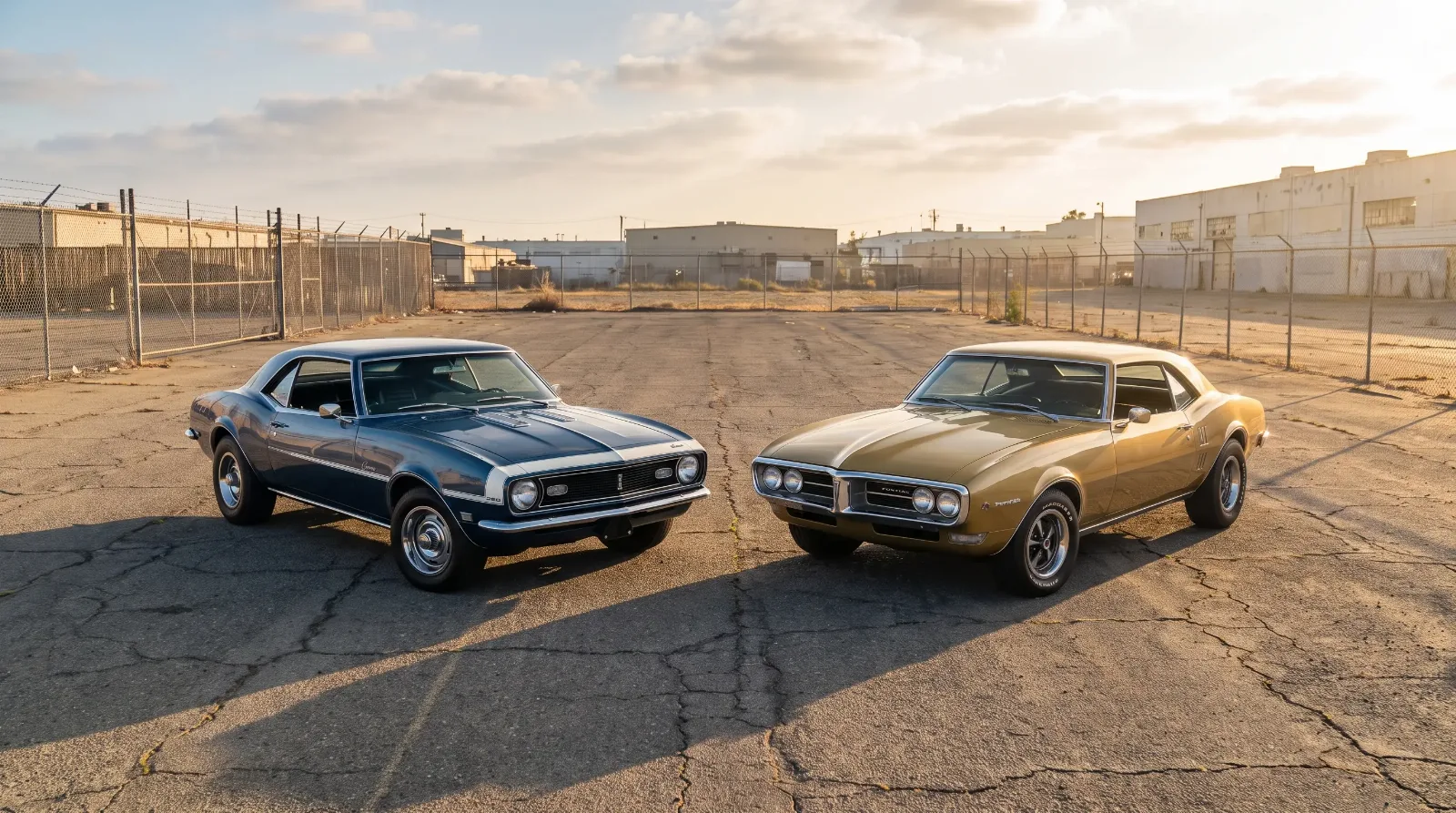
The structural reason is straightforward. The Trans-Am series, particularly after 1967, rewarded cars that combined adequate power with light weight and good handling balance. The Corvette was not light. The C2 weighed roughly 3,100 pounds in street trim. A Camaro Z/28 prepared for Trans-Am competition weighed less, had a shorter wheelbase, and turned in more readily. The Z/28's 302 cubic inch small-block, built specifically to displace just under the 305 cubic inch limit, was a high-revving engine that suited road course work. It was, in a direct sense, an engine designed for Trans-Am and then sold to customers. Chevrolet already had one car built for that series. Putting the Corvette in it as well would have required a different car than the one Duntov had built.
There were Corvette appearances in Trans-Am-adjacent events through the late 1960s, and privateers ran modified cars in various regional series. But Chevrolet's factory support went to the Camaro program. Roger Penske and Mark Donohue took the 1968 and 1969 Trans-Am championships in Camaros. That was the direction the corporate racing budget pointed.
What the SCCA record actually means
The Corvette's SCCA legacy is more substantial than most people realize, partly because it accumulated over a long period in a class structure that didn't generate the same headline attention as Le Mans or Daytona. B-Production national championships don't get covered in the same breath as overall wins at major international circuits. But they represent something real: a production car, sold at Chevrolet dealers, that could be driven to a road course, raced, and driven home, and that won against serious competition at the national level.
Thompson's four B-Production championships and two C-Production titles between 1956 and 1963 are the clearest evidence of what Duntov built. The cars he drove were not stripped race cars in any meaningful sense. They were street Corvettes with factory competition options, the kind of thing you could order from a dealer if you knew the right option codes. That combination, factory engineering expressed through production options and proven in amateur competition, is what made the SCCA program significant.
The C2 era continued that success. The introduction of independent rear suspension in 1963 made the car genuinely better on a road course, not just faster in a straight line. Drivers who had been competitive with the C1 found the Sting Ray more forgiving under braking and more adjustable in corners. The production numbers for the high-output engines stayed low enough that not many buyers could get the full competition specification, but enough were built to keep the class legal.
The Trans-Am chapter is more complicated, and more honest to read as a limitation than a failure. The series was structured around cars the Corvette wasn't designed to be. Chevrolet built the car it wanted to build and found the competition context that fit it. SCCA production-class racing fit. Trans-Am, with its displacement ceiling and its emphasis on lighter, more nimble machines, didn't. That's not a knock on the Corvette. It's a description of what the car is.
For anyone interested in a Corvette from the SCCA era, the C1 cars with documented racing history and the early C2 Sting Rays with factory high-output options represent a specific intersection of street car and competition car that Chevrolet has rarely managed as cleanly since. The tank sticker matters. The option codes matter. And the record Thompson built over seven seasons at Watkins Glen, Elkhart Lake, and Road America is the context that makes those option codes mean something.
Sources and notes
- Ludvigsen, Karl. Corvette: America's Star-Spangled Sports Car. Motorbooks International, 1973. Primary reference for Duntov's engineering work and SCCA competition record through the C2 era.
- Antonick, Michael. Corvette Black Book 1953–2019. Michael Bruce Associates, 2019. Production numbers, option codes, and RPO data for all model years.
- SCCA National Championship Records, Sports Car Club of America archives. Thompson's championship titles are documented in official SCCA records for 1956, 1957, 1958, 1960, 1962, and 1963.
- Duntov, Zora Arkus. Engineering memoranda and correspondence, General Motors Design Archive. Reproduced in part in various Corvette histories; primary source for the development of the 1957 competition package.
- Lamm, Michael, and Holls, Dave. A Century of Automotive Style: 100 Years of American Car Design. Lamm-Morada, 1997. Contextual background on the Corvette's design and engineering timeline.
- Yates, Brock. "The Flying Dentist." Car and Driver, various issues, 1960s. Contemporary coverage of Thompson's racing career and the Corvette's SCCA program.