
Two cars pull up to a red light at dusk, engines idling low, and neither driver says a word. The camera doesn't need dialogue here. It's spent the whole movie building to this moment, and the audience already knows exactly what the light turning green is going to mean. More often than not, one of those cars is a Chevelle, and the other is whatever the story has decided deserves to lose to it.
Ownership & Lifestyle
6 min read
The Chevelle's Onscreen Rivals
Why filmmakers keep pairing the Chevelle against a Mustang, Charger, or 'Cuda, and what those onscreen rivalries borrow from real muscle car history.
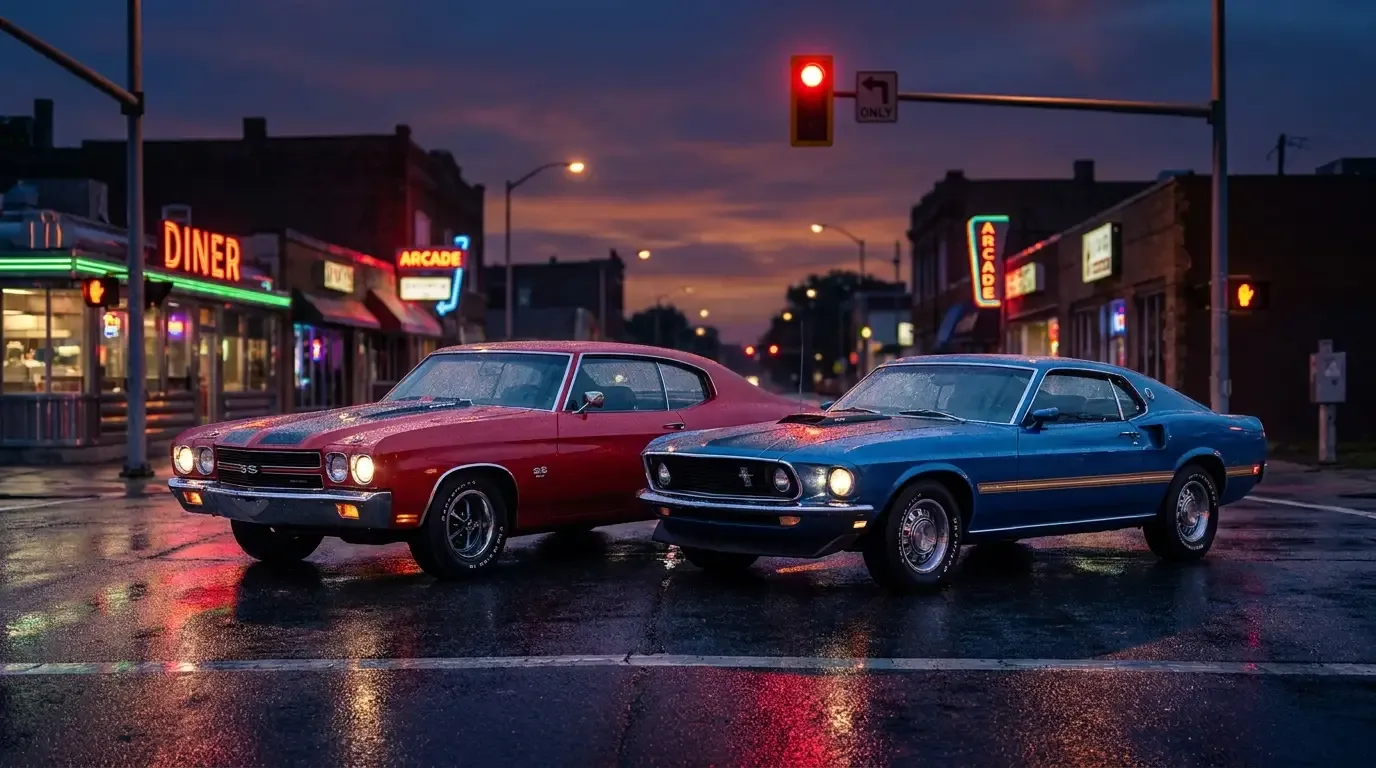
Screenwriters reach for this setup constantly because it works without explanation. A muscle car standoff communicates history, ego, and stakes in about four seconds of screen time, and the Chevelle has spent decades being cast as one half of that equation, usually the half the audience is rooting for.
The rivalry that never needed dialogue
Car rivalries on screen borrow from something real. Detroit's muscle car era was genuinely a horsepower war between manufacturers, and audiences who grew up around that era, or who absorbed it secondhand through their parents' garage stories, bring that history into the theater with them. When a Chevelle lines up against a rival on screen, the tension isn't invented out of nothing. It's inherited from an actual decades-long argument about which brand built the better street car.
That inherited weight is part of why Chevelle in pop culture keeps circling back to these matchup scenes. They're cheap to write and expensive to fake convincingly, which is exactly the kind of scene that rewards a production willing to put real metal on the road instead of leaning on a computer.
Chevelle vs Mustang: the classic screen matchup
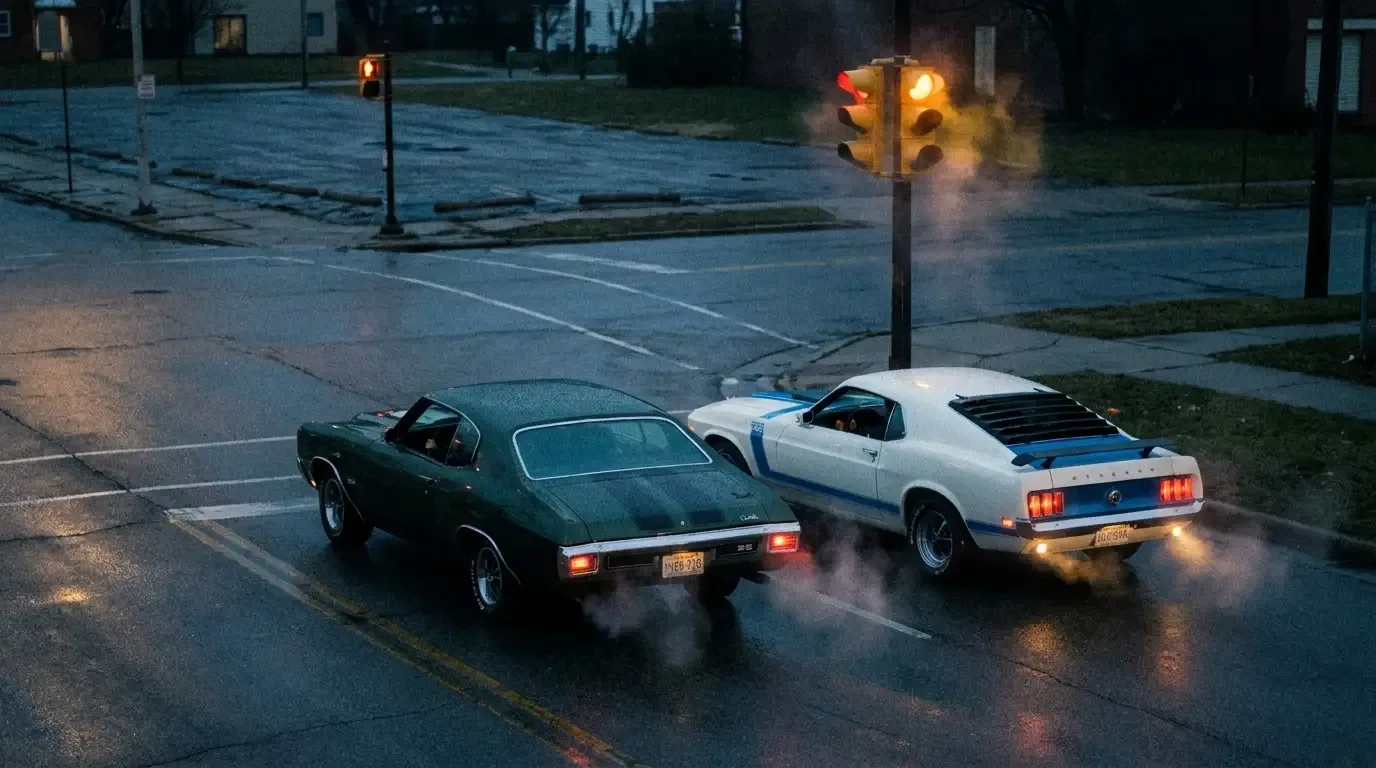
The Chevelle-versus-Mustang pairing shows up more than any other on-screen rivalry involving this car, and it's not hard to see why. Both were affordable, both had genuine performance variants that could embarrass more expensive cars, and both had passionate, loyal owner bases that never fully made peace with each other off screen either. Writers didn't invent this argument. They just gave it a script.
What makes the Mustang matchup work dramatically is that it never reads as a mismatch. A Boss 302 or a Mach 1 against a Chevelle SS is a fight either car could plausibly win, which keeps tension in the scene instead of turning it into a foregone conclusion. Compare that to scenes where a muscle car races something clearly overmatched. Those play as comic relief. A Chevelle and a Mustang lined up at a light plays as genuine stakes.
Other cars that have gotten cast opposite it
| Onscreen rival | What the matchup usually represents |
|---|---|
| Ford Mustang | The classic brand-loyalty rivalry, closest in era and price point |
| Dodge Charger | Big-block muscle vs. big-block muscle, often framed as raw power on both sides |
| Plymouth Barracuda / 'Cuda | Mopar underdog energy, usually the wildcard in a three-car scene |
| Chevrolet Camaro | The in-house rivalry, GM against itself, usually played for banter rather than hostility |
The Camaro matchup is the odd one out on this list because it's a family argument rather than a real rivalry. Writers use it to establish character, not stakes. Two GM products racing each other reads as friendly competition between people who respect each other, which is a very different tone than a Chevelle-Mustang standoff.
The Charger matchup carries a different weight entirely. When a Chevelle lines up against a Charger on screen, the scene rarely plays as banter. Both cars carry a reputation for raw, unrefined power, and writers tend to frame that pairing as two heavyweights who respect each other but aren't about to say so out loud. It's the rivalry that reads closest to real animosity, which is probably why it shows up less often than the Mustang matchup. A film can only sustain so much genuine tension before it needs to release it.
Why filmmakers keep writing this rivalry
Part of it is practical. Both cars are visually distinct enough that even a casual viewer can track which one is which mid-chase, which matters more than it sounds like it should when you're cutting fast-moving footage together. A muscle car rivalry between two visually similar sedans doesn't read the same way on screen. The Chevelle's long hood and fastback roofline against a Mustang's more angular, notchback profile gives editors an easy visual shorthand, no narration required.
There's a sound design reason too. Different engine families genuinely sound different, and a scene cutting between a small-block Mustang and a big-block Chevelle can use that audio contrast to help the viewer track the race even during wide shots where the cars themselves are small in frame. A rivalry between two cars that sound alike loses that extra layer of clarity, which is one more reason writers keep reaching for pairings with real mechanical differences instead of inventing rivalries between similar cars for the sake of variety.
"You don't need a character to explain why these two cars hate each other. Anyone who grew up around a garage already knows. The rivalry does half the writer's job for them before a single line of dialogue gets spoken."
Nora Beckett
What the rivalry says about the cars themselves
There's something telling in how often the Chevelle gets written as the car worth rooting for rather than the car that needs to be beaten. It suggests a certain baked-in sympathy, the underdog with the bigger engine, the family car that turned out to have teeth. That's not an accident of casting. It reflects how the car has always been perceived off screen too, a Chevrolet built for regular people that happened to be capable of embarrassing cars that cost more.
That perception carries real financial weight once the credits roll and the cameras go home. Read next: From Screen to Street for a look at how decades of winning these on-screen showdowns have actually moved the needle on what real Chevelles sell for today.
Sources and notes
Related Reading
Have a
Chevrolet Chevelle
for Sale?
Reach thousands of serious classic car collectors across the US.
Sell It Here →
Are You a Classic Car Dealer?
List your full inventory and connect with targeted classic car buyers.
Join as a Dealer →

About the author
Nora Beckett
Automotive features writer and photographer who tells the human stories behind the cars, from show fields to cross-country road trips.
Related Listings - Chevrolet Chevelle
More in Ownership & Lifestyle
Comments
Be the first to comment on this article.