
There is a moment on an early Beach Boys record where the whole thing stops being about surfing and starts being about a car. You hear an engine turn over, and then Brian Wilson is singing the praises of a Chevrolet 409 like it is a girl he cannot get out of his head. That was 1962, and it turned out to be a preview of the whole decade. For a stretch of years, some of the biggest names in American pop were writing love songs to engines, and the car radio became the place where a generation's obsession got its soundtrack.
Ownership & Lifestyle
6 min read
Muscle Cars in Music
How muscle cars became pop music icons, from the Beach Boys' "409" and Ronny and the Daytonas' "G.T.O." to Springsteen's road anthems.
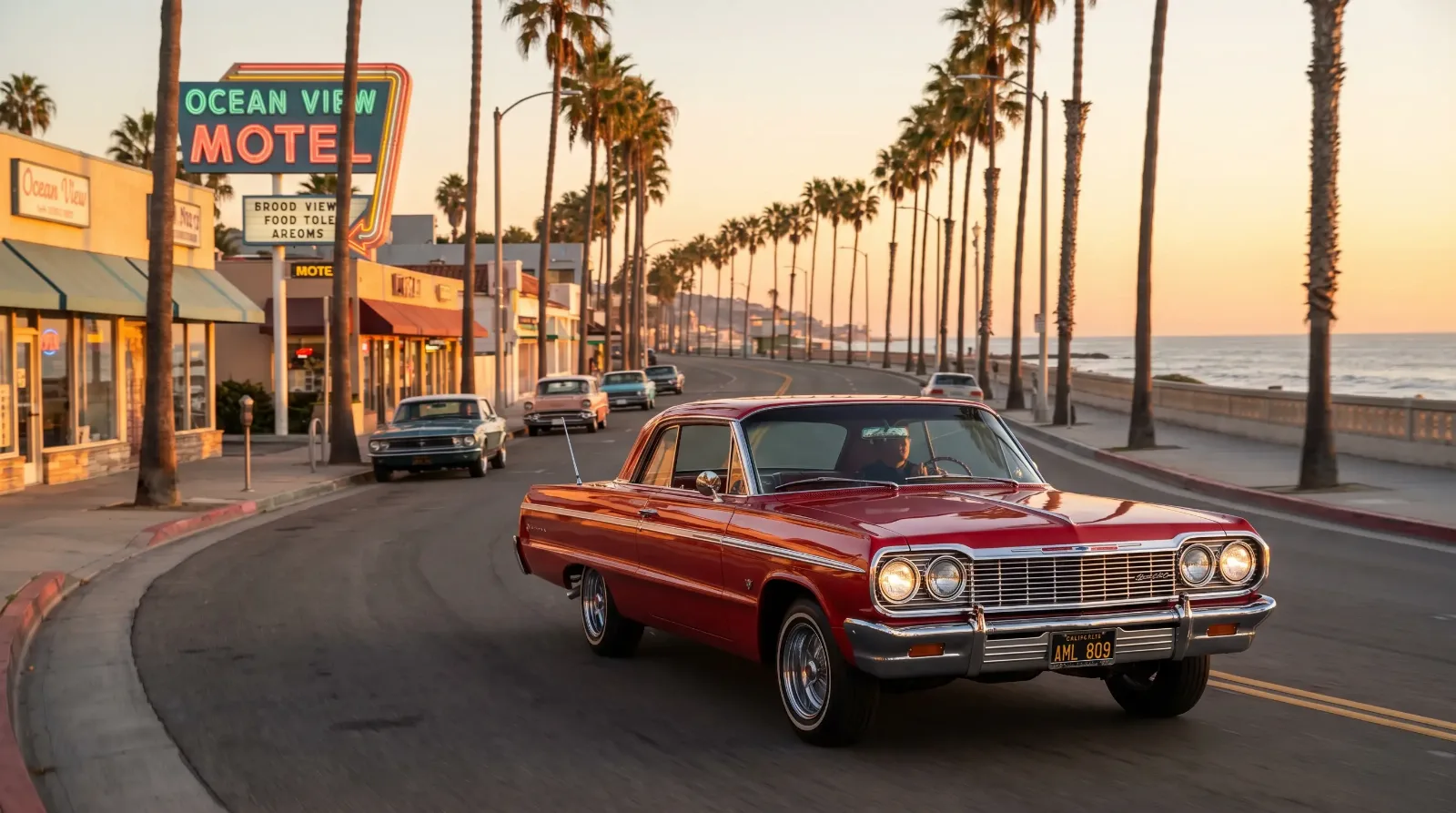
Music and muscle cars grew up together, feeding each other. The cars gave songwriters a subject their young audience already loved, and the songs gave the cars a reach that no advertisement could buy. If you want the broader context of how these machines wove themselves into everyday life, the muscle car culture explainer covers the whole sweep of it.
When California put cars on the radio
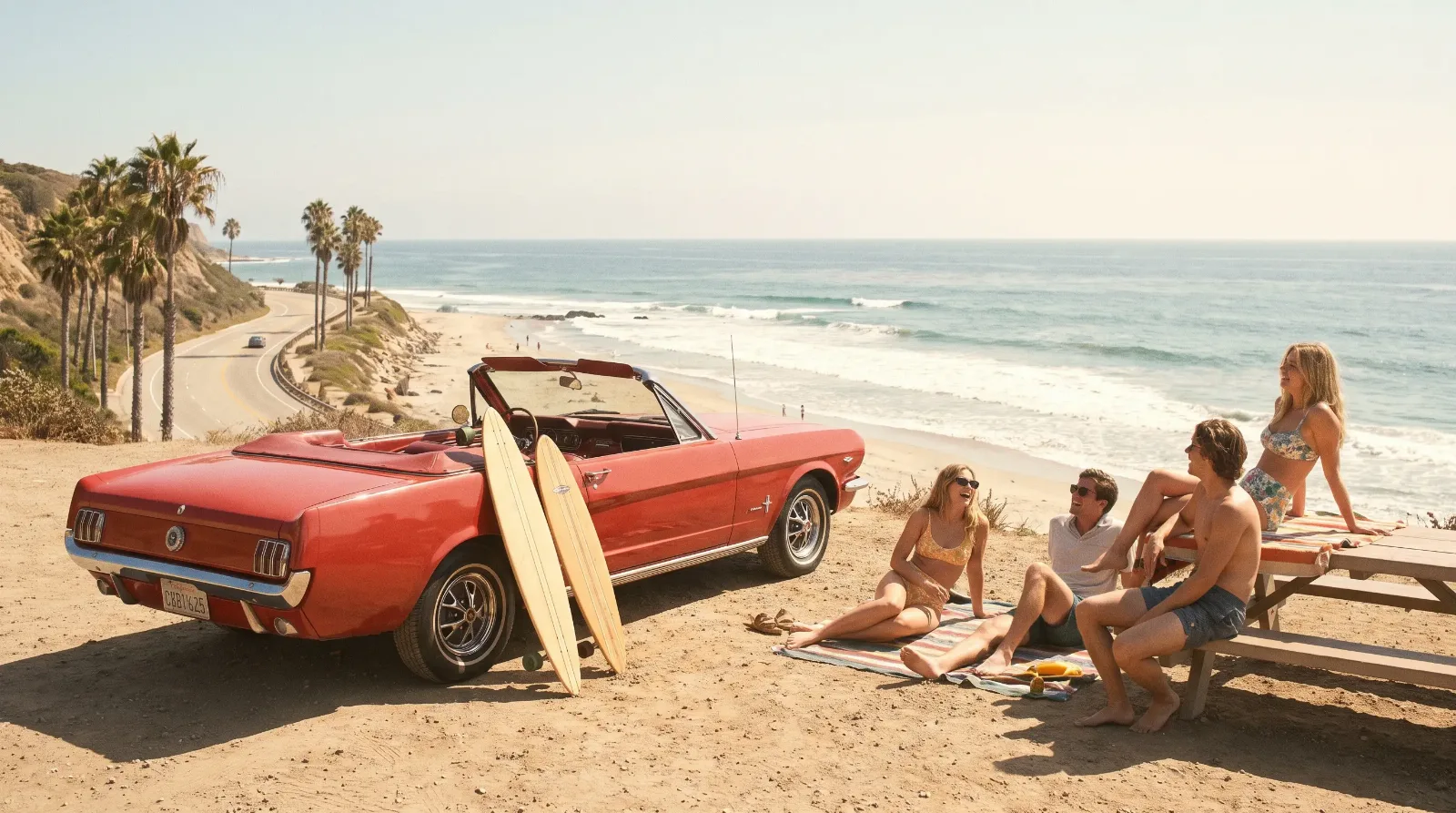
The first wave came out of Southern California, where surf music and car culture were basically the same scene. The Beach Boys led it. "409" celebrated the big Chevrolet engine by name, complete with the sound of a real motor firing up at the start of the track. "Little Deuce Coupe" from 1963 sang about a hopped-up 1932 Ford, which was a hot rod rather than a factory muscle car, but the spirit was identical. It was a young man bragging about his ride in three-part harmony.
These were not novelty records buried on B-sides, though "409" started life as one. They were part of a movement. A whole genre of what people called hot rod music sprang up, with groups singing about specific cars, specific engines, and specific races. The cars were not metaphors. They were the actual subject, named and numbered, and the audience knew exactly what a 409 was because half of them wanted one.
The song that named a Pontiac
Then in 1964 a group called Ronny and the Daytonas released a song simply titled "G.T.O." It was a straight celebration of the new Pontiac, rattling off the car's features like a spec sheet set to a beat, and it climbed the national charts. Think about what that means. A pop record named after a specific new model, selling that model's image to millions of young listeners, at no cost to Pontiac. You could not design a better piece of marketing, and nobody at the factory had to lift a finger.
That is the strange power of a car song. When Wilson Pickett cut "Mustang Sally" in 1966, the Ford Mustang got tangled up in one of the defining soul records of the era, and the association stuck for good. The songs did not just reflect which cars were popular. They helped decide it. A hit record could put a nameplate into the heads of people who never read a car magazine in their lives.
From celebration to something deeper
As the sixties turned into the seventies, the way music used muscle cars changed. The early songs were pure celebration, all speed and bragging. Later songwriters started reaching for the car as a symbol of something heavier, freedom, escape, a working-class dream that was already slipping away.
Bruce Springsteen built a good part of his early work on that idea. In "Racing in the Street" he sings about a 1969 Chevrolet with a 396 as if the car were the last honest thing in a hard life, and the muscle car stops being a toy and becomes a way out, or the memory of one. That shift tracks the culture itself. By the time Springsteen was writing, the golden age of cheap horsepower was ending, and the car in the song carried all the weight of what had been lost.
"A hit song could sell a car better than any dealer, because nobody argues with a chorus. You just find yourself singing about a 409, and one day you realize you kind of want one."
Patrick Walsh
Why the songs still matter
The car songs did something no advertisement could. They made the muscle car part of the emotional furniture of a generation. A person who was sixteen in 1965 cannot hear "G.T.O." now without going straight back to a summer, a girl, a stretch of road. The car and the song are fused, and you cannot pull them apart. That is why these records still turn up at every cruise night and car show, playing from somebody's stereo while the same models they sang about sit gleaming in the lot.
| Song | Year | The car it celebrated |
|---|---|---|
| "409" by The Beach Boys | 1962 | The Chevrolet 409 engine |
| "Little Deuce Coupe" by The Beach Boys | 1963 | A hot-rodded 1932 Ford |
| "G.T.O." by Ronny and the Daytonas | 1964 | The Pontiac GTO |
| "Mustang Sally" by Wilson Pickett | 1966 | The Ford Mustang |
| "Racing in the Street" by Bruce Springsteen | 1978 | A 1969 Chevrolet with a 396 |
The soundtrack keeps playing
The tradition never really stopped. Muscle cars still show up in country songs, in rock, in hip-hop, wherever an artist wants to signal power, nostalgia, or a certain kind of American swagger. The specific engines change, but the impulse is the same one Brian Wilson had in 1962. There is something about these machines that makes people want to sing about them.
That connection between the music and the metal is a big reason the cars themselves stay desirable, and plenty of the models that inspired those old hits are still out there to be owned. If a song ever made you want one, you can find muscle cars up for grabs and see what is available. The cars in the movies and games kept the flame going too, and you can read the full story of how muscle went digital and miniature. The radio started it, though. Long before the auction hammer, there was a chorus.
Related Reading
Have a
Classic Car
for Sale?
Reach thousands of serious classic car collectors across the US.
Sell It Here →
Are You a Classic Car Dealer?
List your full inventory and connect with targeted classic car buyers.
Join as a Dealer →

About the author
Patrick Walsh
Automotive journalist covering classic car shows, events, and the enthusiast community across North America.
More in Ownership & Lifestyle
Comments
Be the first to comment on this article.