
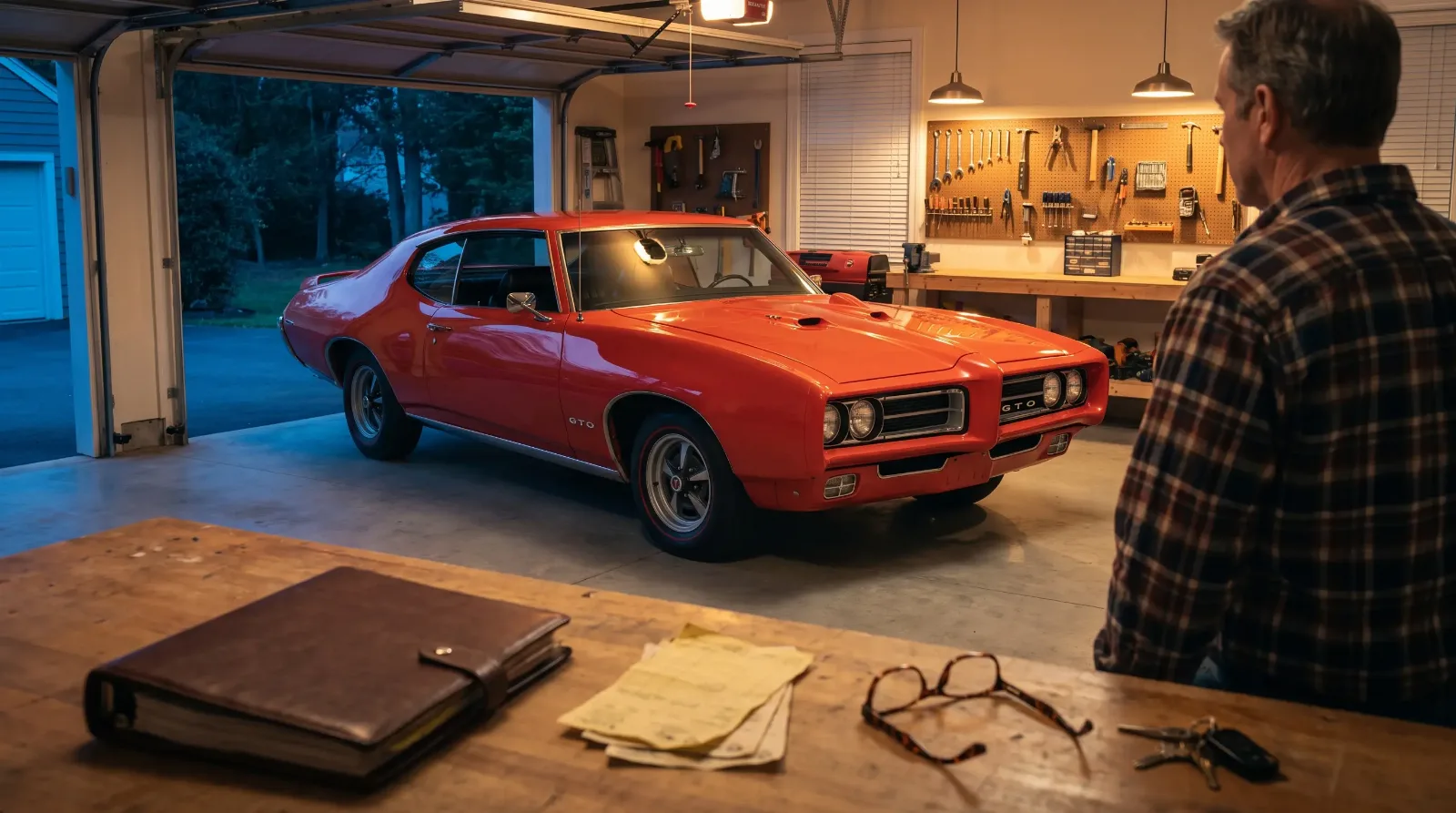
A seller sends me his insurance declarations page and asks why nobody will pay the number printed on it. The car is insured for an agreed value well above what the comps support, and he reads that figure as proof of worth. It is proof of something. Just not of what a buyer will pay. Agreed value vs market value is one of the most common sources of a mispriced listing, and the confusion runs in one direction: it pushes asking prices up.
Market & Values
8 min read
Agreed Value vs Market Value: Why Insurance Numbers Aren't Sale Prices
Agreed value vs market value: why your classic's insurance figure isn't a sale price, why the two drift apart and how to use the policy number.

The two numbers answer different questions. One says what your insurer will pay if the car is destroyed. The other says what a stranger will pay to own it this season. This article separates them, explains why they drift apart, and shows how a seller can use the insurance figure without leaning on it. For the full pricing method, sold comps and condition tiers included, see our guide on how much is my classic car worth.
What agreed value actually is
Collector car insurance usually works differently from a daily-driver policy. On an ordinary auto policy, a total loss pays actual cash value: what the insurer decides the car was worth at the moment of the loss, after depreciation. For a 1969 coupe that a standard adjuster might value like any other old used car, that can be a painful number.
Agreed value fixes the figure in advance. You and the insurer settle on an amount when the policy is written, and if the car is a total loss, that is what the policy pays, without a deduction for depreciation and less any deductible that applies. Hagerty, which calls its version Guaranteed Value, and American Collectors both describe it that way. The insurer accepts the number based on what you submit: photos, a description, sometimes an appraisal, sometimes nothing more than its own valuation data for the model.
Notice what is missing from that process. Nobody put the car on the market. Nobody tested whether a buyer would actually pay the number. The insurer agreed to a coverage amount it was willing to write a premium against. That is a contract term, not a transaction.
The valuation terms sellers mix up
Sellers run into several valuation terms, and they are not interchangeable. The differences matter more when you sell than when you insure.
| Term | Question it answers | Who sets it | Useful for pricing a sale? |
|---|---|---|---|
| Agreed value | What the insurer pays on a total loss | Owner and insurer, by agreement | As a rough upper reference only |
| Stated value | The most the insurer may pay on a total loss | Owner states it, but the policy can pay actual cash value if that is less | No |
| Actual cash value | What the car was worth at the moment of loss, per the adjuster | Insurer, after the fact | No |
| Replacement or insurance appraisal | What it would cost to replace the car | Appraiser | Limited. Usually runs high. |
| Fair market value | What a willing buyer pays a willing seller | The market, read through comps | Yes. This is the one. |
Only the last row is a sale price. Everything above it is a figure built for a different purpose, by people who were not trying to buy the car.
Why the policy number drifts away from the market
Insurance figures tend to run ahead of what a car would actually sell for. There are structural reasons for that, and none of them involve anyone acting in bad faith.
Replacement is not resale. If your car is destroyed, you would have to find another one, in a hurry, at retail, and probably travel or pay shipping to get it. The coverage amount reasonably reflects that cost. A buyer of your car faces none of that pressure. He can wait, compare, and walk.
Owners set the number. On many policies, the owner proposes the value. Owners grade their own cars generously, and they remember what they spent. An insurer will often accept a figure within a reasonable range for the model rather than challenge it, because the premium scales with the coverage.
Values go stale. A figure agreed three years ago reflects that market, not this one. Some insurers add an inflation guard, which American Collectors describes as automatically adjusting the agreed value limit on a covered total loss, and Grundy advertises protection for market appreciation and inflation. Those features move with inflation, not with what your model is actually doing. Meanwhile, if values on your model softened and nobody revisited the figure at renewal, the policy may still carry the old peak.
Restoration spending. After a big job, owners raise their coverage to protect the investment. That is prudent. It also writes the invoice total into the policy, and as anyone who has sold a restored car knows, the invoice total is rarely what the market pays.
The drift can run the other way too. An owner who never updated a policy on a model that climbed may be underinsured, and the policy figure may sit below what the car would bring. Either way, the insurance number tells you about the policy. Comps tell you about the car.
"An insurance number is the price of replacing your car in a hurry. A sale price is what a stranger pays when he is in no hurry at all. Expect the second to be lower."
Marcus Feld
Using the insurance figure when you sell
I don't tell sellers to ignore the agreed value. I tell them to put it in the right place.
First, do not lead a listing with it. "Insured for $X" in an ad reads as a seller who doesn't have comps, and experienced buyers discount accordingly. If the figure is well above the market, it also signals that you will be hard to negotiate with, which costs you calls.
Second, use it as a check, not an anchor. If your comp-based asking price lands well above the agreed value, ask why. Either the policy is stale, or your grading is optimistic. If the comps land well below it, the policy is probably the one that's out of date, and it may be costing you premium you don't need to pay. Once you have a realistic market figure, how the actual number gets set and adjusted during the sale is covered in depth, and the details are here.
Third, if a written appraisal backed the agreed value, read what kind it was. A replacement-cost appraisal answers the insurance question, and a buyer's inspector will spot that immediately. A fair market value appraisal is the one that supports a sale. If you want an appraisal to help you sell, order that type and say so to the appraiser.
Keeping the policy right while the car is for sale
The selling period carries its own insurance questions, and a few of them catch owners out.
Keep the car insured until the sale is complete and the title has changed hands. Test drives, inspections, and a car parked in a buyer's view on your driveway are all exposure. Collector policies carry usage limits (Hagerty's, for example, cover club events, shows, tours and occasional pleasure driving but not daily use) and conditions on who may drive, so check with your insurer whether a prospective buyer behind the wheel is covered before you hand over the keys.
Do not cancel on the day the deposit arrives. Cancel after the funds have cleared and the paperwork is signed. A deposit is not a sale, and a deal that falls apart leaves you with an uninsured car if you moved too early.
Finally, expect the buyer's insurer to set its own number. Your agreed value doesn't transfer. The new owner's policy will be written against his documentation and the insurer's valuation data, which is one more reason the figure on your declarations page has no weight in the negotiation. It was a number for your policy, and the policy ends when the car leaves.
Insurance numbers protect you against loss. Sale prices come from the market. Price from comps, use the policy as a sanity check, and let the buyer see evidence of the car rather than evidence of your coverage.
Sources and notes
- Hagerty: agreed value vs Guaranteed Value, stated value and actual cash value
- American Collectors Insurance: classic car insurance, agreed value and inflation guard
- Grundy: Insurance 101, agreed value, stated amount and inflation protection
- Old Cars Weekly: So, are you really insured? (stated amount forms)
- Hagerty: does my vehicle qualify (usage and driver requirements)
Policy terms vary by insurer and state. Read your own policy, and treat this as general information, not insurance advice.
Related Reading

#classic car insurance
#classic car appraisal
#selling a classic car
#fair market value
#agreed value insurance
#agreed value vs market value
#stated value

About the author
Marcus Feld
Accredited collector-car appraiser who reads the market through hammer prices, condition tiers and risk.
More in Market & Values



Comments (1)
G
Glenn Burkhardt
1 day ago
My '66 Chevelle SS 396 came to me with the seller's declarations page on top of the folder, agreed value $72,000, asking $70,000, as if that were a discount. Comps for that car, a numbers-matching four-speed driver, were closer to $55,000, and we settled near there. Here is the plain version of why his number ran high: he set it after a $30,000 restoration, the insurer accepted it, and nobody ever tested it against a buyer. Agreed value only means the insurer pays that figure on a total loss. It says nothing about what a stranger will pay. Once the car was mine, I insured it for what I paid and revisited the figure at each renewal.