Make an offer
Asking price
$38,390
Pro Dealer

1965 Ford Mustang

Saskatoon, Saskatchewan

$38,390

1965 Ford Mustang

Video

Vehicle Details

Make

Ford

Model

Mustang

Year

1965

Mileage

70,000 miles

Body Type

Fastback

Transmission

Manual

Fuel Type

Gasoline

Engine

302 ci V8

Description

Price: US $38,390 (CAD $54,990 at the dealer).

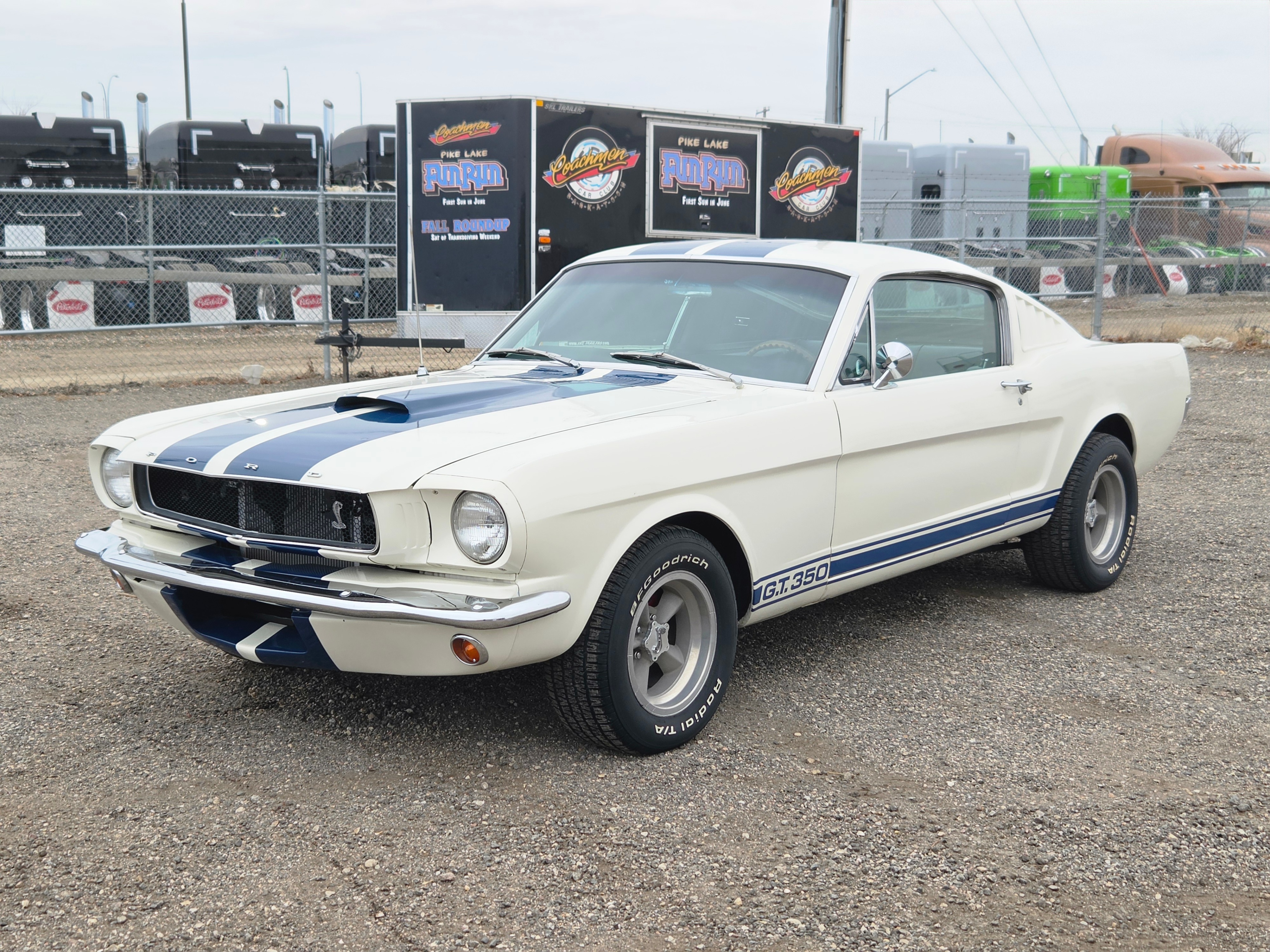
1965 Ford Mustang 2+2 GT 350 tribute. Nice little pony with great curb appeal. Not a true GT 350, but started life as a fastback with standard interior, painted tropical turquoise with a white interior with black trim and was sold in the Fargo North Dakota sales district.

The car was equipped with a 2.80:1 standard rear differential, 3-speed manual transmission, 289 2-bbl V8 and built in Dearborn. Now the car has a hopped up 302 with lots of performance parts including cam, E-street Edelbrock aluminum heads, Edelbrock Performer intake and Holley 4-bbl Carb. Cobra valve covers, an oval air cleaner, MSD ignition and aluminum rad with electric fan and headers with dual exhaust are nice upgrades as well.

Behind the power barn is now a 4-speed manual. It’s obvious when you’re under the hood that a lot of dollars were spent in this area. The engine bay is glossy and black, and most parts are new. A new master cylinder with front disc brakes also in place.

No power options, but on a car this small it doesn’t really mean much. The car has great looks, now painted the correct Wimbledon white with blue stripes from front to back, and side stripe kit. An aftermarket hood with functional scoop, side vent louvers and lower front valance with scoop, plus Shelby badging has also been added.

Matte silver torque thrust wheels with Shelby center caps and white letter tires complete the look! The car was painted some time ago, but the paint has survived remarkably well and was a quality restoration to begin with. The interior is all black now and in good condition overall. Door panels, seats, carpets and headliner are all nice.

Unlike a real Shelby GT 350 that had no back seat, this 2+2 still has the fold down rear seats. Behind that are a set of speakers, but currently there’s no stereo or radio in the car and they are leftovers from a previous install. The top of the dash is nice, but the dash panel itself could still use a bit of restoration, however the car has been through the shop, and everything seems to be working.

A hurst shifter sticks out of the center console and wood rimmed steering wheel with cobra horn button have been added. The car shows 70,000 miles, but with and engine swap and restoration, true milage is unknown. A set of aftermarket gauges hang below the dash as well.

The trunk is in good condition with a correct fitting trunk mat, and a new gas tank (which makes the bottom of the trunk) has been installed. The car really moves well and sounds great – loads faster than a stock 2+2 Mustang from ’65. It also turns heads, and although it’s not a true Shelby GT 350 (less than 500 made by Carrol Shelby).

It certainly attracts attention!

Classic Ford Mustang Buyer's Guide

Full guide
M
Mike Sullivan
Muscle Cars
1964–1973
~5 min read
Updated Apr 2026
The definitive buyer's guide for classic Ford Mustang 1964½-1973. Generation breakdown, rust hotspots, engine code identification, Marti Report essentials, and current market pricing.
This guide covers
✓ 10-point inspection checklist
✓ Common issues & what to avoid
✓ In-person inspection guide
✓ Market pricing by year & condition
✓ 6 FAQs answered
✓ History & fun facts

Ford Mustang Market Overview

Based on 324 Ford Mustang listings currently on ClassicCarsArena.com

324
Listed Now
$40,458
Avg. Asking Price
1934–2012
Year Range
Price Position on Our Site - Average Range
This car: $38,390
Low: $3,000 High: $278,555
Transmission Distribution
Automatic 51%
Manual 35% ◄
Condition Distribution
Excellent 11%
Good 10%
Fair 4%
Poor 1%
Project 0%
Data from ClassicCarsArena.com listings Browse all 324 listings →
💰

What is this car worth?

Check asking prices for the 1965 Ford Mustang

Valuation Tool →
🔑

Selling a classic? Here's how

Fees, audience and photo limits compared: compare the places to sell classic cars .

List Yours →

Classic Ford Mustang Buyer's Guide

The Ford Mustang launched on April 17, 1964 and sold a million units faster than any car in American history. Sixty years later, the first-generation Mustang (1964½-1973) remains the cornerstone of the classic car hobby, the gateway car for new collectors, the trophy car for veteran enthusiasts, and the most cloned, faked, and re-stamped muscle car on the market. Whether you're hunting a base inline-six coupe or a documented Boss 429, knowing what separates the real cars from the tribute builds is the difference between an investment and a money pit.

What to Check Before Buying

✓
Verify VIN against data plate and engine casting , Fifth digit of VIN = engine code. Cross-reference with block casting number behind cylinder head.
✓
Order Marti Report for any 1967+ car over $30K , Ford's original production records via Marti Auto Works. $25 confirms what the car actually was when it left the factory.
✓
Inspect torque boxes from underneath , Front and rear, where the unibody meets floor pans. Rotted torque boxes = $3,000-$6,000 repair and chassis flex.
✓
Pull kick panels and check cowl seam , Where windshield base meets firewall. Cowl rust here drains into the cabin and rots floor pans.
✓
Magnet test rocker panels and quarters , Body filler is non-magnetic. If the magnet doesn't stick, the panel has been filled, meaning underlying rust.
✓
Check shock tower welds for cracks , Cracks radiating from upper shock mount = beaten chassis. Common on Big Block cars and 428 CJs.
✓
Verify original GT/Mach 1/Boss equipment , Without Marti docs and matching data plate, treat all performance trim claims as clone candidates.
✓
Test all electrical functions , Every gauge, every switch, every light. Brittle 60-year-old harnesses and worn switches are universal.
✓
Compression test all eight cylinders , Should read 145-175 PSI uniformly. Variance >15% between cylinders = head gasket or ring problem.
✓
Drive at least 30 minutes on highway , Listen for differential whine, transmission slip, brake pulsation, steering wander. Watch for overheating in stop-and-go traffic.

Common Issues

Mustang rust is everywhere and predictable. The torque boxes (front and rear, where the unibody meets the floor pans) are the structural killers, rotted torque boxes mean the car flexes under load and the doors won't close right. Cowl rust hides under the dashboard where the windshield base meets the firewall. Floor pans rust through from the underside in any car that lived north of the Mason-Dixon. Rear quarters, lower fenders behind the front wheels, and the trunk drop-offs are all standard rust zones. Mechanically, first-gen Mustangs are simple but the small details matter. The Toploader four-speed is bulletproof when synchronized properly; the C4 and C6 automatics are robust but commonly leak from front pump seals. The 9-inch rear is bombproof, but make sure the gear ratio matches what's claimed. Engine identification by casting numbers is essential: many cars wear the wrong block, and a 1968 GT 390 with a 1973 351W block is not what the seller is advertising. Electrical issues plague any 60-year-old car. The original wiring harnesses are brittle, the headlight switches fail, the gauges read inconsistently, and the turn signal switches die. Plan to replace the headlight switch, the ignition switch, and at least the engine-bay harness on any first-gen Mustang you buy. Budget $800-$1,500 for a complete electrical refresh.

What to Look For

Always start with the data plate (door tag) and the VIN. The fifth digit of the VIN is the engine code: A=289 4V, C=289 2V, D=289 standard, K=289 HiPo, F=302 2V, J=302 4V (Boss 302), M=351 4V, Q=428 CJ, R=428 SCJ Ram Air, S=390 4V, Z=Boss 429. Cross-reference the VIN engine code with the actual block casting number, they must agree. For any car claimed as a GT, Mach 1, Boss, Shelby, or Cobra Jet, demand a Marti Report. Marti Auto Works has Ford's original production records and can verify exactly what the car was when it left Dearborn or San Jose. A $25 Marti Report will save you $25,000 in mistakes. Cars without Marti documentation should be priced as clones, period. Unibody integrity is the other non-negotiable. Pop the hood, look at the shock towers, cracks radiating from the upper shock mount are common on Big Block cars and indicate the chassis has been beaten. Inspect the torque boxes from underneath. Lift the trunk mat and look at the trunk drop-offs. Pull the rear seat and check the floor where the seat bolts down. Fresh undercoating on a project car is a red flag, it's almost always hiding rust repairs.

Price Guide

Base 1965-1966 coupes with the inline-six or 289 2V remain the most accessible classic Mustang at $18,000-$32,000 for solid drivers. Convertibles add $8,000-$15,000 to equivalent coupe pricing. Fastbacks (1965-1968) are dramatically more valuable due to Bullitt and Eleanor pop-culture demand, a clean 1967-1968 fastback small-block runs $45,000-$75,000. 1967-1968 GT 390 cars (Bullitt-style) trade for $60,000-$110,000 with documentation. The 1968 GT 428 Cobra Jet is the holy grail of the small-bumper era at $120,000-$220,000 for documented numbers-matching cars. 1969-1970 Boss 302 and Mach 1 cars run $70,000-$140,000 depending on condition and equipment. The Boss 429 is six-figure-plus territory, $300,000-$600,000 for documented examples. 1971-1973 cars (the Big Body era) have historically been the bargain entry point but appreciation has accelerated since 2020. A clean 1973 Mach 1 with the 351 Cobra Jet now runs $45,000-$75,000, up dramatically from the $25,000 territory of a decade ago. Project cars (running but rough) start around $15,000 for coupes and $22,000 for fastbacks.

Did You Know?

The Mustang was originally going to be called the Cougar: Lee Iacocca's team had "Cougar" emblems already produced before a focus group response prompted the last-minute name change. The Cougar name was eventually used for the Mercury sister car launched for 1967. Ford originally projected first-year Mustang sales of 100,000 units. The car sold 418,812 units in its abbreviated 18-month launch year, and over a million Mustangs were sold by March 1966, a sales pace that has never been equaled by any other American automobile launch. The iconic 1964½ designation isn't actually a real model year: Ford built the early Mustangs as 1965 models, but the cars produced before September 1964 had different alternators, generators, and other details, leading collectors to designate them "1964½" cars to distinguish them.

More from Rod's Hotrods Customs and Sales

See all cars from Rod's Hotrods Customs and Sales

Similar Listings

All 1965 Ford Mustang for sale

Contact Seller

Share only if you'd like the seller to call you directly.

Hi, I found your 1965 Ford Mustang listed at $38,390 on ClassicCarsArena.com.

By contacting this seller you accept the Visitors Agreement

Call this seller?

You're about to call Rod's Hotrods Customs and Sales about the 1965 Ford Mustang.

+1 (306) 242-7637

Before you call: Never wire money or share bank info over the phone. Read our scam-avoidance tips.
Call Now

Car alert

Get an email when a 1960-1970 Ford Mustang is listed

At most one email a day. Stop anytime with one click.

Send to a Friend

Share this 1965 Ford Mustang listing.

Report this Ad

Help us keep the marketplace clean. Our moderation team reviews every report within 24 hours.