
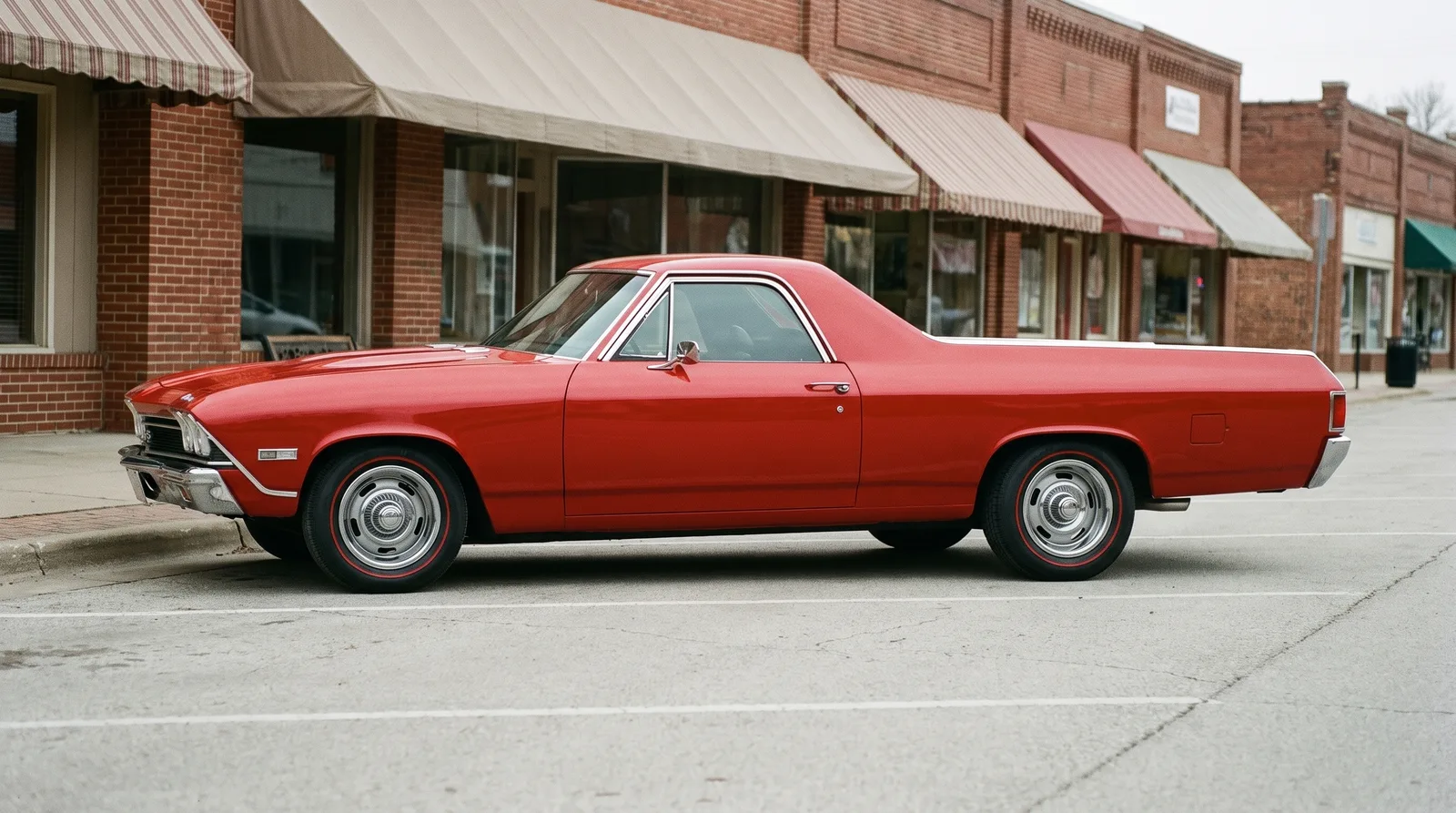
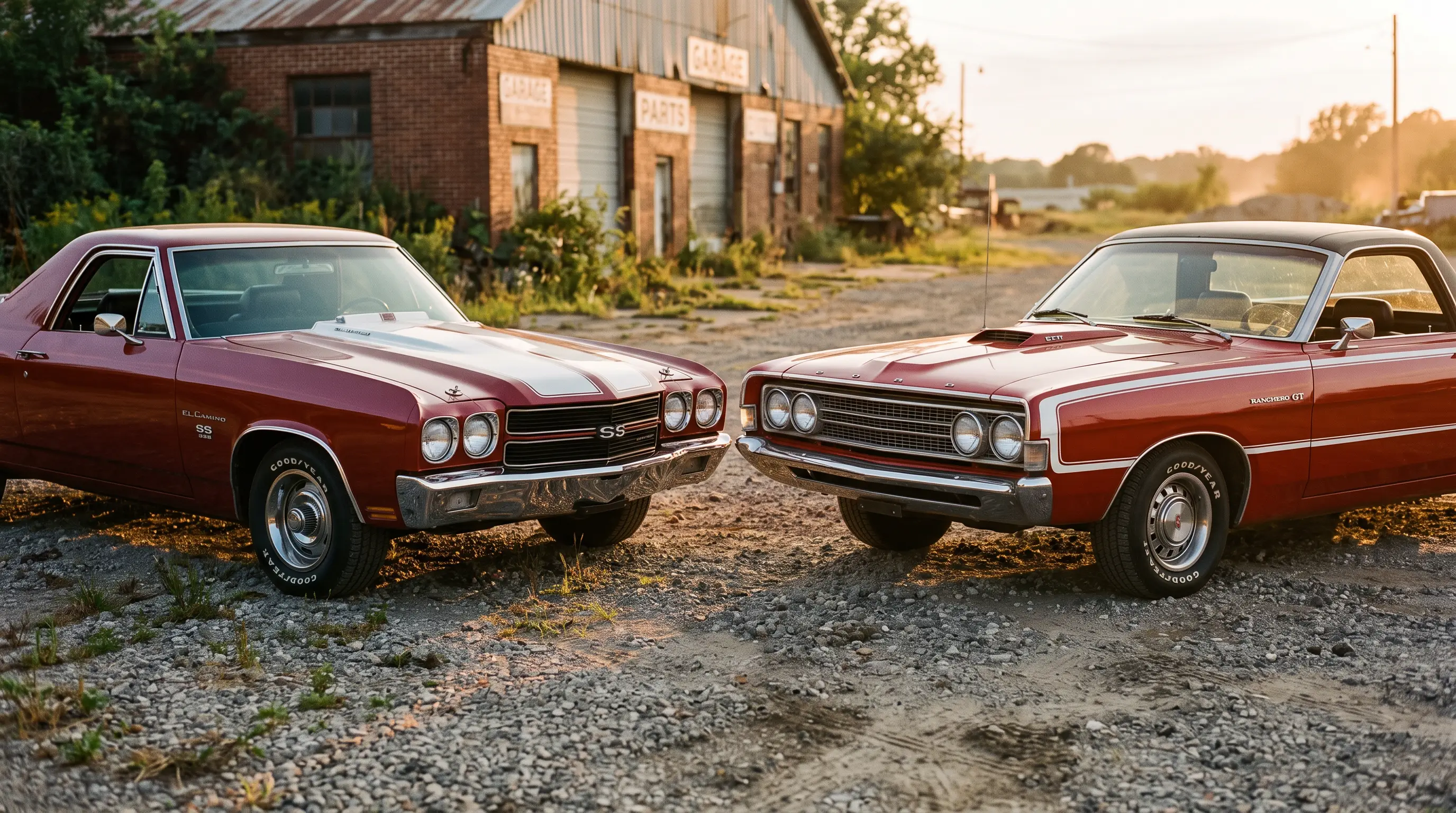
The el camino vs ranchero 1968 muscle clash is the moment both trucks stopped being dressed-up haulers and started competing directly on the drag strip, at least on paper. Chevrolet gave the El Camino a full body redesign for 1968, riding the new Chevelle's smoother, longer flanks and offering the SS396 package as a factory-built option rather than something a dealer bolted together. Ford moved the Ranchero onto the redesigned Fairlane and Torino platform that same year, and for the first time the Ranchero could be ordered with the GT package and a genuine big-block, putting real horsepower behind a nameplate that had spent most of the decade playing catch-up.
Car Features
7 min read
1968: When the Rivalry Turned to Muscle
In 1968 the El Camino SS396 and Ranchero GT turned a decade-old rivalry into a genuine muscle-car fight, backed by factory RPO codes and real big-block hardware.
RPO codes and what they actually authorized
Factory records on the El Camino side are more complete than most enthusiasts expect, because Chevrolet used the same RPO, or Regular Production Option, coding system across the Chevelle line, and El Camino build sheets carry the same codes. RPO Z25 brought the SS396 package to the El Camino for 1968, bundling the 396 cubic inch V8 with heavy-duty suspension, dual exhaust, and the black-out hood treatment borrowed from the Chevelle SS. Depending on the specific engine code stamped into the block, output ranged from a base 325 horsepower L35 up to the L78 rated at 375 horsepower, a figure Chevrolet's own El Camino sales literature rarely spotlighted the way it did for the Chevelle SS396, likely because the L78 remained a stealth, checkbox-only option that most El Camino buyers never asked about, even though it was available to anyone willing to order it.
The Ranchero GT could be ordered with the 390 cubic inch V8 as standard equipment in the GT package, and the 428 Cobra Jet became a genuine mid-year option on the Ranchero GT as well, following the Cobra Jet's spring 1968 debut across Ford's intermediate and pony car lineup. Surviving factory-documented 1968 Ranchero Cobra Jets are rare, and exact production counts are not well established in public records, so any specific unit figure should be treated with caution unless it cites a Marti Report or comparable factory source.
Selling the muscle image, not just the engine
What makes 1968 a genuine turning point rather than just another running change is that both companies were now marketing these trucks alongside their halo muscle cars instead of separately from them. Chevrolet's print advertising for the El Camino SS396 leaned on the same imagery used for the Chevelle SS, sometimes in the same publication spread. Ford did something similar with the Ranchero GT, tying it visually to the Torino GT and even the Fairlane 500. The message from both factories was identical: this is not a farm truck wearing a costume, this is a genuine performance model that happens to have a bed instead of a trunk.
| Spec | 1968 El Camino SS396 | 1968 Ranchero GT |
|---|---|---|
| Platform | Redesigned Chevelle | Redesigned Fairlane/Torino |
| Base big-block | 396 cu in, RPO Z25 package | 390 cu in, GT package |
| Top factory engine | 396 cu in L78, 375 hp | 428 Cobra Jet, mid-year option |
| Trim identifier | SS396 badging, black-out hood | GT stripe kit, bucket seats |
What the documentation gap tells researchers
Production totals for El Camino SS396 in 1968 are documented well enough in Chevrolet's own shipping data to give researchers a real baseline, unlike some of the softer estimates that circulate for earlier years. Ranchero GT numbers for 1968 are harder to pin to a single confirmed figure without a Marti Report pull, and anyone building a serious history should treat any specific unit count they read online with caution unless it cites a factory source. That documentation gap is one reason the El Camino side of this rivalry tends to be easier to research from primary sources, while the Ranchero side often relies more heavily on period road tests and dealer literature.
"Every RPO code on a 1968 El Camino build sheet tells you something the seller's story might not. If the codes and the car do not agree, believe the codes."
- Tom Ramirez
The two trucks also diverged in how they handled the muscle image outside of raw output. The El Camino's SS396 stuck closely to the Chevelle SS formula, which meant buyers largely knew what they were getting because the passenger car had already established the reputation. The Ranchero GT, on the other hand, was introducing a genuinely new level of factory-backed performance to a nameplate that had spent 1960 through 1965 wearing compact Falcon underpinnings. For Ford dealers, 1968 was the year they could finally tell a Ranchero shopper that this was not a lesser Fairlane, it was a legitimate GT-badged performance vehicle with a bed.
Suspension, chassis, and the engineering behind the badges
Suspension and chassis changes tell a related part of the story that gets less attention than the engine bay. Both the SS396 package and the Ranchero GT brought heavy-duty springs, larger anti-roll bars, and revised shock valving tuned specifically around the added weight of a big-block up front, a genuinely different engineering problem on a truck-bodied vehicle than on the coupe or sedan the components were originally developed for. Chevrolet's engineers had years of Chevelle SS suspension development to draw from and simply adapted known-good hardware to the El Camino's slightly different weight distribution. Ford's engineers were doing something similar with Torino GT componentry, but the Ranchero's marginally longer rear overhang for the bed meant the tuning was not a pure carryover, and period road tests noted a slightly different ride character between the Ranchero GT and its Torino GT coupe sibling as a result.
Dealer positioning in 1968 also mattered more than it had in previous years, since both trucks now carried genuine performance credibility rather than just borrowed badging. Chevrolet salesmen could point to a Z25-optioned El Camino sitting next to a Chevelle SS396 on the same lot and make an honest apples-to-apples comparison on power and handling, a pitch that had real teeth for the first time. Ford dealers found themselves in a similar position with the Ranchero GT parked near a Torino GT, and the sales conversation shifted from "this is basically a truck" to "this is basically the same car with a bed," a framing neither company could have used with a straight face just two or three years earlier.
Why 1968 still anchors the rivalry today
1968 mattered because it removed any ambiguity about what these vehicles were for. Before this year, a buyer could argue the El Camino and Ranchero were still fundamentally work trucks with an options list. After 1968, with SS396 and GT badging backed by genuine big-block hardware and RPO documentation to prove it, that argument stopped holding up. Anyone researching how this single model year fits into the broader arc should read our el camino vs ranchero retrospective, which places 1968 against the years on either side of it. The rivalry did not stop accelerating here either. Two years later both companies pushed big-block output even further, a chapter covered in a related story on the 1970 peak of the war. For buyers who want a documented 1968 example of either camp today, the market still turns up factory-optioned trucks worth chasing, and it is worth starting with El Caminos for sale now to see what condition and paperwork currently command at auction.
Sources and notes
Related Reading

About the author
Tom Ramirez
Corvette researcher and historian based in Bowling Green, Kentucky. Two decades documenting Corvette production history from original factory records.
Related Listings - Chevrolet El Camino




Comments (1)
L
Linda Kowalski
2 days ago
Tom, a question from the Ford side. Would a Marti Report on a 1968 Ranchero GT show the Cobra Jet as a distinct engine code, or does it only list the code and leave you to decode it yourself?
D
Dale Pruitt
1 day ago
Linda, I am a Chevy man but I taught enough Ford kids to know the drill on this one. 1) Read the engine code in the VIN on the door data plate and the dash tag, since that letter is the first thing anybody checks on a claimed Cobra Jet. 2) Get the Marti Report, which as I understand it lists that same code along with the build date and plant, so you can see whether the paperwork and the plate agree. 3) Then look at the block itself, casting date against build date, because a correct VIN with a replacement engine is common. Hope that helps.