
Period documents from 1969 rarely mention Chevrolet by name in Ford's own Bronco literature, and that silence is itself a kind of evidence. The ford bronco 1969 vs blazer preview is a story about a manufacturer watching a rival approach without yet having to react to it directly, a rare snapshot of a market moment right before it shifted permanently.
Car Features
7 min read
1969 Bronco Before the Blazer Storm
The ford bronco 1969 vs blazer preview looks at the year just before Chevrolet's K5 Blazer arrived, when Ford's compact SUV still had the segment largely to itself.
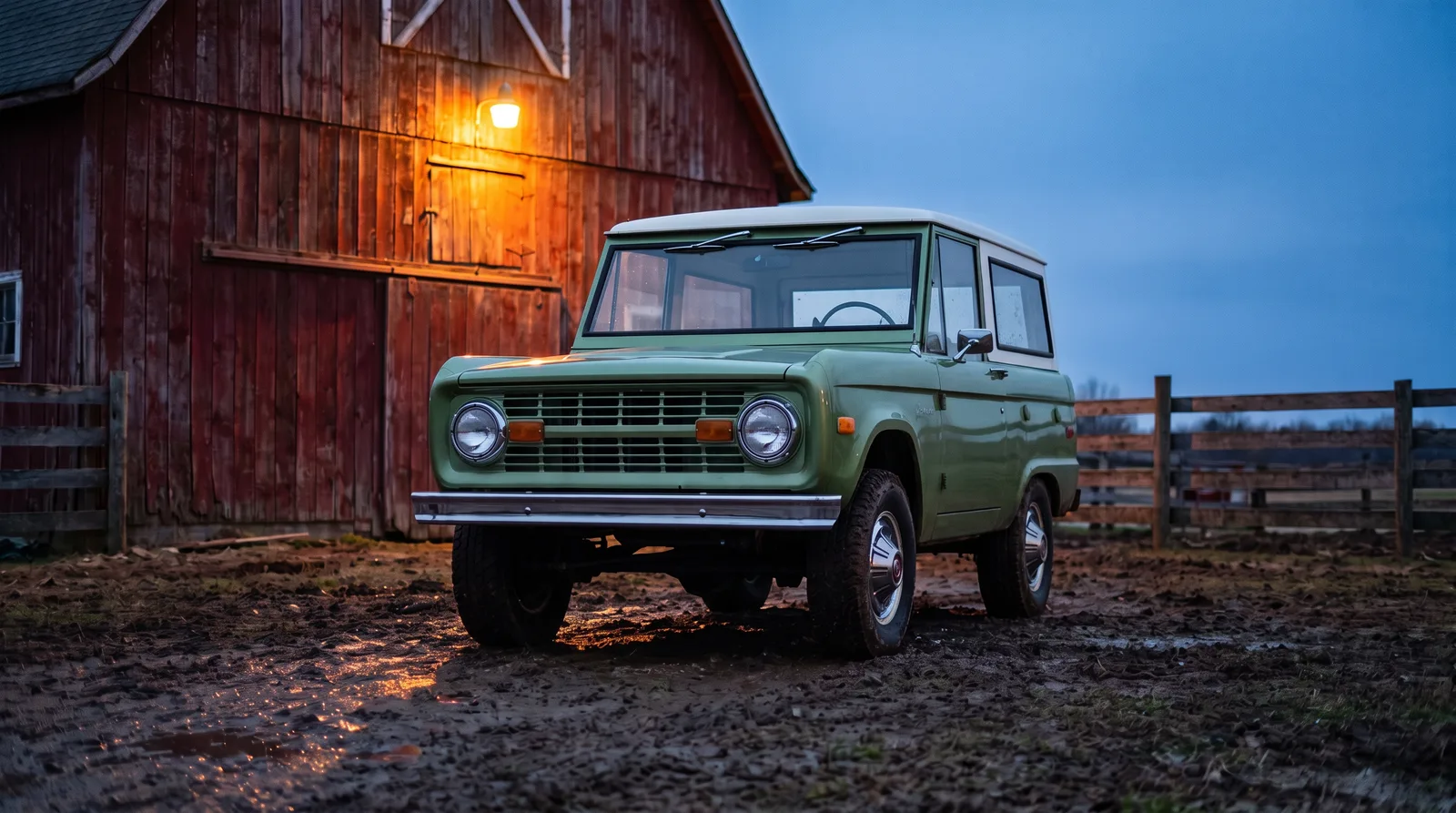
The competitive picture before the storm arrived
Through the mid and late 1960s, the Bronco's real competition had been the International Harvester Scout, a truck it had been designed to answer from the outset. By 1969, Chevrolet's K5 Blazer had arrived, launching for that same 1969 model year, built on a shortened version of Chevrolet's pickup platform, with its wheelbase cut from 115 inches to 104 inches, a removable top, and a considerably larger V8 option range than the Bronco offered.
This makes 1969 an unusual pivot point to examine. The Bronco's engineering and trim decisions that year, covered in the truck's broader running changes for the period, were made without the Blazer's full market impact yet visible in the sales figures Ford's planners would have been reviewing.
How the two trucks actually differed on paper
The philosophical difference between the two trucks mattered as much as any spec sheet number. The Bronco was purpose-built on its own dedicated chassis with a tight 92-inch wheelbase, prioritizing off-road agility over interior space. The Blazer, built on a shortened version of Chevrolet's existing pickup platform, offered a larger overall footprint and access to Chevrolet's bigger displacement V8 options, trading some of the Bronco's nimbleness for size and power.
Neither approach was objectively correct. They represented different bets about what buyers in this expanding market segment actually wanted. Ford bet on a compact, purpose-built trail machine. Chevrolet bet on a larger, more powerful truck built from existing platform economics. The market would eventually reward both approaches, though not equally, and the following decade of sales figures tells that story more clearly than any 1969 comparison could.
| Attribute | Ford Bronco | Chevrolet K5 Blazer (incoming) |
|---|---|---|
| Platform origin | Dedicated chassis | Shortened pickup platform |
| Wheelbase | 92 inches | Longer, pickup-derived |
| Top V8 option (period) | 289/302 small block | Larger displacement available |
Why the timing of this comparison matters historically
Studying a competitive market in the moment just before a major rival arrives is a useful exercise precisely because it avoids hindsight bias. Ford's product planners in 1969 were not yet reacting to Blazer sales data. They were finishing a development cycle that had begun years earlier, refining the Bronco's existing formula rather than adjusting course in response to a competitor that had not yet proven itself in showrooms.
That context matters for anyone reading Bronco history backward from today. It is tempting to assume every product decision Ford made in this period was a direct response to Chevrolet, but the documentation does not support that reading for the 1969 model year specifically. The Bronco's changes that year were largely internally driven, continuing patterns established over the previous several seasons rather than reacting to a rival still finding its footing.
What this comparison tells buyers today
For collectors, this window matters because 1969 represents one of the last model years where the Bronco existed in something close to its original competitive vacuum. Trucks from this year and the ones immediately before it carry a certain historical weight for that reason, having been engineered before Ford had to actively defend market share against a well-funded domestic rival. For the complete account of everything else that changed in this specific model year, the full story covers the ground this comparison only touches on.
"You cannot properly understand the Bronco's 1970s trajectory without first understanding what the truck looked like in the moment right before it had real competition breathing down its neck."
- Sarah Whitfield
How the rivalry played out once the Blazer actually arrived
Once Chevrolet's truck reached volume production, the comparison stopped being theoretical and started showing up directly in showroom traffic and magazine comparison tests. Buyers who might once have walked straight to a Ford dealer now had a genuine second option with a bigger engine bay and a removable top of its own. Ford did not abandon the Bronco's original formula in response, at least not immediately, but the pressure was real, and it shaped decisions the company would make later in the decade as the truck matured into its 1970s form.
Looking back, it is easy to see the Blazer's arrival as the moment the compact SUV segment stopped being a niche experiment and became a genuine battleground between the two largest domestic manufacturers. The 1969 Bronco sits right on the near side of that line, a truck still operating under the older rules of a market that had not yet decided how big or how powerful this category of vehicle needed to be.
It is worth noting that International Harvester's Scout was still very much part of this conversation as well, even as the Bronco and Blazer began to dominate the sales figures. A three-way rivalry, rather than a simple two-truck story, is closer to the truth of how this segment actually developed through the late 1960s and into the 1970s. Ford's planners in 1969 were watching all of it, weighing the Scout's established presence against the Blazer's looming arrival, and making decisions about the Bronco's future with both rivals in mind, even if the documentation from the period rarely names either one directly.
That triangulated competition is part of what makes this period so interesting to study now. None of the three manufacturers had the luxury of assuming their approach was correct. Each one was making a bet, informed by whatever sales data and dealer feedback they had on hand, about what this new category of vehicle should ultimately become.
Shopping this specific window of production
Buyers interested in a Bronco from this exact competitive moment, before the Blazer reshaped the segment, should look specifically at 1969 production trucks rather than treating the era as interchangeable with the years immediately following. Verifying build dates against known Blazer launch timing helps confirm exactly which side of that market shift a given truck was built on. You can browse classic Bronco listings to see what survives from this narrow, historically significant window today.
It also pays to talk to sellers about how they position a truck from this year. Some will mention the Blazer unprompted, framing their Bronco as the more purpose-built alternative from an era before the segment ballooned in size and power. Others will not think about the comparison at all, simply presenting the truck on its own terms. Neither approach tells you much about the truck's actual condition, but it can tell you something about how deeply a seller understands the history of what they are selling, which is often a useful signal about how carefully the rest of the truck has been documented and maintained.
Sources and notes
Related Reading

About the author
Sarah Whitfield
Third-generation classic car collector specializing in pre-war American and European coachbuilt automobiles. Researcher and concours enthusiast.
Related Listings - Ford Bronco


Comments
Be the first to comment on this article.