
Engine transitions rarely get remembered as turning points, but the shift from the 289 to the 302 in the Ford Bronco lineup deserves more attention than it usually gets. The ford bronco 289 to 302 v8 swap in factory production was not a marketing event. It was a supplier and engineering decision that quietly reshaped what the little truck could do, and the reasoning behind it holds up well under scrutiny even decades later.
Car Features
7 min read
From 289 to 302, the V8 That Transformed the Bronco
Ford's shift from the 289 to the 302 V8 in the Bronco lineup was a quiet engineering decision with real consequences. Here is the evidence behind the transition.
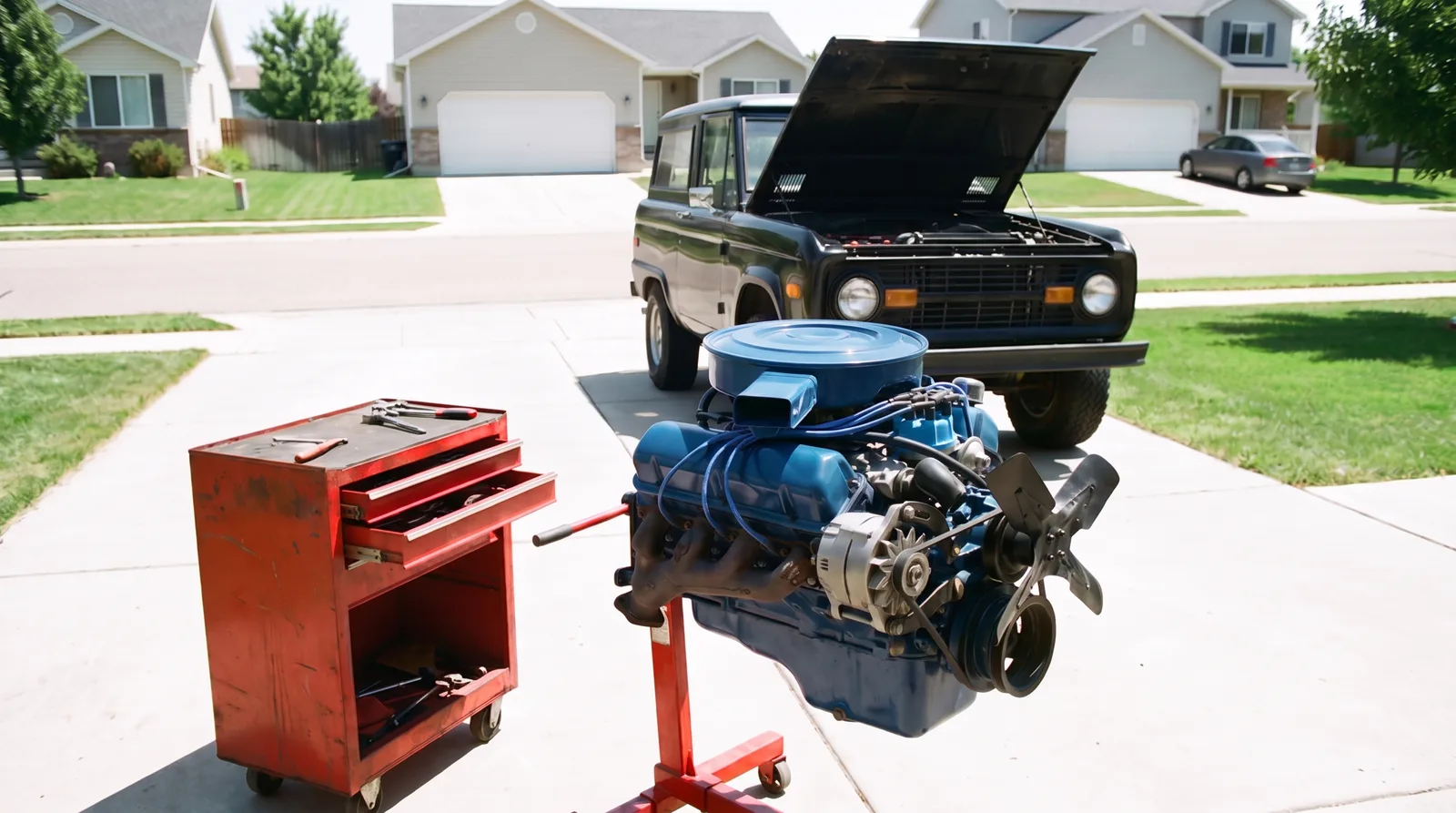
Why the 289 arrived first and what it actually delivered
Ford introduced a 289 cubic inch V8 as an option for the Bronco not long after the truck's 1966 launch, giving buyers who wanted more than the base inline six a real alternative for towing, hauling, and highway driving. The 289 was a proven small block by that point, already established in Mustangs and Fairlanes, so dropping it into the Bronco's engine bay was a low-risk way to expand the truck's appeal without redesigning the platform. Ford added the 289 as a Bronco option in March 1966, rated at 200 horsepower with the standard two-barrel carburetor.
The math behind that decision is straightforward. Ford already had 289 tooling running at scale for its passenger car lines, which meant the Bronco could gain a V8 option without forcing a dedicated engine program. That is sound engineering economics: reuse a validated component rather than build something new for a lower-volume truck.
What actually changed when the 302 replaced it
The 302 was not a dramatically different engine on paper. It shared the same basic small block architecture as the 289, with a slightly longer stroke that increased displacement and, in most applications, improved low and mid-range torque. For a truck that spent its life climbing grades, towing trailers, and crawling over uneven ground rather than chasing top speed, that torque characteristic mattered more than peak horsepower numbers ever would.
Ford's broader corporate engine strategy was moving toward the 302 across multiple product lines in the same period, and the Bronco followed that shift rather than leading it. That is a useful data point for anyone trying to understand Ford's engineering priorities in the late 1960s: the Bronco was treated as part of a coordinated small block rollout, not as a special case requiring its own bespoke solution.
The evidence in the numbers, not just the folklore
What makes this transition worth studying rather than glossing over is how well documented it is in Ford's own parts and production records. Casting numbers, block dimensions, and factory service literature all confirm the swap in ways that go beyond the anecdotal stories that circulate at car shows. When a fact can be verified against a parts catalog rather than a secondhand account, it deserves more weight, and the 289 to 302 transition is one of the better documented drivetrain changes in early Bronco history. The 302 became the Bronco's V8 option for the 1969 model year, replacing the 289 outright rather than sitting alongside it.
This kind of documentation trail also matters practically. A restorer trying to keep a Bronco period correct needs to know exactly which block belongs in which model year, and casting number references settle disputes that owner recollection alone cannot.
| Engine | Displacement | Architecture | Primary strength |
|---|---|---|---|
| 289 V8 | 4.7L | Ford small block | Proven, high-volume tooling |
| 302 V8 | 5.0L | Ford small block | Improved low-end torque |
What this means for buyers evaluating a truck today
If you are looking at a Bronco advertised with a factory V8, the honest first question is not how much power it makes. It is whether the engine actually matches the truck's original build specification. A numbers-matching 289 or 302 carries different collector value than a period-correct swap, and neither is automatically worth more than the other unless you know which one you are actually buying.
The practical takeaway is simple: verify before you value. Ask for casting number photos, cross-reference them against known production windows, and treat any seller who cannot answer the question directly with appropriate skepticism. That approach protects you regardless of whether you are chasing originality or just want a reliable driver.
"An engine swap is not automatically a red flag, but an undisclosed one is. I want the casting number, not the seller's confidence, before I decide what a Bronco's drivetrain is actually worth."
- Emily Chen
Finding a Bronco with the right drivetrain for your goals
Whether your priority is factory originality or simply a dependable small block V8 under the hood, the used market has enough volume from this era that patience usually pays off. Start by browsing to find a classic Bronco and treat every listing's engine claim as a starting point for your own verification rather than the final word.
Why this engine story keeps repeating across Ford's lineup
The 289 to 302 transition inside the Bronco is really one instance of a pattern Ford repeated across nearly its entire vehicle range in this period. The same small block architecture underpinned Mustangs, Fairlanes, Falcons, and full-size trucks, which meant a single engineering investment paid dividends across dozens of nameplates simultaneously. That kind of platform thinking is unglamorous from a marketing standpoint, but it is exactly the sort of decision that keeps a manufacturer's costs under control while still delivering measurable improvements to the end customer.
For the Bronco specifically, riding on the coattails of a company-wide engine strategy meant access to continuous improvement without the truck ever needing its own dedicated engineering budget for the small block program. Every refinement Ford made to the 302 for its car lines showed up, sooner or later, in the Bronco's engine bay as well. That is a quieter kind of engineering benefit than a flashy new option, but it is no less real, and it is one of the reasons the small block V8 Bronco remains such a dependable platform for enthusiasts still driving these trucks today.
None of this diminishes the importance of verifying exactly which engine sits in a given truck before you buy it. Shared architecture across a company's lineup is a benefit to owners and a complication for appraisers, since it means engines move between applications more easily than most people assume. The diligence described above is not optional if you care about what you are actually paying for.
There is a practical upside to this shared architecture that owners still benefit from today. Because the 289 and 302 saw such widespread use across Ford's lineup for so many years, parts availability for rebuilds and maintenance remains far better than it is for many contemporary competitors' engines. Rebuild kits, gaskets, and internal components are still comparatively easy to source, which keeps ownership costs more predictable than they would be for a rarer, lower-volume power plant from the same era. That accessibility is one of the quieter reasons the small block V8 Bronco has remained such a practical choice for owners who actually want to drive their trucks rather than trailer them to shows.
Measured against that backdrop, the 289 to 302 story stops looking like a minor footnote and starts looking like part of the reason these trucks are still viable daily classics decades later. An engine platform that is well documented, well supported, and broadly interchangeable across an entire manufacturer's lineup is exactly the kind of foundation that keeps old vehicles on the road instead of parked in a barn waiting for parts that no longer exist.
Sources and notes
Related Reading

About the author
Emily Chen
Bay Area engineer with a deep focus on vintage Japanese and European performance cars. Approaches classic car research and restoration with an analytical eye.
Related Listings - Ford Bronco


Comments
Be the first to comment on this article.