
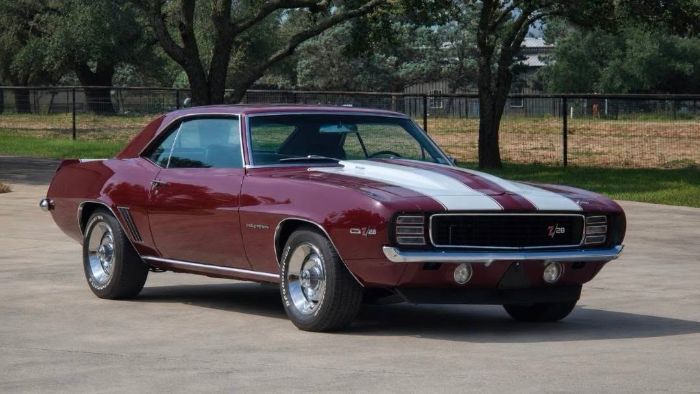
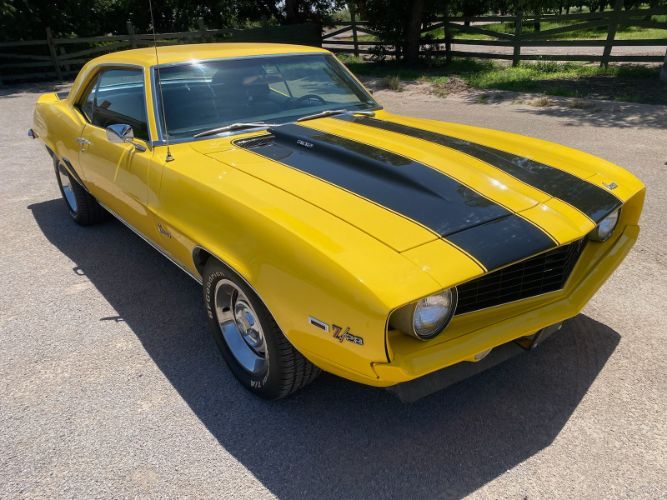
Of all the options on the 1969 order form, few are argued about as often, or named as loosely, as RPO VE3. Collectors call it the 1969 Camaro Endura bumper: a front bumper molded in urethane and painted the color of the car, in place of the usual chrome. The option was real, it was cheap, and it was offered for one model year only. Most of what gets repeated about it beyond that deserves a second look, starting with the name. The records are thin in places, so this account sticks to what the order codes and production figures support and flags what they do not.
Car Features
6 min read
The 1969 Camaro's Body-Color Front Bumper Option
RPO VE3, the 1969 Camaro Endura bumper: what it cost, how many were built, where the Endura name came from and how to judge an original today.
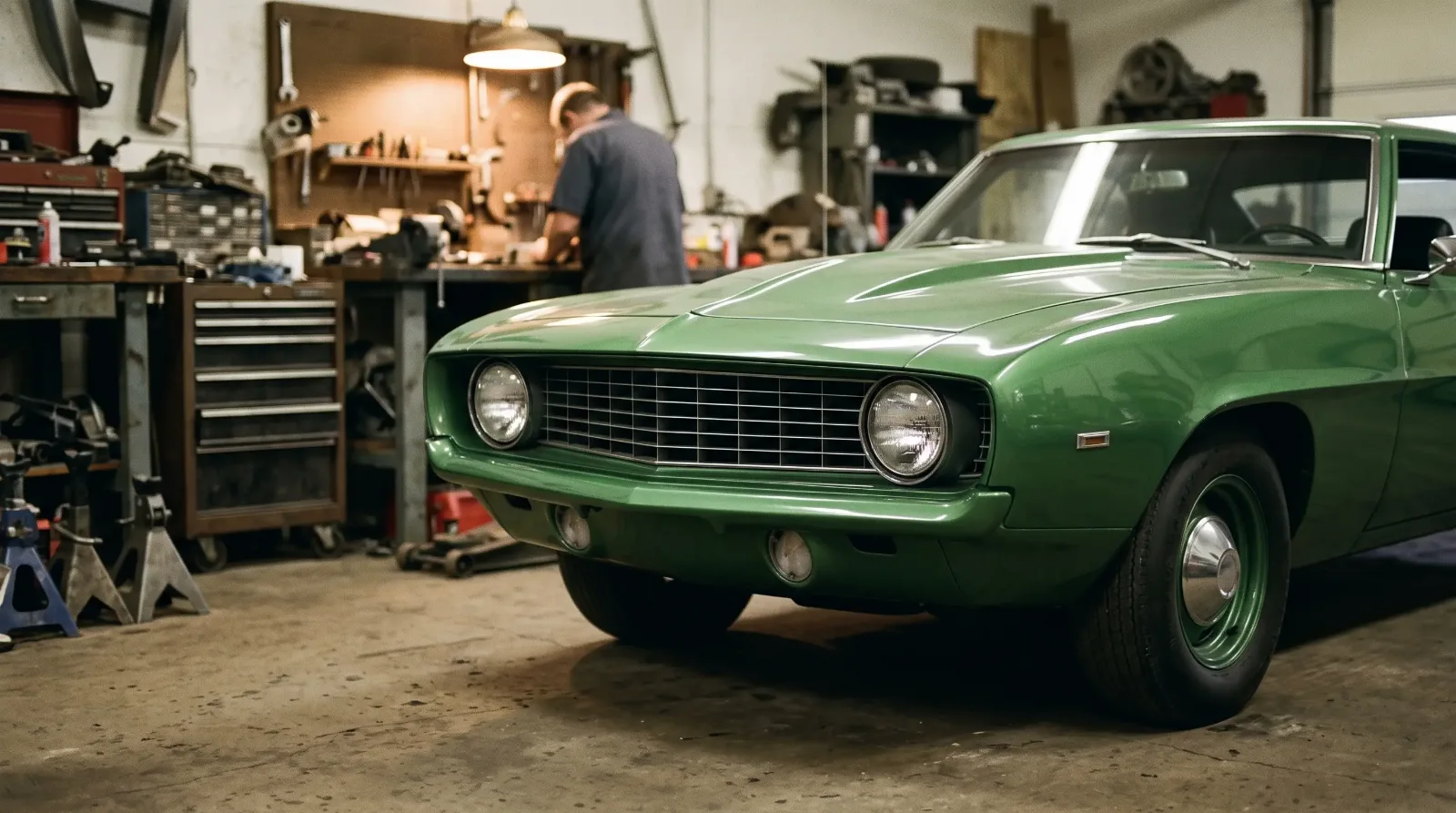
What RPO VE3 actually was
The Camaro Research Group lists RPO VE3 as "Bumper, special body color front (Endura)," and dates it to the 1969 model year only. As the wording says, it covered the front bumper only, replacing the chrome part with a body-color one. The price was $40.00 list plus $2.15 for delivery and handling, which is why you will see both $40.00 and $42.15 quoted. Neither number is wrong; one simply includes the D&H charge.
The option was not tied to any trim level or package. Any 1969 Camaro could be ordered with it. What the records do show is one firm conflict on the order form: VE3 was not available with the V31 front bumper guards. It also changed the price of the ZP5 Appearance Guard Group, which normally cost $42.00. With VE3 (or with G31) the group dropped to $30.00, and with both G31 and VE3 it was $18.00.
What the records do not settle is the interplay with the Rally Sport. Whether VE3 required, excluded or simply coexisted with the RS hidden-headlamp front end is not documented in any source available. Anyone who tells you otherwise with confidence should be asked for the paperwork.
Where the Endura name came from
The idea came from across the hall at GM. A body-color urethane nose made its debut on the 1968 Pontiac GTO, the car Motor Trend named its 1968 Car of the Year. The material was a high-density, closed-cell polyurethane from GM's Inland division in Dayton, Ohio. Inland called it "Indura." Pontiac renamed it Endura, and the name stuck.
That is the gentle correction worth making: Endura was Pontiac's trade name. Chevrolet's own words for the Camaro part were different. Factory documents describe a "special front bumper," the US brochure called it a "color-matched" bumper, Canadian literature used "Astro" bumper, and a 1969 television ad spoke of a "new resilient bumper." Those naming details come from Camaro Research Group forum members rather than from a brochure page we could open, but they line up. The Camaro Research Group adds "(Endura)" in parentheses as a convenience, and collectors have used it ever since. Using the word is fine. Calling it the official Chevrolet name is not.
How many cars got the 1969 Camaro Endura bumper
The production figure most often cited is 12,650 cars, from factory data compiled through Williamson. The White Book puts it at "just over 12,000." The two agree in order of magnitude, and 12,650 is the better-supported number. Against total 1969 Camaro production of 243,085 cars from the US plants, that works out to about 5.2 percent.
| Item | Figure |
|---|---|
| Option code | RPO VE3, 1969 model year only |
| Price | $40.00 list, $42.15 with delivery and handling |
| Cars built with VE3 | 12,650 |
| Total 1969 Camaro production | 243,085 |
| Share of 1969 production | About 5.2 percent |
| Not available with | V31 front bumper guards |
For a sense of scale, compare it with another 1969 option that collectors chase. Houndstooth seat trim, offered only in 1968 and 1969, went into about 8 percent of 1969 production, so the body-color bumper is the scarcer of the two. The seat trim has its own story in the houndstooth interiors. What no one has published is a breakdown of VE3 cars by package (how many Z28s, SS cars or pace cars got one) or the build dates when the option started and stopped. A figure for "Endura Z28s" offered at a car show is a guess unless it comes with a source.
Originals, reproductions and how to read one
Restorers on the Camaro Research Group forum describe an original VE3 bumper as a urethane cover molded over an uncoated steel liner with metal brackets, possibly from two different suppliers. That liner is the weak point. In rust-belt cars it rusted quickly from the inside, out of sight. Forum measurements describe originals as amber urethane, about 12 lb and about 3 inches tall, and reproductions as grey, about 8 lb, a little under 3 inches tall and softer. The brackets differ too: originals have an angled cut with a round notch, reproductions square cuts with a square notch. Those figures come from owners with scales and tape measures rather than from GM, so treat them as a guide.
The bigger problem is the material itself. Urethane of that era shrinks and cracks with age, which is why original bumpers are scarce and a new-old-stock part is described as "almost impossible" to find. Restorers today mostly turn to the licensed GM restoration part, OER 3938643, listed at $503.99 each as of October 2026, with bracket kit R10092. That is more than twelve times what the option cost new, before paint.
"The bumper on the car is the least reliable evidence you will find. It can be swapped in an afternoon. The order code on the paperwork cannot, and that is what tells you whether a car left Norwood or Van Nuys with VE3."
Tom Ramirez
The option did not come back for 1970, but the idea did. By 1978 the Camaro wore body-color urethane bumper covers front and rear as part of the regular design, a Corvette-type cellular urethane, and nobody needed an option code to get one. In that sense VE3 was a one-year preview of where the car was heading. For the full context of the year and the generation it closed, read the first-gen Camaro story.
Sources and notes
- Camaro Research Group: 1967-69 Camaro RPOs with production totals and pricing
- Camaro Research Group forum: VE3 bumper, OEM versus aftermarket
- Chevy Hardcore: three unusual and obscure first-gen Camaro options
- Mac's Motor City Garage: the 1968 Pontiac GTO Endura nose
- OER: 1969 Camaro front bumper, part 3938643
Related Reading
Have a
Chevrolet Camaro
for Sale?
Reach thousands of serious classic car collectors across the US.
Sell It Here →
Are You a Classic Car Dealer?
List your full inventory and connect with targeted classic car buyers.
Join as a Dealer →
#first generation camaro
#chevrolet camaro
#1969 camaro
#camaro restoration
#endura bumper
#RPO VE3
#Camaro options

About the author
Tom Ramirez
Corvette researcher and historian based in Bowling Green, Kentucky. Two decades documenting Corvette production history from original factory records.
Related Listings - Chevrolet Camaro
Comments
Be the first to comment on this article.