
A show car tells you what the people inside the studio wanted to build when nobody from accounting was in the room. The first-generation Camaro got two of them that still matter. The Cherokee was a 1967 SS convertible reworked into a rolling argument for a more aggressive Camaro. The Camaro Caribe concept, shown in March 1968, went further and cut the car into a pickup. One survives, restored and documented down to its VIN. The other has simply dropped out of the record. Both are worth studying if you build first-gens, because they show where the factory's own designers thought the shape could go, and how far the best ideas sat from what reached the showroom.
Car Features
7 min read
The Camaro Caribe and Cherokee: Chevy's First-Gen Show Cars
The 1967 Cherokee and the 1968 Camaro Caribe concept: how Chevrolet's studio reworked the first-gen Camaro, what survives and what a builder can learn.
The Cherokee: a 1967 SS convertible with the studio's hands on it
The Cherokee started as a real production car. Its base was a 1967 Camaro SS convertible, VIN 124677N233228, pulled from the Norwood, Ohio, assembly line. The VIN reads the way it should: 124677 for a 1967 V8 convertible, N for Norwood. That matters, because it means this is a factory car modified by factory people, not a custom that borrowed a name later.
Bill Mitchell's styling studio did the body. Look at the list of changes and you can see a designer working the ends of the car, which is exactly where the 1967 Camaro was softest. Out back went a hand-formed ducktail spoiler and a custom deck lid. Up front, the studio fitted Corvette-style split "blade" bumpers, cast in brass, a custom hood with a clear Lexan scoop, a hood-mounted tach and driving lights. Those split bumpers are the detail I would point a young builder to. They break the front into two pieces and let the grille read as a face instead of a chrome shelf. It is a different idea from the one Chevrolet put into production two years later with the body-color bumper option, but both come from the same itch: get rid of the heavy bright bar across the nose.
The paint was Candy Apple Metalflake Red over an Aztec Gold Metallic base. The interior is less settled. Photos from the 1967 New York show suggest a red interior, while the restored car today is black, so it may have changed somewhere in the car's long life.
Four Webers, a Can-Am pace car and two names
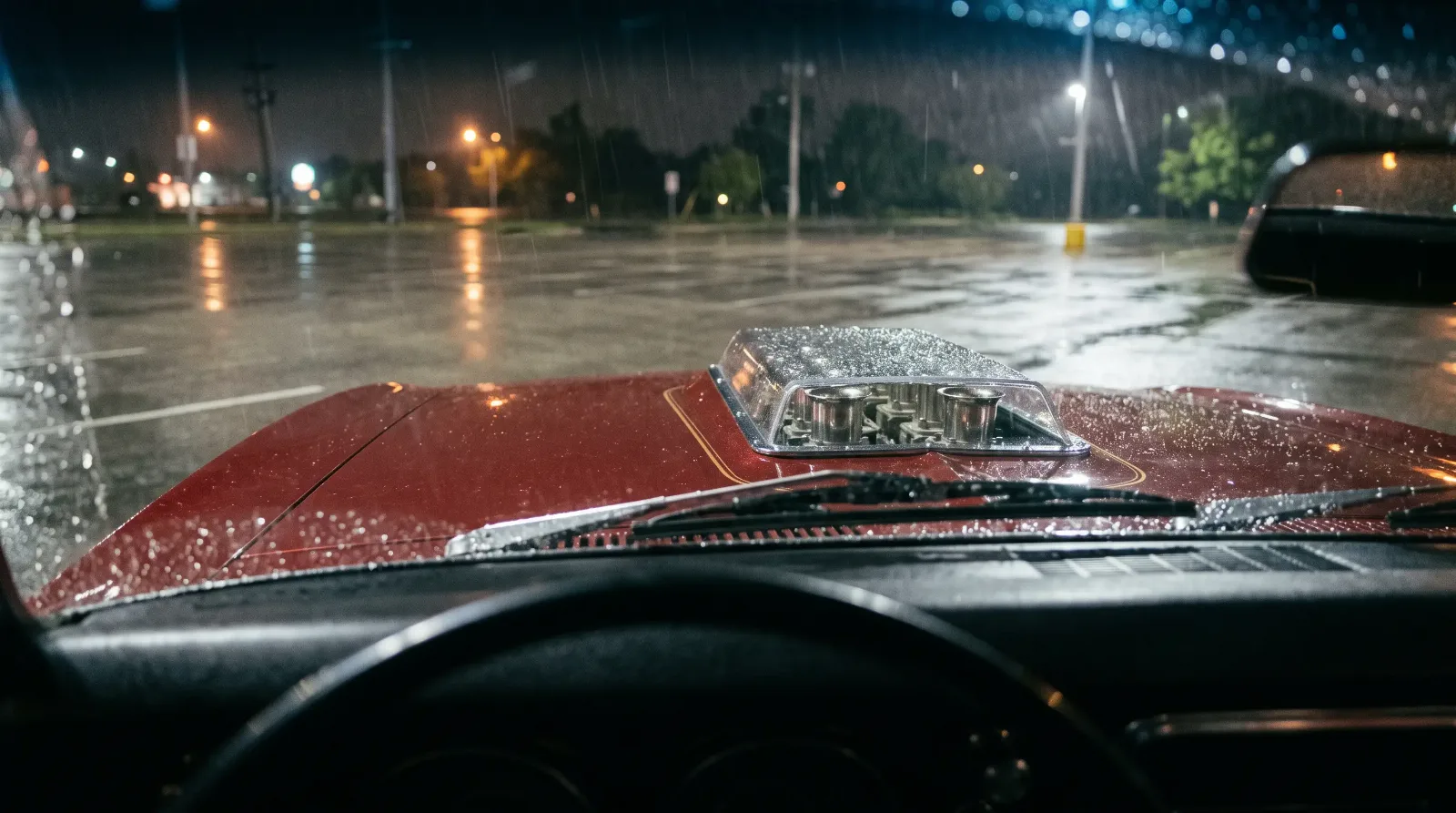
The engine side came from Vince Piggins, Chevrolet's performance man. He started with the L78 396, rated at 375 hp gross, and topped it with a Moon intake carrying four Weber downdraft carburetors, backed by a Turbo Hydra-Matic 400 and a 12-bolt axle. Four Webers on a big-block is not a street-car decision. It is a show decision, made to be seen when the hood went up, and a period-correct one: a builder copying this car today should resist the temptation to hide modern fuel injection under that scoop.
The car also had two names. At the Chicago Auto Show, February 25 to March 5, 1967, it was billed as the "Carnival Camaro." At the New York International Automobile Show, April 1 to 9, 1967, it appeared as the "Cherokee Camaro," alongside a yellow "Californian" and a white Z-28. Then it went to work. It paced the first 1967 Can-Am round at Road America with Stirling Moss driving, and it paced the Players 200 Can-Am at Mosport Park on September 23, 1967, again with Moss at the wheel, in what was its final pace-car outing.
The Camaro Caribe concept: a dream pickup for 1968
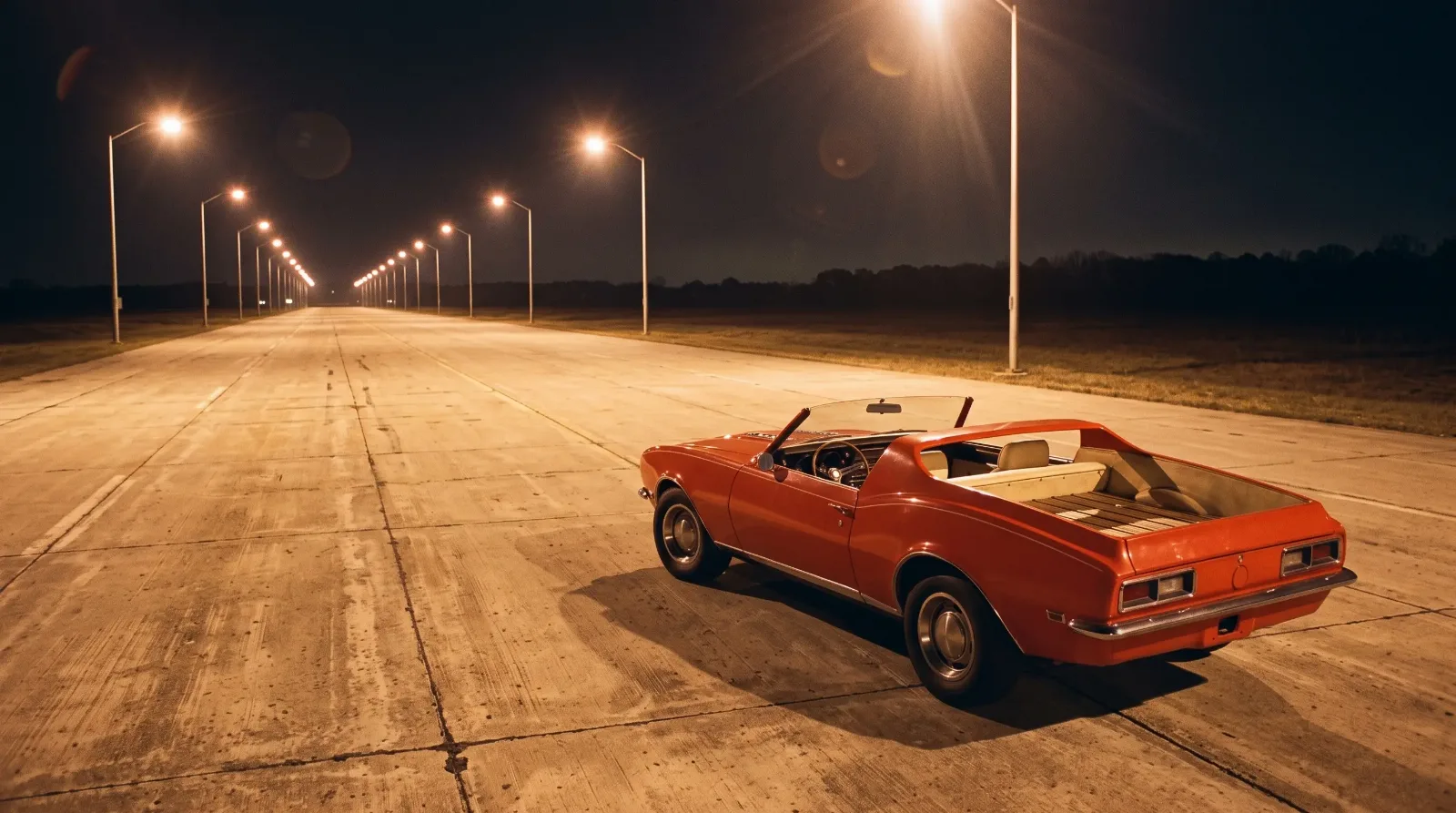
The Caribe made its debut at the Rod and Custom Show at the Toledo Sports Arena in Ohio, March 7 to 9, 1968. Chevrolet called it a "design study" and a "dream pickup," and that is the honest description. The roof, rear seat area and trunk were removed, and in their place went a five-foot pickup box with teak floor planks laid over four storage wells and palomino vinyl on the inner walls.
The front half kept the Camaro's proportions but changed the details. A low windshield with no header sat on narrow pillars, and an aerodynamic roll bar right behind the seats worked as a targa-style wind deflector to cut buffeting. The nose got a recessed jet-type intake with small high-intensity lamps, and the rear lamps flashed at high frequency as the stop signal. The paint was red, "really red" in Chevrolet's own words, on 15-inch aluminum wheels with brushed-aluminum inserts and Goodyear Wide Oval tires.
Inside, the studio worked in palomino and ivory vinyl with wood accents and charcoal carpet, plus a console extension with a hot-beverage dispenser and cup storage. Under the hood sat a 396 with a fully synchronized four-speed and a Positraction rear axle. The hood carries SS louvers, and one book author identifies the base car as a 1968 SS-396.
| Detail | Cherokee (1967) | Caribe (1968) |
|---|---|---|
| Base car | 1967 SS convertible, Norwood | 1968 SS-396, per one book author |
| Engine | L78 396, four Weber carburetors | 396, four-speed manual |
| Signature change | Ducktail, split brass blade bumpers | Five-foot pickup box with teak floor |
| Debut | Chicago Auto Show, 1967 | Toledo Rod and Custom Show, 1968 |
| Known fate | Restored, revealed at MCACN 2013 | Not documented |
What happened to them, and what a builder should take away
The Cherokee's paper trail is the kind restorers dream about. From Mitchell it went to Augie Pabst, then to Vilter Chevrolet in Milwaukee, then to Custom Top Co. in 1971, then to Edward R. Maurer of Brookfield, Wisconsin, who titled it in 1987, and on to Terry Lietzau. It was shown unrestored on Rally wheels at MCACN in 2010, crossed the block at Russo and Steele in January 2012 and went to The Brothers Collection, and was revealed restored at MCACN in Rosemont, Illinois, in 2013, with paint by Charley Hutton's Color Studio in Nampa, Idaho.
The Caribe's trail goes cold. It made the auto show rounds early in 1969, and a newspaper ad from May 1, 1969, lists a "Chevrolet Caribe" at Cal-Expo in Sacramento. After that, nothing confirmed. You will also see the Caribe called "XP-14" online. A GM contact says that number is wrong, and no official project number has turned up, so leave it off any tribute build sheet. As for production, the plain reading is that there probably never was any intent. It was a one-off.
"If you want to build a Caribe tribute, fine, cut the roof. But do it with a 396, a four-speed and teak in the bed, and call it a tribute. The day someone shows up with a billet LS and calls it the Caribe, he has missed the whole point of the car."
Jim Vasquez
What both cars show is the studio pushing on the ends of the Camaro and leaving the middle alone. The Coke-bottle body side was already right. The bumpers, the nose and the tail were where designers saw room to work, and the optional body-color nose on the 1969 car went after the same chrome bar. For how these show cars fit the rest of the first-generation run, read more here, and for the full arc from 1967 onward, see our Camaro history.
Sources and notes
- Old Cars Weekly: Car of the Week, the 1967 Cherokee Camaro
- Chevy Hardcore: the Cherokee Camaro at MCACN 2013
- Sports Car Digest: Russo and Steele Scottsdale 2012 auction results
- Camaro Research Group forum: the Caribe thread and Chevrolet press release
- Chevy Hardcore: a Camaro parts hauler, the Chevrolet Caribe
- Mac's Motor City Garage: five fascinating Camaros that never were
Related Reading

Have a
Chevrolet Camaro
for Sale?
Reach thousands of serious classic car collectors across the US.
Sell It Here →
Are You a Classic Car Dealer?
List your full inventory and connect with targeted classic car buyers.
Join as a Dealer →
#first generation camaro
#chevrolet camaro
#Bill Mitchell
#concept cars
#show cars
#Camaro Caribe
#Camaro Cherokee
About the author
Jim Vasquez
Southern California hot rod and custom car builder with roots in the traditional kustom kulture scene.
Related Listings - Chevrolet Camaro
Comments
Be the first to comment on this article.