
Plymouth built the second generation Barracuda for three model years without a full redesign, yet a 1967 vs 1969 Barracuda comparison turns up more differences than most casual owners realize. The body shell stayed largely the same across the run, but engines, trim, and marketing all shifted year to year in ways that the factory record documents clearly, even if the changes never made it into most people's mental picture of the car.
Car Features
7 min read
How the Barracuda Changed From 1967 to 1969
A factory-historian breakdown of what actually changed under the second generation Barracuda's skin between 1967 and 1969, from engine fitment to trim.
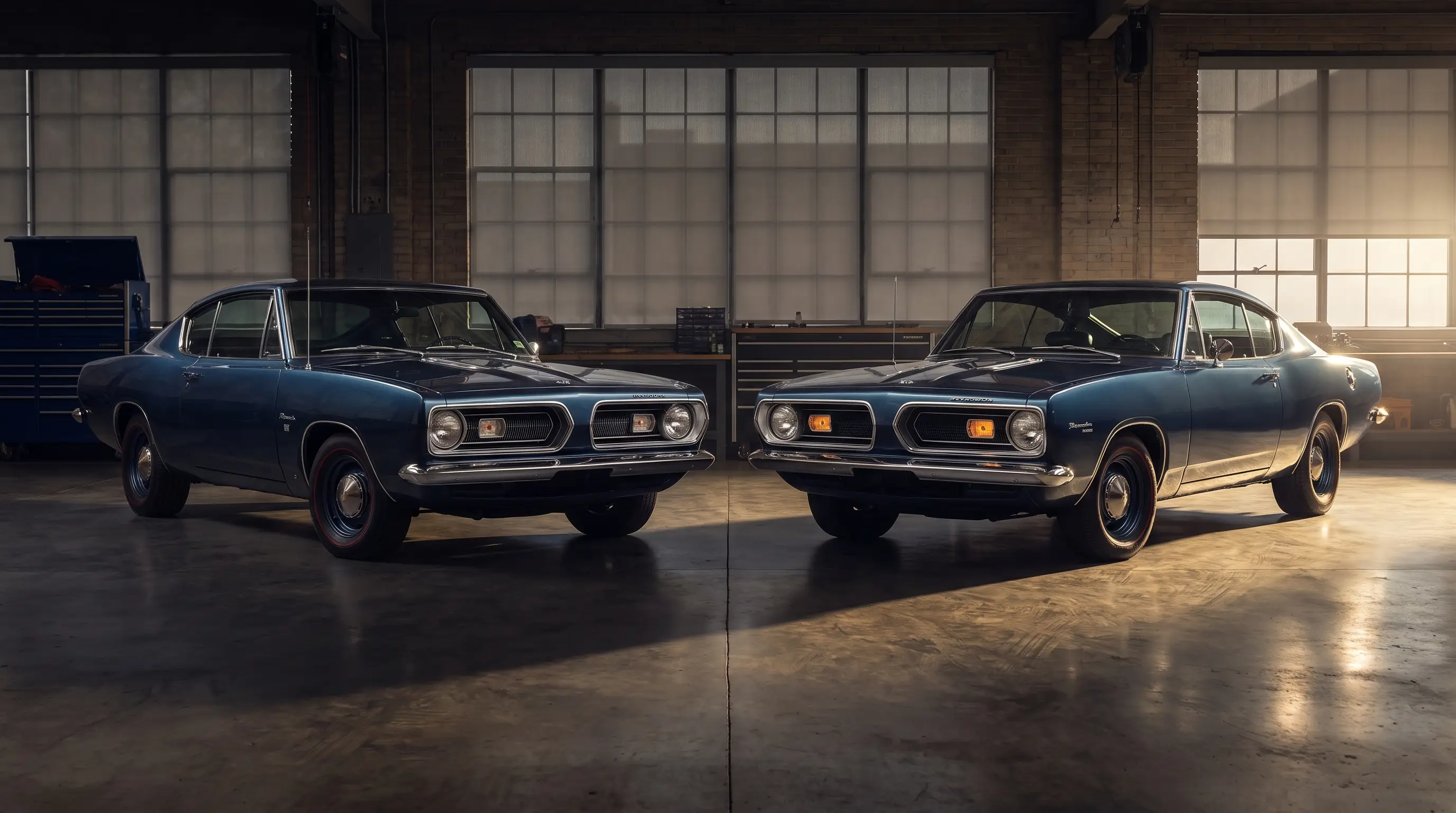
1967: the platform gets serious
The 1967 Barracuda was the first year of the second generation, built on Chrysler's A-body platform shared with the Valiant but with unique sheet metal in fastback, hardtop, and convertible form. This was the year Plymouth introduced the Formula S package, the performance option that would define the model's identity for the rest of the generation. The 1967 Formula S came with the 273 cubic inch Commando V8 as its base performance engine, a genuinely small displacement by muscle car standards of the day, and a heavy duty suspension package that reviewers of the era actually praised for handling rather than just straight line speed.
Factory records show the 273 Commando was rated at 235 horsepower, a respectable number for a small block in 1967 but nothing that put fear into a GTO or a 4-4-2. Plymouth knew this. Mid year, the 383 cubic inch big block became available, though Chrysler engineers had to modify the engine bay and even the K-member to make the big engine fit a car designed around a small block. It was a tight fit both mechanically and in the parts catalog, and 1967 383 cars are correspondingly rare today.
1969: the big block matures and the trim expands
By 1969, the fitment problems were solved and the 383 was a fully sorted, catalog-listed option delivering 330 horsepower in Formula S trim. Plymouth also broadened the Formula S concept, adding the 340 cubic inch small block as a lighter, better-balanced alternative to the big block for buyers who valued handling over raw torque. This is the year the lineup arguably reached its peak sophistication, offering three distinct performance characters, small block agility, big block muscle, and a base six or 318 for buyers who just wanted the styling, within one model.
Trim and color options also expanded substantially by 1969. High Impact paint colors, the loud, saturated hues Chrysler used to compete for showroom attention, appeared partway through the model year and gave the aging body a fresh visual identity even without sheet metal changes. Interior options grew too, with more upholstery choices and a broader console and gauge package selection than the comparatively spartan 1967 cars offered.
| Feature | 1967 | 1969 |
|---|---|---|
| Formula S base engine | 273 Commando V8, 235 hp | 340 (275 hp) or 383 (330 hp) V8 available |
| 383 big block | Mid-year addition, tight fitment | Fully sorted factory option |
| High Impact colors | Not offered | Available late in model year |
| Body styles | Fastback, hardtop, convertible | Fastback, hardtop, convertible |
Why the changes matter more than they look
Because the body shell barely changed across these three years, it is easy to assume the cars underneath were nearly identical too. Factory build records say otherwise. Engine codes, suspension part numbers, and trim tag data all shifted meaningfully between 1967 and 1969, and anyone restoring or authenticating a car from this era needs to know which year they are actually working with before assuming parts interchange cleanly. A 1967 K-member is not the same part as a 1969 K-member on a 383 car, despite looking similar at a glance.
Collectors researching a specific car should treat the model year as more than a cosmetic detail. It determines what engine was actually available at the factory, what the correct suspension components look like, and what trim combinations existed on the option sheet Plymouth printed that year. Getting this wrong is one of the more common authentication mistakes in the hobby.
"People assume the second generation Barracuda didn't change much because the sheet metal looks similar year to year. The build sheets tell a completely different story."
- Tom Ramirez
Reading the full arc of the generation
These two model years bookend a period where Plymouth was actively figuring out what a compact performance car could be, and 1968 sits between them as a transition year with its own quirks. For a complete account of how the 273, 340, and 383 options evolved across all three years, along with the trim and body style history that connects them, the full story covers the entire second generation in depth.
Anyone weighing a purchase in this segment should factor model year specifics directly into their evaluation, since a 1967 and a 1969 car can differ meaningfully in what is correct and original even when they look nearly identical in photographs. Buyers researching current inventory can review classic Barracuda for sale listings with these year-specific details already in mind before making an offer.
1968: the transition year nobody names
Sandwiched between the two years everyone talks about, 1968 rarely gets its own paragraph in most retrospectives, yet it is where several of the changes that would define 1969 actually took root. The 340 small block, often credited to the 1969 model year in casual conversation, was already available as a Formula S engine option in 1968, a fact that surprises even some long-time owners who assume the small block performance option arrived alongside the more heavily marketed changes of the following year.
Trim details shifted quietly in 1968 as well, with interior upholstery patterns and console designs updated from the 1967 originals well before the more dramatic High Impact color rollout of 1969 grabbed all the attention. Treating 1968 as a footnote between two more famous years misses how much of the groundwork for 1969's reputation was actually laid down a full year earlier.
What this means for restoration accuracy
Anyone restoring a car from this three-year window needs to resist the temptation to treat the generation as a single, interchangeable unit. A part correct for a 1969 Formula S is not automatically correct for a 1967 example carrying the same nominal engine option, because suspension components, wiring details, and even some sheet metal stampings changed between years in ways that period parts catalogs documented precisely. Restorers who skip this step and assume universal interchangeability across all three years risk building a car that looks right but fails a detailed judging inspection or an informed buyer's walkaround.
The safest approach is to identify the exact model year first, using the VIN and any surviving broadcast sheet, before sourcing a single reproduction part, since suspension and engine mount hardware changed across these three years in ways period parts catalogs documented by year. That single step avoids the majority of authenticity disputes that come up around cars from this specific window of production.
The historian's verdict
Neither year is objectively better; they represent different points in the same three-year development arc. The 1967 car is the raw first draft with a tight-fitting big block option and a simpler trim sheet. The 1969 car is the fully realized version of the same idea, with a sorted 383, the addition of the 340, and a broader palette of colors and options. Knowing which one you are looking at, and what that means for authenticity, is the difference between informed collecting and guesswork.
Sources and notes
- Plymouth Barracuda - Wikipedia
- Original 273 4V: 1967 Plymouth Barracuda - Barn Finds
- 1969 Formula S 383-S specifications - Automobile Catalog
- 1968 Formula S 340-S specifications - Automobile Catalog
- 1967-1969 Plymouth Barracuda 383/440 - HowStuffWorks
- The 1967-1969 Plymouth Barracudas Were Out to Win You Over - MotorCities
Related Reading
Have a
Plymouth Barracuda
for Sale?
Reach thousands of serious classic car collectors across the US.
Sell It Here →
Are You a Classic Car Dealer?
List your full inventory and connect with targeted classic car buyers.
Join as a Dealer →

About the author
Tom Ramirez
Corvette researcher and historian based in Bowling Green, Kentucky. Two decades documenting Corvette production history from original factory records.
Related Listings - Plymouth Barracuda
Comments
Be the first to comment on this article.