
Chevrolet built a lot of Bel Airs for 1955, but the ragtop is the one that stops people at car shows. The 1955 Bel Air convertible sat at the top of the model range that year, and Chevrolet knew it. It was priced above every other passenger car in the lineup, it got extra brightwork, and it was the car dealers put in the front window when they wanted foot traffic. Sixty-some years later it is still doing that job, just at Barrett-Jackson instead of a showroom on Main Street.
Car Features
7 min read
The 1955 Bel Air Convertible
Chevrolet built the 1955 Bel Air convertible as a halo car meant to draw traffic into showrooms, and its rarity and structural differences still set it apart from the hardtop today.
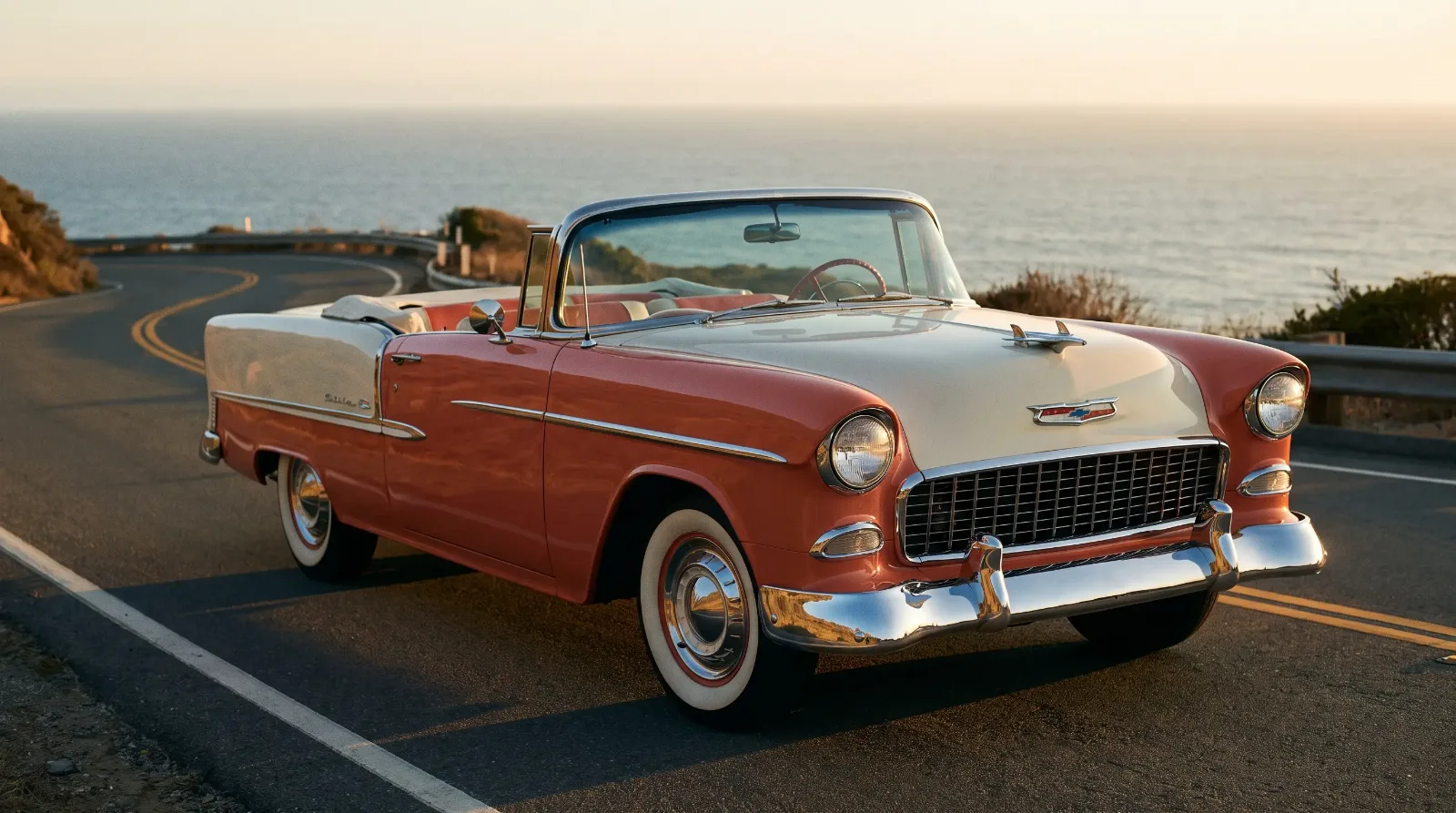
A halo car, on purpose
Chevrolet's 1955 lineup ran three trim levels: the base 150, the mid-range 210, and the Bel Air on top. Within Bel Air, the convertible carried the highest list price of any 1955 Chevrolet passenger car, list price around $2,305, ahead of even the Nomad wagon. That was a deliberate decision inside Chevrolet's marketing division. The convertible was meant to pull people into showrooms who would then buy a cheaper hardtop or sedan once they saw what the styling could do in person. Dealers called this a "traffic builder," and the term shows up repeatedly in Chevrolet's internal sales literature from the period. The 1955 Bel Air convertible existed to be looked at first and sold second.
The formula worked. Convertible sales for 1955 were modest against the volume models, but the car generated outsized attention in print advertising and at the New York Auto Show, where Chevrolet's stand leaned hard on color and top-down photography rather than mechanical specifications.
What made the ragtop different from the hardtop
Underneath the sheet metal, the convertible shared its chassis and running gear with the rest of the 1955 Bel Air range, including the option of the new small-block V8. But a convertible body is not simply a hardtop with the roof cut off. Chevrolet's engineers added structural reinforcement to the rocker panels and the X-frame to compensate for the lost rigidity of a fixed roof, and the power-operated fabric top mechanism, along with its hydraulic pump and header latch, was unique to the body style. None of that shows up in a brochure, but it is why a well-preserved convertible frame today commands more attention from restorers than a comparable hardtop frame. The extra bracing is there for a reason, and it tells a knowledgeable buyer that Chevrolet did not treat the convertible as an afterthought.
| Spec | 1955 Bel Air convertible |
|---|---|
| Body style | 2-door convertible, power top |
| Base engine | 235 cu in inline-six, 123 hp |
| Optional engine | 265 cu in V8, up to 180 hp with Power Pack |
| Base price (1955) | approx. $2,305 (six-cylinder base) |
| Wheelbase | 115 inches |
Color and the top-down effect
Chevrolet leaned on its expanded 1955 color palette hardest with the convertible, since a two-tone body reads differently with the top folded than it does on a sedan. Combinations like Coral and India Ivory, or Regal Turquoise over Shoreline Beige, were photographed constantly with the top down for showroom posters, because the contrast panel on the rear fender became a design feature rather than a background detail once the roof was out of the picture. Buyers who wanted maximum visual effect ordered the convertible specifically because the body style let the color combination do more work. That is a small point of Chevrolet product planning that rarely gets mentioned, but it explains why so many surviving convertibles wear the boldest color pairings from the 1955 chart rather than the conservative ones.
Rarity and what it means today
Convertibles have always survived at lower rates than closed cars. Soft tops age, get replaced with mismatched fabric, or simply fail and let interiors rot from the inside out, and a fair number of 1955 ragtops were driven hard as weekend cars long after they stopped being anyone's daily transportation. That combination of low original production against a body style with above average attrition is why the convertible commands a real premium over a hardtop or sedan built the same year with a comparable engine. Documentation matters more here than on almost any other 1955 body style, since replacement tops, replaced interior kits, and incomplete build sheets are common enough that a verified numbers-matching convertible stands apart from the crowd immediately.
"Every 1955 Bel Air convertible I've traced back to its original build sheet tells a slightly different story than the folklore around it. The paperwork is where the real history lives, not the swap meet rumor."
- Tom Ramirez
Anyone tracing a specific car should start with the factory literature rather than assumptions, because Chevrolet's own numbers are more precise than most of what circulates at swap meets. For readers who want the broader context on how this car fits into the 1955 model year as a whole, where this started covers the full picture beyond just the convertible.
Buying one today
A genuine, well-documented 1955 Bel Air convertible is not a casual purchase. Prices reflect both the halo status Chevrolet gave the car in 1955 and the collector premium convertibles carry across nearly every American make from the era. Buyers should expect to pay significantly more than a hardtop in equivalent condition, and should weight documentation, top mechanism condition, and frame integrity above cosmetics. For those actively shopping, dealers and private sellers list a range of restored and original examples, and browsing current classic Air for sale listings is a reasonable way to get a feel for where the market sits before committing to a specific car.
The mechanics of the top itself
The convertible's power top ran off a small hydraulic pump mounted behind the rear seat, fed by fluid reservoirs that also powered the front header latch release, a system advanced enough for 1955 that Chevrolet's own literature called attention to it directly rather than treating it as a minor convenience. Getting that system to work reliably at highway speed, without leaks or slack in the seals, required tighter build tolerances than a fixed roof ever demanded, which is part of why the convertible commanded its higher price beyond simple market positioning. Original pumps and cylinders are scarce today, and a convertible with its factory hydraulic hardware intact and functional is worth more to a serious collector than one that has had the system replaced with reproduction parts, even when the replacement performs identically.
The fabric top itself came in a limited range of colors, generally black, white, or a shade coordinated to the body's contrast panel, and Chevrolet expected dealers to stock enough combinations to satisfy regional taste without overcomplicating inventory. A white top over a Coral and India Ivory body was a common enough combination that it shows up repeatedly in period photography, while a black top tended to appear on the more conservative color pairings. None of this was accidental. Chevrolet's marketing team understood that a convertible top color is as visible in a parking lot as the body paint itself, and treated it accordingly.
The convertible in period road tests
Automotive writers covering the 1955 Bel Air convertible in period consistently noted two things: how much lighter and more eager the car felt with the optional V8 compared to the base six, and how composed the body remained over rough pavement despite the loss of a fixed roof. That composure was not automatic. It reflected the additional frame and rocker reinforcement Chevrolet engineered specifically for the convertible body, work that a casual buyer walking the showroom floor would never notice but that a road test driver felt immediately on a washboard county road. Reviewers of the era rarely dwelled on ride quality the way modern outlets do, but even brief period commentary on the convertible's stiffness stands out against how flexible many open cars of the early 1950s had been.
The 1955 Bel Air convertible was built to be the car people remembered from the showroom floor. Seventy years on, it still tends to be the one people remember from the show field, and that was never an accident.
Sources and notes
Related Reading
Have a
Chevrolet Bel Air
for Sale?
Reach thousands of serious classic car collectors across the US.
Sell It Here →
Are You a Classic Car Dealer?
List your full inventory and connect with targeted classic car buyers.
Join as a Dealer →

About the author
Tom Ramirez
Corvette researcher and historian based in Bowling Green, Kentucky. Two decades documenting Corvette production history from original factory records.
Related Listings - Chevrolet Bel Air




Comments
Be the first to comment on this article.