
There's a fellow at our local show, been coming for going on twenty years, who still argues with anybody who'll listen that his 1963 Chevy II SS is "the first real Nova," never mind that Nova wasn't even the model's name yet. He's not entirely wrong about the spirit of it. The 1963 Chevy II SS was the moment Chevrolet stopped treating the compact as an economy car with an options sheet and started treating it like something you'd actually want to drive fast. Whether you call that car a Chevy II or a Nova depends on which badge you're standing in front of, but the package itself is not up for debate. It's all in the build sheet.
Car Features
6 min read
The 1963 Chevy II Super Sport
The 1963 Chevy II SS turned a dressed-up Nova 400 into Chevrolet's first real compact performance package, and clubs still argue over which cars really earn the badge.
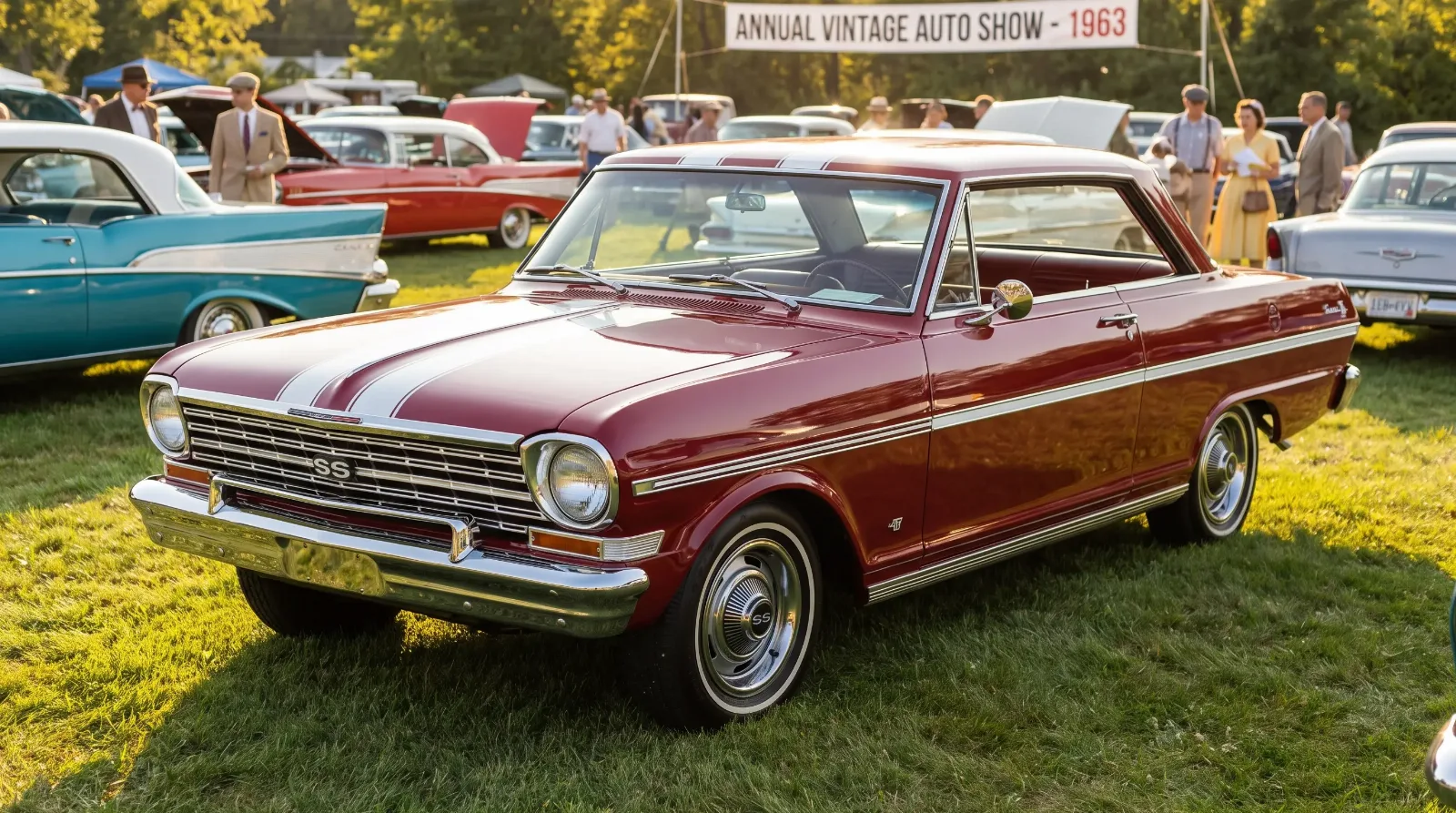
How the SS package landed on the Nova 400 body
For 1963, Chevrolet took the top-trim Nova 400 and layered a Super Sport package on top of it rather than building a separate model from scratch. That is the same approach the division used successfully on the full-size Impala SS, and it worked just as well shrunk down to Chevy II size. Buyers who wanted the SS treatment picked it as an option on the Nova 400 Sport Coupe, which meant the SS badge always rode alongside the top trim rather than replacing it.
The bones of that story go back further than 1963, and if you want the full picture, the first-gen Chevy II is where the lineup actually starts. What matters for our purposes is that by 1963, Chevrolet had already built the top trim buyers wanted to dress up. The SS package just gave them a reason to.
What actually came on an SS car
Here's where the shop-talk debates get useful, because the SS package was specific about what it added, and none of it was cosmetic-only fluff. Bucket seats and a floor-mounted console came standard, along with a full set of gauges instead of the idiot lights the lesser trims made do with. Special wheel covers, twin sport stripes down the flanks, and SS badging front and rear rounded out the visual side.
Here's where a lot of casual retellings get it backward: the 1963 SS package, cataloged as RPO Z03, was an appearance and instrumentation upgrade, and it rode on the same 194 cubic inch inline six as any other Nova 400. Chevrolet did not put a factory V8 under an SS hood until the following year. For 1964, the 283 cubic inch small-block arrived as the Chevy II's first factory V8 option, rated at 195 horsepower. That's the detail that separates a genuine 1963 SS from a car wearing the wrong model year, or from a Nova 400 dressed up with a later small-block swap.
| Feature | Standard on 1963 SS |
|---|---|
| Engine | 194 cu in inline-six, standard (283 cu in V8 not available until 1964) |
| Seating | Bucket seats with console |
| Instrumentation | Full gauge package |
| Exterior | SS badging, twin sport stripes, special wheel covers |
The arguments this car still starts at shows
I've heard grown men nearly come to blows over whether a Nova 400 with an aftermarket console and some added badges counts as an "SS" if the owner never bothered documenting the swap. It doesn't, and the club's own judging sheets settle that argument every time, because the record cares about the original build code, not what the car looks like parked under the tent. A genuine 1963 SS has the Z03 package built at the factory, six-cylinder and all. Everything else is a Nova 400 wearing somebody's idea of what an SS should be, or a later-year SS with a 283 getting misremembered as a '63.
That distinction matters more every year, because these cars have been swapped, restored, and re-restored enough times that oral history alone won't settle a debate anymore. The clubs that track these things by cowl tag and invoice have quietly become the only honest referee left.
I've watched a car get bumped down a full class at judging because the owner couldn't produce anything beyond a family story about the engine. Nice car, good story, wrong paperwork. The judges didn't enjoy doing it, but the rules exist so that somebody's grandfather's memory doesn't outrank an actual factory record. That's not being difficult. That's just what keeps the whole hobby honest when everybody's got a story to tell.
Why the 1963 SS still gets argued about today
Every club has that one member who treats the 1963 SS as the true starting point of everything that came after it, SS badges included, right through the later Nova performance cars. There's a case for that argument even if the timeline is messier than the shorthand suggests. This was the car where Chevrolet decided the Chevy II platform deserved a genuine performance package instead of just a nicer interior, and that decision echoed through the rest of the decade.
"Doesn't matter what the fellow at the swap meet tells you his car is. The invoice either matches the year, the engine, and the Z03 code, or it doesn't. That's the whole argument, settled in one line."
Wayne Coburn
If you want to keep tracking how this story unfolds after the SS package proved itself, keep reading the series, because the next chapter is about a body style that let Chevrolet sell the same idea with the top down. The SS started the argument about what a Chevy II could be. The rest of the decade just kept adding chapters to it.
My friend at the show is still going to call his car the first real Nova, and honestly, I've stopped correcting him. He's got the invoice, the matching numbers, and forty years of showing up to prove he earned the argument. That's more documentation than most people bring to the debate, and around here, that's usually enough to win it.
Sources and notes
- Wikipedia: Chevrolet Chevy II / Nova
- GM Heritage Collection: 1963 Chevrolet Nova SS
- A History of the Chevrolet Nova and Chevy II
- Classic Promenade: 1963 Chevrolet Nova SS Convertible
- Automobile Catalog: 1964 Chevrolet Chevy II Nova SS, 283 V8 Specifications
- HowStuffWorks: 1963-1967 Chevrolet Chevy II Nova SS
Related Reading
Have a
Chevrolet Nova
for Sale?
Reach thousands of serious classic car collectors across the US.
Sell It Here →
Are You a Classic Car Dealer?
List your full inventory and connect with targeted classic car buyers.
Join as a Dealer →
#classic chevrolet
#car club history
#chevrolet nova
#compact muscle car
#Chevy II SS
#1963 Super Sport

About the author
Wayne Coburn
Longtime Corvette owner, judge and club figure who knows the cars, the records and the people behind them.
Related Listings - Chevrolet Nova
Comments (1)
G
Greg Mazur
2 days ago
Question on verification. If the original invoice is gone, what on the car itself documents a factory Z03? Does the cowl tag carry anything SS-specific for 1963, or is the evidence limited to the six-cylinder casting numbers plus the gauge cluster and console mounting points? Need a documented checklist before I look at one next month.
D
datsun_dee
1 day ago
Greg, look at the console bolt holes in the floor. Factory holes got painted with the body, so the edges carry primer. Holes drilled later show bare steel edges and fresher oxidation. Rust tells time.