
The Chevy II station wagon rarely gets mentioned in the same breath as the Nova SS hardtop, and that is a documentation gap worth closing. When Chevrolet rolled out the Chevy II in the fall of 1961 for the 1962 model year, the wagon was not an afterthought bolted on to satisfy fleet buyers. It was part of the original body-style plan from the start, built to compete directly against the Ford Falcon wagon and the Plymouth Valiant wagon in a segment where compact haulers were selling briskly.
Car Features
7 min read
The Chevy II Station Wagon
The Chevy II wagon was never a stripped-down afterthought. It was its own body style, built to compete with the Falcon and Valiant wagons from day one.
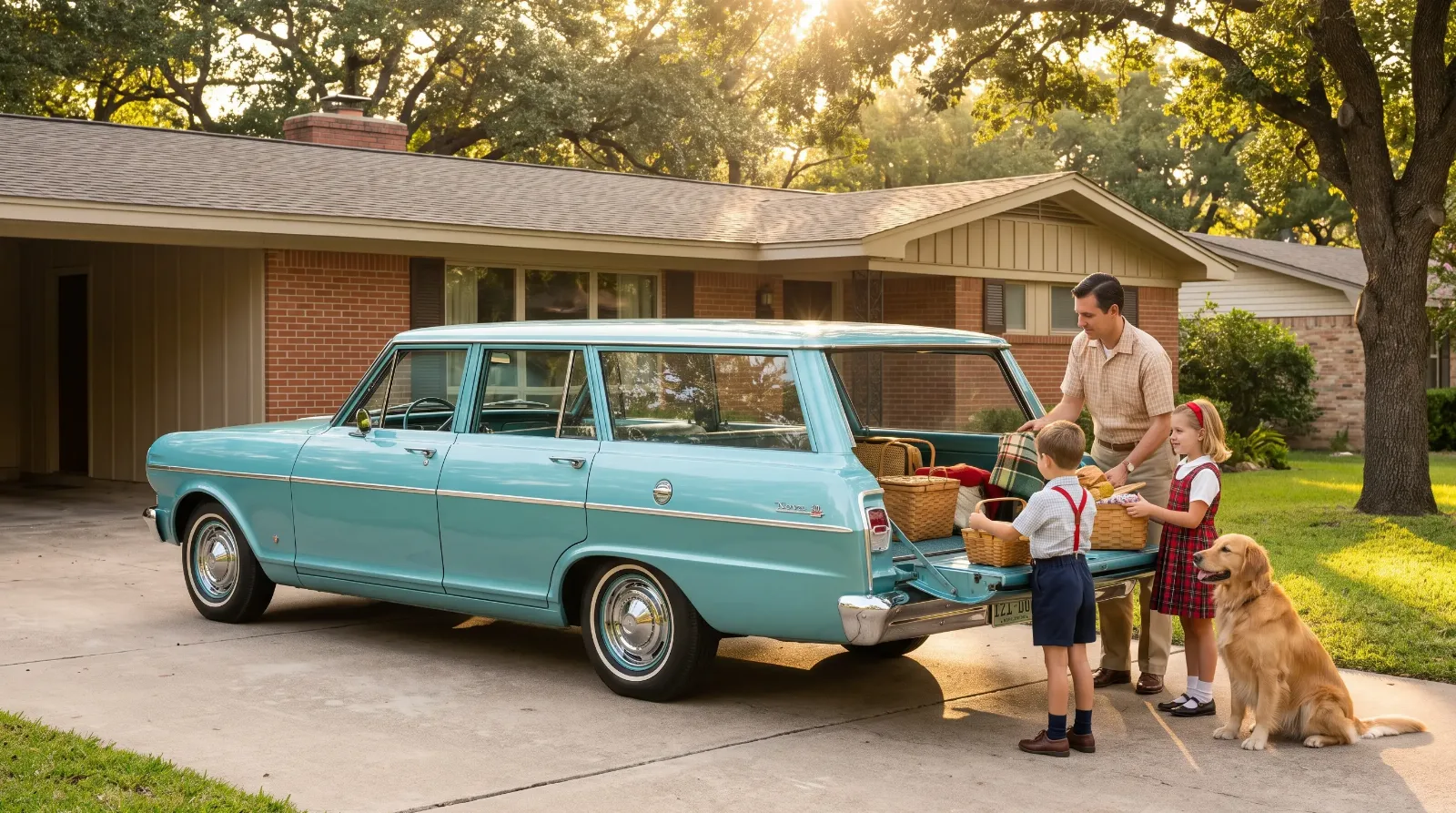
Chevrolet's own sales literature treated the wagon as a legitimate family vehicle, not a stripped-down runabout. That distinction matters because so much of the modern Nova conversation centers on V8 swaps and SS trim, leaving the wagon to be remembered, if at all, as a grocery-getter.
A wagon built for the compact class, not scaled down from one
The 1962 Chevy II wagon shared its 110-inch wheelbase with the sedans and the convertible, so it was not a stretched or compromised platform. Chevrolet offered it in two-door and four-door configurations that first year, with the four-door proving to be the far more popular choice among buyers who actually needed the cargo room. The two-door wagon disappeared from the lineup after 1963, a clear signal from the sales floor about which body style people wanted.
Cargo capacity ran close to 76 cubic feet with the second-row seat folded, respectable for a car in the compact class and only a step behind Chevrolet's full-size Bel Air wagon in usable space. The rear seat folded flat to create a load floor, and the tailgate used a drop-down design with a roll-down glass panel, standard Chevrolet wagon engineering carried down from the full-size cars.
Chevrolet's engineers also carried over the compact platform's lower cowl and beltline into the wagon roofline without raising it awkwardly to compensate for cargo height, something rival compact wagons of the era did not always manage gracefully. The result was a wagon that read as a coherent extension of the sedan's proportions rather than a sedan with a box grafted onto the back, a detail period buyers noticed even if they could not always articulate why the Chevy II wagon looked more finished than some competitors.
Series 100, Series 300, and Nova 400: three ways to haul
Buyers cross-shopping the how the Nova began lineup actually had three wagon trims to pick from, not two. The base Series 100 wagon was aimed squarely at fleet and budget buyers: rubber floor mats, minimal exterior brightwork, and a bench seat with no pretense of luxury. The mid-range Series 300 added body-side moldings and bright window trim, and, unusually for a compact-class wagon, offered an optional rear-facing third seat that turned the four-door into a genuine nine-passenger hauler, a feature closer to what buyers expected from a full-size wagon than an economy compact. The Nova 400 wagon, at the top of the range, added carpeting, upgraded upholstery, extra chrome trim, and a nicer dashboard treatment.
The trim gap across the three wagons was wider than it looked on paper. A Series 100 wagon ordered with the base four-cylinder and no options was a genuinely spartan machine, the kind of car a small business bought in threes for a delivery fleet. A well-equipped Nova 400 wagon with the optional six-cylinder engine, whitewalls, and a radio was a different animal entirely, one that a young family could park in the driveway without embarrassment, while the Series 300's third-seat option carved out its own niche for larger families who needed the extra capacity more than the extra chrome.
Dealer order guides from the period show just how far a buyer could stretch a Nova 400 wagon before it started competing on comfort with Chevrolet's full-size cars. Options like a two-speed wiper, a padded dash, and full wheel covers turned what began as a delivery-grade platform into a wagon a middle-class family could reasonably choose over a Bel Air wagon, at a noticeably lower price and with none of the fuel penalty that came with the bigger car's six or V8 engines.
| Spec | Chevy II wagon, 1962-63 |
|---|---|
| Wheelbase | 110 in. |
| Body styles offered | 2-door (1962 only) and 4-door |
| Trim levels | Series 100, Series 300, Nova 400 |
| Cargo volume, seat folded | Approx. 76 cu ft |
| Base engine | 153 cid Hi-Thrift four-cylinder |
| Optional engine | 194 cid inline six |
What the factory records actually say about production
Pinning down exact wagon production by trim level is harder than most modern write-ups admit. Chevrolet's total Chevy II output for the 1962 model year ran into the hundreds of thousands of units across all body styles, with four-door wagons across all three trims totaling roughly 60,000 units for the year, a smaller slice than sedan production, and it is the four-door wagon body style, more than the two-door, that accounts for most of that figure. Anyone quoting a precise wagon-only figure without citing a specific source is usually rounding from a body-style breakdown that Chevrolet itself published inconsistently between dealer material and internal production summaries.
What is easier to document is how the wagon fit into the broader six-cylinder story. Buyers who wanted more than the base four-cylinder but did not need V8 power gravitated toward the six, and that pairing shows up constantly in period road tests and dealer invoices. For readers who want another angle on that engine choice, the six-cylinder Chevy II wagon was, by most contemporary accounts, the sensible family buy of the lineup.
Living with a Chevy II wagon today
Surviving Chevy II wagons are less common than the sedans or the SS coupes, partly because wagons in general got worked hard and discarded once the family moved on to something newer. That relative scarcity has started to change how collectors view them. A clean four-door Nova 400 wagon with the six-cylinder engine and original trim is no longer treated as a curiosity at swap meets; it is treated as a genuinely hard find.
Parts support is a mixed picture. Mechanical components interchange with the sedans and coupes almost entirely, so engines, suspension, and brakes are not a problem. Wagon-specific trim, the tailgate hardware, and the rear glass mechanism are a different story, and those pieces command real money when they show up.
Anyone actively hunting a wagon should expect to wait. These cars simply do not surface as often as the sedan and coupe body styles, and when a clean example does come up for sale, informed buyers move fast because they know how thin the supply of unmolested tailgate hardware and trim has become. Patience, and a willingness to travel for the right car, tends to pay off better than chasing the first listing that turns up.
"People assume the wagon was a compromise car. It wasn't. Chevrolet engineered it as its own body style with its own hardware, and the factory paperwork backs that up better than any modern opinion does."
Tom Ramirez
For a buyer today, the appeal of the Chevy II wagon is less about performance and more about honesty. It was never pretending to be a muscle car, and it does not need to apologize for that now. It represents the practical, everyday half of the early Chevy II story, the half that put more of these cars into driveways than any SS coupe ever did.
Sources and notes
Related Reading
Have a
Chevrolet Nova
for Sale?
Reach thousands of serious classic car collectors across the US.
Sell It Here →
Are You a Classic Car Dealer?
List your full inventory and connect with targeted classic car buyers.
Join as a Dealer →

About the author
Tom Ramirez
Corvette researcher and historian based in Bowling Green, Kentucky. Two decades documenting Corvette production history from original factory records.
Related Listings - Chevrolet Nova
Comments
Be the first to comment on this article.