
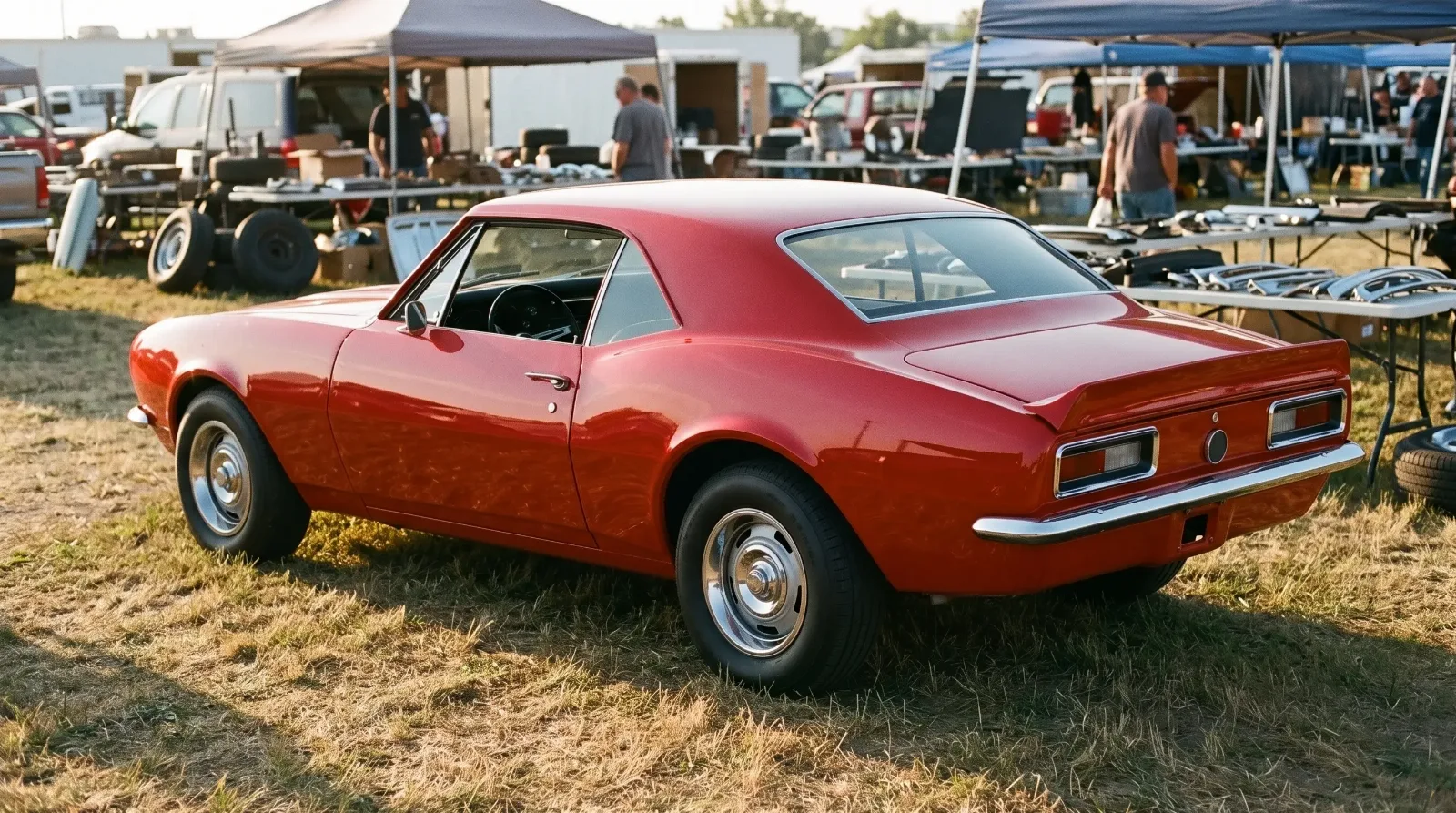
Walk a big swap meet long enough and you will meet him. He has a 1967 Camaro, a 427 under the hood and a story that starts with a dealership. In Chicago the name is Nickey. In Los Angeles it is Dana. On the East Coast it is a Baldwin-Motion Camaro, and he will tell you about the guarantee before you ask. The story is always good. The folder under his arm decides whether it is true. Yenko gets most of the ink when people talk about dealer big-block Camaros, but three other shops were dropping 427s into Camaros in the same seasons, each with its own way of doing business. Here is how each one worked, and what it takes to prove a car really came from one of them.
Car Features
8 min read
Nickey, Dana and Baldwin-Motion: The Other Dealer 427 Camaros
How Nickey, Dana and Baldwin-Motion put Corvette 427s into Camaros around a GM rule, what each offered, and why paperwork decides what a car is.
Why the 427 had to come from a dealer
The reason these cars exist is a corporate memo, not a horsepower race. GM barred factory installation of any engine "larger than 400 cubic inches" in non-Corvette passenger cars smaller than full-size. The Camaro could be ordered with a 396 rated as high as 375 hp in L78 form, and that was the ceiling. The Corvette, sitting in the same showrooms, had 427s. Any dealer with a service bay, a hoist and a parts counter could do the arithmetic.
Chevrolet's own answer for 1967 went in the other direction. The factory built the Camaro Z28 around a 302 cubic inch small-block rated at 290 hp gross, an engine sized for the SCCA Trans-Am limit and built to rev, not to win stoplight arguments. If you wanted cubic inches, you went to a dealer who would pull the factory engine and put in a Corvette one. One drag racer tied much of that world together: Dick Harrell built cars for Nickey Chevrolet in Chicago from 1966, then for Yenko Chevrolet, then for Fred Gibb Chevrolet in La Harpe, Illinois.
Nickey Chevrolet and the backward K
Nickey was an old Chicago store long before it was a speed shop, founded in 1925 by brothers Edward and John Stephani and later located at 4501 W. Irving Park Road. For the 427 Camaro it teamed with Bill Thomas Race Cars of Anaheim, California. The split was geographic: Chicago handled the East and Midwest, Anaheim handled the West Coast, and Car and Driver referred to the outfit as "Nickey-Bill Thomas Co."
The usual engine was the Corvette L72 427, cast iron with a single four-barrel, rated at 425 hp gross. You will see 450 hp in some spec tables. That is a tuned or claimed figure; 425 is what GM put on paper. Some individual cars received the tri-power 427 rated at 435 hp, and those are documented one car at a time rather than as a standard package. Buyers could step up through preparation stages. Stage I added headers, an 8,000 rpm tach, stripes and Nickey wheels. Stage II added a camshaft, a Hurst shifter and a heavy-duty clutch. Stage III went to solid lifters, a new rear axle and Racemaster tires.
Car and Driver put the price at $3,891 "at either Thomas' or Nickey's counter," then added that "$3900 usually is only the beginning." Nobody has published a firm total for Nickey 427 Camaro production, so treat any number you hear at a car show as a guess. The dealership itself was sold in 1973 and became Keystone Chevrolet, and the Nickey Chicago speed shop closed in 1977.
Dana Chevrolet: the West Coast 427 Camaro
Dana Chevrolet sat in South Gate, California, in the Los Angeles area, and its owners had racing in the family tree. Peyton Cramer came from Shelby American, and he ran the store with Paul Doski. Their high-performance and racing manager was Dick Guldstrand, until Competition Press & Autoweek reported that he and Dana had parted ways as of October 28, 1967. Guldstrand then opened his own shop in Culver City.
The Dana 427 Camaro followed the same recipe as Nickey's: an L72 Corvette 427 at 425 hp stock, a Corvette tri-power on some cars, and the high-compression L88 427 on the option list. Doug's Headers were standard. The figure repeated in enthusiast magazines is about 50 cars from 1967 to 1969, with only about six documented survivors. No factory or dealer record backs that count, so treat it as an estimate.
Who sold the first 427 Camaro is an argument without an ending. Collectors who keep the period clippings quote Competition Press & Autoweek of November 7, 1966, calling Dana "the first on the scene" to offer a 427 Super Camaro, and they point to a Nickey magazine ad from that same month offering ready-to-drive 427 conversions. The honest version: both stores had 427 Camaros on offer by November 1966, and no primary document settles which got there first.
The Baldwin-Motion Camaro and the Phase III guarantee
Joel Rosen started Motion Performance in 1963 at a Brooklyn gas station with a Clayton chassis dyno. In 1966 he moved to Long Island, next door to Baldwin Chevrolet, at 598 Sunrise Highway in Baldwin. The arrangement was the clever part. The cars were sold new through Baldwin Chevrolet, converted by Motion, and kept the full GM factory warranty.
The top of the range was the Phase III, usually built on an L88-based 427 that Motion advertised at about 500 hp. That is a marketing number, not a rating. What Motion did put in writing was a performance guarantee: 11.50 seconds at 120 mph or better in the quarter mile, with a Motion-approved driver on an NHRA or AHRA strip, or your money back. Rosen has said nobody ever claimed it. A ZL-1 Camaro that Motion built for Drag Racing magazine ran 11.48 seconds at 122 mph.
One documented 1969 Phase III Camaro carried a window sticker of $9,330 with a Hone-O-Drive and 4.56 gears. That is one car, not a list price. Baldwin-Motion kept building big-block Camaros from 1967 to 1974, and the last Baldwin-Motion supercar was an L88 1974 Corvette.
| Dealer | Location | Usual engine | Detail worth knowing |
|---|---|---|---|
| Nickey Chevrolet | Chicago, with Bill Thomas in Anaheim | L72 427, 425 hp gross | $3,891 per a 1967 Car and Driver review |
| Dana Chevrolet | South Gate, California | L72 427, L88 optional | About 50 built, an enthusiast estimate |
| Baldwin-Motion | Baldwin, Long Island, New York | Phase III 427, about 500 hp claimed | 11.50 at 120 mph or money back |
The paperwork is the car
These cars sell on the dealer name, and the market numbers explain why the folder matters. A 1967 Nickey Stage III, born an L78 car and converted to an L72, sold for $400,000 at the Mecum Indy Spring Classic in 2011. A 1967 Nickey 427 RS/SS with the 435 hp engine sold for $70,550 at Mecum Chicago on November 3, 2000. A 1973 Phase III Camaro that cost $8,000 new, when a no-frills V8 Camaro ran about $3,300, brought $90,200 including premium at Mecum Harrisburg on August 3, 2019. Single cars on single days, not an index.
The conversion happened after the car left the factory, so GM records can only prove where a Camaro was shipped, not what a dealer did to it later. NCRS holds mostly complete shipping records for 1965 to 1972 Camaros, with the dealer code, name and address, offered at $50 per car when the service was announced in 2014. A record showing delivery to Nickey, Dana or Baldwin Chevrolet is a start. It is not a finish. The rest has to come from dealer invoices, period photos and a chain of owners who can be found. Meanwhile, plenty of people build honest tributes, and a recreation is fine as long as nobody calls it something else.
"Every club has a man with a Nickey story. I always ask him the same thing: show me the invoice from Irving Park Road. The good ones open the folder. The rest start talking about the paint."
Wayne Coburn
None of this was a factory program, and that is the point. These were stores working around a rule, each in its own way, and the cars they built are now judged on documents more than on dyno sheets. If you want the factory side of the same era, follow the Z28 name across 35 years. For the Nickey name, there is a short epilogue: Stefano Bimbi bought the Nickey rights in 2002 and revived the brand as Nickey Performance in Loves Park, Illinois. And for where all these cars sit in the Camaro's long run, start with the bigger picture.
Sources and notes
- Supercars.net: 1967 Nickey Camaro 427 Stage III, with the Car and Driver price quote
- Wikipedia: Nickey Chevrolet, founding, the backward K and the later history
- Street Muscle: the Dana 427 Camaro specification and production estimate
- Supercar Registry forum: the November 1966 Dana and Nickey clippings
- Sports Car Market: the 1973 Baldwin-Motion Phase III Camaro and the Motion sales model
- Car Guy Chronicles: Joel Rosen, Motion Performance and the Phase III guarantee
Related Reading
Have a
Chevrolet Camaro
for Sale?
Reach thousands of serious classic car collectors across the US.
Sell It Here →
Are You a Classic Car Dealer?
List your full inventory and connect with targeted classic car buyers.
Join as a Dealer →
#first generation camaro
#chevrolet camaro
#427 camaro
#baldwin motion
#Nickey Chevrolet
#Dana Chevrolet
#dealer supercars

About the author
Wayne Coburn
Longtime Corvette owner, judge and club figure who knows the cars, the records and the people behind them.
Related Listings - Chevrolet Camaro
Comments
Be the first to comment on this article.