
On April 17, 1964, the Mustang went on display at the New York World's Fair and into showrooms the same day, and the face that went with it belonged to Lee Iacocca. That is how the story has been told ever since, at shows, in club newsletters, around open hoods on a Saturday afternoon. It leaves out two men. Don Frey ran the engineering program that got the car from approval to launch in about 18 months. Hal Sperlich was the product planner credited with building it on the Falcon. The Don Frey Mustang story and the Hal Sperlich Mustang story are less famous than Iacocca's, but without them there is no car to put on display in Flushing Meadows. For how that launch fed the pony-car phenomenon, the bigger picture is told elsewhere. This one is about the two men in the background of the photographs.
Don Frey and Hal Sperlich: The Other Fathers of the Mustang
Iacocca got the fame. Don Frey ran the 18-month engineering program and Hal Sperlich put the first Mustang on a Falcon. Their story.
Who Frey and Sperlich were in 1962
Donald N. Frey was born in St. Louis, Missouri, on March 23, 1923. He joined Ford in 1950 on the metallurgy side, which is about as far from the marketing department as a young engineer could get. By the early 1960s he was in the Ford Division's management under Iacocca, and his title in that period depends on who you read. Walter T. Murphy, who worked alongside him, remembered him as chief product planner. The EBSCO reference summary calls him assistant general manager. In 1964 he became vice president and chief engineer. Titles moved fast in that building, and the job he did matters more than the label on his door.
Harold K. Sperlich, Hal to everyone, came to Ford by a different road. He served in the US Navy Seabees during the Korean War and worked at Alcoa before he joined Ford in 1957 as a product planner. He later became manager of special studies in product planning, the kind of title that sounds like a back office and in practice meant thinking about cars that did not exist yet.
Both men sat on the Fairlane Committee, the small group Iacocca gathered at a Dearborn motor lodge to work out what a young buyer's car should be. Both names appear on each of the member lists that hold up. When the committee's brief turned into a funded program, they were the two people most responsible for turning a set of targets into hardware.
The Don Frey Mustang job: 18 months, approval to showroom
Henry Ford II approved the project in September 1962, by The Henry Ford's account. The budget is disputed: the museum says $45 million against the $75 million Iacocca asked for, while Murphy's insider account has the chairman granting the full $75 million. Either way, the money came with a deadline: the brief named April 1964 and the World's Fair.
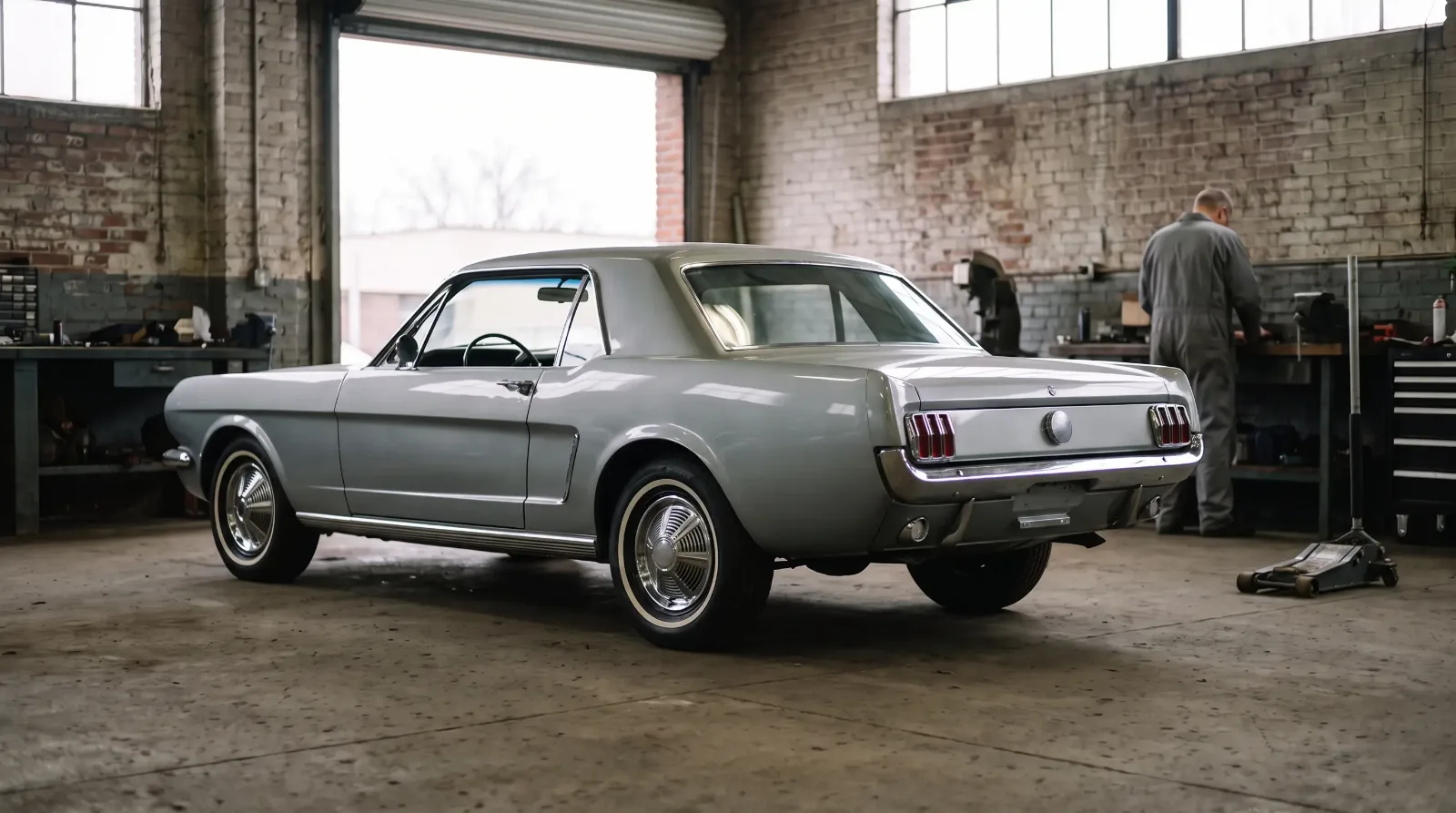
Frey is the man the records put in charge of meeting it. Northwestern University, where he later taught, calls him the project manager for the original Mustang, and his Wikipedia biography says he supervised its development. That development ran from September 1962 to April 1964. That is about 18 months, a span usually described as a record. Think about what had to happen in that window. A body design chosen in late summer 1962 had to be engineered for production, tooled, fitted to existing running gear and built in volume. Pre-production cars left the Rouge line on February 10, 1964, and regular production started on March 9. The car went on sale five and a half weeks later.
The schedule was only possible because so much of the car was not new. That is where Sperlich comes in.
Sperlich and the Falcon under the skin
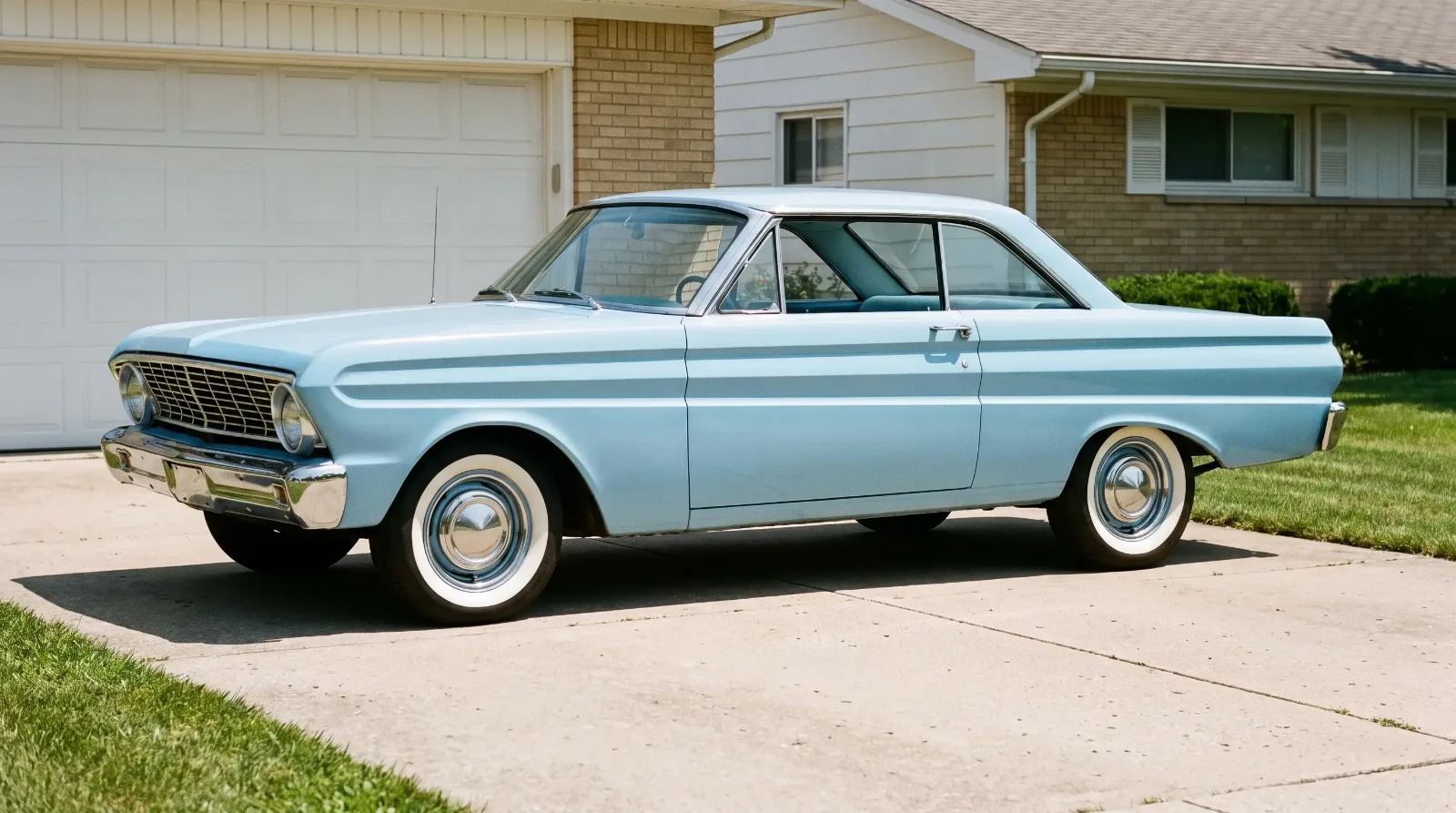
Sperlich is credited with the decision to base the Mustang on the Falcon; The Henry Ford gives him the idea of building the car on the Falcon chassis. His obituary on Military.com tells it in physical terms: his team cut up a Falcon and added parts. It is not a glamorous image. It is a planning team with a saw making the case that a sporty car did not need a new chassis to look like one.
The result borrowed the unitized platform of the 1964 Falcon, with chassis, suspension and drivetrain pieces drawn from the Falcon and the Fairlane. The 170 six came from the Falcon, the 260 V8 from the Fairlane, and the 289 family followed. Wheelbase was 108 inches. The Henry Ford puts the cost of creating the Mustang from scratch at $400 million. The Falcon had been Ford's best-selling car in 1960, so its parts were already in production in large numbers.
That choice made the price possible too. The hardtop listed at $2,368 at launch, under the committee's $2,500 ceiling. The full engineering story of the Falcon underneath has its own article. What matters here is whose idea it was. Iacocca could sell the car and Frey could schedule it, but the reason it could be built cheaply and quickly traces back to a product planner who looked at a compact sedan and saw a pony car inside it.
| Detail | Don Frey | Hal Sperlich |
|---|---|---|
| Joined Ford | 1950, metallurgy | 1957, product planner |
| Mustang role | Head engineer and project manager, Sept 1962 to Apr 1964 | Product planning; credited with the Falcon-based package |
| Left Ford | 1968, to become president of General Cable Corp. | Fired after pushing the Mini-Max small-van proposal; joined Chrysler in 1977 |
| Later work | Bell & Howell CEO from 1971 for 17 years; Northwestern professor from 1988 | Head of product planning at Chrysler: K-car (1981), Caravan and Voyager minivans (1984 model year) |
| Honors | National Medal of Technology, 1990; National Academy of Engineering member | Automotive Hall of Fame, 2009 |
| Died | March 5, 2010, Evanston, Illinois, aged 86 | January 20, 2025, aged 95 |
After the Mustang: two very different roads
Frey stayed at Ford through the first generation's best years. He resigned in 1968 to become president of General Cable Corporation, then ran Bell & Howell as chief executive from 1971 for 17 years, retiring in 1988. That same year he joined Northwestern University as a professor of industrial engineering and management sciences. In 1990 President George H.W. Bush presented him with the National Medal of Technology. He was also a member of the National Academy of Engineering. He died in Evanston, Illinois, on March 5, 2010, at 86.
Sperlich's road ran through more fights. He stayed in product planning and rose to vice president, and in the 1970s he pushed a "World Car" idea behind the platform that became the Fox-body Mustang, an ambition Ford dropped by 1974. He is also credited with the 1976 Ford Fiesta. The proposal usually blamed for ending his Ford career was a small van called the Mini-Max, which Henry Ford II wanted nothing to do with. Sperlich was its driving force, Ford fired him, and he joined Chrysler in 1977, months before Henry Ford II fired Iacocca in July 1978.
At Chrysler he finally got to build what Ford would not. As head of product planning he was behind the K-car in 1981 and then the Dodge Caravan and Plymouth Voyager, on sale late in 1983 as 1984 models. Sources disagree on whether he retired in 1988 or 1989. He entered the Automotive Hall of Fame in 2009 and died on January 20, 2025, at 95.
"People love a car with one father. The Mustang never had one. It had a salesman who could get the money, an engineer who could get it built on time, and a planner who saw a pony car hiding inside a Falcon. Leave out any of them and the April 1964 date slips, or the price does."
Patrick Walsh
Why the credit went to Iacocca
None of this is a knock on Iacocca. He chaired the committee, made the pitch and carried the car in public, and the launch made his name. But fame tends to collect on whoever stands in front of the car, and Frey and Sperlich spent 1962 to 1964 behind it. Frey's later career took him out of the car business entirely, into General Cable, Bell & Howell and a university classroom. Sperlich's most famous work came at a rival company, and minivan buyers had no reason to know he had once helped put a Mustang body on a Falcon floor.
The fair way to tell it is as a three-man story with one spokesman. The marketing case came from Iacocca's committee. The schedule belonged to Frey. The cheap, quick, borrowed-parts architecture that made a $2,368 sticker possible belonged to Sperlich. Every first-generation car that turns up at a show today, six or V8, carries that division of labor under its sheet metal, whether its owner knows those two names or not.
Sources and notes
- Wikipedia: Donald N. Frey
- Northwestern McCormick: obituary of Donald Frey
- Military.com: Hal Sperlich, Navy Seabee and engineering pioneer, dies at 95
- Mopar Insiders: Hal Sperlich, architect of the minivan and K-car, passes at 95
- The Henry Ford: Mustang, the birth of an American icon
- Wikipedia: Lee Iacocca
Related Reading

Automotive journalist covering classic car shows, events, and the enthusiast community across North America.
Related Listings - Ford Mustang
Comments
Be the first to comment on this article.