
Most histories of the Mustang start with a man and a sketch. The paper trail starts with a motel meeting room. The Fairlane Committee was a small group of Ford Division managers who met away from headquarters, worked through the market research, and wrote down the targets the first Mustang was built to hit. It did not style the car and it did not engineer it. What it did was decide what the car had to be, and then help sell that decision to the one man who could release the money. For the wider arc of how the car came about, our Mustang origins guide covers it. This piece stays with the committee itself, and with how much of its story the records can actually carry.
Car Features
8 min read
The Fairlane Committee: The Meetings That Made the Mustang
Who sat on the Fairlane Committee, where it met, what its research showed, and how its four-number brief shaped the first Ford Mustang.
Why it was called the Fairlane Committee
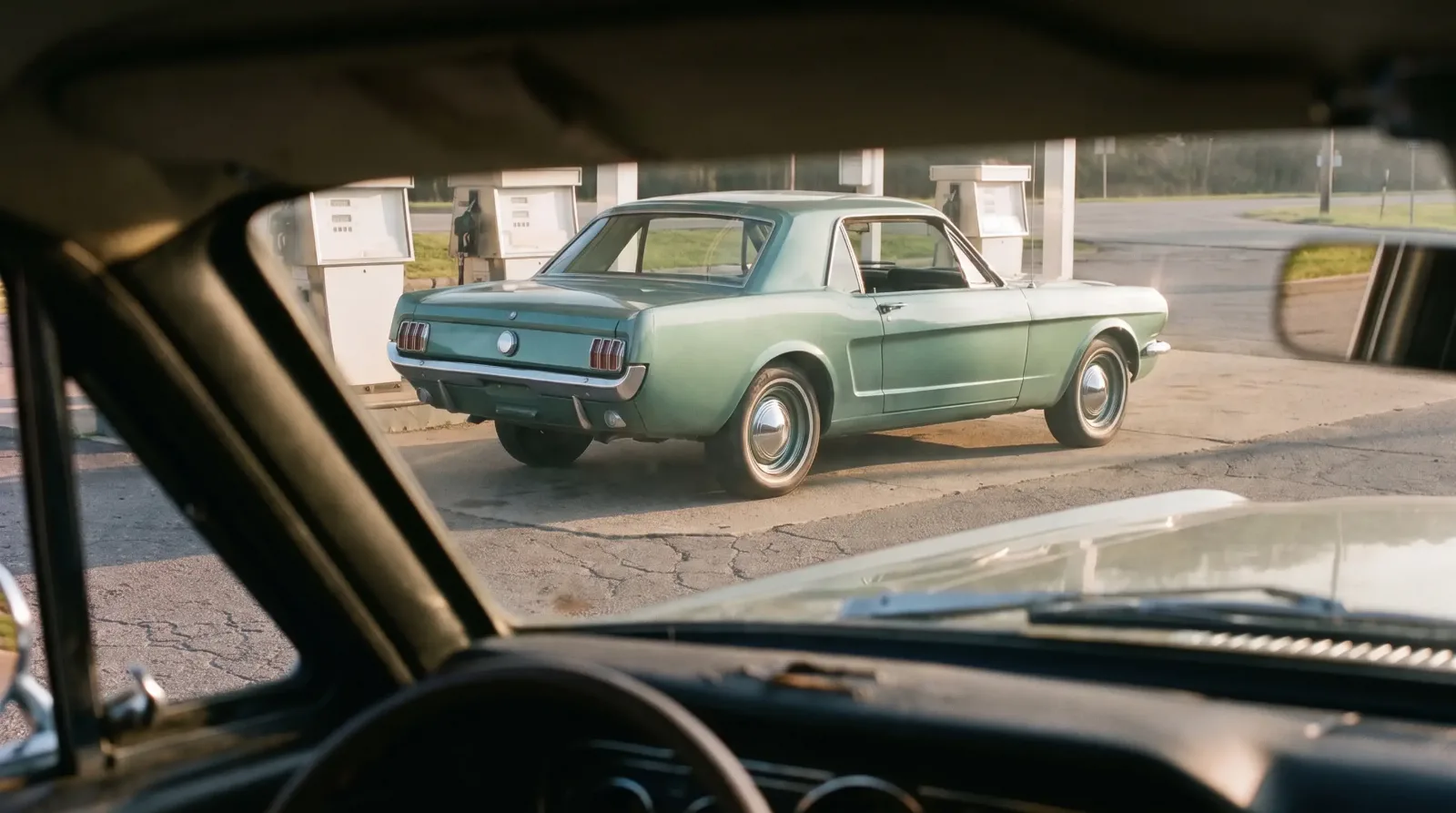
The name has nothing to do with the Fairlane car. The group met at the Fairlane Inn, a motor lodge in Dearborn about two miles west of Ford's World Headquarters. The Henry Ford, which holds a period postcard of the place in its collection, notes that the inn was chosen over the Dearborn Inn and describes the meetings held there in 1961 as discreet. The Fairlane Inn had opened in the mid-1950s and kept operating, under various names, until 2005.
Walter T. Murphy, who sat in those meetings as the division's public relations manager, calls it the "Fairlane Motel" in his own account, published by Ward's on May 1, 1996. He puts the frequency at twice a month. You will see "weekly" in some retellings. I have not found a named source behind that word, so twice a month is the figure I work with.
Why a motel and not a conference room at headquarters? The Henry Ford's account gives the reason. The Dearborn Inn was where Ford's senior executives gathered, and Lee Iacocca, vice president and general manager of the Ford Division since November 10, 1960, wanted his team working away from the unconvinced eyes at the main office. A car for young buyers was not yet an idea the building believed in.
The dating is softer than most accounts admit. The Henry Ford places the meetings in 1961, and EBSCO has the group already working to a target introduction date by late 1961. At least one published review puts them in 1962. Both can be right: the group formed in 1961 and its work ran on into 1962, the year the project was approved. Anyone who hands you an exact date for the first meeting is quoting a source I have not been able to locate.
Who sat on the Fairlane Committee
There is no official roster. What survives is a set of lists that overlap without matching. Two are worth putting side by side: the EBSCO reference summary of the Mustang launch, and Murphy's insider account written more than three decades after the fact. The titles differ because these men changed jobs often.
| Member | EBSCO summary | Murphy, Ward's (1996) |
|---|---|---|
| Lee Iacocca | Formed and led it | Appointed the group |
| Don Frey | Assistant general manager | Chief product planner |
| Hal Sperlich | Product manager | Chief car designer |
| Frank Zimmerman | Marketing manager | Division marketing expert |
| Walter T. Murphy | PR manager | PR manager and speechwriter |
| Sid Olson | Writer | Not listed |
| John Bowers | Not listed | Advertising manager |
| Robert Eggert | Not listed | Market research |
| William Laurie | Not listed | J. Walter Thompson agency |
Five names appear on both lists: Iacocca, Frey, Sperlich, Zimmerman and Murphy. That is the core I would stand behind. Murphy names his men as the people in the room at one meeting, so his list is a snapshot rather than a roster. It adds an advertising manager, a market researcher and a senior man from the J. Walter Thompson agency, which says a good deal about the group's center of gravity. This was a planning and marketing committee. Its technical weight sat with Frey, who had joined Ford in 1950 on the metallurgy side, and with Sperlich, a product planner whom Murphy remembered as the group's chief car designer. What those two did once the money came through is a separate story, told in our piece on Frey and Sperlich.
Two more names turn up in later retellings, Jacque Passino and Donald Petersen. I could not confirm either from a source I trust, so treat any roster that includes them as unverified.
What the research told them
The committee's case rested on numbers. According to the EBSCO summary, its research pointed at four things. The 20-to-24 age group was projected to grow by more than 50 percent during the 1960s. Two-car families had gone from about one million in 1959 to about 13 million by 1962 and 1963. Chevrolet was selling the Corvair Monza and Ford had nothing to put against it. And Ford was getting letters from owners asking for the two-seat Thunderbird to come back.
Read together, those points describe one buyer: young, often shopping for a second car, and wanting more style than a plain compact offered. The Monza mattered because it showed a rival already selling to that buyer while Ford's lots had no answer. The Thunderbird letters pulled the other way, toward a two-seater. The committee kept the sporting feel and added a back seat, the decision that separates the production Mustang from the mid-engine Mustang I concept Ford showed at Watkins Glen on October 7, 1962.
There was money context too. Ford had halted its Cardinal small-car project in the United States, writing off about $35 million already spent. Any proposal for another new small car was going to reach the chairman's desk in the shadow of that number. The sources do not tie the two together in so many words, but it is hard to read the approval story without it.
The brief: four seats, under 2,500 lb, under $2,500
The targets themselves are the best-documented part of the whole episode. The Henry Ford and EBSCO give the same set: four seats, a weight under 2,500 lb, a base price under $2,500, and a public launch in April 1964 at the New York World's Fair. A trade-press obituary of designer Gale Halderman repeats the first three as the mandate handed to the stylists, with a length limit of 180 inches added. Here is how the first production car measured up.
| Target | Committee brief | What shipped |
|---|---|---|
| Seating | Four | Four |
| Weight | Under 2,500 lb | 2,445 lb base curb weight (Wikipedia); 2,556 lb hardtop (The Henry Ford spec page) |
| Base price | Under $2,500 | $2,368 hardtop at launch |
| Launch | April 1964, New York World's Fair | April 17, 1964, at the Fair and in showrooms the same day |
| Development time | Not specified | September 1962 to April 1964, about 18 months |
The price target was hit cleanly, with more than $130 to spare. The launch date was hit to the month. Weight is where it gets interesting. The commonly quoted 2,445 lb base curb weight comes in under the line; The Henry Ford's own spec page gives 2,556 lb for the hardtop, which does not. Both may be correct for different configurations. Either way, the target described a stripped car. A fully equipped V8 car weighed about 3,000 lb.
Selling it to Henry Ford II
Two accounts of the approval exist, and they disagree on the money. The Henry Ford dates it to September 1962 and lists the conditions: a $45 million budget instead of the $75 million Iacocca had asked for, that extra inch of rear legroom, and the plain condition that the car had to sell. Murphy's Ward's account, headlined as Iacocca's third pitch, has the decision confirmed at 10:30 in the morning in Henry Ford II's 12th-floor office at the Glass House, with the chairman telling him "you've got $75 million to fund your Mustang."
I cannot reconcile those two figures. One is a museum's account; the other is an eyewitness memory set down about 34 years later, and they may describe different stages of the same negotiation. Neither should be quoted as the settled number.
The styling was not the committee's job. Gene Bordinat set the Ford, Lincoln-Mercury and Advanced studios against each other, full-size clays were reviewed on August 16, 1962, and the Ford studio design from Joe Oros and Dave Ash was chosen late that summer. After approval, the work passed to engineering, and the car went from approval to showroom in about 18 months, a pace usually described as a record.
"The committee usually gets told as a story about vision. The records read more like arithmetic. Under 2,500 pounds, under $2,500, four seats and a date on the calendar. Most of what people remember about the first Mustang was decided inside those numbers."
Tom Ramirez
When the Mustang Club of America inducted Iacocca into its Hall of Fame in 1997, the citation credited him with leading the Fairlane Committee that produced the 1964½ Mustang. That is fair as far as it goes. The committee was his, and so was the pitch. But the record shows a handful of managers in a Dearborn motor lodge, twice a month, turning population projections and owner letters into a set of targets the car then actually met. The rest of what followed, from the launch crowds to the long production run, belongs to the story of the classic Mustang.
Sources and notes
- The Henry Ford: Mustang, the birth of an American icon
- The Henry Ford: Fairlane Inn Motel, Dearborn, Michigan postcard
- Ward's archive: Walter T. Murphy on the Mustang's birthing pains (1996)
- EBSCO Research Starters: Ford introduces the Mustang
- Gardner Business Media: designer of original Mustang dies at 87
- Mustang Club of America Hall of Fame list (PDF)
Related Reading
Have a
Ford Mustang
for Sale?
Reach thousands of serious classic car collectors across the US.
Sell It Here →
Are You a Classic Car Dealer?
List your full inventory and connect with targeted classic car buyers.
Join as a Dealer →
#1964 mustang
#mustang history
#Ford Mustang
#Lee Iacocca
#Fairlane Committee
#Henry Ford II
#Ford Division

About the author
Tom Ramirez
Corvette researcher and historian based in Bowling Green, Kentucky. Two decades documenting Corvette production history from original factory records.
Related Listings - Ford Mustang
Comments
Be the first to comment on this article.