
A woman in Ohio kept the plastic on her 1976 Cadillac Eldorado's seats for eleven years. Her daughter told me the story at a car show, half embarrassed and half proud, describing how her mother would peel back a corner of the sheeting just to let a guest run a hand across the leather, then smooth it back into place before anyone could sit down. That single detail says more about the 1976 Cadillac Eldorado interior than any spec sheet could. This was a cabin people were told to preserve, not use, and plenty of owners believed it.
Car Features
6 min read
Inside the 1976 Eldorado
A story of plastic seat covers, pillowed leather, and an interior some owners never let themselves actually live in, inside the 1976 Cadillac Eldorado.
A cabin built to be remembered
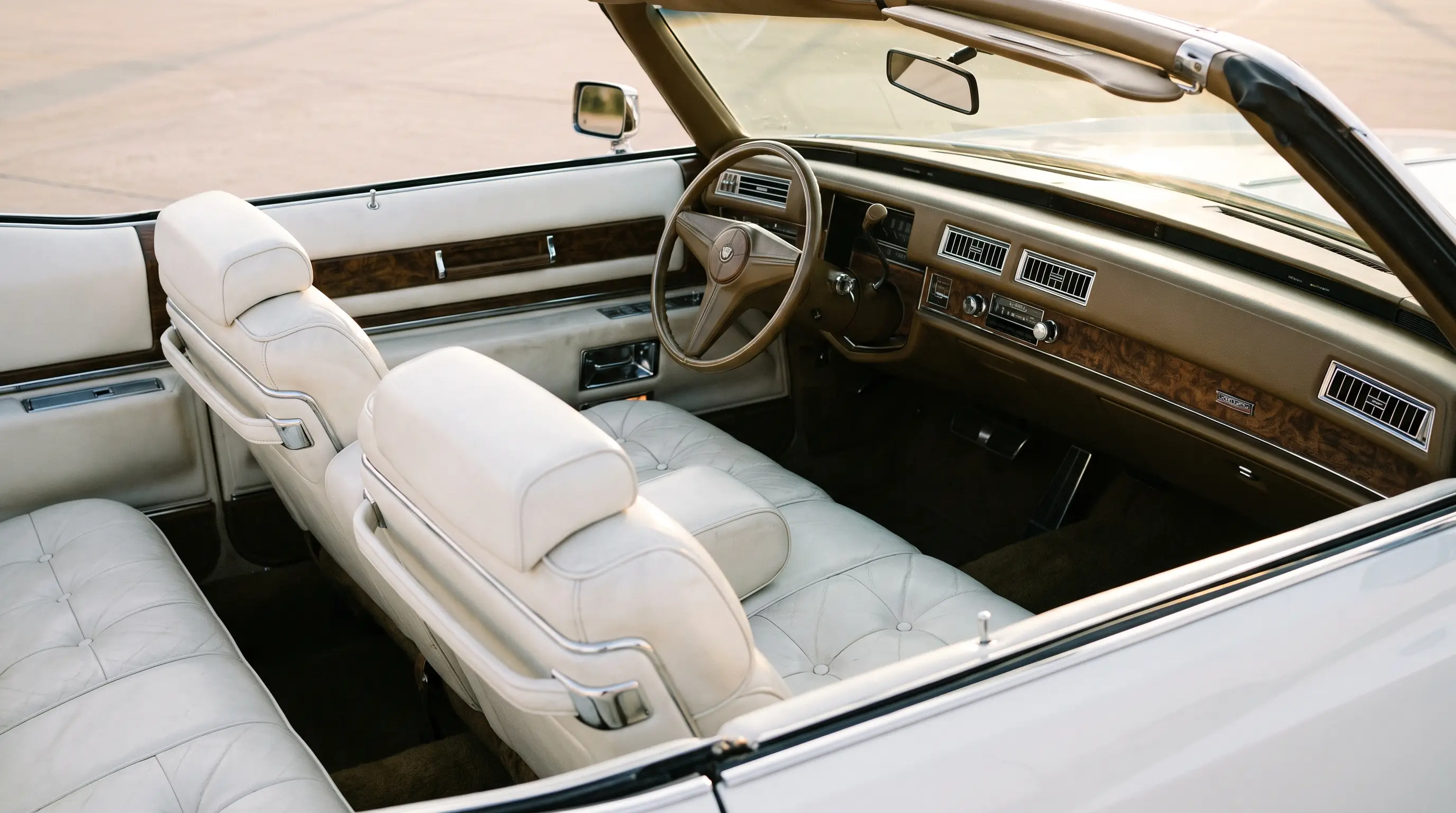
Step inside a 1976 Eldorado and the first thing you notice is how much space there is to notice things in. The dashboard stretched wide and low, wrapped in simulated wood trim on most trim levels, with a full instrument cluster that still used analog gauges rather than the digital readouts that would arrive on Cadillacs within a few years. The steering wheel was thin rimmed by modern standards, wrapped in a material that felt more like a piece of furniture than a control surface, which was rather the point.
Seating options ranged from a standard notchback bench to the more luxurious Biarritz package, which added thicker pillowed leather upholstery, additional sound insulation, and small comfort details like extra padding in the armrests. Buyers who wanted to signal that they had spent real money on their Eldorado gravitated toward Biarritz, and the difference is still obvious to anyone who sits in both a base and an upgraded car today.
| Feature | 1976 Eldorado |
|---|---|
| Seating | Notchback bench standard, Biarritz leather optional |
| Dash trim | Simulated wood on most trims |
| Instrumentation | Full analog gauge cluster |
| Climate control | Automatic climate control available |
| Sound system | AM/FM stereo, available 8-track player |
The cars that never got dirty
Because Cadillac and its dealers marketed 1976 as the last year for an American convertible, a real number of buyers treated their new Eldorados less like transportation and more like an investment they happened to be able to sit in. Plastic seat covers, garage storage, and odometers that stopped climbing after a few thousand miles were common enough that low mileage 1976 Eldorados are not the rarity you might expect from a forty-plus year old car. That preservation instinct is exactly why, decades later, so many surviving examples still smell faintly of the vinyl and leather they left the factory with rather than decades of cigarette smoke and fast food.
Not every owner treated the car that way, of course. Plenty of 1976 Eldorados were bought simply because someone wanted a beautiful, comfortable car and used it exactly as intended, taking road trips and running errands and letting the leather crease the way leather is supposed to. Those cars have a different kind of story to tell, one written in worn armrests and a driver's seat bolster gone slightly soft, and I find myself drawn to them just as much as to the pristine, plastic wrapped survivors.
What the materials say about the era
Run a hand over the door panel of an unrestored 1976 Eldorado and you are touching a specific moment in American manufacturing, one where genuine leather and thick padded vinyl were still standard expectations at the top of a lineup, before cost cutting in the 1980s thinned out the materials on even the most expensive American cars. The stitching patterns, the weight of the door pull handles, the particular give of the seat cushions under your weight, all of it reflects a company still building for buyers who expected a Cadillac interior to feel meaningfully different from a Chevrolet's.
That tactile richness is part of what makes the 1976 Eldorado's interior worth documenting on its own, separate from the mechanical story of the convertible top or the marketing campaign that surrounded it. For readers who want the mechanical and historical context behind this cabin, you can read the background on how the 1976 model year came to be positioned the way it was.
"I think about that woman's plastic seat covers more than I probably should. There is something tender about a person deciding a machine deserves to be protected from the very life it was built to hold."
- Nora Beckett
Small comforts that mattered
The 1976 Eldorado offered a long list of convenience options that seem quaint now but represented real luxury at the time, from power six way seats that could be adjusted at the touch of a switch to a trip odometer that let a driver track a specific journey without resetting the main mileage count. Automatic climate control, when ordered, maintained a set cabin temperature without the driver needing to fiddle with fan speed or vent position, a feature that many cars in this price range still lacked entirely.
The available 8-track player, an option that feels almost comically dated today, was in 1976 a genuine selling point, letting owners bring their own music into a car that otherwise relied on AM and FM radio. I have talked to more than one owner who kept a small collection of period correct tapes in the glovebox specifically to complete the experience of driving the car the way it would have been driven new, right down to the music filling the cabin.
Door panels carried simulated wood accents that matched the dashboard, and even the interior door handles were shaped and weighted to feel substantial under a hand, part of a broader design philosophy where every touchpoint in the cabin was meant to communicate that this was Cadillac's flagship. Little of that attention to tactile detail survived the cost cutting that hit American luxury interiors in the following decade, which is part of why cars from this specific window feel so distinct to sit inside even now.
Sitting inside one today
The best way to understand what made the 1976 Eldorado's interior special is still to sit in one, ideally with the windows down and the seat adjusted the way its original owner would have set it. Preservation class examples, plastic covers long since removed and stored in a box somewhere, still carry a kind of quiet dignity that newer cars rarely manage. If you are searching for a car of your own to sit inside, you can find a classic Eldorado and decide for yourself whether you want a pristine example or one that has lived a full and comfortable life.
Sources and notes
Related Reading
Have a
Cadillac Eldorado
for Sale?
Reach thousands of serious classic car collectors across the US.
Sell It Here →
Are You a Classic Car Dealer?
List your full inventory and connect with targeted classic car buyers.
Join as a Dealer →
#preservation class
#Cadillac Eldorado
#classic cadillac
#1976 Eldorado
#Eldorado interior
#d'Elegance

About the author
Nora Beckett
Automotive features writer and photographer who tells the human stories behind the cars, from show fields to cross-country road trips.
Related Listings - Cadillac Eldorado
Comments
Be the first to comment on this article.