
The keys are in the wrong hands before anyone notices. Jeff Spicoli, sunburned and serene, slides behind the wheel of a car that belongs to the most feared football player at school, and that player's younger brother is in the passenger seat, already regretting it. The fast times at ridgemont high camaro is about to have the worst afternoon of its life. It was a Z28, the striped and spoilered top of the Chevrolet pony car line at the end of the 1970s, and it belonged to Charles Jefferson, played by a young Forest Whitaker. Spicoli was Sean Penn. The car never says a word, yet it carries one of the film's best stretches on its fenders.
Car Features
7 min read
Fast Times at Ridgemont High and Its Camaro Z28
Spicoli, a borrowed Z28 and a construction site: the story of the most famous wrecked Camaro in teen film and the car behind it.
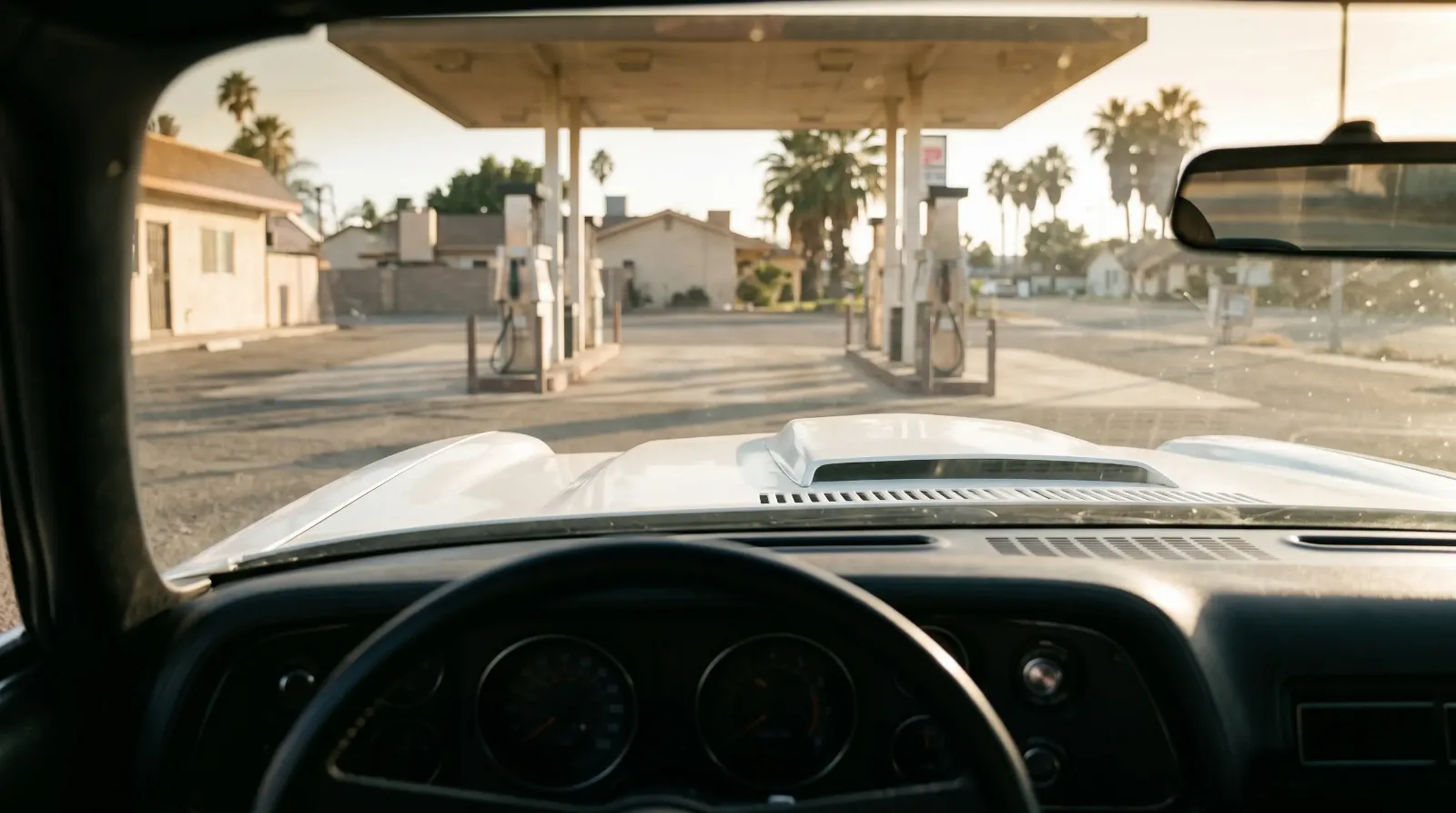
The movie is one thread in a long run of Camaros on screen and in song, and you can read more here about how the car became shorthand for a certain kind of American youth. This piece stays with one car, one bad decision and the strange afterlife of a wreck.
A borrowed car and a bad afternoon
Jefferson is the school's star football player, a large and silent presence who walks the hallways like weather. His younger brother, played by Stanley Davis Jr., is the one who ends up riding with Spicoli. Nobody in the audience needs to be told that this will go badly. The film lets the dread sit for a moment, and then Spicoli drives.
He drives the way he does everything, loosely and with total confidence. He runs a red light. He turns too fast into a construction site, and the Camaro goes through it and under it, scraping out the other side as a crumpled thing with the shine knocked off. Both of them climb out unhurt. That detail matters. The scene stays funny because the only casualty is the car.
Then comes the line of reasoning that makes Spicoli who he is. He is sure he can fix it, because his father repairs televisions, and in his mind that is close enough. The brother's face says everything the script leaves out.
The cover-up and the 42-0 game
Spicoli's solution is a small masterpiece of teenage logic. He dresses the wreck up to look as if fans from rival Lincoln High trashed it, then leaves it to be found. Jefferson finds it. He does not cry or shout at anyone in particular. He takes it out on the field, tackling with a fury that the coaching staff could never have drawn out of him, and Ridgemont beats Lincoln 42-0.
It is a joke about cause and effect, and the Camaro is the hinge of it. A boy's pride, parked at the curb, becomes a scoreboard. Anyone who grew up with a car that meant more than it should will recognize the feeling. The car was not transportation. It was a version of himself he could park and polish.
"What stays with me is how small the car looks after the crash, sitting there with its stripes still on, as if it had not been told. A Z28 at the end of the 1970s was a public statement, and the film knows exactly how much it costs a kid to see that statement folded in half."
Nora Beckett
Is the Fast Times at Ridgemont High Camaro a 1978 or a 1979?
Ask around and you will hear three different model years. Most published accounts, including writing from Hagerty, Jalopnik and Looper, call the car a 1979 Z28. One outlet says 1978. A list article reportedly gave 1981, and a reader corrected it in the comments. The 1979 answer has the most support, and there is a visual argument for it, but no studio record we could find confirms it.
For 1979, the Z28 got a new front air dam and flared front fenders that gave it a lower, more aggressive face, plus large "Z28" decals that ran from the front flares back to the bottoms of the doors. A 1978 Z28 lacks that front treatment, which makes the nose the quickest way to tell the two years apart on screen. Late cars from the 2nd gen Camaro run all look alike to a casual eye, but the nose and flares are what separate a 1979 from the year before. Until a primary source turns up, 1979 is the best-supported reading rather than a settled fact.
Other things are just as unknown, and it is worth saying so plainly. Studio records that would settle the paint color have not surfaced in anything we could check. Neither has how many cars the production used or wrecked, or whether the crumpled car was a genuine Z28 or a dressed-up lookalike. Movie cars are often doubles. Until a production document or a credible crew account turns up, those questions stay open.
The Z28 in the showroom in 1979
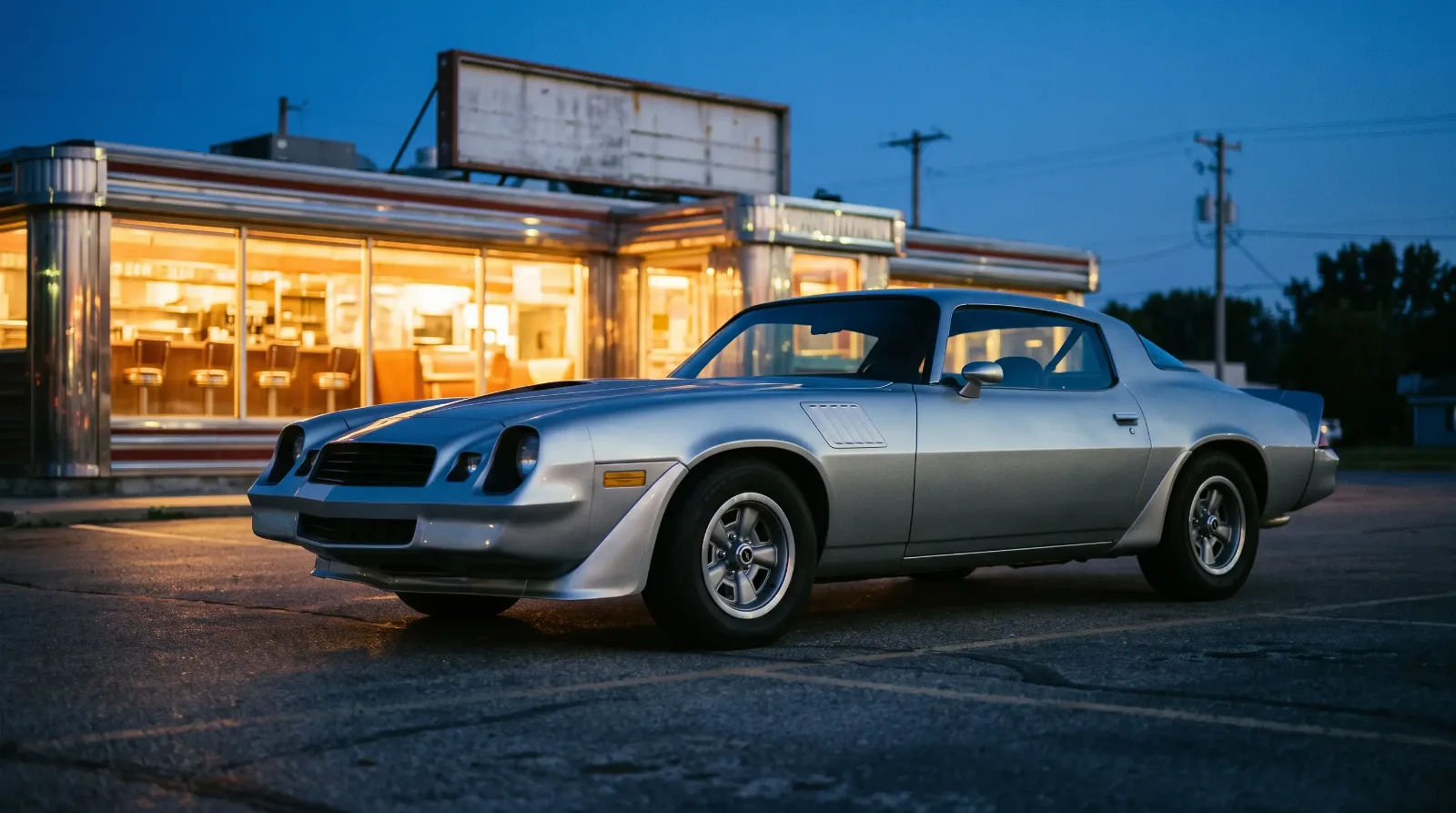
On paper, a Z28 of the kind Jefferson loved so much was not fast by the standards of a decade earlier. Emissions rules and the switch to net horsepower ratings had taken the edge off. But the 1979 Z28, the year most accounts give for the film car, looked the part completely, and in 1979 looking the part sold cars in enormous numbers.
| 1979 Camaro Z28 | Figure |
|---|---|
| Engine | 350 cu in V8, four-barrel carburetor |
| Rated output | 175 hp (SAE net) at 4,000 rpm |
| Base price, Z28 Sport Coupe | $6,120 |
| Z28s built | 84,877 |
| All Camaros built, model year 1979 | 282,571 |
| New for 1979 | Front air dam, fender flares, long "Z28" side decals |
Those numbers tell a quiet story. Nearly one Camaro in three built that year was a Z28. The car in the movie was not rare or exotic. It was the car a kid with a good after-school job or generous parents could actually reach for, which is exactly why it works on screen. Every teenager in the audience knew someone with one, or wanted to be someone with one.
A teenager's car on a teenager's film
The film itself was a modest production. Universal released it on 13 August 1982, from Refugee Films, with Irving Azoff and Art Linson producing. It was Amy Heckerling's first feature as a director, and Cameron Crowe wrote the screenplay from his 1981 book, Fast Times at Ridgemont High: A True Story. Principal photography began on 2 November 1981 and ran about eight weeks, with school scenes shot at Van Nuys High School and mall scenes filmed after hours at the Sherman Oaks Galleria.
That grounded, low-budget texture is part of why the car feels real. Nobody built it into a hero car or gave it a name. It sits at the curb the way a real Z28 sat outside a real school, slightly too proud of itself. The domestic box office came to about $27.1 million, a strong return for a picture whose budget is given as $4.5 million to $5 million.
Forty-odd years on, the Camaro is still the thing people describe first when they talk about the film, ahead of most of the dialogue. It sits alongside cars that rock singers and actors actually owned, the ones we cover in our piece on the famous owners, though this one never belonged to anyone real. It belonged to a character, and it was wrecked by another, and somehow that made it easier for an entire generation to picture it in their own driveway.
Sources and notes
- Fast Times at Ridgemont High, Wikipedia
- Fast Times at Ridgemont High, Box Office Mojo
- Jeff Spicoli, stoned in the Valley, crashes Z28, Jalopnik
- Five great Camaro cameos on the big screen, Hagerty via Fox News
- Things you forgot happened in Fast Times at Ridgemont High, Looper
- The 25 best movie Camaros, Complex
Related Reading
Have a
Chevrolet Camaro
for Sale?
Reach thousands of serious classic car collectors across the US.
Sell It Here →
Are You a Classic Car Dealer?
List your full inventory and connect with targeted classic car buyers.
Join as a Dealer →
#camaro z28
#camaro pop culture
#movie cars
#second generation Camaro
#1979 Camaro
#Fast Times at Ridgemont High

About the author
Nora Beckett
Automotive features writer and photographer who tells the human stories behind the cars, from show fields to cross-country road trips.
Related Listings - Chevrolet Camaro
Comments
Be the first to comment on this article.