
The 2nd gen Camaro showed up late, sold poorly in its first year, nearly got cancelled in its third, lost its best engine in its fifth, and then had the biggest sales year any Camaro has ever had. Strange résumé for a car. It ran twelve model years, 1970 to 1981, the longest stretch of any shape in the classic Camaro story. It is also the one people argue about most at swap meets, because a 1970 Z/28 and a 1980 Berlinetta share a roofline and not much else. Here is how it went, with the numbers that matter and none of the folklore.
Car Features
11 min read
The Second-Generation Camaro Story (1970½ to 1981)
Late launch, a 174-day strike, two years with no Z28, then the best sales year ever: the 2nd gen Camaro from 1970 to 1981, year by year.
Why the 1970½ showed up five months late
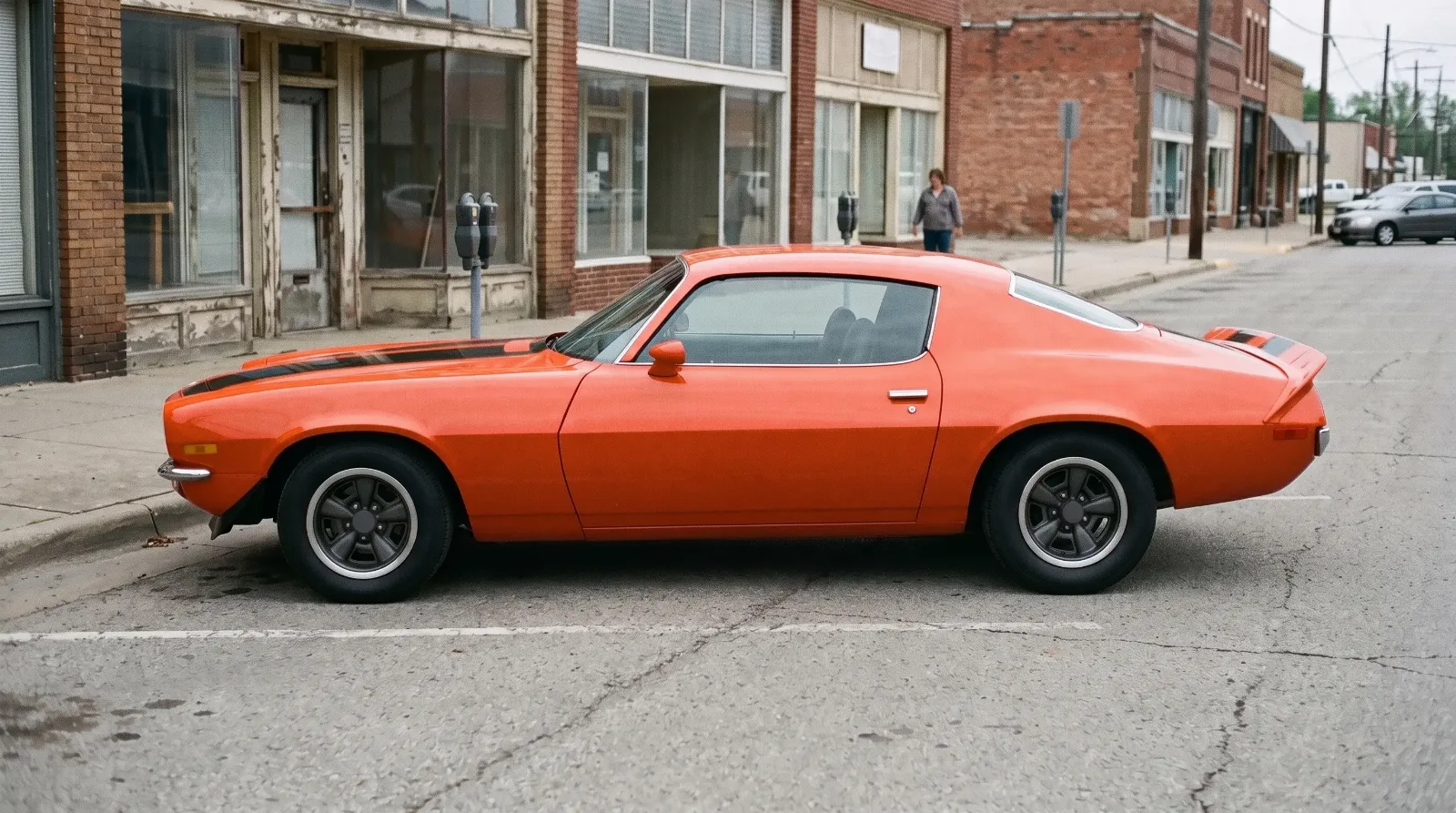
Chevrolet planned a fall 1969 launch. It didn't happen. The Camaro Research Group's account is that the complex rear quarter-panel dies failed during final tryout at Fisher Body and had to be rebuilt, which put the car about five months behind schedule. You will still read that labor unrest caused the delay. The tooling story has more sources behind it. I go with the tooling.
So the 1969 kept rolling. It stayed in production until early December 1969, and some late cars were titled as 1970s in some states. The new car went public on 26 February 1970. Build information reached the plants that February, and every car was titled as a 1970 model. "1970½" is what people call it. It is not what the title says.
Base price was $2,749 for the six-cylinder coupe, with the V8 another $90. Production ran at Norwood, Ohio and Van Nuys, California. The late start hurt. The 1970 model year closed at 124,901 cars, 12,578 of them with the 250 six, and the new generation sold barely 50 percent of what the 1969 had. Car and Driver's May 1970 issue said the car "generally went unnoticed," even in Los Angeles.
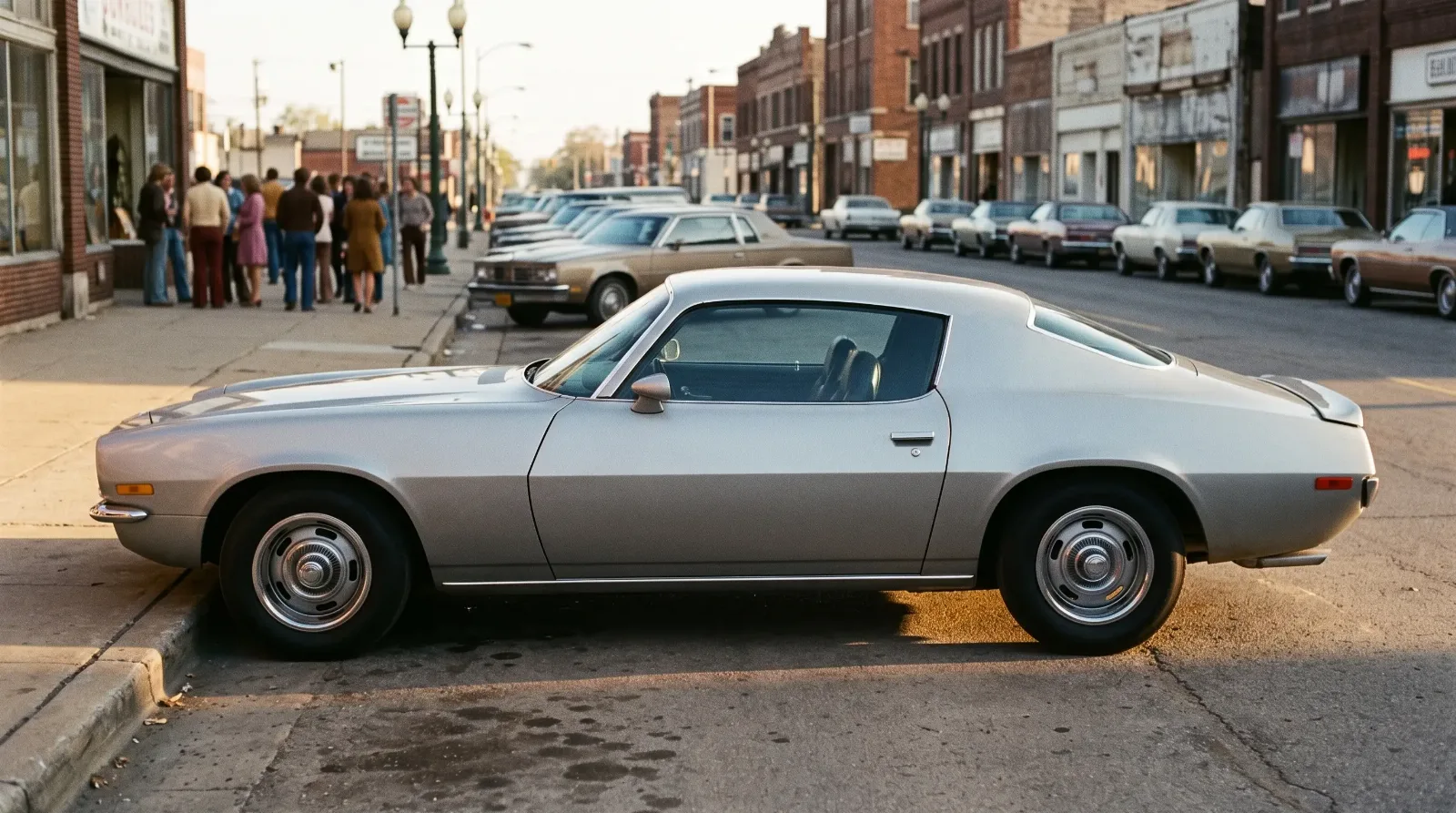
A coupe shaped like a Ferrari, and never a convertible
Sketching started in 1966, as soon as the first-gen design wrapped. Henry (Hank) Haga ran the Chevrolet studio work; Bill Porter was his Pontiac counterpart. The studios studied Pininfarina Ferraris, and it shows. The shape and stance echo the early-1960s Ferrari 250 GT SWB Berlinetta and the 250 GT Berlinetta Lusso. The face came from the 1968 Jaguar XJ6: rectangular grille, faired-in lamps. Four round taillights tied it to the Corvette, which is what Chevrolet management wanted.
Deleting the vent and quarter windows saved about $18 per car, and that money went into insulation, including a double-wall roof. Years later, Irv Rybicki said the car got a new underbody and seat placement "with no interference," and Bill Mitchell credited "the right dash to axle, the right cowl height." That proportion is the whole car. Get it wrong on a restoration, with a tired front end or the wrong tire height, and the thing looks like a kit.
The 1970 coupe sat on a 108-inch wheelbase. It was 188 inches long, 74.4 wide, 50.1 tall and weighed 3,310 pounds. Coupe only, all twelve years. This is the only Camaro generation with no convertible. The likely reason is money: the Firebird had its own sheetmetal, down to different doors, so tooling a convertible (and a proposed two-door wagon) for both divisions was too expensive. The Pontiac half of that arrangement is its own story, told in the second-generation Firebird. Camaro buyers who wanted the sky got T-tops in 1978, and that was it.
1970 to 1972: the last of the high compression
The 1970 engine list ran from the L22 250 six at 155 hp to the L78 396 at 375 hp, both gross. In between sat the L14 307 (200 hp), the L65 two-barrel 350 (250), the L48 350 (300) and the Z/28's LT-1 (360). The "396" was really 402 cubic inches after a .030-inch overbore. Chevrolet listed LS6 and LS7 454s early on. None were produced. Ignore anyone with a "factory 454" second-gen and a good story.
The LT-1 is the engine people mean when they say the 1970 Z/28 was special: 11.0:1 compression, four-bolt mains, solid lifters, a Holley 780 four-barrel, 360 hp at 6,000 rpm and 380 lb-ft. It was also the first Z/28 you could get with an automatic, a Turbo Hydra-Matic 400. Car and Driver ran 0 to 60 mph in 5.8 seconds and the quarter mile in 14.2 at 100.3 mph.
It didn't last. Early in 1970, GM president Ed Cole announced lower compression for 1971 so engines could run on lower-octane unleaded fuel. The 1971 LT-1 dropped to 330 hp gross, the L48 to 270, the 402 to 300. For 1972 GM switched to SAE net ratings and the numbers fell hard on paper: Z28 255 hp, 402 at 240, L48 at 200, the six at 110. Some of that drop is real. Some is just a new way of measuring. Before anybody tells you a 1972 is "weak," ask which rating they are quoting.
The cars were still good. Road & Track named the 1971 Camaro SS 350 one of the world's 10 best cars in August 1971. But 1972 was the last year for the SS 350, the SS 396 and a factory big block in a Camaro until the SS name came back in 1996. Only 970 SS 396s were built that final year.
The 1972 strike that nearly killed it
On 7 April 1972, UAW Local 674 walked out at Norwood. The fight was over GM consolidating its Chevrolet and Fisher Body plants under GMAD, which the union said required a new contract. The strike ran until 27 September. That is 174 days, the longest strike in GM history at the time.
Norwood was the only plant building Camaros and Firebirds in 1972, so the line just stopped. About 1,100 partly built cars sat inside. By the time workers came back, those cars could not meet the 1973 federal bumper and safety standards, and they were scrapped. Model-year production ended at 68,656.
GM considered killing the F-body outright. The car survived thanks to what one account calls "friends in high places." Who those friends were is less settled. One profile credits Alex Mair, who ran product engineering at Chevrolet before he moved on to GMC and Pontiac, but it is a lone source, and I would not hang the rescue on one name. The Firebird took the hit worse, falling from 53,124 cars in 1971 to 29,951 in 1972, and Pontiac almost dropped it. GM also moved Nova production away from Norwood after the strike.
Bumpers, smog and two years without a Z28
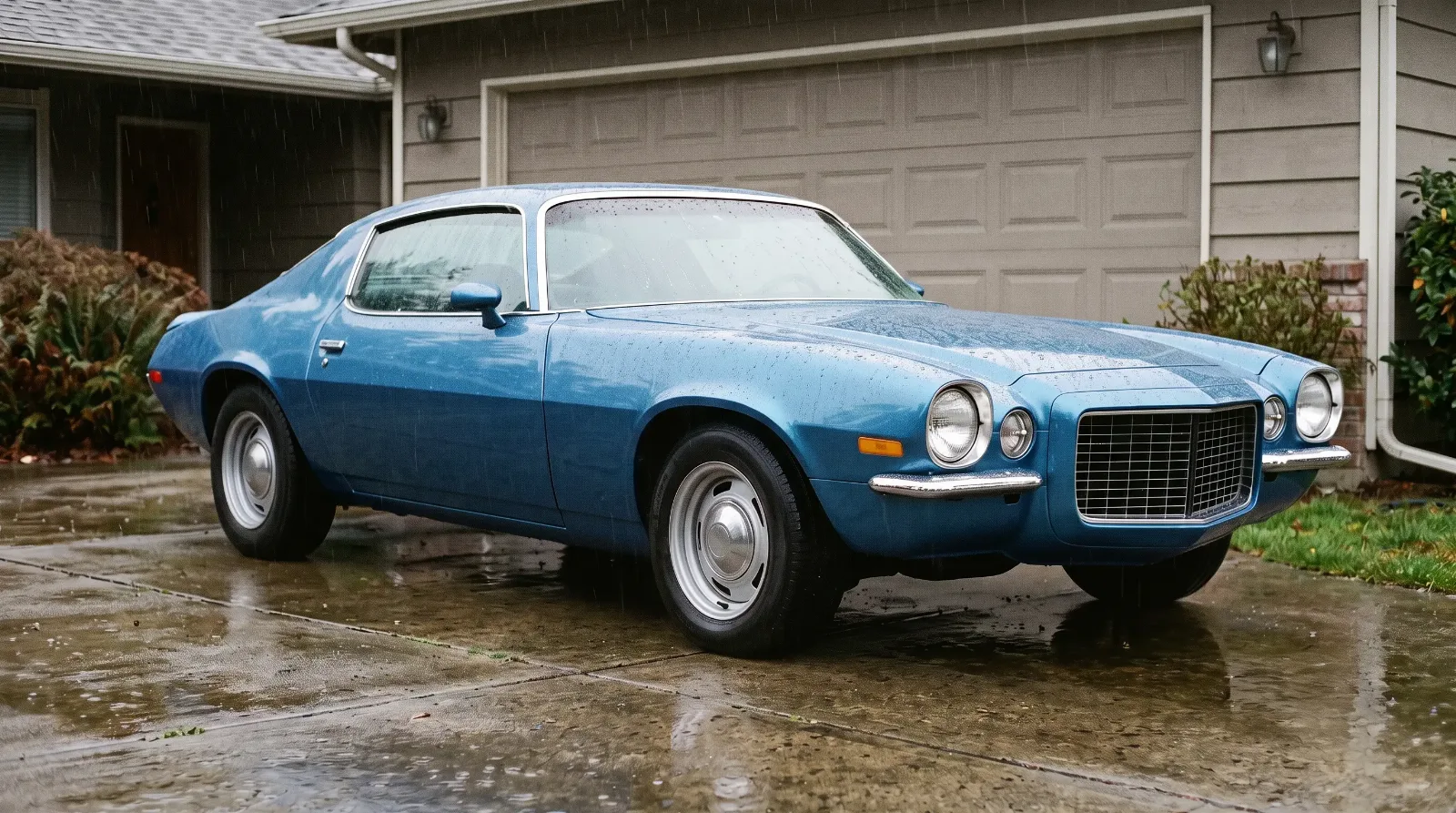
For 1973 the SS was gone and the Type LT, for Luxury Touring, took its place as the featured model. It had the Quiet Sound Group, full-foam seats, deep-twist carpet, woodgrain door trim, full gauges and variable-ratio steering. Of the 96,751 Camaros built that year, 32,327 were LTs. The Z28 switched to hydraulic lifters (the L82) and could be ordered with air conditioning for the first time. 1973 was also the last split-bumper Rally Sport, and the only one with extra reinforcement to pass the first federal bumper test (5 mph at the front, 2.5 mph at the rear).
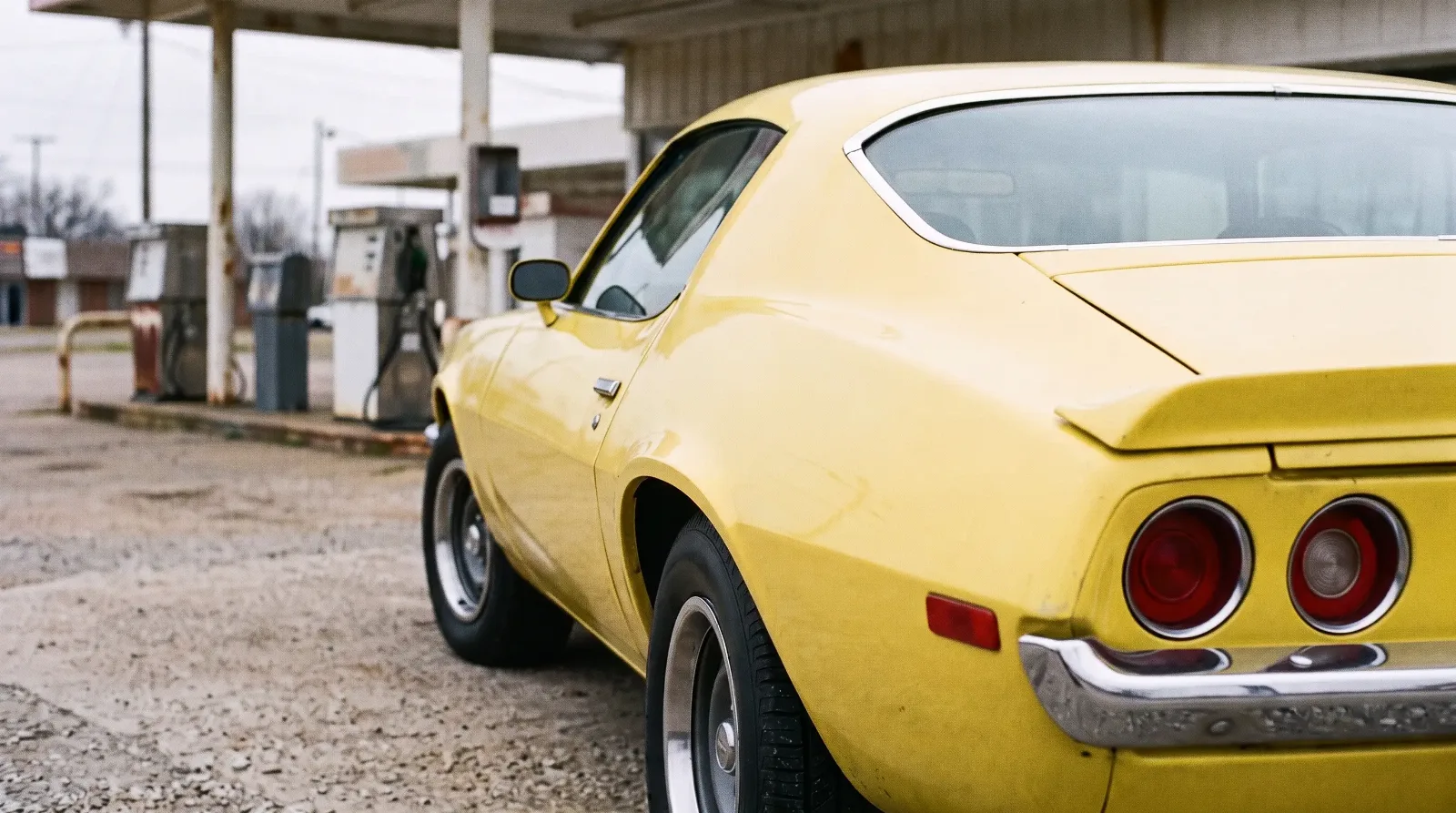
Then the government got involved with the nose. For 1974, federal bumper standards forced a facelift: aluminum bumpers front and rear, a new fiberglass nose with deep headlamp buckets, a forward-sloping grille, and wraparound rectangular taillamps in place of the round ones. The car grew 7 inches. Power steering became standard on V8s, the tank went from 18 to 21 gallons and the Z28 got HEI ignition. It was the last year of the flat rear window and thick roof pillars.
Buyers didn't mind. 1974 production hit 151,008, and 13,802 were Z28s, the best second-gen Z28 year to that point. Chevrolet dropped the Z28 anyway, citing tight emission regulations. For 1975 every US GM passenger car got a catalytic converter. The 250 six made 105 hp and the two 350 V8s made 145 and 155 hp net. That 155 was the most you could buy in a Camaro that year. Chevrolet had just replaced Porsche as the car supplier for the IROC race series, and it had no performance Camaro to sell in 1975 or 1976.
"A 1975 Camaro with 155 horsepower is not a muscle car. It is a comfortable coupe with a long hood. Buy it as that and you will be happy. Pay muscle car money for it and you won't."
Mike Sullivan
Pontiac kept the Trans Am going the whole time, and in 1976 about 47,000 of its 110,000 Firebirds were Trans Ams. Chevrolet noticed. Meanwhile the Camaro picked up small wins: a wraparound rear window, power locks, cruise control and leather seats for 1975, then a new 305 V8 at 140 hp, standard on the LT, for 1976. Production that year was 182,959.
The comeback, 1977 to 1981
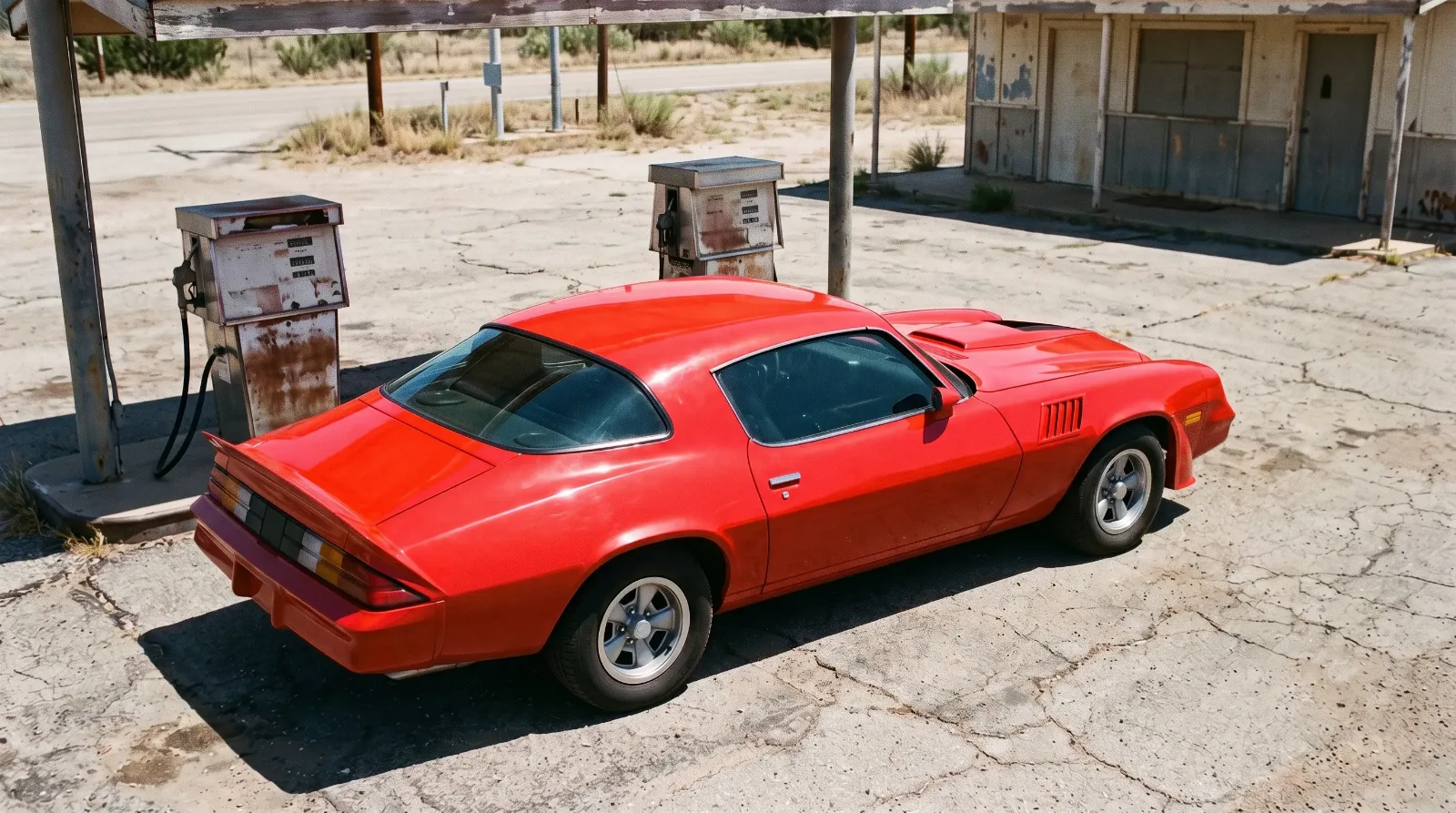
Chief engineer Tom Zimmer pushed for the Z28's return after watching those Trans Am sales, and engineer Jack Turner led the revival. It debuted at Daytona in February 1977 and went on sale that spring as the "1977½," this time a separate model instead of an option package. The LM1 350 four-barrel made 185 hp at 4,000 rpm and 280 lb-ft at 2,400 (175 hp in California), through a Borg-Warner Super T10 four-speed and a 3.73 axle. Front springs were more than 20 percent stiffer than on the 1970 to 1974 cars, rears about 30 percent. Car and Driver got 0 to 60 in 8.6 seconds and a 105-mph top speed. Slow by 1970 standards. Quick for 1977. Chevrolet built 14,349.
1977 was also the first year the Camaro outsold the Mustang: 218,853 Camaros against 153,117 Mustang IIs. For 1978 the nose and tail went to body-color urethane bumper covers, the taillamps got amber turn signals and T-tops arrived. Z28 production jumped to 54,907. In 1979 the Berlinetta replaced the LT, and the Camaro had the biggest year in its history: 282,571 cars, including 84,877 Z28s, 67,236 Berlinettas and 19,101 Rally Coupes. It outsold the Toyota Corolla by about 8,000.
| Model year | Camaros built | What changed |
|---|---|---|
| 1970 | 124,901 | Late launch, 26 February 1970 |
| 1971 | 114,630 | Lower compression across the range |
| 1972 | 68,656 | 174-day Norwood strike; last SS and big block |
| 1973 | 96,751 | Type LT; last split bumper |
| 1974 | 151,008 | Aluminum bumpers, new nose, longer body |
| 1975 | 145,770 | Catalytic converter; no Z28 |
| 1976 | 182,959 | 305 V8 arrives; still no Z28 |
| 1977 | 218,853 | Z28 returns; Camaro outsells Mustang |
| 1978 | 272,631 | Urethane bumpers, T-tops |
| 1979 | 282,571 | Berlinetta; best Camaro year ever |
| 1980 | 152,005 | Air Induction hood; new V6s |
| 1981 | 126,139 | Computer Command Control, 17-digit VIN |
The last two years brought the Z28's rear-facing Air Induction hood, with a solenoid-operated flap that opens at full throttle. In 1980 the Z28's 350 made 190 hp, the most since 1974, and 45,137 Z28s were built. Six-cylinder buyers got a 229 V6 (a 231 in California), and V6 sales hit 51,104, the best year ever for a six. 1981 brought Computer Command Control, a check-engine light and the 17-digit VIN. The Z28's 350 dropped to 175 hp and came only with an automatic; manual and California cars got a 165-hp 305. Production was 126,139. Then the long-hood car was done, replaced by the downsized 1982 Camaro.
Buying a 2nd gen Camaro today
The spread is wide. Hagerty's #2-condition values in May 2024 ran from $11,200 for a 1980 base car with the lowest-output V8 to $84,800 for a 1970 SS 396 with the L78. Quoted values for 1970 to 1981 cars were up 32 percent over the prior three years, and the 1981 Z28 was up 80 percent in four years against 24 percent for a 1981 base car or Berlinetta. Those numbers are two years old now. The direction is what matters.
My problem is with the top of the market. Plenty of early cars wear SS or Z/28 badges they weren't born with. Badges are cheap. Before 1972 the VIN won't tell you the engine, so a 1970 or 1971 high-option car needs paperwork, and the asking price should track the paperwork, not the stripes. From 1972 on, the VIN at least gives you a starting point.
The value play is the late cars. A 1978 to 1981 Z28 has the looks, a 350 and parts that are easy to find, and a lot of them were built, so you can be picky. Start with the second-generation Camaros for sale and compare a few before you fall for any of them. The best 2nd gen Camaro to buy is the one with the most receipts, not the loudest exhaust.
Sources and notes
- Wikipedia: Chevrolet Camaro (second generation)
- Hagerty: your handy 1970 to 1981 Chevrolet Camaro buyer's guide (production data credited to NastyZ28.com)
- Hagerty: second-gen Camaro, the one that had class
- Hagerty: the 1977 Camaro Z28 return, with Car and Driver test figures
- Cincinnati Enquirer: the Norwood plant and the 1972 strike
- Automotive History Preservation Society: Jim Wangers interview, on Alex Mair's roles at Chevrolet and Pontiac
Related Reading

Article
The Classic Chevrolet Camaro Story
Article
The first-generation Camaro story (1967-1969)
Article
The Third-Generation Camaro Story (1982 to 1992)
Article
The 1970½ Camaro: Why the Second Generation Arrived Late
Article
How the 1970½ Camaro Got Its European Look
Article
The Split-Bumper Rally Sport, 1970 to 1973
External
/chevrolet/camaro/second-generation
Have a
Chevrolet Camaro
for Sale?
Reach thousands of serious classic car collectors across the US.
Sell It Here →
Are You a Classic Car Dealer?
List your full inventory and connect with targeted classic car buyers.
Join as a Dealer →
#camaro history
#camaro z28
#chevrolet camaro
#1970s muscle cars
#Norwood Assembly
#2nd gen Camaro
#Camaro Berlinetta

About the author
Mike Sullivan
Detroit-area muscle car enthusiast and restoration specialist with three decades of hands-on experience working on American iron.
Related Listings - Chevrolet Camaro
Comments
Be the first to comment on this article.