
The Firebird 350 HO rarely gets top billing in first-generation Firebird stories, and that is exactly the problem this piece sets out to correct. Wedged between the mainstream 350 two-barrel and the 400 cubic inch performance engines that get most of the attention, the 350 HO occupies the awkward middle position that middle children everywhere recognize. It was never going to headline a magazine cover next to a Ram Air car, and it was never meant to be the economy option either. Understanding how the Firebird began as a project gives useful context here, since Pontiac built its first-generation engine lineup as a genuine ladder of choices, and the 350 HO was a deliberate rung on that ladder, not an afterthought.
Car Features
6 min read
Firebird 350 HO: The Middle Child
The Firebird 350 HO sat between the base 350 and the 400 cubic inch performance engines, offering real V8 punch without the weight and premium of the flagship options.
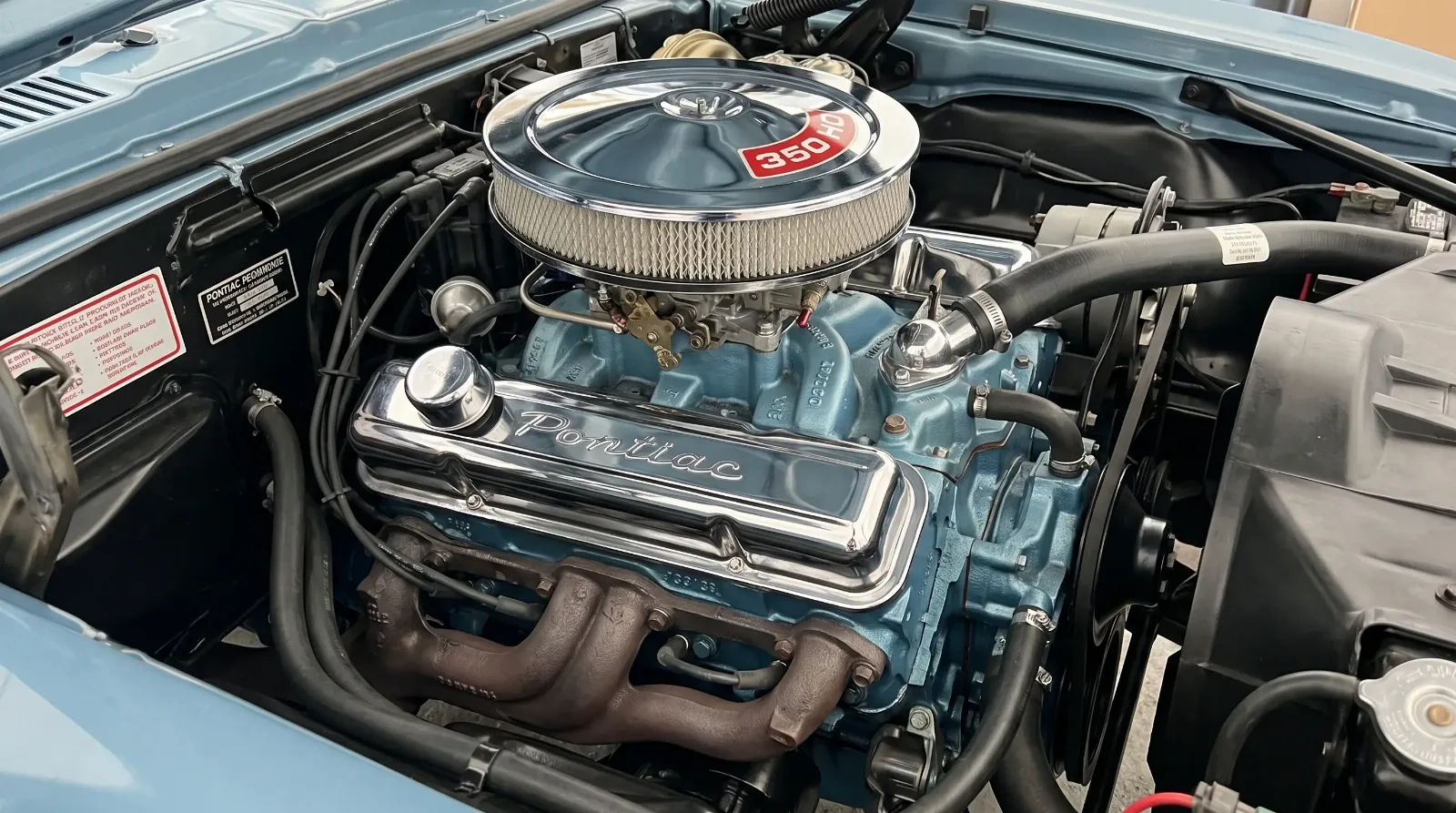
Filling a real gap in the lineup
When Pontiac replaced the 326 cubic inch V8 with the larger 350 for the 1968 model year, it kept the same basic structure of offering a standard two-barrel version and a hotter four-barrel HO variant. The standard 350 delivered smooth, adequate power for a buyer who wanted V8 torque without much drama. The HO version existed for the buyer who wanted more performance than the base 350 offered but did not want to step all the way up to a 400, whether for cost, insurance, or simple preference for a lighter engine over the front wheels.
That positioning mattered more than it might sound. A 400 cubic inch engine changed the car's weight distribution and often its insurance bracket in ways a buyer might not want, even if they could afford the extra displacement. The 350 HO offered a genuine middle path: noticeably quicker than the base 350, with a four-barrel carburetor and firmer valvetrain, but still built around a smaller, lighter block than the big-inch options.
What made the HO different from the base 350
The 350 HO's four-barrel carburetor was the most visible difference from the base engine, but the changes ran deeper than the induction system. A hotter camshaft profile, tighter valve springs, and dual exhaust on most applications gave the HO a noticeably different power delivery than the standard 350, which leaned toward smooth, low-end torque rather than a strong pull higher in the rev range. Pontiac rated the 1968 350 HO at 320 horsepower, with the figure adjusted to 325 horsepower for 1969 as the factory revised its rating methodology across several engines that year.
| Engine | Carburetor | Approximate rating |
|---|---|---|
| 350 base (1968-69) | Two-barrel | 265 hp |
| 350 HO (1968) | Four-barrel | 320 hp |
| 350 HO (1969) | Four-barrel | 325 hp |
| 400 base | Four-barrel | 330 hp |
Why it gets overlooked today
Collector attention has always gravitated toward the biggest number on the spec sheet, and the 350 HO simply does not have a Ram Air scoop or a 400 badge to draw a crowd at a car show. That has kept prices for genuine, well-documented 350 HO cars more reasonable than comparable 400 cars, which is either an overlooked opportunity or a fair reflection of the car's more modest performance ceiling, depending on who is doing the talking.
What the 350 HO does offer is a genuinely balanced first-generation Firebird. The engine is light enough that the car's steering and front-end feel stay closer to the six-cylinder cars than to the nose-heavy 400s, while still delivering real V8 performance that a base 350 cannot match. For a buyer who wants to drive the car regularly rather than trailer it to shows, that balance carries real weight.
"Nobody writes songs about the 350 HO. It just quietly does the job the 400 gets credit for half the time, at a price the 400 crowd would laugh at, and it handles better than either of them expects."
Tom Ramirez
Buying and living with a 350 HO
Verifying a genuine 350 HO comes down to the same documentation discipline that applies across the first-generation lineup: build sheets, engine casting numbers, and dealer paperwork where they survive. The HO's four-barrel intake and correct carburetor are the easiest components to swap onto a base 350, so a casing number check matters more here than a visual inspection ever will.
For buyers weighing the 350 HO against its garage-mates, a look at a companion piece covering the first-generation cabin is worth the time, since engine choice and interior specification were often ordered together by buyers building a specific kind of car rather than simply picking options at random. The 350 HO rewards exactly that kind of buyer, someone who wanted a complete, well-rounded package rather than a single headline number.
Parts availability and restoration reality
Restoring a 350 HO today is generally more straightforward than restoring a Ram Air 400, simply because the base architecture was shared with a much larger production run of ordinary 350 engines across multiple Pontiac and GM models. Reproduction and used blocks, heads, and internal components are correspondingly easier to source, and a competent machine shop familiar with Pontiac V8s can handle a rebuild without hunting for the scarce, HO-specific pieces that complicate 400 Ram Air projects. The carburetor and intake specific to the HO application are the exceptions worth tracking down carefully, since those are the components most likely to have been swapped over the decades by an owner chasing a quick performance upgrade or simply replacing a worn part with whatever was on hand.
For an owner planning to drive the car rather than trailer it, that parts reality translates into lower ongoing costs and less anxiety about sourcing an irreplaceable component after a mechanical failure. It is one more quiet advantage for an engine that rarely gets credit for having any advantages at all.
Sources and notes
- Pontiac V8 engine - Wikipedia
- 1968 Pontiac Firebird Fact Sheet - Over-Drive Magazine
- 1969 Pontiac Firebird Fact Sheet - Over-Drive Magazine
- 1969 Pontiac Firebird 350 HO - carfolio.com
- 1968 Pontiac Firebird 400: A Profile of a Muscle Car - HowStuffWorks
- How to identify Pontiac engine blocks - Hagerty Media
Related Reading
Have a
Pontiac Firebird
for Sale?
Reach thousands of serious classic car collectors across the US.
Sell It Here →
Are You a Classic Car Dealer?
List your full inventory and connect with targeted classic car buyers.
Join as a Dealer →

About the author
Tom Ramirez
Corvette researcher and historian based in Bowling Green, Kentucky. Two decades documenting Corvette production history from original factory records.
Related Listings - Pontiac Firebird

Comments
Be the first to comment on this article.