
Open the door of a well-kept 1967 Firebird and the first thing that registers is not the seat or the wheel. It is the instrument panel. Pontiac built the gen1 Firebird interior around a set of round, deep-set gauges that looked like they belonged in something faster and more expensive, and that single design decision did more for the car's reputation than any option-sheet horsepower figure. The rest of the cabin was honest, occasionally plain, and full of small choices that tell you exactly what Pontiac was trying to sell in 1967.
Car Features
6 min read
Gen1 Interior and Rally Gauges
The first-generation Firebird's cabin ran on honest gauges and optional Rally instrumentation rather than luxury, and the details Pontiac left out say as much as what it put in.
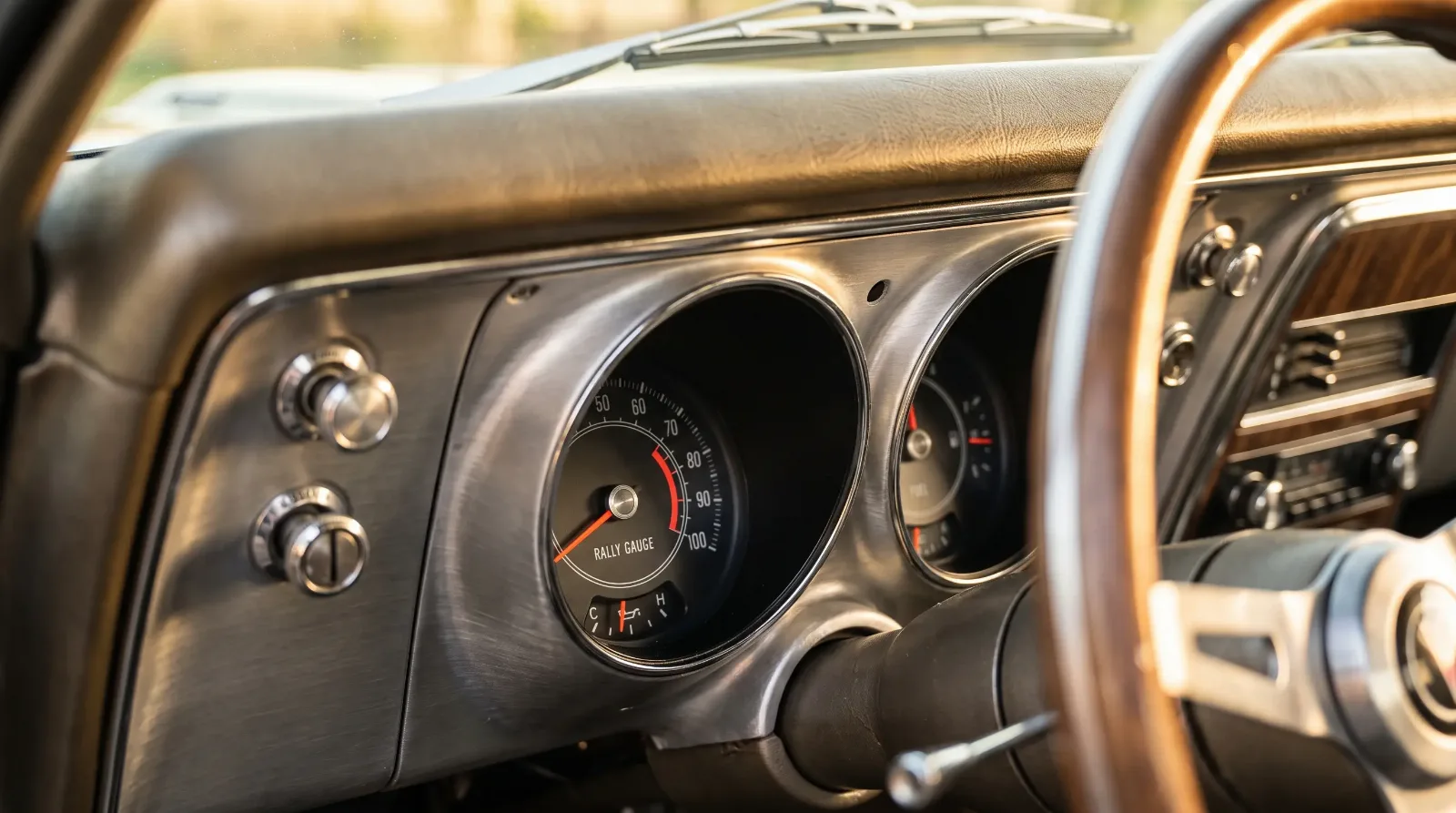
The gauge cluster that made Pontiac's case
The standard Firebird dash used four round pods set into a brushed-look face, with the speedometer and a combination gauge flanking two smaller dials for fuel and temperature. It read as purposeful rather than decorative, and that mattered because Pontiac was chasing a buyer who cross-shopped Mustang and Camaro and wanted proof the Firebird was not just a Chevrolet with a different nose.
Order the Rally Gauge cluster, option code 444, and the picture changed. Rally Gauges replaced the base car's fuel-only right-hand pod with a cluster that added oil pressure, coolant temperature, and an ammeter alongside the fuel gauge, in place of the standard idiot lights. A tachometer was not part of that dash cluster on the 1967 car. Buyers who wanted a factory tach ordered the separate hood-mounted tachometer, a distinct option that bolted to the hood ahead of the windshield rather than living in the dash pod. It was not standard equipment, and that is the detail buyers miss most often when they assume every early Firebird came with a full gauge package. It did not. A base six-cylinder coupe could leave the factory with the minimum dial count, and plenty did.
For a car built to compete on image as much as spec, the Rally Gauge option did quiet, effective work. It gave the driver something to look at that suggested seriousness, whether or not the engine under the hood backed it up.
Vinyl, cloth, and the standard buckets
Front bucket seats were standard across the 1967-69 run, a point Pontiac used in its own advertising to separate the Firebird from sedans with bench seating. Base trim used a vinyl-and-vinyl combination that wore well and aged into cracked, sun-baked surfaces on cars that sat outside for decades. Cloth-and-vinyl combinations were available and are less common to find intact today, since cloth simply degrades faster than vinyl in a car that was driven and not garaged.
The rear seat on the coupe and convertible was a proper bench, not a token perch, though legroom was tight by the standards of anything built after the mid-1970s. Door panels carried simple map pockets and modest brightwork. Nothing about the base interior was trying to impress on its own. It was the Rally Gauges, the console, and the wheel that did that work.
Deluxe interior option and what it changed
The Custom Trim interior, often shorthanded by owners today as the deluxe package, upgraded door panels, added extra brightwork, and offered a wood-grain applique across the dash and console that made the cabin read considerably more upscale than the price difference suggested. Pontiac also offered a center console with a floor shifter for cars ordered with a four-speed or the console-shift automatic, and a console-equipped car photographs and drives differently than a column-shift base model even though the mechanical underpinnings are identical.
A wood-rimmed steering wheel was available separately and is one of the more collected standalone options from this era, since it upgrades the driving experience without touching anything under the hood. Pontiac's surviving build data does not break out a reliable take rate for this option, so exact production figures for the wood-rim wheel are not something collectors can cite with confidence today.
| Interior element | Standard or optional | Notes |
|---|---|---|
| Instrument cluster | Standard: combination gauge and idiot lights | Base cars lack tach and oil pressure gauge |
| Rally Gauge cluster | Optional | Adds oil pressure, coolant temp, ammeter; tach was a separate hood-mounted option |
| Front seats | Standard buckets | Vinyl standard, cloth-and-vinyl optional |
| Custom Trim interior | Optional | Upgraded door panels, wood-grain applique |
| Center console | Optional, tied to shifter type | Floor shift required for console fitment |
Where the numbers get murky
Pontiac's build sheets from this period documented options reasonably well, but interior color and trim combination data was not preserved with the same rigor collectors apply to engine codes today. A tank sticker or a Protect-O-Plate can confirm drivetrain and some option content, but confirming the exact original interior color on a repainted or reupholstered car usually comes down to comparing the underside of the seat springs or the back of a door panel to factory paint chip references, not a single document. Anyone restoring a car to original interior spec should expect to do that legwork rather than trust a single source. Owners chasing this level of detail on another angle of what makes these cars worth the effort will run into the same documentation gaps.
"The interior tells you more about how a car was actually optioned than the engine bay does half the time. Anybody can drop a different carburetor on a small-block. Nobody retrofits a full Rally Gauge cluster into a dash that was punched for idiot lights without leaving a mark somewhere."
Tom Ramirez
What holds up in an original interior today
Vinyl seat covers from this era have held up better than most owners expect, provided the car was not left in direct sun for years at a stretch. Dash pads are the weak point across nearly every 1967-69 example, since the original material was prone to cracking and warping regardless of how carefully the car was stored, and a straight, uncracked original dash pad is now a genuinely uncommon find. Reproduction pads exist and fit well, but original examples in good condition carry a real premium among buyers chasing numbers-matching, all-original presentation rather than a driver-quality restoration.
For readers who want the full arc of how this generation came together before the mechanical and trim details, the 1967-69 Firebird covers the broader story. And for anyone weighing whether a project car is worth the interior work described here, a look at current first-gen Firebirds for sale is the fastest way to gauge what a correctly trimmed example actually costs versus what a tired one needs before it gets there.
The gen1 Firebird interior was never trying to be luxurious. It was trying to look purposeful at a price point Pontiac could defend, and on the cars that survived with their gauges, console, and trim intact, it still does that job.
Sources and notes
- First Generation Firebird Registry: Optional Instrument Cluster/Console FAQ
- First Generation Firebird Registry: Hood Tach Information
- Firebird Central: 1967-1968 Firebird Analog Instrument System
- Wikipedia: Pontiac Firebird (first generation)
- Hagerty Valuation Tools: Pontiac Firebird
- Classic Industries: Firebird Dash Gauges Reference
Related Reading
Have a
Pontiac Firebird
for Sale?
Reach thousands of serious classic car collectors across the US.
Sell It Here →
Are You a Classic Car Dealer?
List your full inventory and connect with targeted classic car buyers.
Join as a Dealer →
#first-generation
#pontiac firebird
#classic pontiac
#rally gauges
#interior trim
#Custom Trim option

About the author
Tom Ramirez
Corvette researcher and historian based in Bowling Green, Kentucky. Two decades documenting Corvette production history from original factory records.
Related Listings - Pontiac Firebird
Comments
Be the first to comment on this article.